I and the Village
by Marc Chagall
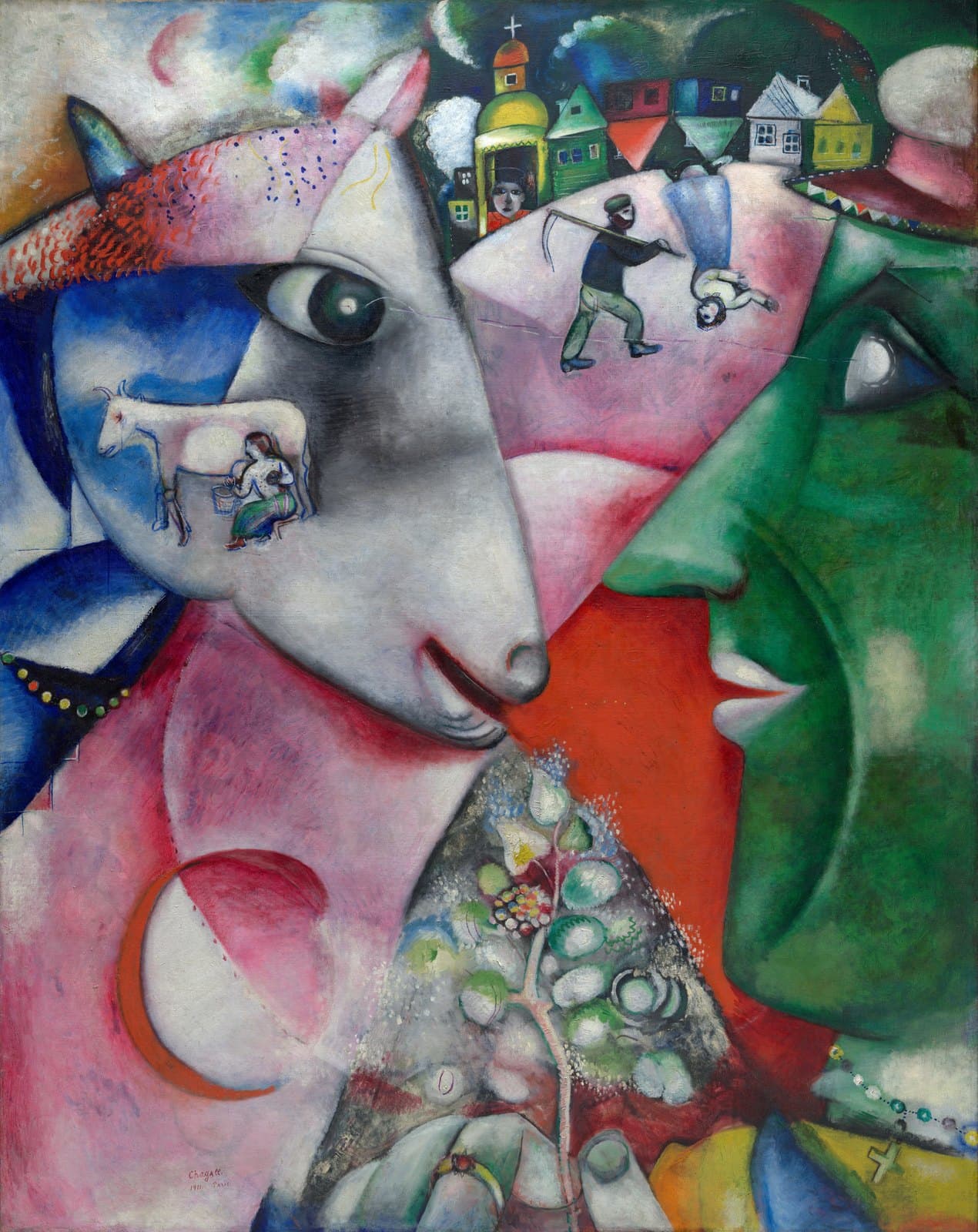
A green-faced man and a pale horned animal face each other across a canvas six feet high, their eyes joined by a thin white line. Marc Chagall painted it in 1911, the year he reached Paris, in a studio at La Ruche on the passage de Dantzig. The Museum of Modern Art in New York bought it in 1945 and shows it in gallery 503.
- 1911
- Oil on canvas
- The Museum of Modern ArtNew York, United States
About Marc Chagall
What the painting shows
Two heads fill the lower two-thirds of the canvas in profile, turned towards each other. The head on the right is a man's, painted green, with a pale eye and a heavy pink lip. The head on the left belongs to an animal — pale grey and white, with one blue horn, a long muzzle and a single large dark eye ringed in black. A thin white line runs from one pupil to the other across the middle of the picture.
Inside the animal's cheek, on a blue field, a small white cow stands in profile while a woman in a green skirt sits beneath it with a pail, milking. Along the top edge a village runs across a dark ground: a church with a yellow-green dome and a cross, then a row of small houses in green, red, white and yellow. Two of the houses stand on their roofs, upside down.
Below the village a man in a dark blue shirt and pale green trousers walks to the right with a scythe over his shoulder. A woman in white floats in front of him, head down and feet up. At the bottom of the canvas a sprig with white and green blossoms rises out of the red and pink ground, held at its base. A red crescent curves over a white disc at the lower left.
The canvas is 192.1 by 151.4 centimetres, about six feet three inches high. Marc Chagall signed it at the lower left, with the date beneath the name.
Painted in the first Paris year
Marc Chagall reached Paris in 1911 on a stipend from a patron, took a studio at La Ruche, the rotunda of cheap studios at 2 passage de Dantzig in the fifteenth arrondissement, and painted this canvas there. The Museum of Modern Art states the sequence plainly: he made it one year after moving to Paris, where he joined the community of artists La Ruche housed. Chaïm Soutine, Amedeo Modigliani, Fernand Léger and Ossip Zadkine worked in the same building.
The museum credits Paris with the picture's structure. Its 2024 gallery label points to the fractured and fragmented visual language of Cubism, which Marc Chagall encountered after he arrived. The subject came from the other end of his life — a Hasidic Jewish childhood near Vitebsk, in what was then the Russian Empire and is now Belarus.
The title was not his. The Museum of Modern Art records that the poet Blaise Cendrars, a close friend, supplied it, and reads it as a pun on the interpenetrating eyes of the two central figures.
The museum calls the animal two different things
The Museum of Modern Art does not identify the animal consistently. Its 2019 publication MoMA Highlights describes the faces of a goat and a man meeting at the centre of the painting. Its 2024 gallery label, printed beside the canvas, describes lines connecting the eyes of peasant and cow.
Both texts are the museum's own, and the difference is not a small one for a painting about a farming village. The animal in the picture has one visible curved horn, a long straight muzzle and a beard-like white shape under the chin. A second, smaller white cow appears separately inside its cheek, with the milkmaid.
Records elsewhere follow one or the other without noting the split. The atlas reports both, because the holding museum prints both.
There is a second I and the Village
The Solomon R. Guggenheim Museum in New York owns a work with the same title, and it is not a copy of this one at another scale. The Guggenheim dates its version to about 1923–24 and gives the medium as gouache, watercolour and graphite on paper, measuring 39 by 30 centimetres, under the accession number 41.435.
Marc Chagall left Russia for good in 1922 and reworked earlier compositions on paper through the 1920s. A reader searching for I and the Village will meet both records, and the 1911 oil at the Museum of Modern Art is the large one painted in Paris.
How it reached New York
The Museum of Modern Art's provenance research traces the canvas from Nell Walden, who acquired it in Berlin in 1916. Nell Walden and her husband Herwarth Walden ran Der Sturm, the Berlin gallery and magazine that gave Marc Chagall his first solo exhibition in 1914.
The painting was returned to Marc Chagall in Paris in 1926 and sold by him that February to the Belgian collector René Gaffé. The Museum of Modern Art acquired it on 13 June 1945, through the Mrs. Simon Guggenheim Fund, four years after Varian Fry's rescue network had got the artist himself out of France.
Close reading
Reading the work, detail by detail
Two heads in profile fill the lower two-thirds of the canvas and a thin white line joins their pupils. Start with that line, then the animal's eye at the left end of it and the green man's at the right, then work up to the village along the top edge and down to the sprig at the bottom.
1.The line between the two eyes
The line is drawn, not painted around: a single pale stroke laid over the colour beneath it, wavering slightly along its length. It ends in a pupil at each side, which makes the two heads a pair rather than two subjects sharing a canvas. The Museum of Modern Art reads the title, supplied by Blaise Cendrars, as a pun on that joining.
2.The animal's eye
The eye is set far forward on the head, where a horse's or a goat's would not be, and it looks out of the canvas rather than at the man opposite. The Museum of Modern Art calls this animal a goat in its 2019 book and a cow on its 2024 gallery label. The horn above it is painted blue.
3.The cow and the milkmaid inside the cheek
A second, smaller animal sits inside the first one's head, drawn in outline on a flat blue ground with no shading. The woman is seated on a low stool with her head turned up towards the udder. The scale is a decision rather than perspective: the pair are a memory held inside the animal's face.
4.The two houses standing on their roofs
The row runs the full width of the upper right. Two houses in it are turned through 180 degrees, and they are drawn with the same care as the upright ones, with windows and doors correctly placed for a house the other way up. Nothing else in the strip is disturbed.
5.The scythe and the woman upside down
The man walks along the lower edge of a pink wedge, feet flat and both hands on the shaft. The woman ahead of him is inverted head to foot, and her white dress falls towards her knees rather than towards her head, so she reads as hanging rather than as falling. The two are the same size and share the same plane.
6.The green face
The face is green from hairline to jaw, with no attempt at modelling towards a skin colour. Only the lip is pink and the eye white. He faces the animal directly and his eye sits at the right end of the white line, level with the animal's.
7.The sprig at the bottom
The stem is held at the bottom of the canvas by a hand that the reproduction shows only in part. The blossoms are dabbed on in short strokes of white, green and yellow, the only passage in the picture worked that way; everything else is drawn or laid flat.
8.The crescent over the white disc
The crescent and disc sit on the chest of the pale animal, on flat pink, and belong to no object in the village above. The disc is unpainted white, the crescent a single band of orange-red, and the two overlap without either cutting into the other.
9.The signature
The name is written in a loose cursive with the date on the line below. The Museum of Modern Art publishes no inscription field for the painting, so the atlas records only that a signature and date are visible there and does not transcribe the word that follows.
Timeline
1911
Painted at La Ruche, 2 passage de Dantzig, in Marc Chagall's first year in Paris.
1914
Der Sturm, the Berlin gallery of Herwarth Walden, gives Marc Chagall his first solo exhibition.
1916
Acquired by Nell Walden in Berlin, per the Museum of Modern Art's provenance research.
1926
Returned to Marc Chagall in Paris, and sold by him on 22 February to the collector René Gaffé in Brussels.
1945
Acquired by the Museum of Modern Art on 13 June, through the Mrs. Simon Guggenheim Fund, as 146.1945.
2024
Hangs in gallery 503, the Alfred H. Barr, Jr. Galleries, with a new gallery label.
Where to see it
The Museum of Modern Art
11 West 53 Street, New York, NY 10019, United States
The museum's collection record places the painting on the fifth floor in gallery 503, the Alfred H. Barr, Jr. Galleries. Check the record before travelling, since a gallery listing is not a promise of display.
Plan your visit on the museum’s official website (opens in a new tab)Frequently asked questions
Where is Marc Chagall's I and the Village?
The Museum of Modern Art in New York, object number 146.1945. The museum's collection record places it on the fifth floor in gallery 503, the Alfred H. Barr, Jr. Galleries. A gallery listing is not a promise of display, so check the museum's record before travelling.
Where did Marc Chagall paint I and the Village?
In Paris, in a studio at La Ruche, the rotunda of cheap studios at 2 passage de Dantzig in the fifteenth arrondissement. The Museum of Modern Art states that he painted it one year after moving to Paris from what is now Belarus. Chaïm Soutine, Amedeo Modigliani and Fernand Léger worked in the same building.
Is the animal in I and the Village a goat or a cow?
The Museum of Modern Art says both. Its 2019 book MoMA Highlights calls the central animal a goat; its 2024 gallery label calls it a cow. The painting also holds a second, smaller white cow inside the large animal's cheek, with a woman milking it.
Who named I and the Village?
The poet Blaise Cendrars, a close friend of Marc Chagall in Paris. The Museum of Modern Art records that he supplied the title and reads it as a pun on the two central figures, whose eyes are joined by a thin white line.
How big is I and the Village?
192.1 by 151.4 centimetres — six feet three and a half inches high by four feet eleven and a half wide. Oil on canvas, in portrait format.
Why are there two paintings called I and the Village?
The Solomon R. Guggenheim Museum owns a later version on paper, dated about 1923–24, in gouache, watercolour and graphite, 39 by 30 centimetres, accession number 41.435. The 1911 oil at the Museum of Modern Art is the large canvas painted in Paris.
More by Marc Chagall
If you like Marc Chagall
Explore painters from the same movements and circles.
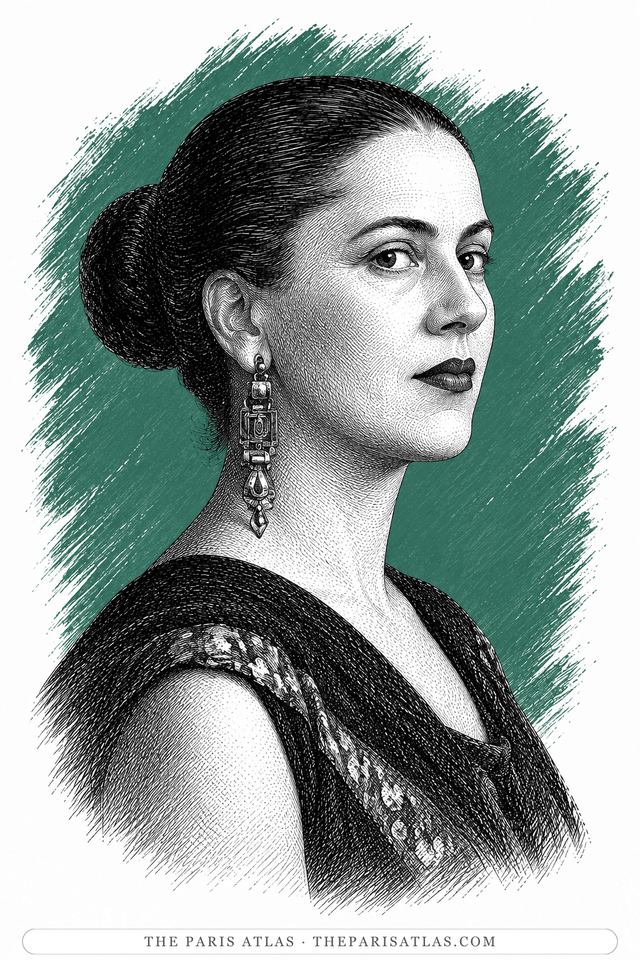
Tarsila do Amaral
Brazilian painter who spent the 1920s moving between São Paulo and Paris, studied Cubism under André Lhote, Albert Gleizes and Fernand Léger, and used what she learned to paint Brazilian towns, railways, plants and bodies. Her 1928 painting Abaporu prompted the manifesto that gave the Anthropophagic movement its name.
View artist
Arman
French-American artist, lifelong friend of Yves Klein, and a founder of New Realism.
View artist
Jean Arp
Strasbourg-born sculptor and poet — Hans in German, Jean in French, both all his life — who co-founded Dada at the Cabaret Voltaire in 1916, composed collages by dropping torn paper 'according to the laws of chance', and settled at Meudon outside Paris in a house his wife Sophie Taeuber-Arp designed.
View artist
References
The sources below include collection records, catalogues, scholarly research, and primary materials that informed this page. They document I and the Village, its making, and its place in cultural history.

1Marc Chagall. I and the Village. 1911
WebsiteThe Museum of Modern ArtUsed forWeb source consulted for documented facts and historical context presented on the I and the Village page.
2Marc Chagall
WebsiteMuseum of Modern ArtUsed forWeb source consulted for documented facts and historical context presented on the I and the Village page.
3Marc Chagall, I and the Village, ca. 1923–24
WebsiteSolomon R. Guggenheim MuseumUsed forThe Guggenheim's later version on paper, used here to keep the two records apart.
4Chronology of Marc Chagall
WebsiteMusée national Marc Chagall, NiceUsed forWeb source consulted for documented facts and historical context presented on the I and the Village page.
5Biography of Marc Chagall
WebsiteMusée national Marc Chagall, NiceUsed forWeb source consulted for documented facts and historical context presented on the I and the Village page.
These references provide the documented foundation for this work's history and interpretation. Claim-level citations remain attached to the specific claims they support.
 Explore more resources