Paris through the Window
by Marc Chagall
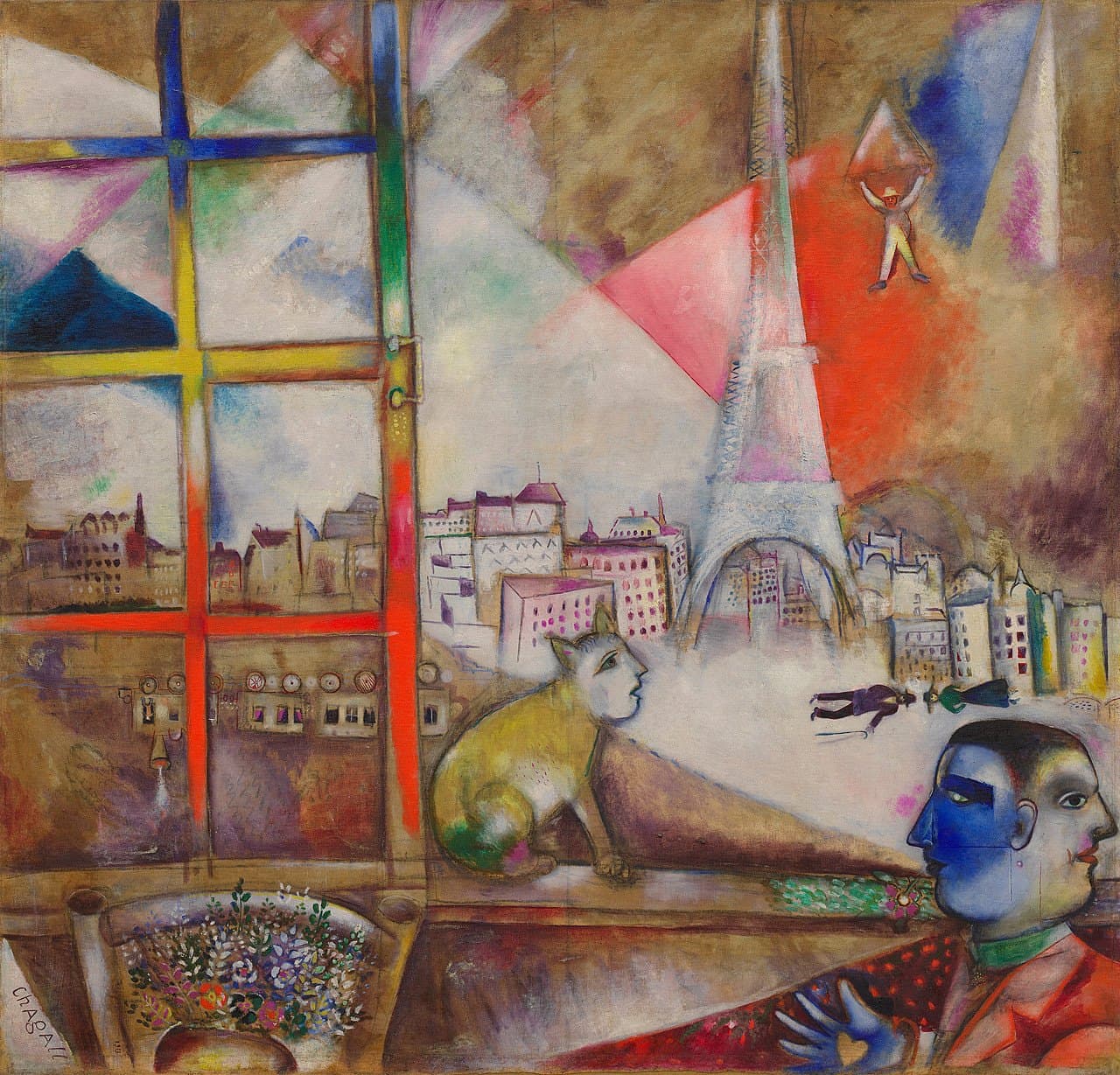
A window stands open on Paris, its glazing bars painted blue, yellow, green and red. The Eiffel Tower rises through the middle of the view, a parachutist drops at the upper right, a cat with a human face sits on the sill, and a head with two faces watches from the lower right corner. The Solomon R. Guggenheim Museum in New York owns it as 37.438.
- 1913
- Oil on canvas
- Solomon R. Guggenheim MuseumNew York, United States
About Marc Chagall
What the painting shows
The left third of the canvas is a window seen from inside a room. Its glazing bars change colour along their length — blue across the top, yellow, then green, then a long red vertical that runs to the bottom of the frame. Through the panes are grey and brown roofs, and beyond them a wash of pale sky broken by flat wedges of blue, pink and white.
The Eiffel Tower stands just right of centre, drawn in thin pale grey lines against a red field. Around its base is a city of white and pink blocks with rows of small windows. A red triangle spreads to the left of the tower and a smaller one to the right, and at the upper right a figure hangs beneath a pointed canopy with both arms raised.
A cat sits on the windowsill at the centre bottom, its body yellow and green and its head turned in profile, with a human face and a small pointed ear. To the right of the tower two figures lie flat in the air over the rooftops, one in dark clothes with a green cap.
In the lower right corner is a single head with two profiles. The left half is blue and faces left; the right half is pale and faces right; they share one hairline and one ear. Below it a hand opens on a red ground. At the lower left a planter of small flowers sits on a rail, and the signature runs up the left edge beside it.
What the museum reads in it
The Solomon R. Guggenheim Museum credits the picture's colour to Robert Delaunay. Marc Chagall's debt to the Orphic Cubism of his colleague, the museum writes, is clear in the semitransparent overlapping planes of vivid colour in the sky above the city. The Eiffel Tower was a frequent subject in Robert Delaunay's own work.
The museum reads the parachutist as a piece of contemporary news, since the first successful jump took place in 1912. It reads the two-faced head as the artist looking west to his new home in France and east to Russia at the same time.
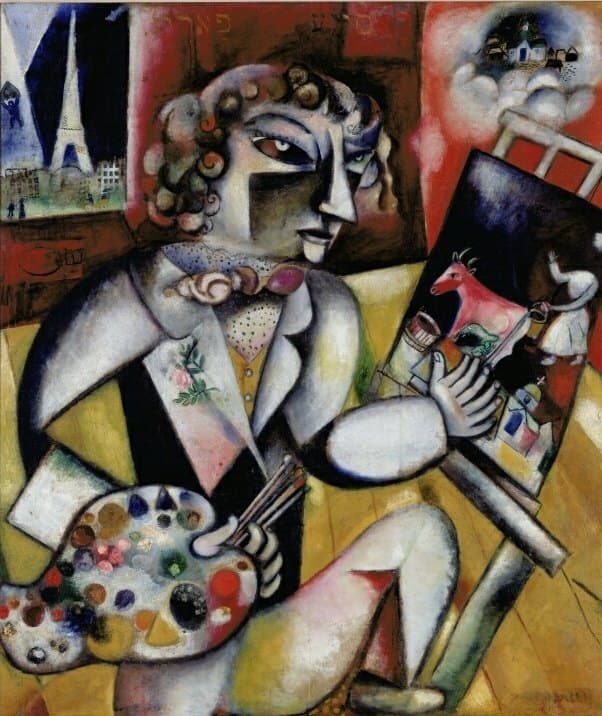
It also enters a warning against reading any of it too literally. Marc Chagall refused literal interpretations of his paintings, the museum writes, and it is perhaps best to think of them as lyrical evocations. The picture, it adds, enlarges a window view from a self-portrait painted a year earlier, in which the artist set his birthplace against Paris.
The museum prints it with a small t
The Solomon R. Guggenheim Museum's catalogue entry and its image caption both read Paris through the Window. Its curatorial essay, printed on the same page, capitalises the word as Paris Through the Window, and most books follow the capitalised form.
The atlas uses the museum's catalogue spelling. Anyone searching for the painting will find both, and they are one picture.
The title was supplied by Blaise Cendrars, the poet who was Marc Chagall's friend in Paris. The Solomon R. Guggenheim Museum records that he named this canvas.
The museums disagree about when he arrived
The Solomon R. Guggenheim Museum opens its account with a date: after Marc Chagall moved to Paris from Russia in 1910, his paintings quickly came to reflect the latest avant-garde styles.
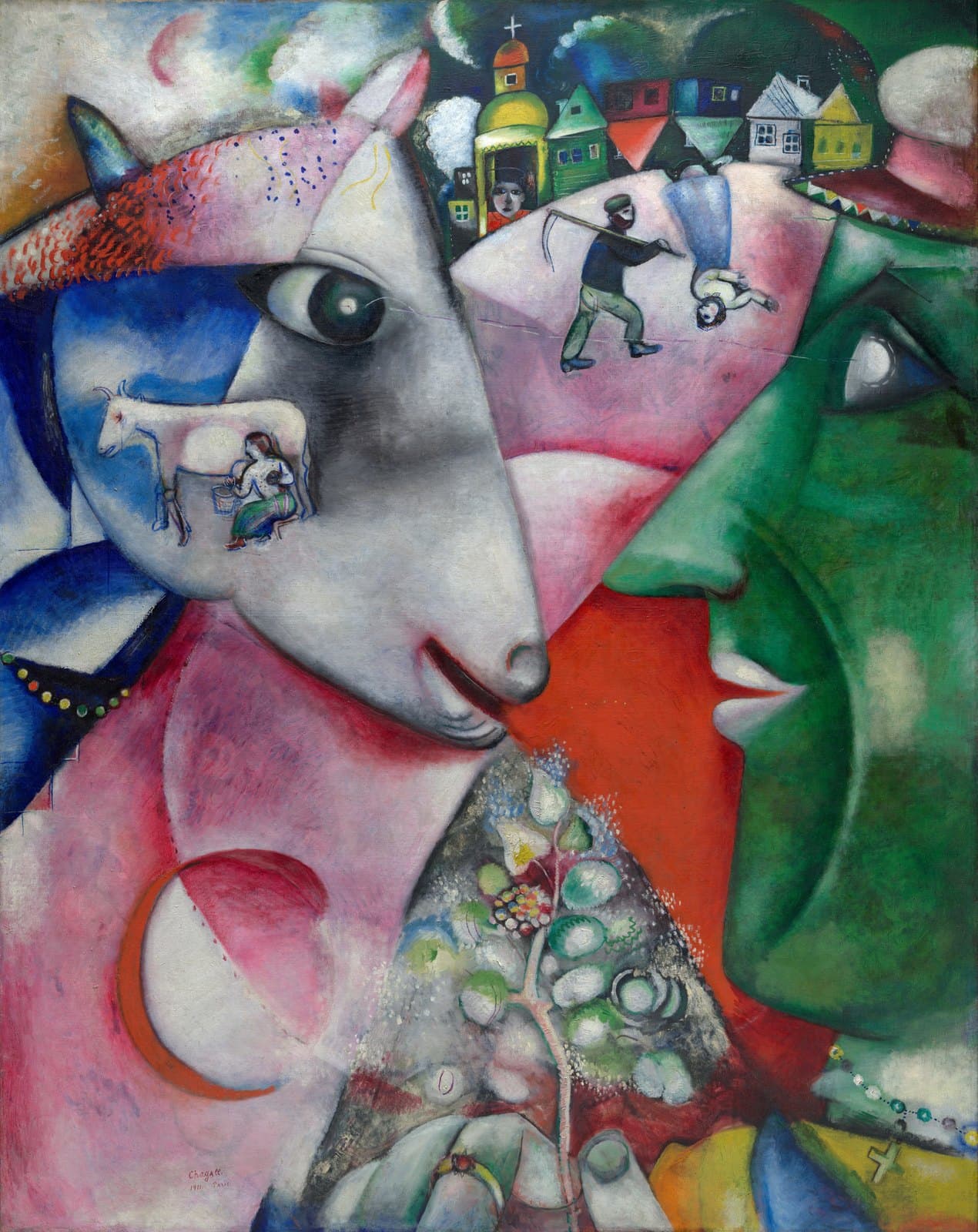
The Musée national Marc Chagall in Nice places the move a year later, in 1911, and the Museum of Modern Art describes I and the Village of 1911 as painted one year after he moved. The year of arrival is unsettled between institutions, and the atlas records the disagreement rather than choosing.
Either way, the studio was the same. Marc Chagall worked at La Ruche, the rotunda of cheap studios at 2 passage de Dantzig in the fifteenth arrondissement, alongside Chaïm Soutine, Amedeo Modigliani and Fernand Léger.
How it reached New York
The painting belongs to the Solomon R. Guggenheim Founding Collection and entered it by gift, which is how the museum's own credit line records it. Solomon R. Guggenheim assembled that founding group of paintings in the 1930s, before the museum opened to the public in New York.
The museum carries the canvas under the object number 37.438, and files its photograph of it under the same number. The painting has stayed in New York since.
Close reading
Reading the work, detail by detail
The left third of the canvas is a window frame; the rest is what can be seen past it. Start with the coloured glazing bars, then the Eiffel Tower and the figure falling beside it, then come back inside to the cat on the sill and the two-faced head in the corner.
1.The glazing bars
The bars change colour along their length rather than at the joints, so a single vertical runs green, then red, without a break in the drawing. The red band is the strongest colour in the left half of the picture and carries the eye down to the sill.
2.The Eiffel Tower
The tower is drawn rather than painted: a pale outline with the lattice ruled inside it, laid over the colour behind. A red wedge spreads to its left and a narrower one to its right, so the same structure sits on two different grounds at once. The Solomon R. Guggenheim Museum links the motif to Robert Delaunay.
3.The parachutist
The canopy is a plain triangle and the lines to it are not drawn, so the figure appears to hold it up rather than hang from it. The Solomon R. Guggenheim Museum reads the figure as contemporary news: the first successful parachute jump was made in 1912, the year before the painting.
4.The cat with a human face
The body is unmistakably a cat, drawn with a long back and folded forelegs. The head is not: the muzzle is a human nose and chin, and the ear is added at the top like a costume. It sits on the sill facing the city rather than the room.
5.The head with two faces
It is one head, not two overlapping. The hair runs continuously over both, a single green earring hangs at the join, and the shoulders below are shared. The Solomon R. Guggenheim Museum records a reading of the figure as the artist looking west to France and east to Russia at once.
6.The figures lying flat in the air
Both are drawn small, at the scale of the buildings under them, and both are perfectly level rather than tilted. Their feet point back towards the Eiffel Tower, which sets them travelling away from it across the roofs.
7.The open hand
The hand belongs to the two-faced figure above it, and it is the only part of that body the canvas shows apart from the head and collar. It is painted blue-grey against the red, and held open rather than reaching.
8.The flowers on the rail
The flowers are worked in small separate touches, unlike the flat planes everywhere else in the picture. They stand inside the room, on the near side of the window, which fixes the viewer's position at a table by the glass.
9.The signature
The signature is in block capitals rather than the cursive used on I and the Village two years earlier. It sits at the extreme left edge, below the window rail and clear of the flowers.
Timeline
1910 or 1911
Marc Chagall moves from Russia to Paris. The Solomon R. Guggenheim Museum gives 1910; the Musée national Marc Chagall gives 1911.
1912
The first successful parachute jump, which the Guggenheim reads behind the falling figure at the upper right.
1913
Painted in Paris, and named by the poet Blaise Cendrars.
1937
Enters the Solomon R. Guggenheim Founding Collection by gift, as 37.438.
Where to see it
Solomon R. Guggenheim Museum
New York, United States
A public viewing address has not yet been confirmed for this holding.
A collection record is not a promise of display. Check the museum's record before travelling.
Frequently asked questions
Where is Marc Chagall's Paris through the Window?
The Solomon R. Guggenheim Museum in New York, accession number 37.438. It belongs to the Solomon R. Guggenheim Founding Collection and came in by gift. Check the museum's record before travelling, since a collection record is not a promise of display.
Is it Paris through the Window or Paris Through the Window?
Both forms are the museum's. The Solomon R. Guggenheim Museum's catalogue entry and image caption print Paris through the Window with a small t, while its curatorial essay on the same page capitalises it. The atlas follows the catalogue spelling.
Who is the falling figure in Paris through the Window?
A parachutist. The Solomon R. Guggenheim Museum reads the figure as a reference to contemporary experience, since the first successful parachute jump was made in 1912, the year before the painting. He hangs beneath a pointed canopy at the upper right with both arms raised.
What does the two-faced head in Paris through the Window mean?
The Solomon R. Guggenheim Museum records a reading of the Janus figure as the artist looking west to his new home in France and east to Russia at once. The museum also notes that Marc Chagall refused literal interpretations of his paintings.
How big is Paris through the Window?
136 by 141.9 centimetres, about 53 and a half by 55 and seven-eighths inches. Oil on canvas, very slightly wider than it is tall.
Why is the Eiffel Tower in Paris through the Window?
It was the subject Marc Chagall's colleague Robert Delaunay had made his own, and the Guggenheim treats the borrowing as deliberate. For both artists, the museum writes, the tower served as a metaphor for Paris and perhaps for modernity itself.
More by Marc Chagall
If you like Marc Chagall
Explore painters from the same movements and circles.
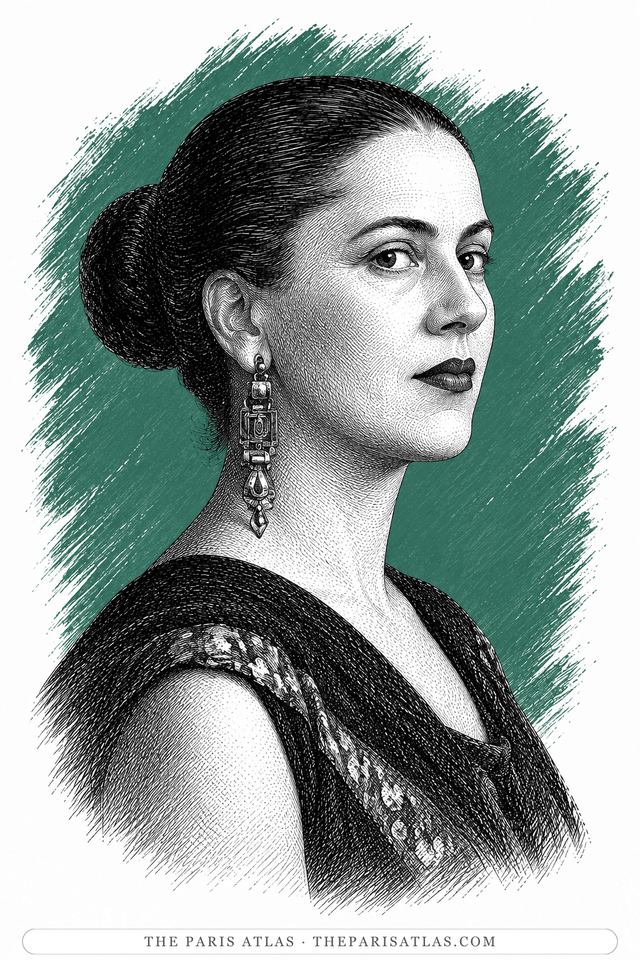
Tarsila do Amaral
Brazilian painter who spent the 1920s moving between São Paulo and Paris, studied Cubism under André Lhote, Albert Gleizes and Fernand Léger, and used what she learned to paint Brazilian towns, railways, plants and bodies. Her 1928 painting Abaporu prompted the manifesto that gave the Anthropophagic movement its name.
View artist
Arman
French-American artist, lifelong friend of Yves Klein, and a founder of New Realism.
View artist
Jean Arp
Strasbourg-born sculptor and poet — Hans in German, Jean in French, both all his life — who co-founded Dada at the Cabaret Voltaire in 1916, composed collages by dropping torn paper 'according to the laws of chance', and settled at Meudon outside Paris in a house his wife Sophie Taeuber-Arp designed.
View artist
References
The sources below include collection records, catalogues, scholarly research, and primary materials that informed this page. They document Paris through the Window, its making, and its place in cultural history.

1Marc Chagall, Paris through the Window
WebsiteSolomon R. Guggenheim MuseumUsed forWeb source consulted for documented facts and historical context presented on the Paris through the Window page.
2Marc Chagall. I and the Village. 1911
WebsiteThe Museum of Modern ArtUsed forCited for the Museum of Modern Art's dating of the move to Paris.
3Chronology of Marc Chagall
WebsiteMusée national Marc Chagall, NiceUsed forWeb source consulted for documented facts and historical context presented on the Paris through the Window page.
4Biography of Marc Chagall
WebsiteMusée national Marc Chagall, NiceUsed forWeb source consulted for documented facts and historical context presented on the Paris through the Window page.
These references provide the documented foundation for this work's history and interpretation. Claim-level citations remain attached to the specific claims they support.
 Explore more resources