The Palais Garnier Ceiling
by Marc Chagall
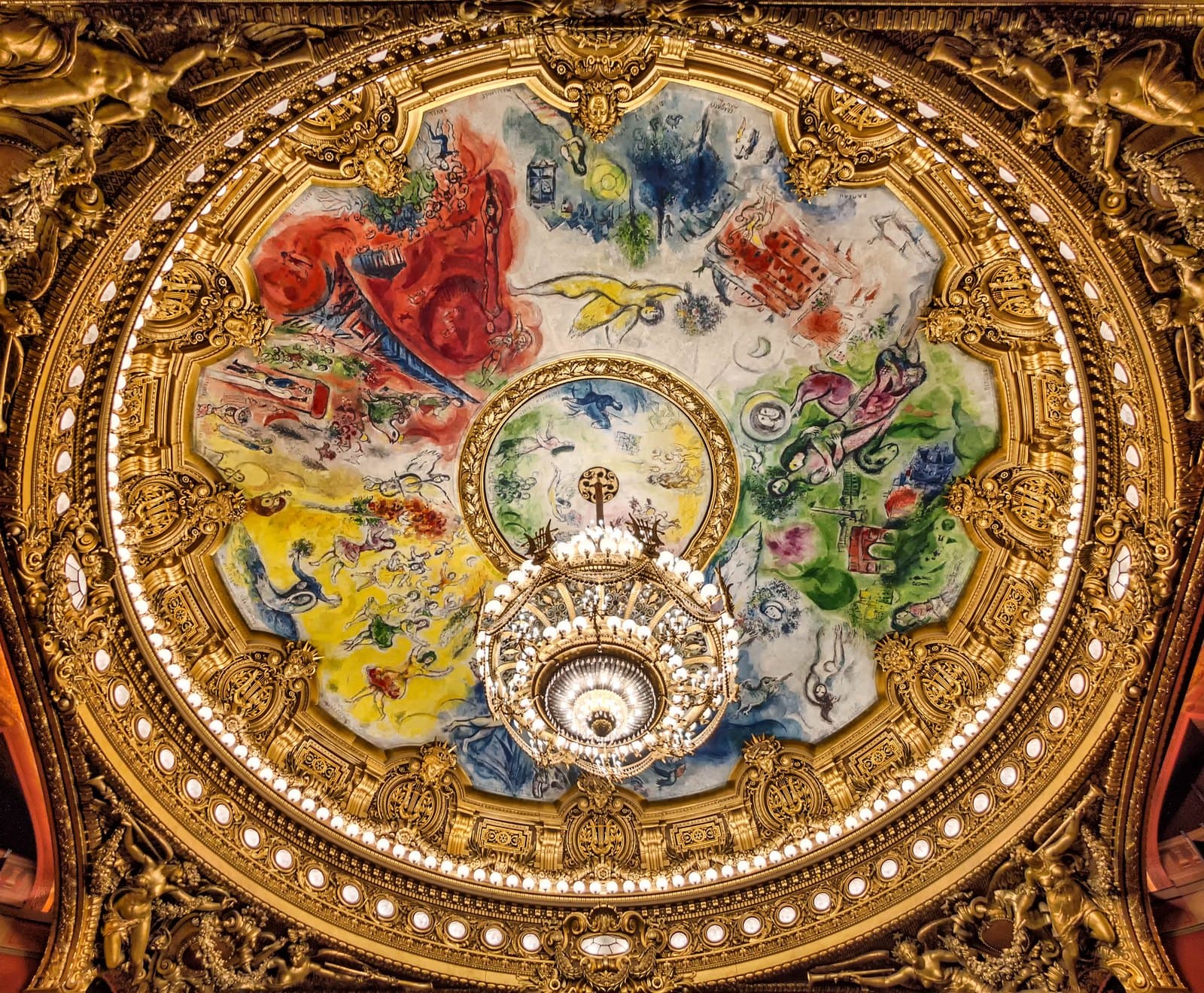
Marc Chagall painted the ceiling of the auditorium of the Palais Garnier at the invitation of André Malraux, then France's minister of culture, and it was installed in 1964. It covers 220 square metres of the dome in broad fields of colour around the chandelier, with a separate disc at the centre. It is painted architecture, seen in place: the work cannot be moved to a gallery, and the only way to look at it is to stand in the auditorium and look up.
- 1964
- Paint on canvas, made in sections and assembled, covering the dome of the auditorium
- Opéra national de Paris, Palais GarnierParis, France
About Marc Chagall

A work you have to stand under
The ceiling is not a portable object. It was made in pieces and assembled at the Eiffel workshops at Meudon, then fixed in the dome of the auditorium of the Palais Garnier, and it has stayed there. There is no accession number, no loan history and no gallery wall.
That changes what a reader can do with it. A visitor books a tour or a performance at the Palais Garnier and looks up, because there is no other way to see the work itself. Every reproduction is a photograph taken from the floor, with the chandelier hanging in front of the middle of it.
The Opéra national de Paris gives it no title beyond its position. Its visitor pages call it le plafond de Marc Chagall — Marc Chagall's ceiling — and its history pages call it the new ceiling of the Palais Garnier, painted by Marc Chagall.
What the ceiling shows
A ring of colour fills the dome inside the gilt cove of Charles Garnier's auditorium, and a separate circular panel sits at the centre, held in its own gilt frame. The chandelier hangs from that centre, so from the floor the middle of the painting is read around a gold crown of lamps and a drop of crystal.
The ring is divided into broad fields of a single colour: red, blue, green, yellow and white, each running into the next. Small figures cross them — dancers, lovers, angels, musicians, a bird, a horse — and buildings appear at their edges, drawn in outline rather than modelled. Composers' names are lettered in paint around the outer rim of the ring.
The Bibliothèque nationale de France identifies the scenes work by work. The green field carries Richard Wagner's Tristan und Isolde, with a couple embracing near the Arc de Triomphe, and Hector Berlioz's Roméo et Juliette. The white field holds an opera by Jean-Philippe Rameau, with the lit façade of the Palais Garnier and Jean-Baptiste Carpeaux's sculpture La Danse, beside Claude Debussy's Pelléas et Mélisande. The blue field takes Modest Mussorgsky's Boris Godunov, with the tsar enthroned and Moscow behind him.
The red field holds Maurice Ravel's Daphnis et Chloé around a large Eiffel Tower, and Igor Stravinsky's The Firebird, in which Marc Chagall painted himself with his palette and brushes among the musicians. The yellow field takes Adolphe Adam's Giselle and Pyotr Ilyich Tchaikovsky's Swan Lake. A pale blue field crowns the whole with Wolfgang Amadeus Mozart's The Magic Flute.
The central disc carries four more. Christoph Willibald Gluck's Orfeo ed Euridice is in the green part, Ludwig van Beethoven's Fidelio in the blue and Georges Bizet's Carmen in the red. In the yellow is an opera by Giuseppe Verdi that the Bibliothèque nationale de France identifies only as probably La traviata.
André Malraux asked for it
The commission came from André Malraux, then France's minister of culture. The Bibliothèque nationale de France names him as the person who ordered the work. The Musée national Marc Chagall in Nice records that the painter worked on the decoration of the ceiling at André Malraux's request between 1963 and 1965, and that it was inaugurated in 1964.
Marc Chagall was seventy-seven when he finished it, which the Bibliothèque nationale de France records. The same page calls the result an exploit technique — a technical feat — as much as a painting, and gives its area as 220 square metres.
The Centre Pompidou holds the preparatory studies. Its Cabinet d'art graphique carries a group of drawings of 1963 titled Maquette pour le plafond de l'Opéra Garnier, in pastel, felt-tip, ink, graphite and cut paper. Some are rectangular and some circular. Meret Meyer gave them to the museum in 2022, under the inventory number AM 2022-431, and several were on loan to the Musée national Marc Chagall in Nice through 2026.
The row it caused
The Bibliothèque nationale de France describes the reaction without softening it: the work set off a violent polemic. Two questions were asked at the time. Should the painted ceiling of Jules-Eugène Lenepveu, dating from the nineteenth century, be masked? And did a contemporary work belong in the building at all?
The question of masking is the one that describes what happened. Jules-Eugène Lenepveu's ceiling of 1872, Les Muses et les Heures du jour et de la nuit, was covered rather than destroyed. The Musée d'Orsay holds the painter's own maquette for it, an oil on canvas of 141 by 142.5 centimetres, inscribed to his friend Charles Garnier and dated 1872. It belongs to the Bibliothèque nationale de France and has been on deposit at the Orsay since 1986.
Marc Chagall was Russian-born, Jewish and a French citizen only since 1937, and the argument about whether he should paint over a monument of the Second Empire was conducted in those terms. The ceiling went up regardless, and the Opéra national de Paris now lists it among the things a visitor is shown.
How to see it
The Palais Garnier is open to visitors outside performance hours, and the auditorium is part of the route when no rehearsal is running. The Opéra national de Paris sells an unaccompanied visit and a multimedia tablet tour, and names the ceiling among the four things that tour is built around, alongside the auditorium itself, the paintings of the Grand Foyer and the façade.
Access to the auditorium is never guaranteed, because the room is a working theatre. Check the Opéra national de Paris visitor page before travelling.
Close reading
Reading the work, detail by detail
The photograph is taken from the floor of the auditorium, which is the only place the work can be seen from, and the chandelier hangs in front of the middle of it. Start with the gilt frame that holds the central disc, then take the coloured fields of the outer ring one at a time.
1.The chandelier in front of the painting
The chandelier is fixed at the centre of the ceiling, so it covers part of the central disc from every seat in the house. Any photograph of the work has it in the middle, and so does the view a visitor gets standing on the floor.
2.The disc at the centre
The centre is a separate panel with its own frame, lighter in colour than the ring around it. The Bibliothèque nationale de France reads four operas in its coloured quarters: Christoph Willibald Gluck's Orfeo ed Euridice in the green, Ludwig van Beethoven's Fidelio in the blue, Georges Bizet's Carmen in the red, and in the yellow an opera by Giuseppe Verdi it identifies only as probably La traviata.
3.The red field
This is the largest single colour on the ceiling and it runs from the outer rim almost to the central frame. The figures on it are drawn in pale line over the red rather than painted into it. The Bibliothèque nationale de France places Maurice Ravel's Daphnis et Chloé around a large Eiffel Tower in the red, with Igor Stravinsky's The Firebird beside it.
4.The green field
The two figures are the biggest bodies anywhere on the ceiling and they lie horizontally along the field rather than standing in it. The Bibliothèque nationale de France assigns the green to Richard Wagner's Tristan und Isolde, with a couple embracing near the Arc de Triomphe, and to Hector Berlioz's Roméo et Juliette.
5.The yellow field
The figures here are smaller and more numerous than anywhere else on the ceiling, and they are spread across the yellow at every angle rather than arranged on a ground line. The Bibliothèque nationale de France gives the yellow to Adolphe Adam's Giselle and Pyotr Ilyich Tchaikovsky's Swan Lake.
6.The blue field at the top
The blue sits at the top of the photograph, between two paler fields, and is the coolest passage on the ceiling. The Bibliothèque nationale de France puts Modest Mussorgsky's Boris Godunov in a blue field, with the tsar enthroned and the city of Moscow behind him.
7.The composers' names on the rim
The names are lettered in paint at the very edge of the work, on the same ground as the pictures, in capitals small enough to be missed from the floor. The Bibliothèque nationale de France names fourteen composers on the ceiling, each with a work attached.
8.Charles Garnier's frame around it
The painting stops at the gilt. Everything outside the ring — the cornice, the carved trophies, the lamps and the figures in the corners — is Charles Garnier's building of the 1860s and 1870s, and none of it was altered in 1964. The join is where the argument of that year was fought.
9.The blue below the chandelier
This field is the hardest to see from the floor, because the chandelier hangs directly in front of it. The Bibliothèque nationale de France describes a pale blue field crowning the whole with Wolfgang Amadeus Mozart's The Magic Flute, a large angel flying over the scene with a flute-playing bird.
Timeline
1872
Jules-Eugène Lenepveu paints the auditorium ceiling of Charles Garnier's new opera house, Les Muses et les Heures du jour et de la nuit. His maquette, inscribed to Charles Garnier, is now at the Musée d'Orsay.
1963
Marc Chagall makes the maquettes now in the Centre Pompidou's Cabinet d'art graphique, in pastel, felt-tip, ink, graphite and cut paper.
1963–1965
He works on the decoration at André Malraux's request, per the chronology of the Musée national Marc Chagall.
1964
The ceiling is made in sections, assembled at the Eiffel workshops at Meudon, installed in the dome and inaugurated. Marc Chagall is seventy-seven.
2022
Meret Meyer gives the preparatory maquettes to the Centre Pompidou, as AM 2022-431.
2026
Several of the maquettes are lent to the Musée national Marc Chagall in Nice for Chagall à l'œuvre, 7 February to 21 September.
Where to see it
Opéra national de Paris, Palais Garnier
Paris, France
A public viewing address has not yet been confirmed for this holding.
The ceiling is in the auditorium of the Palais Garnier and can only be seen there. Access to the auditorium depends on rehearsals and performances, so check the Opéra national de Paris visitor page before travelling.
Frequently asked questions
Did Marc Chagall paint the ceiling of the Paris Opera?
Yes. The Opéra national de Paris records the inauguration of the new ceiling of the Palais Garnier, painted by Marc Chagall, in 1964. André Malraux, then France's minister of culture, commissioned it, and the Musée national Marc Chagall dates the work on it to 1963–1965.
How big is Marc Chagall's ceiling at the Palais Garnier?
220 square metres of painted surface, according to the Bibliothèque nationale de France. It was made in pieces and assembled at the Eiffel workshops at Meudon before being fixed in the dome of the auditorium.
What is under Marc Chagall's ceiling at the Palais Garnier?
The 1872 ceiling by Jules-Eugène Lenepveu, Les Muses et les Heures du jour et de la nuit. The Bibliothèque nationale de France records that the question argued at the time was whether that nineteenth-century painting should be masked, so it was covered rather than removed. Lenepveu's own maquette for it is at the Musée d'Orsay.
Which composers are on the Palais Garnier ceiling?
Fourteen, each with a work attached. The Bibliothèque nationale de France names Christoph Willibald Gluck, Ludwig van Beethoven, Giuseppe Verdi, Georges Bizet, Jean-Philippe Rameau, Claude Debussy and Modest Mussorgsky. It also names Richard Wagner, Hector Berlioz, Maurice Ravel, Igor Stravinsky, Adolphe Adam, Pyotr Ilyich Tchaikovsky and Wolfgang Amadeus Mozart.
Can you see Marc Chagall's ceiling at the Palais Garnier?
Yes, from the auditorium. The Opéra national de Paris sells unaccompanied visits and a multimedia tablet tour built around the auditorium, the ceiling, the Grand Foyer paintings and the façade. Access to the auditorium depends on rehearsals and performances, so check the visitor page before travelling.
Is Marc Chagall's ceiling a painting you can borrow for an exhibition?
No. It is painted architecture, fixed in the dome of a working theatre, with no accession number and no loan history. The Centre Pompidou's 1963 maquettes travel; the ceiling itself does not.
More by Marc Chagall
If you like Marc Chagall
Explore painters from the same movements and circles.
Tarsila do Amaral
Brazilian painter who spent the 1920s moving between São Paulo and Paris, studied Cubism under André Lhote, Albert Gleizes and Fernand Léger, and used what she learned to paint Brazilian towns, railways, plants and bodies. Her 1928 painting Abaporu prompted the manifesto that gave the Anthropophagic movement its name.
View artist
Arman
French-American artist, lifelong friend of Yves Klein, and a founder of New Realism.
View artist
Jean Arp
Strasbourg-born sculptor and poet — Hans in German, Jean in French, both all his life — who co-founded Dada at the Cabaret Voltaire in 1916, composed collages by dropping torn paper 'according to the laws of chance', and settled at Meudon outside Paris in a house his wife Sophie Taeuber-Arp designed.
View artist
References
The sources below include collection records, catalogues, scholarly research, and primary materials that informed this page. They document The Palais Garnier Ceiling, its making, and its place in cultural history.


1Le plafond de Chagall
WebsiteBibliothèque nationale de France — PasserellesUsed forThe Bibliothèque nationale de France's panel-by-panel guide to the ceiling, and the source for its area and for the row it caused.
2The Paris Opera in the 20th century
WebsiteOpéra national de ParisUsed forWeb source consulted for documented facts and historical context presented on the The Palais Garnier Ceiling page.
3Visit the Palais Garnier
WebsiteOpéra national de ParisUsed forWeb source consulted for documented facts and historical context presented on the The Palais Garnier Ceiling page.
4Chronology of Marc Chagall
WebsiteMusée national Marc Chagall, NiceUsed forWeb source consulted for documented facts and historical context presented on the The Palais Garnier Ceiling page.
5Marc Chagall, Maquette pour le plafond de l'Opéra Garnier, 1963
WebsiteCentre Pompidou, Musée national d'art moderneUsed forWeb source consulted for documented facts and historical context presented on the The Palais Garnier Ceiling page.
6Jules-Eugène Lenepveu, Les Muses et les Heures du jour et de la nuit
WebsiteMusée d'OrsayUsed forWeb source consulted for documented facts and historical context presented on the The Palais Garnier Ceiling page.
These references provide the documented foundation for this work's history and interpretation. Claim-level citations remain attached to the specific claims they support.
 Explore more resources