White Crucifixion
by Marc Chagall
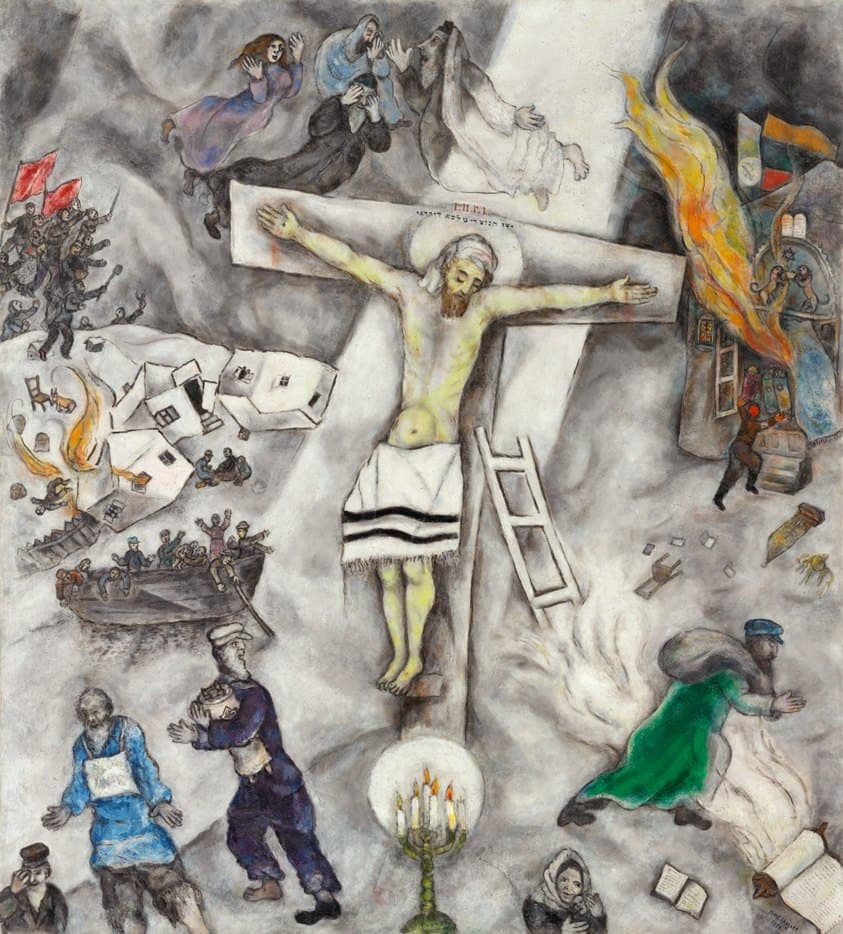
Christ hangs on a cross at the centre of a grey canvas, wearing a prayer shawl in place of a loincloth and a white cloth round his head, with a shaft of white light behind him. Around him a synagogue burns, a village lies overturned, soldiers advance under red flags and refugees crowd an open boat. Marc Chagall painted it in France in 1938 and the Art Institute of Chicago bought it in 1946.
- 1938
- Oil on canvas
- Art Institute of ChicagoChicago, United States
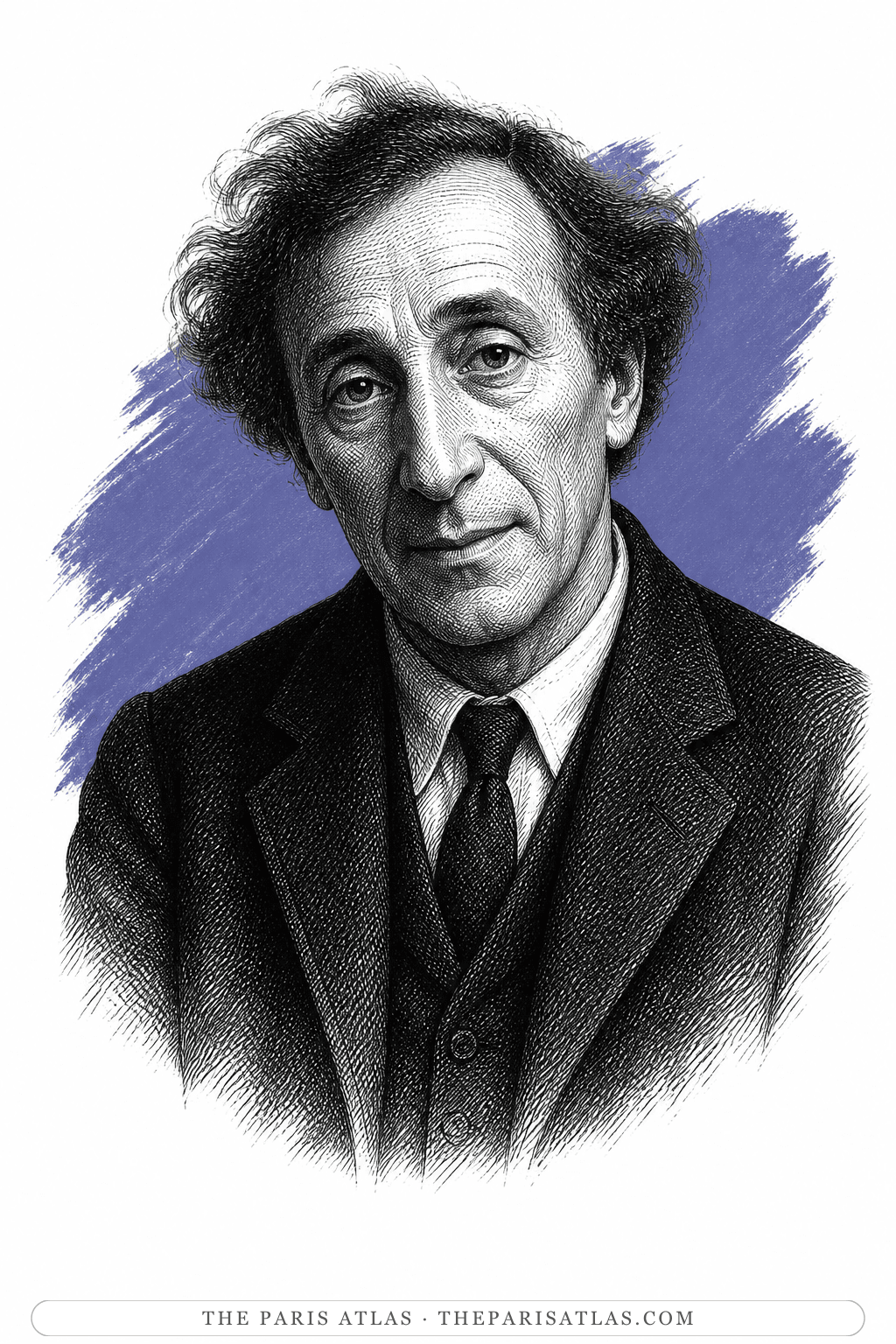
About Marc Chagall
What the painting shows
The cross stands upright at the centre, lit by a broad white shaft that runs from the top of the canvas to the bottom. Christ's head is wrapped in a white cloth rather than crowned with thorns, and a pale halo rings it. His loincloth is a prayer shawl, a tallit, white with two black stripes and a fringed lower edge. Above his hands an inscription in Hebrew letters runs along the crossbar. A plain white ladder leans against the cross on the right.
Four figures float above the crossbar in the upper part of the canvas. Three are bearded men in dark coats, hands raised or pressed to the face; one is a woman in a purple dress and dark cloak, her mouth open. A fourth figure in white stretches across the top right of the group.
The left side of the canvas is a village turned over. White houses lie on their sides and roofs, one of them burning, with small figures scattering among them. Below, an open boat rides low in the water, crowded with people, several of them with their arms up. At the upper left a line of soldiers comes down a slope under three red flags.
On the right a synagogue burns. Orange flames rise past a coloured window, and the ark stands open beside them with the tablets of the Law above it. A man in brown crouches below with objects in his arms. Lower down, a man in a green coat and a peaked cap runs to the right with a white bundle over his shoulder. At the bottom of the canvas a brass candelabrum stands in a circle of white with its candles alight, and an open book lies in the lower right corner.
The canvas is 154.6 by 140 centimetres. The Art Institute of Chicago records the signature at the lower right as MArc ChAgAll, with 1938 beneath it.
What the museum says it is
The Art Institute of Chicago calls it the first of a series in which Jesus appears as a Jewish martyr. The painting calls attention to the persecution and suffering of Jews in 1930s Germany, the museum writes, at the hands of the National Socialist Party. Marc Chagall stressed Jesus's Jewishness by dressing him, and the figures above him, in Jewish clothes.
The scenes around the cross show the devastation of pogroms, the museum states. A pogrom is a violent attack on a Jewish community, often organised or allowed by the local government. Setting those attacks beside the Crucifixion links the martyred Jesus to the Jews being persecuted across Europe. It also, the museum writes, compares the Nazis to Jesus's tormentors.
The museum calls it one of the most overtly political paintings of Marc Chagall's career. That is a strong claim about a painter better known for floating lovers and village weddings.
The title changed twice before it settled
The Art Institute of Chicago's own publication history shows the picture under three names in its first decade. It appeared in Cahiers d'Art in 1939 as Le Christ, dated 1939. It hung at the Dayton Art Institute in 1944 as Crucifixion, undated. The name White Crucifixion first appears in James Johnson Sweeney's catalogue for the Museum of Modern Art's Marc Chagall exhibition of 1946.
The date moved with the title. Several early publications give 1939, one gives 1938–9, and the museum now dates the painting 1938 on the strength of the signature.
French catalogues print La Crucifixion blanche, German ones Die weiße Kreuzigung, Italian ones Crocifissione bianca. The museum's exhibition history records all of them, which is why a search in one language can miss the same canvas in another.
Its first exhibition was in Paris, weeks before the invasion
The Art Institute of Chicago's exhibition history opens with Paris. The painting was shown at the Galerie Mai in a Marc Chagall exhibition that ran from 26 January to 24 February 1940, as catalogue number 1, under the title Le Christ.
Germany invaded France three and a half months later. Vichy stripped Marc Chagall of the French citizenship he had held since 1937, and he was arrested in a round-up in Marseille in 1941. The rescue committee run by the American journalist Varian Fry, with the vice-consul Hiram Bingham, got him and his family out. They reached New York in June 1941.
The painting travelled the same way. The museum's provenance begins with the artist in Paris and then in the United States, which places the canvas in the same crossing.
How it reached Chicago
Marc Chagall gave the painting to his daughter Ida Gordey in New York in 1944, the year her mother Bella Rosenfeld died. The Art Institute of Chicago cites a letter from Marc Chagall to its director Daniel Catton Rich, dated 8 December 1946, which is kept in the curatorial file for the object.
She sold it to the museum on 27 December 1946, six weeks after the Museum of Modern Art's Marc Chagall exhibition had opened at the Art Institute on 14 November. The purchase was made with funds provided by Mrs. Rose H. Alschuler, and the painting carries the accession number 1946.925.
One detail in the museum's provenance is worth flagging for anyone using it. The Art Institute of Chicago records the artist as living in Paris and later at White Falls, New York. The atlas found no other record of a White Falls in his biography, so the spelling should be checked against the curatorial file before it is repeated.
Where it has been since
The Art Institute of Chicago lends it heavily. Its exhibition history runs from the Grand Palais in Paris in 1969 to the Royal Academy of Arts in London in 1985, the Centre Georges Pompidou in 1996 and the Galeries nationales du Grand Palais again in 2003.
Its most recent loan was to Rome. The painting hung at the Palazzo Cipolla della Fondazione Roma from 27 November 2024 to 27 January 2025, in an exhibition built around the single picture and titled Chagall in Rome: The White Crucifixion, for the Jubilee of 2025.
The museum's record listed the canvas as not on view when it was checked in September 2026, with no gallery assigned.
Close reading
Reading the work, detail by detail
A cross stands upright in a broad shaft of white light and everything else in the picture is a disaster arranged around it. Start with the prayer shawl at the hips and the cloth round the head, then read outward: the burning synagogue at the right, the overturned village and the boat at the left.
1.The prayer shawl
The cloth is a tallit, a Jewish prayer shawl, with the stripes and fringe painted plainly enough to identify it. The Art Institute of Chicago states that Marc Chagall stressed Jesus's religious identity by depicting him and the figures above him in traditional Jewish garments, and this is the clearest instance on the canvas.
2.The head in a white cloth
There is no crown of thorns. The head covering is a folded white cloth, and the halo behind it is a plain thin ring rather than a disc of gold. The eyes are closed and the face is turned down towards the right shoulder.
3.The lettering on the crossbar
The titulus, which in most crucifixions carries the Latin abbreviation INRI, is lettered here in Hebrew characters with a red word set above the line. It sits on the plain white of the crossbar with no plaque drawn around it.
4.The burning synagogue
The building is identified by its furniture rather than its shape: the open ark and the tablets of the Law are drawn clearly at the top of the blaze. The flames are the only strong orange on the canvas. The Art Institute of Chicago describes the surrounding scenes as the devastation of pogroms.
5.The village on its side
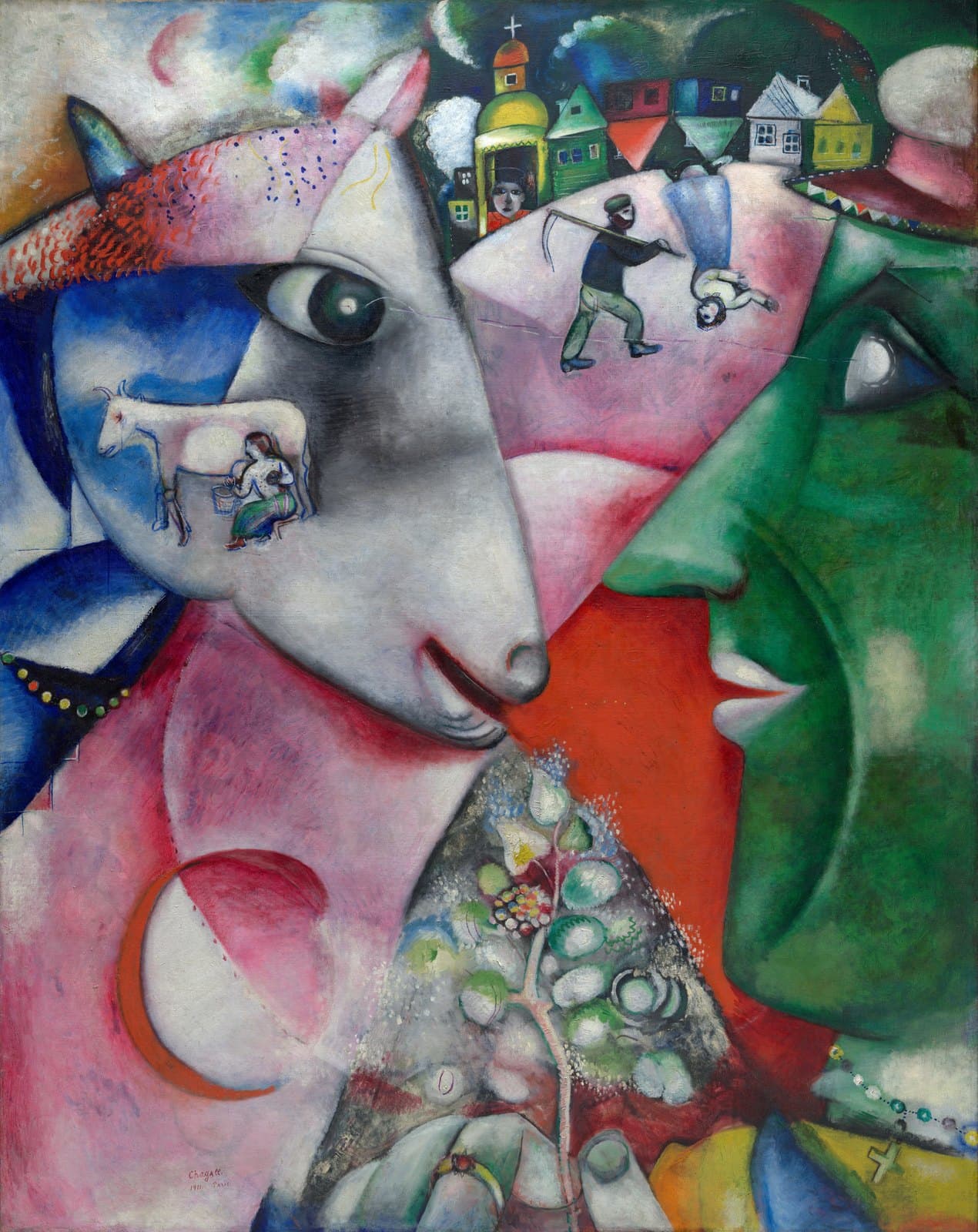
The houses are white with black window openings and are drawn correctly for buildings that have been turned over, with roofs pointing sideways and down. The figures around them are two or three brushstrokes each. The same inverted-house device appears in I and the Village of 1911, used there without violence.
6.The boat
The boat has no sail, no motor and no visible oars, and the water around it is the same grey as the sky. The figures are packed along its length, and at least four have both arms up. Nothing in the picture shows where it is going.
7.The men under red flags
The flags are the only pure red on the upper canvas and are carried at an angle, leaning forward with the movement of the group. The figures beneath them are indistinct, a mass rather than individuals, and they are the only people in the picture advancing rather than fleeing.
8.The ladder against the cross
The ladder belongs to the deposition, the moment after the crucifixion when the body is taken down, and it is painted the same white as the light behind it. It is drawn without perspective and rests against the shaft rather than reaching the crossbar.
9.The candelabrum at the foot
It sits directly below the feet, on the axis of the cross, in a disc of light that separates it from the grey around it. It is the one object in the picture that is neither burning out of control nor being carried away.
10.The man running with a bundle
He is the largest single figure apart from the crucified one, and the only one painted in a strong colour. His body is bent almost to a right angle at the waist and his feet are off the ground, which is how the canvas shows speed.
Timeline
1937
Marc Chagall becomes a French citizen. The same year the Nazi regime includes his work in its exhibition of so-called degenerate art in Munich.
1938
Painted in France, and signed and dated at the lower right.
1939
Reproduced in Cahiers d'Art as Le Christ, dated 1939.
1940
Shown at the Galerie Mai in Paris from 26 January to 24 February as catalogue number 1, under the title Le Christ. It is the painting's first exhibition.
1941
Vichy strips Marc Chagall of his citizenship; Varian Fry's rescue committee and the vice-consul Hiram Bingham get the family out, and they reach New York in June.
1944
Given by the artist to his daughter Ida Gordey in New York.
1946
Shown as White Crucifixion in the Museum of Modern Art's Marc Chagall exhibition, which travels to the Art Institute of Chicago in November. It is the first use of that title.
1946
Sold to the Art Institute of Chicago on 27 December, purchased with funds provided by Mrs. Rose H. Alschuler, as 1946.925.
2024–25
Lent to the Palazzo Cipolla della Fondazione Roma for Chagall in Rome: The White Crucifixion, 27 November to 27 January.
Where to see it
Art Institute of Chicago
111 South Michigan Avenue, Chicago, IL 60603, United States
The museum's record listed the painting as not on view, with no gallery assigned, when it was checked in September 2026.
Plan your visit on the museum’s official website (opens in a new tab)Frequently asked questions
Where is Marc Chagall's White Crucifixion?
The Art Institute of Chicago, accession number 1946.925. The museum's record listed it as not on view, with no gallery assigned, when it was checked in September 2026. It had returned from a loan to the Palazzo Cipolla in Rome in January 2025.
Why is Christ wearing a prayer shawl in White Crucifixion?
To make his Jewishness explicit. The Art Institute of Chicago states that Marc Chagall stressed Jesus's religious identity by depicting him and the biblical figures above him in traditional Jewish garments. The loincloth is a tallit, white with two black stripes and a fringed edge, and the head is wrapped in white cloth rather than crowned with thorns.
What is happening around the cross in White Crucifixion?
A synagogue burns on the right, with its ark open and the tablets of the Law above it. On the left a village lies overturned with one house alight, soldiers advance under three red flags, and an open boat carries refugees. The Art Institute of Chicago describes the scenes as the devastation of pogroms.
When was White Crucifixion first exhibited?
In Paris, at the Galerie Mai, from 26 January to 24 February 1940, as catalogue number 1 under the title Le Christ. Germany invaded France three and a half months later, and Marc Chagall left for New York in June 1941.
Why does White Crucifixion have so many different titles?
Because the name settled slowly. The Art Institute of Chicago's publication history shows it as Le Christ in 1939 and as Crucifixion in 1944, with White Crucifixion first used in the Museum of Modern Art's 1946 catalogue. French, German and Italian catalogues print La Crucifixion blanche, Die weiße Kreuzigung and Crocifissione bianca.
How big is White Crucifixion?
154.6 by 140 centimetres, about 60 and seven-eighths by 55 inches. Oil on canvas, slightly taller than it is wide.
Who owned White Crucifixion before the museum?
Marc Chagall himself, who gave it to his daughter Ida Gordey in New York in 1944. She sold it to the Art Institute of Chicago on 27 December 1946. The museum cites a letter from the artist to its director Daniel Catton Rich, dated 8 December 1946, in the object's curatorial file.
More by Marc Chagall
If you like Marc Chagall
Explore painters from the same movements and circles.
Tarsila do Amaral
Brazilian painter who spent the 1920s moving between São Paulo and Paris, studied Cubism under André Lhote, Albert Gleizes and Fernand Léger, and used what she learned to paint Brazilian towns, railways, plants and bodies. Her 1928 painting Abaporu prompted the manifesto that gave the Anthropophagic movement its name.
View artist
Arman
French-American artist, lifelong friend of Yves Klein, and a founder of New Realism.
View artist
Jean Arp
Strasbourg-born sculptor and poet — Hans in German, Jean in French, both all his life — who co-founded Dada at the Cabaret Voltaire in 1916, composed collages by dropping torn paper 'according to the laws of chance', and settled at Meudon outside Paris in a house his wife Sophie Taeuber-Arp designed.
View artist
References
The sources below include collection records, catalogues, scholarly research, and primary materials that informed this page. They document White Crucifixion, its making, and its place in cultural history.

1Marc Chagall, White Crucifixion, 1938
WebsiteArt Institute of ChicagoUsed forWeb source consulted for documented facts and historical context presented on the White Crucifixion page.
2Chronology of Marc Chagall
WebsiteMusée national Marc Chagall, NiceUsed forWeb source consulted for documented facts and historical context presented on the White Crucifixion page.
3Biography of Marc Chagall
WebsiteMusée national Marc Chagall, NiceUsed forWeb source consulted for documented facts and historical context presented on the White Crucifixion page.
4Marc Chagall
WebsiteMuseum of Modern ArtUsed forWeb source consulted for documented facts and historical context presented on the White Crucifixion page.
These references provide the documented foundation for this work's history and interpretation. Claim-level citations remain attached to the specific claims they support.
 Explore more resources