Self-Portrait with Seven Fingers
by Marc Chagall
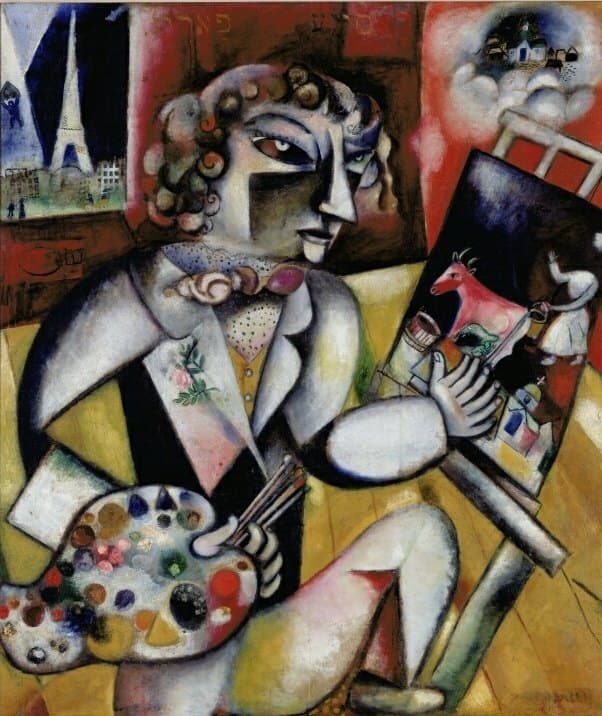
Marc Chagall painted himself at work in his Paris studio, palette in one hand and a canvas on the easel beside him. The Eiffel Tower stands in the window at his left and his home town of Vitebsk floats on a cloud at his right. His left hand has seven fingers. The Stedelijk Museum Amsterdam shows the painting as B 2167.
- 1912–1913
- Oil on canvas
- Stedelijk Museum AmsterdamAmsterdam, Netherlands
About Marc Chagall
What the painting shows
The painter sits at the centre of the canvas in a pale suit with a white shirt and a dark tie, turned three-quarters to his left. His hair is painted as a row of separate spiral curls. His face is split down the middle by colour and drawing, with one brown eye above a shaded cheek and one paler eye in a blue-white plane, and a small pink flower is pinned to his lapel.
Behind him at the upper left a window opens on a dark blue night. The Eiffel Tower stands in it, with a row of buildings below and two small figures on the pavement. At the upper right a white cloud carries a village: a church with a white gable and three or four low houses, drawn small and clear.
On the easel at the right is a second painting — a red-pink animal with horns and, beside it, a woman in white with a pail. The hand resting against that canvas is white, flat and splayed, and it has seven fingers. The painter's other hand holds a fistful of brushes over a large palette at the lower left, dotted with red, blue, green, yellow and white.
The wall behind is red. The floor is yellow, drawn as wide boards running to the lower right. Lettering in Hebrew characters crosses the top edge of the canvas in two groups, one above the window and one above the cloud. The Stedelijk Museum Amsterdam reads them as the words Paris and Russia.
The window is the Paris studio
The Stedelijk Museum Amsterdam states the location outright: the painter's Parisian position is identifiable because the Eiffel Tower is visible through the window. Marc Chagall was working at La Ruche, the rotunda of cheap studios at 2 passage de Dantzig in the fifteenth arrondissement, where he had taken a cell in 1911.
The museum reads the two halves of the picture as two places held at once. In contrast to his geographic location, the museum writes, he paints rural images, a milkmaid and a cow; his home town, Vitebsk, is depicted in a cloud above his head. The Hebrew lettering across the top does the same work in words.
The painting on the easel is one he had already made. It is a version of the composition usually called To Russia, Asses and Others, which places a woman with a pail beside a large animal. The self-portrait therefore shows a Paris studio with a Russian picture standing in it.
Why the hand has seven fingers
The Stedelijk Museum Amsterdam gives a plain reason for the count. The number seven mattered to Marc Chagall, the museum writes, because he was born on the seventh day of the seventh month in 1887. Published birth dates for him differ by a day or two, since the Russian Empire still used the Julian calendar.
A Yiddish expression carries the same figure. To do something mit zibn finger — with seven fingers — is to do it as fast and as well as you possibly can. The Stedelijk Museum Amsterdam does not cite the idiom. The atlas records it as the reading that circulates rather than as the museum's own.
The hand is on the working side of the picture, against the canvas rather than the palette, which is where the extra fingers would be doing the work.
The museum's title is in French
The Stedelijk Museum Amsterdam files the painting under the French title L'autoportrait aux sept doigts and gives Self-Portrait with Seven Fingers only as its translated title. English-language books almost always print the English form, and French and German catalogues print theirs, so the same canvas travels under several names.
The museum's production date is 1912–1913 rather than a single year, and its own summary text repeats that span. Its collection-online listing shortens the date to 1912.
The measurements it publishes carry three figures, 135.5 by 117 by 6 centimetres, because the third is the depth of the stretched canvas rather than a dimension of the picture.
The Stedelijk shows it but does not own it
The credit line on the museum's record reads bruikleen Rijksdienst voor het Cultureel Erfgoed — on loan from the Cultural Heritage Agency of the Netherlands. The painting belongs to the Dutch state and is shown in Amsterdam under that loan.
The record adds that the canvas was restored with support from participants of the VriendenLoterij, a Dutch charity lottery. The museum's object number for it is B 2167, and the painting was marked on view when the record was checked in September 2026.
Close reading
Reading the work, detail by detail
The painter sits at his easel between two windows on the world: Paris through the glass at the left, Vitebsk on a cloud at the right. Start with the hand on the canvas and count the fingers, then take the two views in turn, then the lettering along the top edge.
1.The hand with seven fingers
The hand is on the working side of the picture, against the canvas rather than the palette. It is painted flat white with grey outlines and no shading, so the fingers read as a row of bands and can be counted. The Stedelijk Museum Amsterdam explains the number by the artist's birth on the seventh day of the seventh month.
2.The Eiffel Tower through the window
The window is the only part of the canvas painted in night colours, and the tower is drawn in thin pale lines against that blue. The Stedelijk Museum Amsterdam uses it to fix the studio: the painter's location is identifiable, the museum writes, because the Eiffel Tower is visible through the window.
3.The village on the cloud
The village sits on the cloud rather than behind it, drawn small and in clear outline while the cloud around it is brushed loose. The Stedelijk Museum Amsterdam identifies it as Vitebsk, the artist's home town, and reads its position above his head as the thought he is painting from.
4.The lettering along the top edge
The letters are painted in a warm orange-brown directly on the red wall, in two separate groups rather than one line. The Stedelijk Museum Amsterdam reads them as the words Paris and Russia, set at opposite ends of the canvas over the two views they name.
5.The painting on the easel
The picture inside the picture is one Marc Chagall had already made: a version of the composition usually called To Russia, Asses and Others. It is painted in stronger, flatter colour than the room around it, which keeps it reading as a separate surface rather than as a window.
6.The face split down the middle
The division runs from the hairline down through the nose. The two halves carry different eyes and different colour, but the features stay in register, so the head reads as one face lit two ways rather than as two faces. The curls are drawn as closed spirals, each one finished on its own.
7.The palette
The palette is drawn big enough to take up a quarter of the picture's width and is tipped towards the viewer so every colour on it can be seen. The dabs are laid on thickly and left separate. A fistful of brushes rises from the hand just above it.
8.The flower on the lapel
The flower is the one naturalistic object on the figure, painted with a stem and leaves rather than drawn flat. It sits against the grey of the jacket at the point where the shirt front opens, and it is the only warm colour on the sitter's body.
Timeline
1911
Marc Chagall reaches Paris and takes a studio at La Ruche, 2 passage de Dantzig.
1912–1913
Paints the self-portrait, the date the Stedelijk Museum Amsterdam records for it.
1914
Returns to Vitebsk for what he expects to be a short visit; the First World War closes the borders and he stays eight years.
2026
Catalogued by the Stedelijk Museum Amsterdam as B 2167, on loan from the Cultural Heritage Agency of the Netherlands, and marked on view.
Where to see it
Stedelijk Museum Amsterdam
Amsterdam, Netherlands
A public viewing address has not yet been confirmed for this holding.
The museum's record was marked on view when it was checked in September 2026. A loan can be recalled by its owner, so check the record before travelling.
Frequently asked questions
Where is Marc Chagall's Self-Portrait with Seven Fingers?
The Stedelijk Museum Amsterdam, object number B 2167. The museum shows it on loan from the Cultural Heritage Agency of the Netherlands, which owns it. The record was marked on view when it was checked in September 2026.
Why does Marc Chagall have seven fingers in the painting?
The Stedelijk Museum Amsterdam explains the number by his birth date, which it gives as the seventh day of the seventh month of 1887. A Yiddish expression, to work mit zibn finger, means to do something as fast and as well as possible. The museum does not cite it, and the atlas records it as a reading that circulates rather than as the museum's own.
What is the city through the window in Self-Portrait with Seven Fingers?
Paris. The Eiffel Tower stands in the window at the upper left, above a row of buildings and two small figures on the pavement, and the Stedelijk Museum Amsterdam uses it to place the studio. Marc Chagall was working at La Ruche in the fifteenth arrondissement.
What is written at the top of Self-Portrait with Seven Fingers?
Two groups of letters in Hebrew characters, one above the window and one above the cloud. The Stedelijk Museum Amsterdam reads them as the words Paris and Russia. The museum treats the contrast as the point of the picture: the painter is in one place and painting the other.
What is on the easel in Self-Portrait with Seven Fingers?
A red-pink horned animal with a woman in white beside it, holding a pail. It is a version of the composition usually called To Russia, Asses and Others, which Marc Chagall had already painted. The self-portrait shows a Paris studio with a Russian picture standing in it.
How big is Self-Portrait with Seven Fingers?
135.5 by 117 centimetres, oil on canvas. The Stedelijk Museum Amsterdam publishes a third figure of 6 centimetres, which is the depth of the stretched canvas rather than a dimension of the picture.
More by Marc Chagall
If you like Marc Chagall
Explore painters from the same movements and circles.
Tarsila do Amaral
Brazilian painter who spent the 1920s moving between São Paulo and Paris, studied Cubism under André Lhote, Albert Gleizes and Fernand Léger, and used what she learned to paint Brazilian towns, railways, plants and bodies. Her 1928 painting Abaporu prompted the manifesto that gave the Anthropophagic movement its name.
View artist
Arman
French-American artist, lifelong friend of Yves Klein, and a founder of New Realism.
View artist
Jean Arp
Strasbourg-born sculptor and poet — Hans in German, Jean in French, both all his life — who co-founded Dada at the Cabaret Voltaire in 1916, composed collages by dropping torn paper 'according to the laws of chance', and settled at Meudon outside Paris in a house his wife Sophie Taeuber-Arp designed.
View artist
References
The sources below include collection records, catalogues, scholarly research, and primary materials that informed this page. They document Self-Portrait with Seven Fingers, its making, and its place in cultural history.

1Marc Chagall, L'autoportrait aux sept doigts
WebsiteStedelijk Museum AmsterdamUsed forWeb source consulted for documented facts and historical context presented on the Self-Portrait with Seven Fingers page.
2Chronology of Marc Chagall
WebsiteMusée national Marc Chagall, NiceUsed forWeb source consulted for documented facts and historical context presented on the Self-Portrait with Seven Fingers page.
3Biography of Marc Chagall
WebsiteMusée national Marc Chagall, NiceUsed forWeb source consulted for documented facts and historical context presented on the Self-Portrait with Seven Fingers page.
4Marc Chagall
WebsiteMuseum of Modern ArtUsed forWeb source consulted for documented facts and historical context presented on the Self-Portrait with Seven Fingers page.
These references provide the documented foundation for this work's history and interpretation. Claim-level citations remain attached to the specific claims they support.
 Explore more resources