I See Again in Memory My Dear Udnie
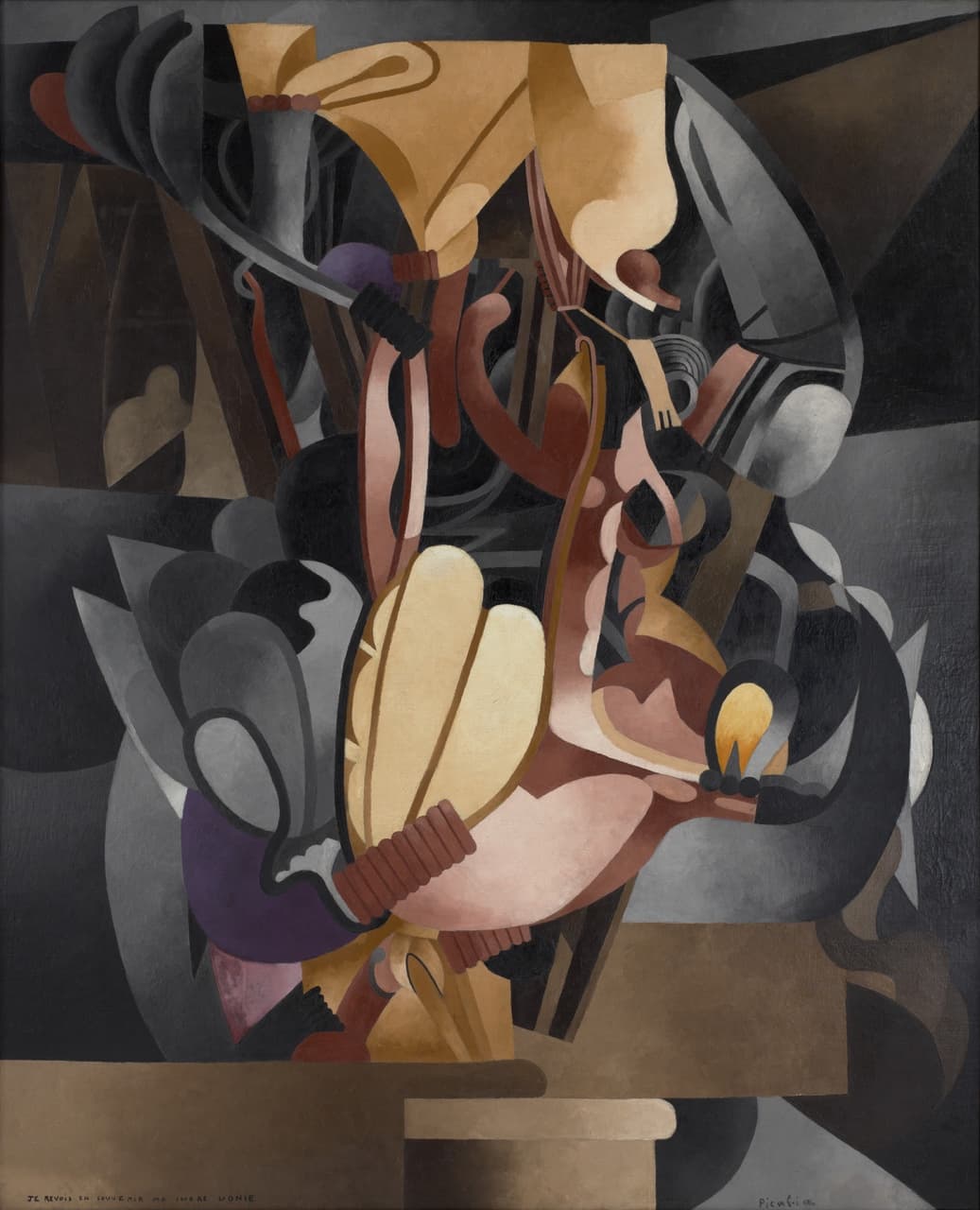
A tall canvas is packed with shapes that look half like machine parts and half like the inside of a body: pistons, coils, a ribbed cream fan and soft pink curves, in browns, pinks and greys. Francis Picabia painted the picture in Paris in the summer of 1914 and wrote its title along the bottom. The painting hangs in the Museum of Modern Art in New York.
- 1914
- Oil on canvas
- The Museum of Modern ArtNew York, United States
About Francis Picabia
Pistons and soft pink curves
The painting is crowded from top to bottom. A tan funnel spreads across the top. Below it hang pink straps, a ribbed black handle, a coiled grey spring and a small tan fork.
The middle is filled by a big cream shape divided by thin lines, bound at its foot by a ribbed rust-red collar, with soft pink forms pressing against it. The whole group stands on a pale tan block like a plinth, as if the painting showed a sculpture.
The Museum of Modern Art calls the canvas a large painting of pulsating, interpenetrating pistons, orifices and circuitry. The museum says Francis Picabia fuses the mechanical with the biological. Some parts look like engine pieces, others like the inside of a body, and many look like both.
A line from Virgil, with one name changed
The title is painted in small capitals along the bottom left: JE REVOIS EN SOUVENIR MA CHERE UDNIE. Around 1914, the Museum of Modern Art says, Francis Picabia began taking words and phrases from the Petit Larousse dictionary.
The dictionary printed a line from Virgil's Aeneid about a dying man who sees his dear Argos again in memory. Francis Picabia kept the line and put Udnie, a name of his own invention, in place of Argos.
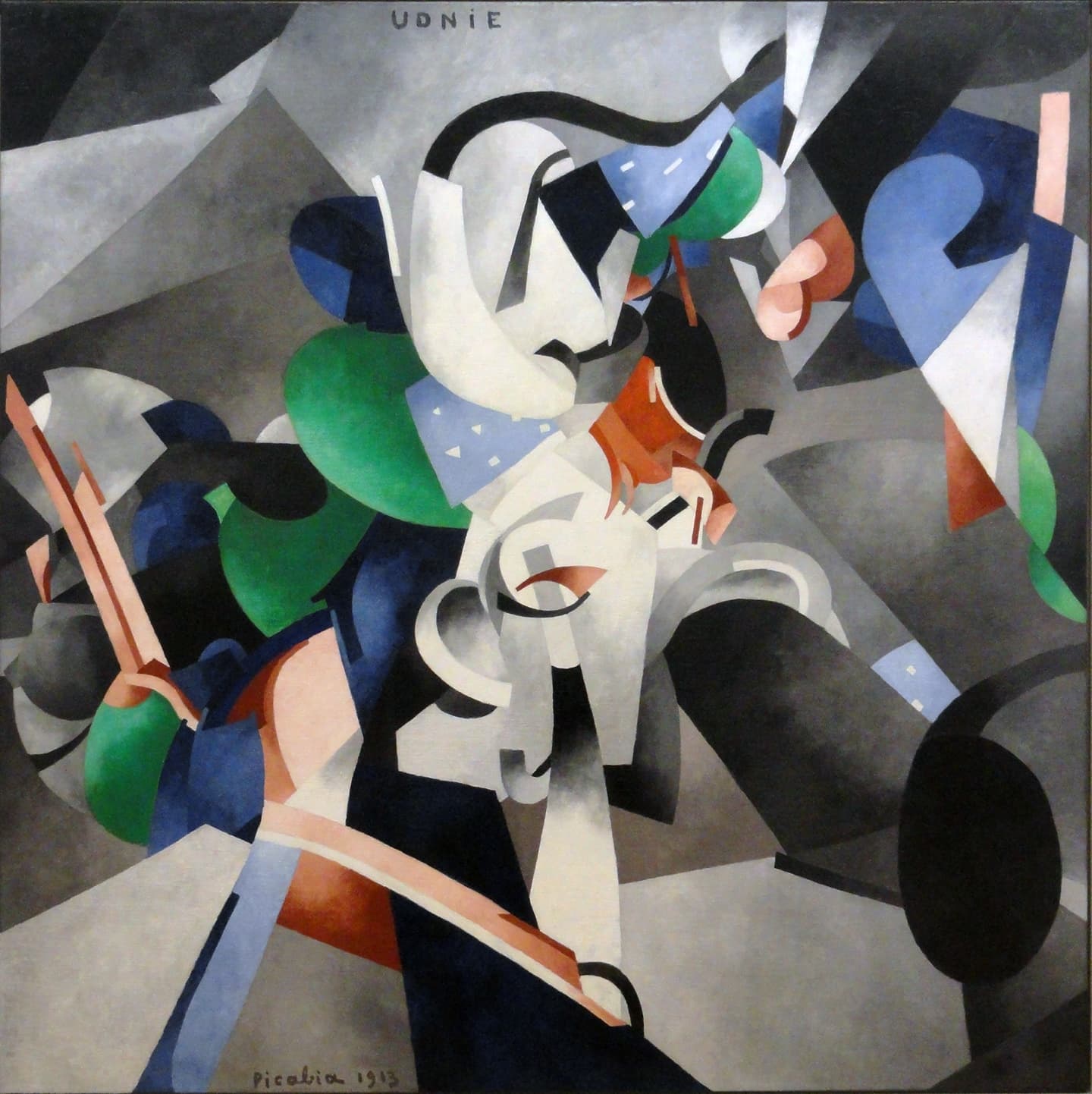
Udnie was the name he had given a year earlier to his huge canvas at the Salon d'Automne, Udnie, now at the Centre Pompidou. The Museum of Modern Art says he linked the name to the dancer Stacia Napierkowska, whom he watched rehearsing on the liner to New York in 1913. Her suggestive performances later got her arrested.
The museum adds that Udnie is also a scramble of the surname of Jean d'Udine. In 1910 Jean d'Udine published a theory linking painting with music and dance through rhythm. In the painting, the museum says, rhythm comes from repeated pistons and openings.
After New York
The Museum of Modern Art says Francis Picabia's love of machines grew during his 1913 visit to New York. A reviewer that year wrote that Francis Picabia had put all former things behind him and grasped the genius of American machinery as the new medium for his art.
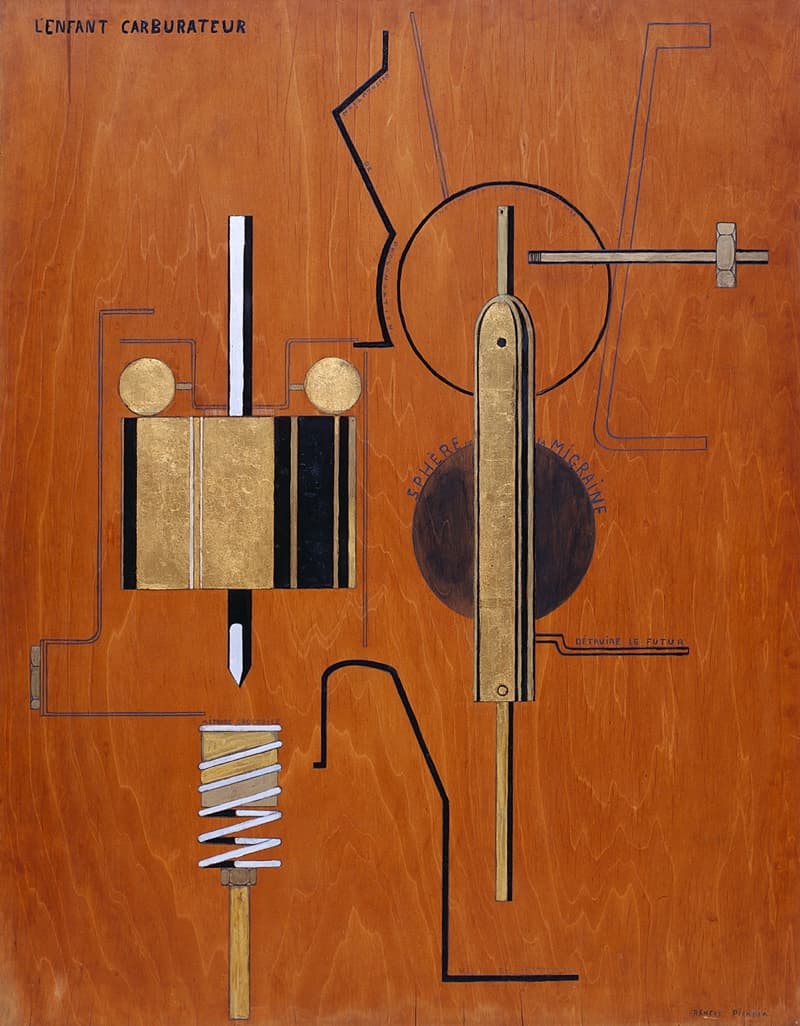
The painting sits halfway through that change. Udnie, the year before, was colour in motion. A year later, in New York, Francis Picabia began to draw people as machines outright. Here the pistons and coils are already present, but they are soft, rounded and painted, not drawn like diagrams.
At the Museum of Modern Art
The Museum of Modern Art dates the painting to Paris, June to July 1914, and bought it in 1954 through the Hillman Periodicals Fund.
The canvas was in the museum's Francis Picabia retrospective of 2016 and 2017, Our Heads Are Round so Our Thoughts Can Change Direction, the first exhibition in the United States to cover his whole career. The painting then hung in the gallery Readymade in Paris and New York in 2019 and 2020.
Where to see it
The Museum of Modern Art, New York, object number 4.1954. The painting was on view on Floor 5, in Gallery 505, when the museum's record was checked in September 2026. The canvas is about 2.5 metres high.
Close reading
Reading the work, detail by detail
I See Again in Memory My Dear Udnie is full of things that look like parts: a spring, a fork, a ribbed handle, a flame in a cup. Up close none of them quite belongs to a machine you could build, and some look more like parts of a body. Francis Picabia painted it in Paris in the summer of 1914.
1.The title along the bottom
Francis Picabia painted the title in small spaced capitals along the bottom edge: JE REVOIS EN SOUVENIR MA CHERE UDNIE, I see again in memory my dear Udnie. The Museum of Modern Art says he took the phrase from a line of Virgil printed in the Petit Larousse dictionary, about a dying man who sees his dear Argos again in memory. Francis Picabia swapped in Udnie, the name he had invented the year before.
2.Francis Picabia, small at the right
The signature is small and easy to miss, written in dark script on a grey band at the bottom right. Compared with Udnie, where name and date are clear, Francis Picabia seems to hide it. The painting carries no date. The Museum of Modern Art dates the canvas to Paris, June to July 1914.
3.A tan funnel across the top
Across the top spreads a wide tan shape like a funnel, a bellows or the bell of a horn. A curled loop sits at its left, and its narrow end is tied off with rust-red rings. The funnel could be the dancer's skirt seen from above, or a machine's intake. The Museum of Modern Art speaks of orifices in this painting, and this is the biggest opening in it.
4.Grey blades like a fan
In the top left corner curved dark grey blades are stacked one behind another, like the vanes of a fan, a turbine or a lobster's tail. A red-brown tab pokes out at the left. The blades are shaded so they look hard and polished, unlike the soft pinks lower down.
5.A ribbed black handle on a grey blade
A long grey blade ends in a thick black grip with ridges, like the handle of a tool or the grip of a bicycle. Behind it sits a round purple shape. The handle is one of the most machine-like pieces in the painting, and yet it is not clear what the tool would be for.
6.Pink straps tied in a bundle
Narrow pink and brown strips hang side by side, tied together at the top like a bundle of ribbons, cables or muscle. They are the kind of shape that makes the Museum of Modern Art call the painting half mechanical and half biological. A viewer can read them either way.
7.A coiled spring and a little fork
A grey coiled spring sits at the right, its rings drawn as curved stripes. In front of it hangs a small tan piece that ends in three prongs, like a fork or a plug. These are the clearest machine parts in the painting. The Museum of Modern Art says rhythm is suggested here by repeated forms, and the spring's rings are a rhythm you can count.
8.A brown knob on a stem
Under the funnel hangs a rounded brown knob with a pale tip, like a door knob, a valve or a nipple. Francis Picabia painted it with soft shading so it looks round and heavy. Whether it is a machine part or a body part is left open.
9.Tubes and lines in the dark centre
Through the dark middle of the painting run tall pink and brown tubes, crossed by thin grey lines. The Museum of Modern Art's label speaks of circuitry, and these lines are the nearest thing to wiring in the picture. The dark behind them makes the tubes stand out as if lit from the front.
10.A big cream shape with ribs
The largest shape in the painting is pale cream, divided by thin brown lines into ribs like a fan, a shell or a lampshade. Pink forms press against its right side. The cream shape is the brightest thing on the canvas, and everything else seems to wrap round it.
11.A ribbed rust-red collar
A ribbed rust-red band wraps round the foot of the cream shape, like a coiled hose, a threaded screw or a tight bracelet. The collar repeats the ribbed black handle higher up. The Museum of Modern Art points to repeated forms like these as Francis Picabia's way of suggesting rhythm, the link between music and dance that Jean d'Udine wrote about.
12.Soft pink curves
In the lower middle the forms go soft and pink, overlapping like folds of skin or cushions. They have no hard edges and no shine. Here the painting feels most like a body. The dancer the title remembers is not shown, but these curves are the closest the picture comes to her.
13.A yellow flame in a black cup
At the right a yellow and orange shape rises out of a black cup edged with round black beads. The shape looks like a flame, a light bulb or a spark. The yellow is the only hot colour in the painting. The flame might stand for the spark in an engine, or simply for a memory that still glows.
14.A deep purple shape at the lower left
At the lower left a deep purple shape swells out, outlined in black, with a grey hooked piece curling round it. The purple is the darkest colour in the painting apart from black. A second, smaller purple shape sits high up behind the ribbed handle, so the colour ties top and bottom together.
15.A grey loop like a handle
Among the grey shapes at the left a loop outlined in thick black stands up like the handle of a jug or a keyhole. The black outline makes it look drawn rather than painted. The loop is one of the few shapes that could be a real object, and still it is not clear which object.
16.A pale shape in the dark at the left
Against the dark left edge floats a pale tan shape with rounded bumps at the top. The shape could be a heart, a mitten or a cloud. The pale shape stands apart from the crowded middle, like something half remembered. It is not clear what it is.
17.A tan block like a plinth
The whole cluster of forms stands on a pale tan block with a rounded edge, like a plinth or a step. The block turns the painting into something on display, like a sculpture or a machine in a showroom. Francis Picabia had spent the year before in New York, where the Museum of Modern Art says his taste for machines grew.
18.Fine cracks along the right edge
Along the right edge the dark grey background is covered with a net of fine cracks from age, easy to see here because the paint is dark and flat. Pale pointed shapes stick out against it like the teeth of a gear or the petals of a flower. The cracks are a reminder that this is a hundred-year-old canvas, not a printed diagram.
Timeline
1913
On the liner to New York, Francis Picabia watches the dancer Stacia Napierkowska rehearse.
1913
He shows Udnie, named after that memory, at the Salon d'Automne in Paris.
1914
Paints I See Again in Memory My Dear Udnie in Paris, in June and July.
1954
The Museum of Modern Art acquires the painting through the Hillman Periodicals Fund.
2016
Shown in the museum's Francis Picabia retrospective, Our Heads Are Round so Our Thoughts Can Change Direction, until March 2017.
2019
Hung in Readymade in Paris and New York, until October 2020.
Where to see it
The Museum of Modern Art
11 West 53 Street, New York, NY 10019, United States
On view on Floor 5, Gallery 505, when the museum's record was checked in September 2026. Displays change, so check before travelling.
Plan your visit on the museum’s official website (opens in a new tab)Frequently asked questions
What does the title mean?
The title means I see again in memory my dear Udnie. The Museum of Modern Art says Francis Picabia took a line from Virgil printed in the Petit Larousse dictionary, about a dying man remembering his dear Argos, and put his own invented name, Udnie, in place of Argos.
Who was Udnie?
Udnie was an invented name. The Museum of Modern Art says Francis Picabia linked the name to the dancer Stacia Napierkowska, whom he watched on the liner to New York in 1913. The word may also scramble the surname of the writer Jean d'Udine.
Is it a machine or a body?
Both, on purpose. The Museum of Modern Art describes pistons, orifices and circuitry, and says Francis Picabia fuses the mechanical with the biological.
How is it related to Udnie at the Centre Pompidou?
Francis Picabia painted Udnie in 1913 and showed it at the Salon d'Automne. A year later he used the same invented name for this painting, which turns the memory of the dancer into softer, machine-like forms.
Where can I see it?
At the Museum of Modern Art in New York, object number 4.1954. In September 2026 the painting was on view on Floor 5, in Gallery 505. Displays change, so check the museum's page before a visit.
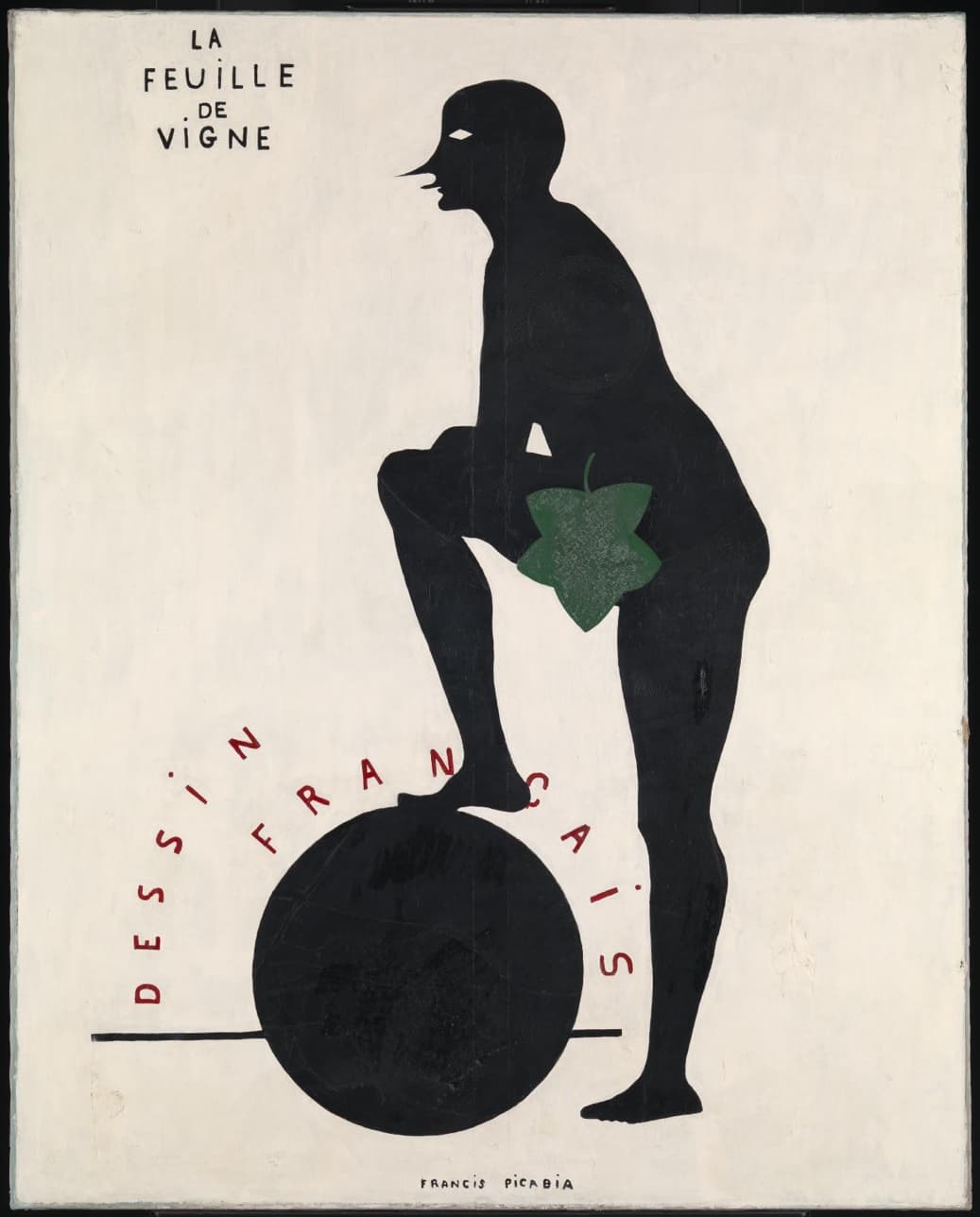
More by Francis Picabia
If you like Francis Picabia
Explore painters from the same movements and circles.
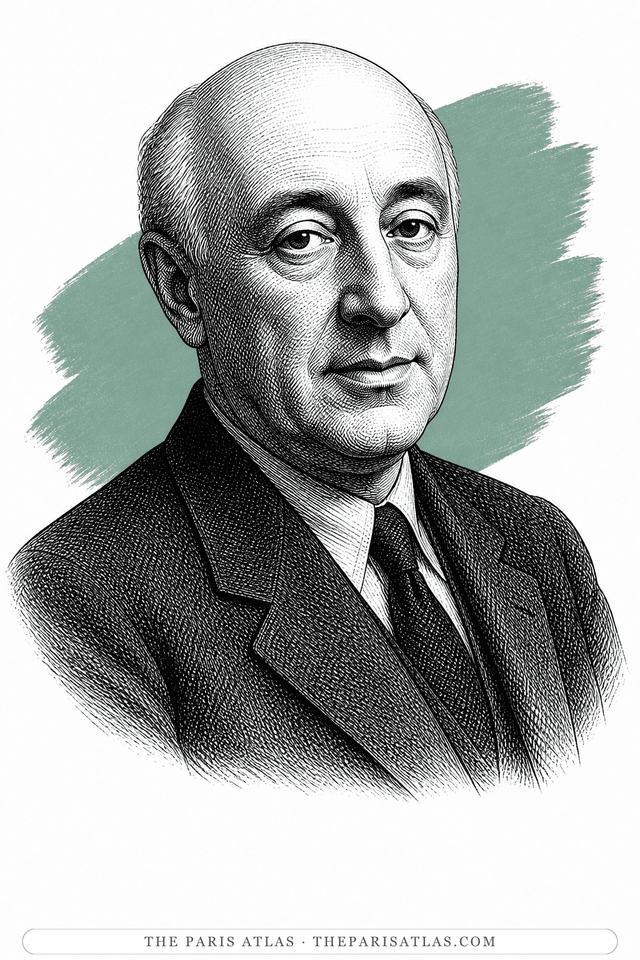
Jean Arp
Strasbourg-born sculptor and poet — Hans in German, Jean in French, both all his life — who co-founded Dada at the Cabaret Voltaire in 1916, composed collages by dropping torn paper 'according to the laws of chance', and settled at Meudon outside Paris in a house his wife Sophie Taeuber-Arp designed.
View artist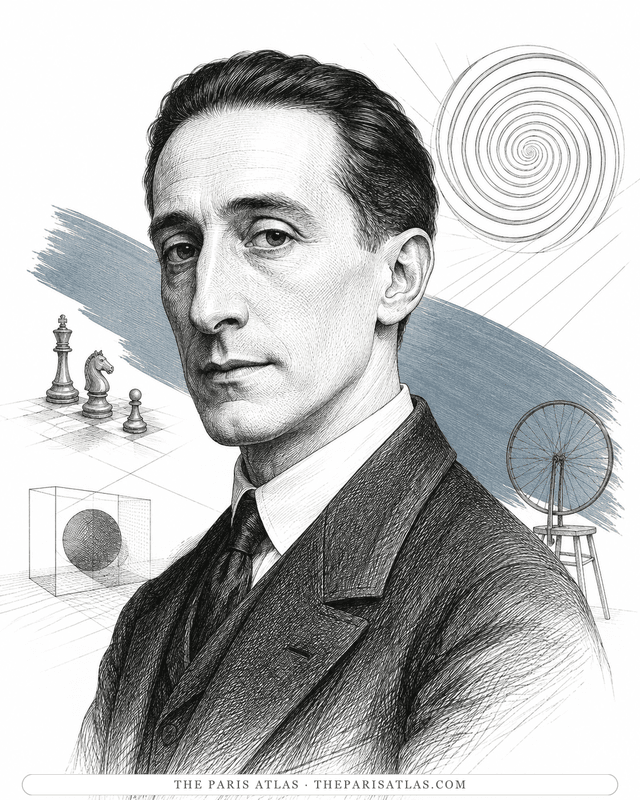
Marcel Duchamp
The century's quietest revolutionary — readymades, the abandonment of painting, chess on a Paris rooftop in Entr'acte, and one anemic film of spinning puns signed Rrose Sélavy.
View artist
Hannah Höch
Berlin Dada artist who developed photomontage into a sharp instrument for cutting through politics, mass media, gender roles, and the public faces of the Weimar Republic.
View artist
References
The sources below include collection records, catalogues, scholarly research, and primary materials that informed this page. They document I See Again in Memory My Dear Udnie, its making, and its place in cultural history.


1I See Again in Memory My Dear Udnie, Paris, June–July 1914
Official recordThe Museum of Modern ArtUsed forThe holding museum's record: date and place, medium, size, credit, the Virgil line in the Petit Larousse, Stacia Napierkowska, Jean d'Udine, the machines of New York, and the image the close-reading views were cropped from.

2Francis Picabia: Our Heads Are Round so Our Thoughts Can Change Direction (November 21, 2016 – March 19, 2017)
WebsiteThe Museum of Modern Art, 2016Used forThe Museum of Modern Art's 2016–2017 Francis Picabia retrospective, the first in the United States to cover his whole career.
3Francis Picabia, UDNIE (Jeune fille américaine), 1913 — collection record, with Didier Ottinger's catalogue text
WebsiteCentre Pompidou, Musée national d'art moderneUsed forThe first Udnie, of 1913, and the dancer on the liner.
4About Picabia — biography
WebsiteComité PicabiaUsed forThe Comité Picabia lists I See Again in Memory My Dear Udnie among Francis Picabia's paintings of 1913–1914.
5Francis Picabia, The Child Carburetor
WebsiteSolomon R. Guggenheim MuseumUsed forThe Guggenheim on the machine portraits Francis Picabia began in New York in 1915.
These references provide the documented foundation for this work's history and interpretation. Claim-level citations remain attached to the specific claims they support.
 Explore more resources