The Child Carburetor
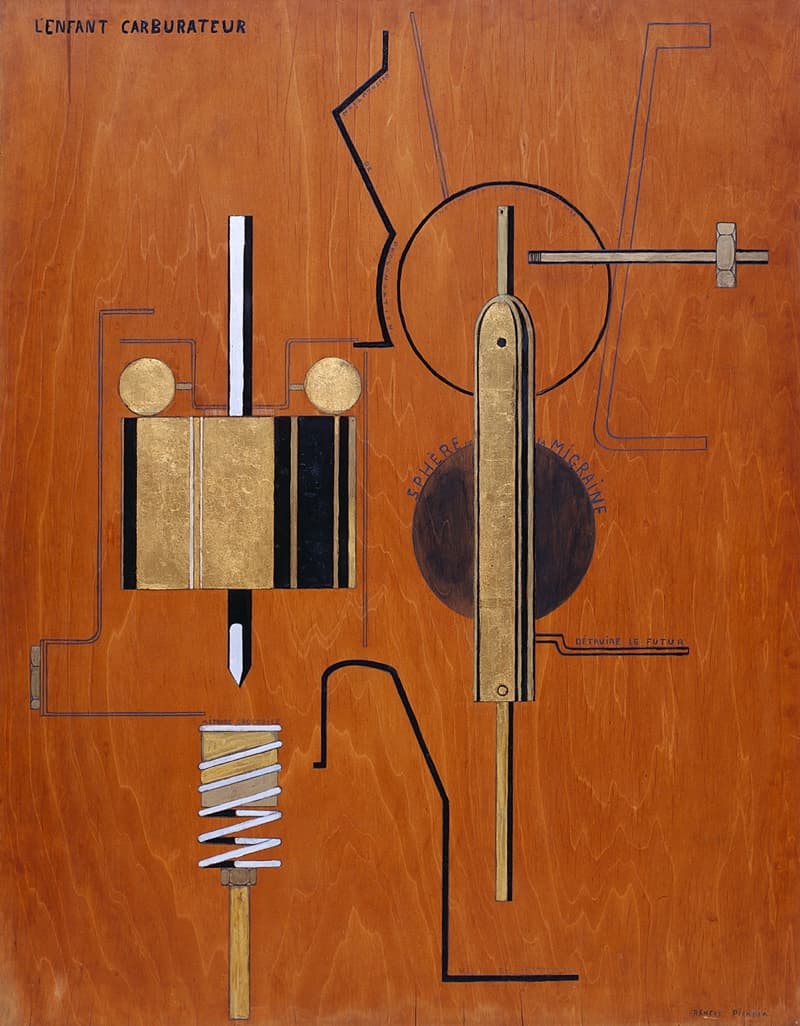
A carburettor drawn like an engineer's diagram, in gold leaf, black and white on a bare orange-brown plywood board. Francis Picabia labelled its parts with nonsense phrases such as Sphere of Migraine and Destroy the Future, and called the picture The Child Carburetor. He made it in 1919, and it belongs to the Solomon R. Guggenheim Museum in New York.
- 1919
- Oil, enamel, metallic paint, gold leaf, graphite and crayon on plywood
- Solomon R. Guggenheim Museum, New YorkNew York, United States
About Francis Picabia
A machine on a wooden board
The picture is painted straight onto a sheet of plywood, and the wood grain shows everywhere between the shapes. On the board Francis Picabia laid out a machine as flat as a drawing in a manual.
At the left sit a gold box with black stripes, two gold discs and a white needle, with a coiled spring below. At the right stand a tall gold bar with holes, a dark disc and a big circle. Black lines and thin blue pencil lines join the parts.
The Guggenheim says the picture is based on an engineer's diagram of a Racing Claudel carburetor, the part of an engine that mixes fuel with air. Francis Picabia copied the look of the diagram and changed what it means.
Labels that make no sense
Each part of the machine has a label, as in a diagram, but the labels are jokes. The dark disc is marked Sphère de la migraine, sphere of migraine. A small pipe is labelled Détruire le futur, destroy the future. The spring is labelled Méthode crocodile, crocodile method.
The title runs across the top: L'Enfant carburateur, the child carburettor. Smaller words run in thin letters along some of the black lines, but they are too small to read in the museum's photograph.
The Guggenheim says the labels set up a match between machines and human bodies. The museum adds that Francis Picabia hinted at the meanings and refused to explain them.
A love machine that does not work
The Guggenheim reads the shapes as two sets of male and female sexual organs. The art historian William Camfield compared the picture to The Large Glass by Marcel Duchamp, in which a bride is a motor that runs on love gasoline. In that light, the museum says, The Child Carburetor becomes a love machine.
The parts would never work, though. The needle points at empty wood, the spring holds nothing up, and the pipes lead nowhere. The Guggenheim says the sexual act is never completed, and that under the joke lies a dig at the belief that science and progress cannot fail.
A scandal at the Salon d'Automne
Francis Picabia had started drawing people as machines in New York in 1915, working alongside Marcel Duchamp. The Guggenheim puts The Child Carburetor in that line of machine portraits, which had an immediate and lasting effect on American art.
By the second half of 1919 Francis Picabia was living in Paris. The Comité Picabia says that, before the Dada season of 1920, he once again scandalised the Salon d'Automne with The Child Carburetor and Parade amoureuse. Paris had never seen machine pictures like them.
Months later Paris Dada began, and the Museum of Modern Art counts Francis Picabia among the leaders of the movement. The Guggenheim says he kept making his beautifully painted little machines until 1922.
Where to see it
Solomon R. Guggenheim Museum, New York, accession number 55.1426. The museum's collection page named no gallery when it was checked in September 2026, so check before travelling.
Close reading
Reading the work, detail by detail
The Child Carburetor looks like a page from an engine manual, painted in gold leaf on a plank of plywood. Up close, every label is a joke and no part would ever work. Francis Picabia showed it in Paris in 1919, and the Guggenheim reads it as a love machine.
1.The title across the top
Francis Picabia wrote the title in plain black capitals across the top left, like the heading on a technical drawing: L'ENFANT CARBURATEUR, the child carburettor. A carburettor is the part of an engine that mixes fuel with air. Calling it a child is one of the jokes no one has fully explained. The Guggenheim offers two guesses and says the answer remains unclear.
2.A box of gold leaf with black stripes
The biggest part of the machine is a wide box covered in real gold leaf, with thin white lines and broad black stripes. The gold is laid on in sheets, and its crinkles catch the light. Francis Picabia painted his machines like precious objects. The Guggenheim calls them quirky but beautifully painted.
3.Two gold discs on stalks
Above the box two gold discs sit on short stalks, one on each side of a white upright rod. They could be floats, valves or weights. The Guggenheim says the shapes of the painting suggest male and female sexual organs, and a reader can see how these round pairs invite that. Thin blue pencil lines bend round them like wiring.
4.A white rod pointing up
A tall white rod with a black edge stands straight up out of the gold box. The rod is the simplest shape in the picture, and one of the most suggestive. In an engine it might be a needle valve, the part that lets fuel through. Here it connects to nothing at the top.
5.The needle's sharp point
Below the gold box the white rod comes out again and ends in a sharp point, like a pencil or the needle of a syringe. The point aims down at empty wood. The machine seems ready to act, but nothing is there to receive it. The Guggenheim says the parts are nonoperative, so the act the picture hints at is never completed.
6.A spring labelled crocodile method
Below the box a white spring winds round a tan and gold cylinder. The words Méthode crocodile, crocodile method, are painted in tiny letters across its top. It is not clear what the crocodile method would be. The spring's lower coils open out as if it were stretching, one of the few things in the picture that seems to move.
7.A nut and a wooden rod
The spring sits on a small hexagonal nut, painted carefully with its flat faces, and below it a tan rod runs down off the board. Francis Picabia gave the nut real weight and shading. Tiny practical details like this make the machine look believable, which makes its nonsense funnier.
8.The sphere of migraine
On the right a dark brown disc sits behind a tall gold bar. Round its upper edge Francis Picabia lettered Sphère de la migraine, sphere of migraine, in blue. The label reads best as a joke: a machine part that causes a migraine instead of making power.
9.A tall gold bar with holes
The tall bar on the right is also covered in gold leaf, rounded at the top like a piston or a tongue. A small dark hole is punched near its top and another near its foot. A thin rod rises out of it. The bar stands inside a large black circle, so it looks like a moving part caught in its housing.
10.Destroy the future
A short pipe leads off the gold bar and runs to the right, labelled Détruire le futur, destroy the future. Destroy the future is the most quoted phrase in the picture. The Guggenheim says that under Francis Picabia's jokes lies a dig at the idea that science is always right and progress is certain. A carburettor pipe that destroys the future says it in three words.
11.A big circle with small writing
A large black circle surrounds the gold bar, like a wheel or a housing. A line of very small letters runs inside its upper edge. They are too small to read in the museum's photograph. The circle is drawn with a steady hand, as if with a compass, like a line in a real technical drawing.
12.A bolt running out to the right
A long tan bolt runs out to the right edge, with a hexagonal nut near its end. The bolt is threaded at its left end, where it meets the circle. The bolt fastens nothing. Thin blue lines cross it, drawn in crayon or pencil, like the construction lines an engineer would rub out.
13.A zigzag line with tiny words
A thick black line zigzags down from the top of the board like a lightning bolt or a bent wire. A few very small words are lettered along it. One of them looks like the word de, but the rest cannot be read at this size. Francis Picabia seems to have wanted some labels to be read only up close.
14.A black line bent like a crank
In the lower half a thick black line bends at sharp angles like a crank or a length of pipe. The line starts in the empty wood and ends near the bottom edge. The long gold rod from the tall bar runs down beside it. Between the shapes, the plywood's grain shows in wavy pale lines, and Francis Picabia left it bare on purpose as the picture's background.
15.FRANCIS PICABIA
The signature is lettered small in faint capitals at the bottom right, FRANCIS PICABIA, in the same style as the labels. The name looks like the draughtsman's name on a technical drawing. Francis Picabia signs as if he were the engineer of this useless machine.
16.A blue bracket with a nut
At the far left a thin blue double line bends at right angles round a small tan nut, like a bracket fixing the machine to a wall. These thin blue lines are drawn, not painted, and the Guggenheim lists graphite and crayon among the materials. They give the picture the look of a working drawing still on the drafting table.
17.Gold leaf up close
Close up, the gold on the box is not smooth paint but thin sheets of gold leaf, with fine creases and patches where the sheets meet. The black stripes beside it look like shiny enamel, one of the paints the Guggenheim lists. Francis Picabia mixed an old craft with modern paint.
18.Faint words at the bottom
Where the black line turns along the bottom, a faint row of small capitals is lettered above it. The row looks like two or three words, but they are too faint to read in the museum's photograph. Not every label in the picture was meant to be easy.
Timeline
1915
In New York, Francis Picabia begins the machine portraits, working alongside Marcel Duchamp.
1919
Makes The Child Carburetor, based on an engineer's diagram of a racing carburettor.
1919
Back in Paris, he shows The Child Carburetor at the Salon d'Automne, where the machine pictures cause a scandal.
1920
The high season of Dada in Paris begins.
1922
Francis Picabia makes the last of his little machine paintings, according to the Guggenheim.
Where to see it
Solomon R. Guggenheim Museum, New York
New York, United States
A public viewing address has not yet been confirmed for this holding.
The museum's collection record gave no gallery when it was checked in September 2026. Check before travelling.
Frequently asked questions
What is a carburettor, and why paint one?
A carburettor is the part of an engine that mixes fuel with air. The Guggenheim says Francis Picabia copied an engineer's diagram of a Racing Claudel carburetor and labelled its parts so that the machine matches a human body.
What do the words mean?
The labels are jokes. Sphère de la migraine means sphere of migraine, Détruire le futur means destroy the future, and Méthode crocodile means crocodile method. The Guggenheim says Francis Picabia hinted at meanings but refused to explain them.
Why is it called a child?
No one knows for sure. The Guggenheim offers two guesses: that a child is only a side effect of sexual pleasure, or that this child machine has not yet grown up. The museum says the answer remains unclear.
Where was it first shown?
The Comité Picabia says Francis Picabia showed The Child Carburetor at the Salon d'Automne in Paris before the Dada season of 1920, and that the machine pictures caused a scandal.
Where can I see it?
At the Solomon R. Guggenheim Museum in New York, accession number 55.1426. Check the museum's collection page before travelling, since the painting is not always on view.
More by Francis Picabia
If you like Francis Picabia
Explore painters from the same movements and circles.
Jean Arp
Strasbourg-born sculptor and poet — Hans in German, Jean in French, both all his life — who co-founded Dada at the Cabaret Voltaire in 1916, composed collages by dropping torn paper 'according to the laws of chance', and settled at Meudon outside Paris in a house his wife Sophie Taeuber-Arp designed.
View artist
Marcel Duchamp
The century's quietest revolutionary — readymades, the abandonment of painting, chess on a Paris rooftop in Entr'acte, and one anemic film of spinning puns signed Rrose Sélavy.
View artist
Hannah Höch
Berlin Dada artist who developed photomontage into a sharp instrument for cutting through politics, mass media, gender roles, and the public faces of the Weimar Republic.
View artist
References
The sources below include collection records, catalogues, scholarly research, and primary materials that informed this page. They document The Child Carburetor, its making, and its place in cultural history.


1Francis Picabia, The Child Carburetor
WebsiteSolomon R. Guggenheim MuseumUsed forThe holding museum's record: the Racing Claudel carburetor diagram, the labels, William Camfield's love-machine reading, the critique of science, and the image the close-reading views were cropped from.
2About Picabia — biography
WebsiteComité PicabiaUsed forThe Comité Picabia on Francis Picabia's return to Paris in 1919 and the scandal of The Child Carburetor at the Salon d'Automne.

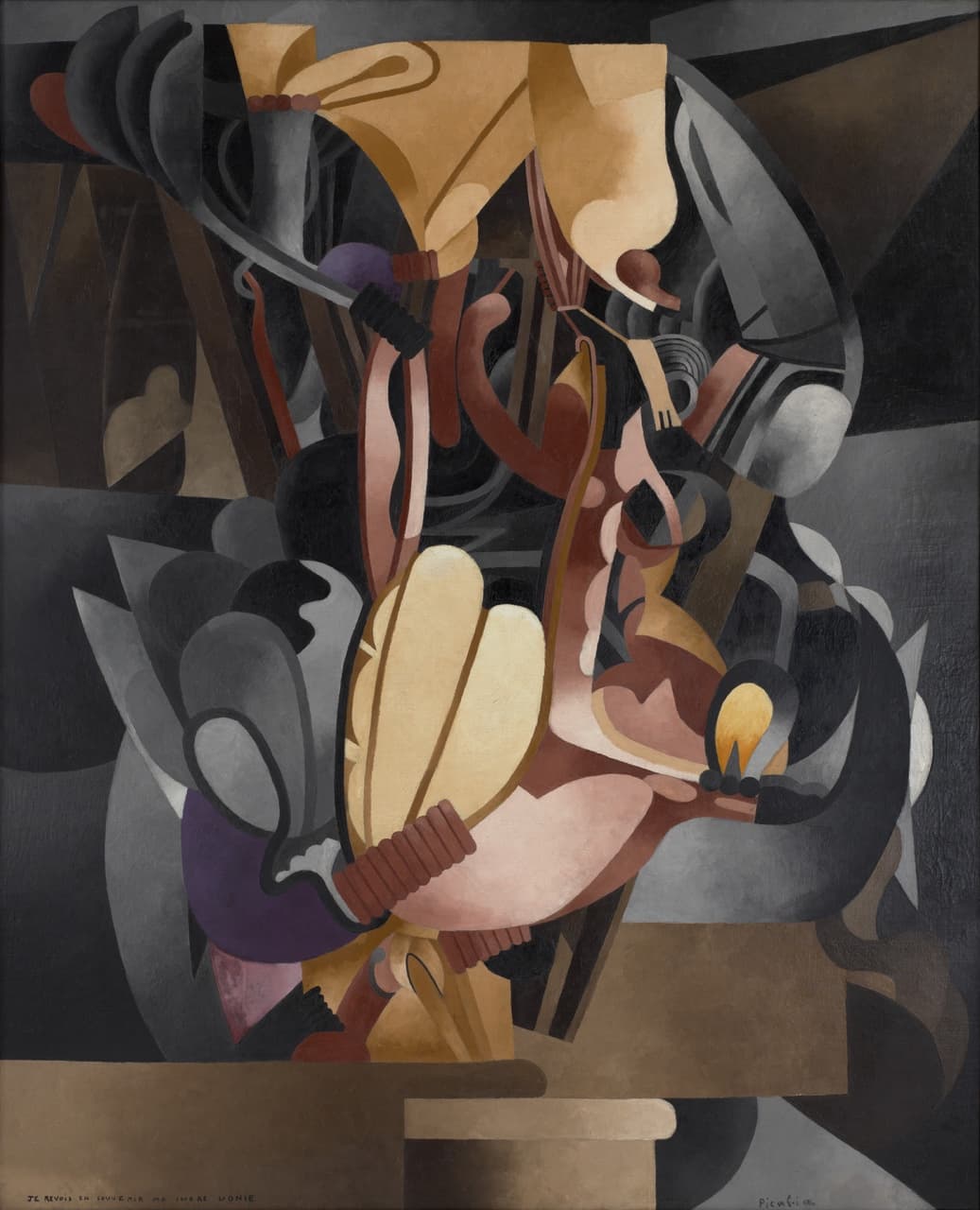
3I See Again in Memory My Dear Udnie, Paris, June–July 1914
Official recordThe Museum of Modern ArtUsed forThe Museum of Modern Art on how Francis Picabia's taste for machines grew in New York in 1913.
4Francis Picabia: Our Heads Are Round so Our Thoughts Can Change Direction (November 21, 2016 – March 19, 2017)
WebsiteThe Museum of Modern Art, 2016Used forThe Museum of Modern Art's 2016–2017 retrospective, on Francis Picabia as one of the leaders of Dada.
These references provide the documented foundation for this work's history and interpretation. Claim-level citations remain attached to the specific claims they support.
 Explore more resources