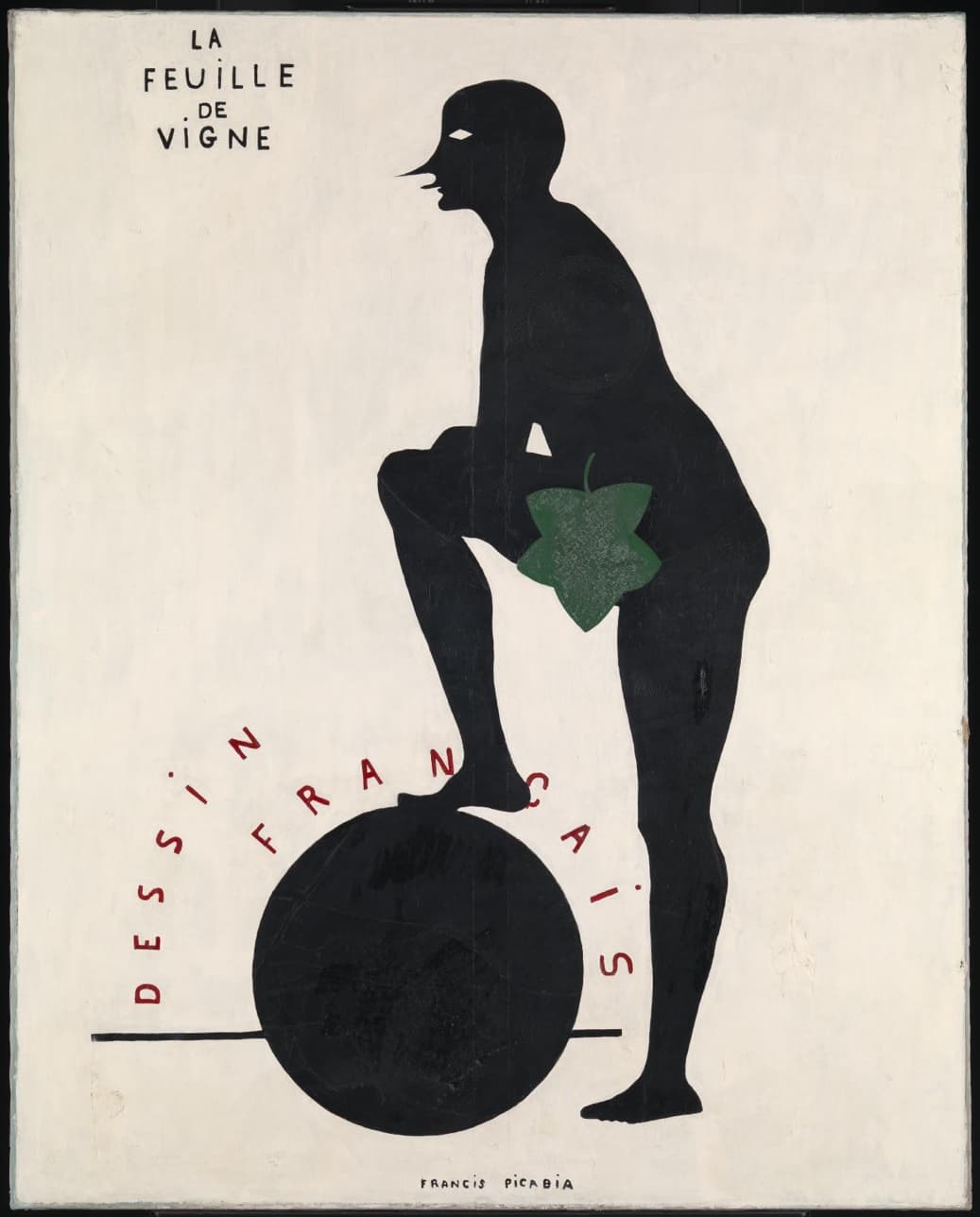
A black silhouette of a naked man with a pointed masked face stands with one foot on a black ball. A single green leaf covers his groin, and red letters round the ball spell DESSIN FRANÇAIS, French drawing. Francis Picabia painted the picture in 1922 over a machine painting that had caused a scandal in Paris the year before. The Fig-Leaf belongs to Tate in London.
On a large cream canvas, two metres high, a man stands in black silhouette, facing left. He leans forward with his right foot up on a black ball, and his face ends in a long pointed nose like a mask. His only feature is one white diamond of an eye.
A green leaf covers his groin. The words LA FEUILLE DE VIGNE are written at the top left. Round the ball, red capitals spell DESSIN FRANÇAIS, French drawing. A thin black bar runs through the ball, like an axle.
Tate points out that the leaf Francis Picabia painted actually looks like a vine leaf. The French phrase feuille de vigne is the usual name for the leaf that covers a statue's genitals, which English calls a fig leaf. Tate bought the painting as The Vine Leaf and later retitled it The Fig-Leaf.
A scandal painted over
Tate says the uneven surface of the canvas shows that The Fig-Leaf was painted over an earlier picture. The earlier picture was Les Yeux chauds, Hot Eyes, a machine painting that caused a scandal at the Salon d'Automne of 1921.
Hot Eyes carried the words Thanks to the Salon d'Automne and Homage to Frantz Jourdain, the Salon's president. Before the Salon opened, a rumour said Francis Picabia would hang an explosive picture, and Frantz Jourdain had to tell the public that every exhibit had been checked.
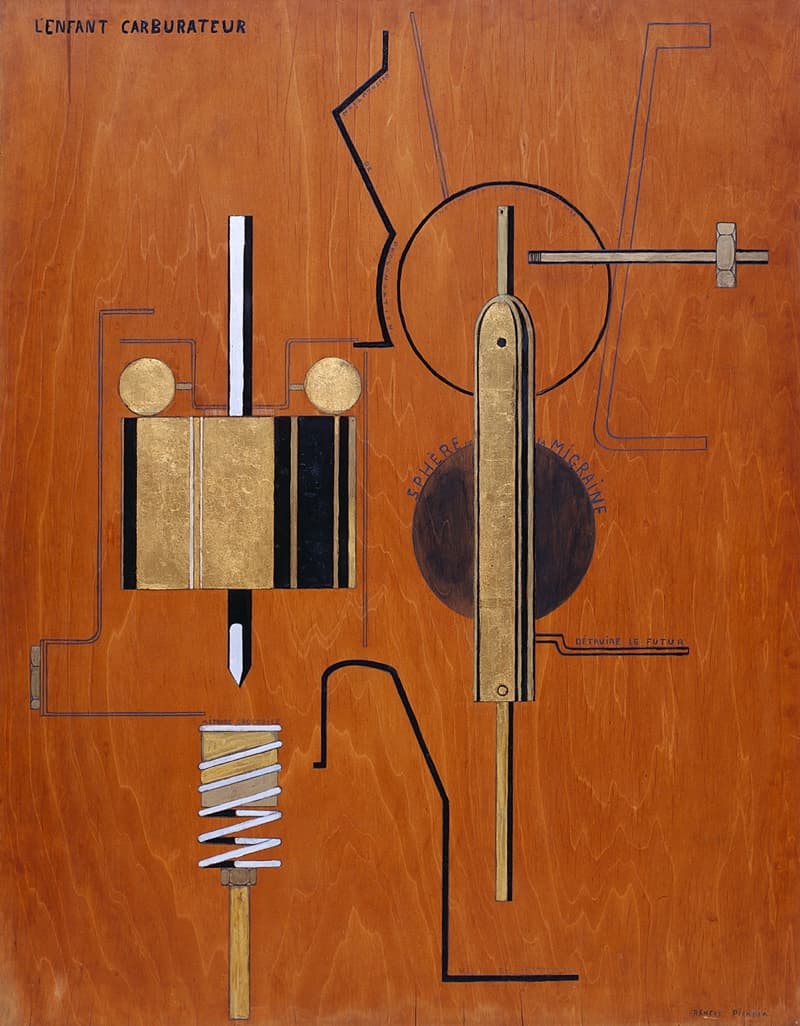
Then the newspaper Le Matin printed a sketch of Hot Eyes beside a diagram of an air-turbine brake from a scientific journal. The comparison proved that Francis Picabia had copied its lines and circles, much as he had based The Child Carburetor on an engineer's drawing.
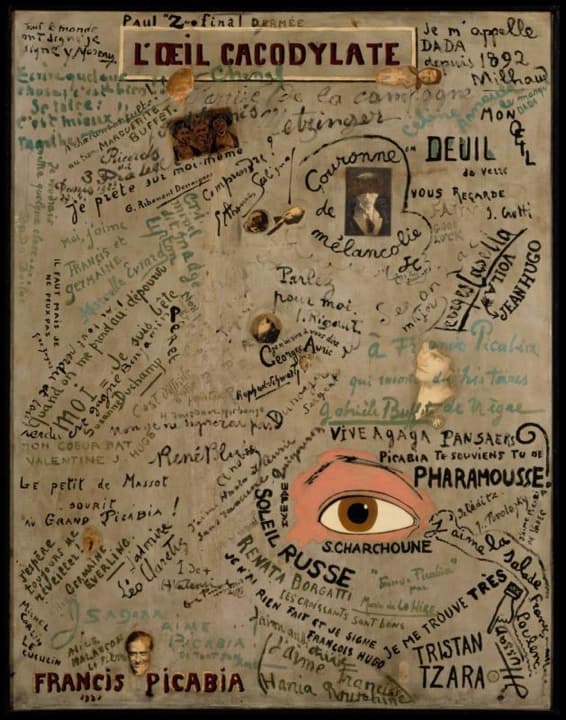
Francis Picabia answered in the paper Comœdia on 23 November 1921. He said copying a diagram was no different from Paul Cézanne copying apples. The article's title was L'Œil cacodylate, the name of the canvas his friends were covering with signatures, L'Œil cacodylate.
In places the old picture still shows through the black. Faint rings and lines can be seen in the man's back and hip.
A fight with the Salons
In January 1922 the Salon des Indépendants, a show with no jury, refused two of the three pictures Francis Picabia sent. Tate says he was told he only wanted publicity, and that as a rich man he did not need to exhibit anyway.
Francis Picabia wrote to the society's president, the painter Paul Signac, that no jury-free Salon had ever turned away work that was not obscene. During the show he had supporters hand out a tract telling visitors where to see the refused pictures.
Francis Picabia painted The Fig-Leaf in the first months of 1922, while living at Tremblay-sur-Mauldre, and sent the canvas to the Salon d'Automne that autumn. Tate reads the move as a way to restart the argument about whether his work was art and whether he had the right to show it.
This time he gave the jury a proper figure, correctly drawn, with a leaf over the part they might object to. Tate says the leaf stands for the censorship Francis Picabia saw in the way art was shown and sold.
Borrowed from Ingres
Tate says the pose comes from Oedipus and the Sphinx, the 1808 painting by Jean-Auguste-Dominique Ingres in the Louvre. In that painting Oedipus leans forward with his elbow on his bent leg, which rests on a rock.
Francis Picabia changed one thing. Tate points out that his figure bends the other leg, so the genitals would show, and a leaf has to be added. The small switch shows up the prudery behind the careful poses of academic painting.
The words DESSIN FRANÇAIS mock the fashion of the moment, when Paris was turning back to the French classical tradition after the war. Tate notes that the Louvre had reopened its galleries of French painting in 1920, and that a large Ingres exhibition was held in Paris in May 1921.
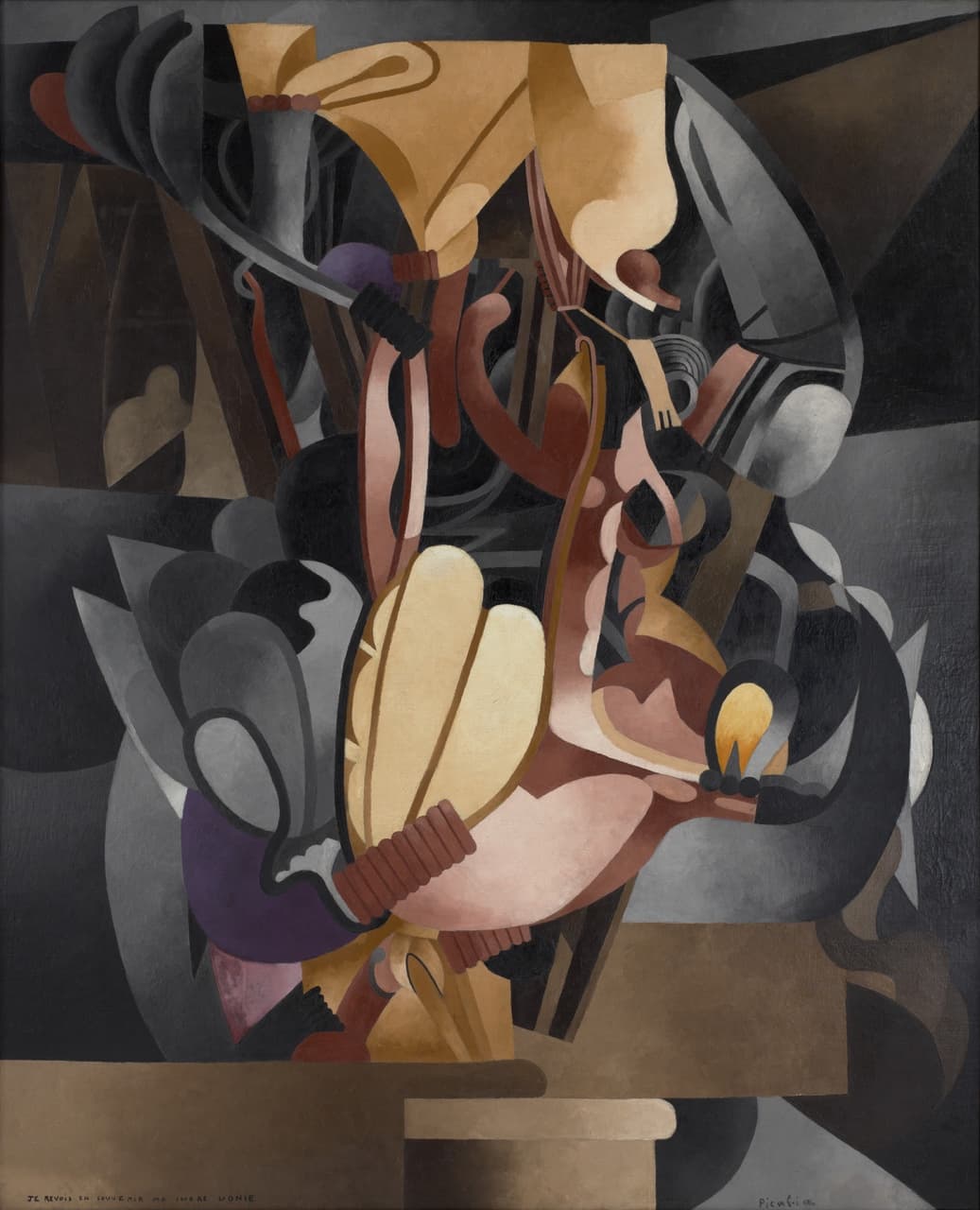
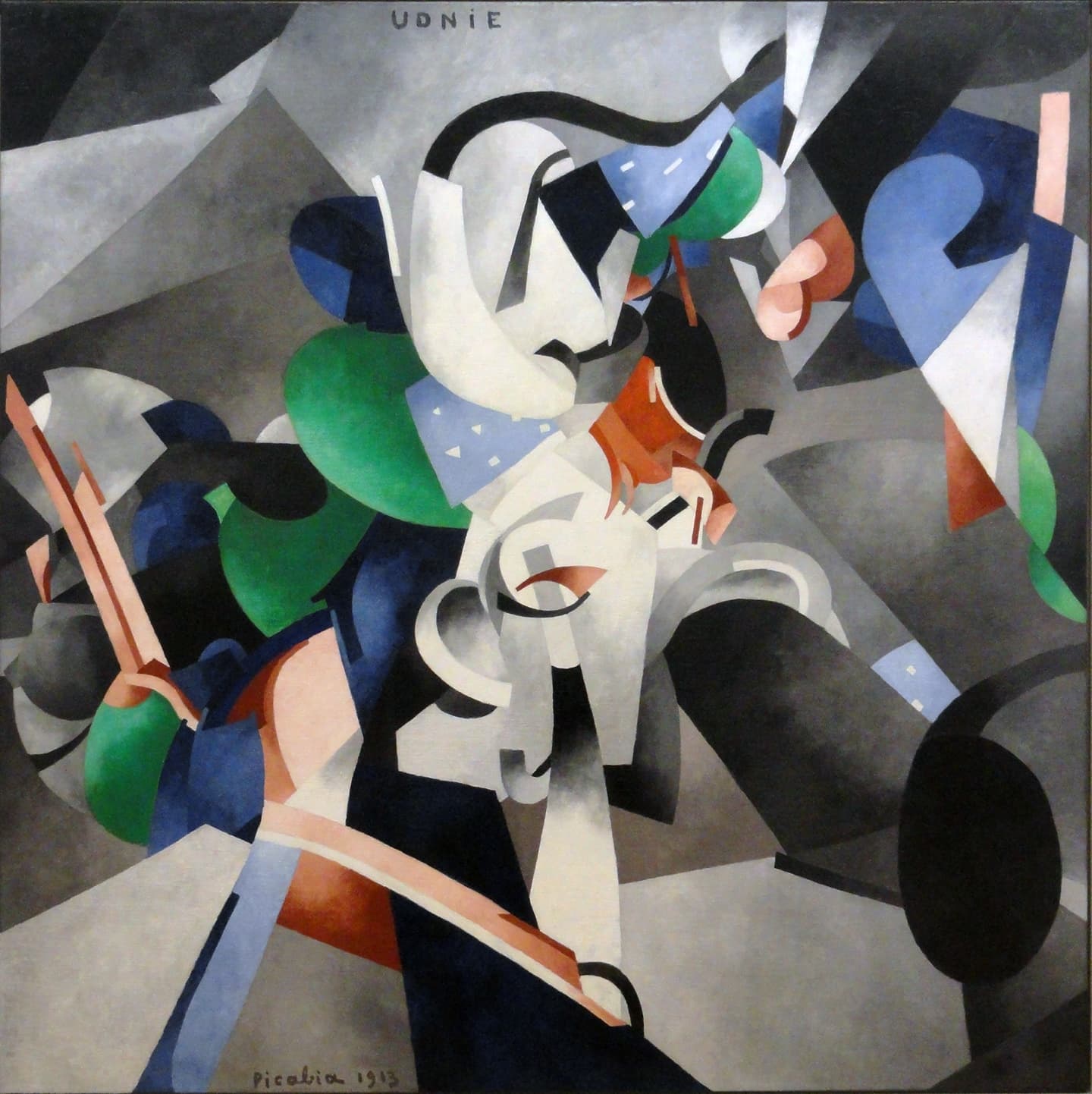
Tate calls the borrowing one of Francis Picabia's earliest quotations from an old master, a habit that would run through his later Transparencies. The Museum of Modern Art's 2016 retrospective traced the same career from Dada provocation to what it called pseudo-classicism.
The masked face
Tate has not found the source of the man's face, with its long nose and sharp upper lip. Tate suggests the half-masks worn by actors of the commedia dell'arte, the old Italian comic theatre. Painters in Paris such as Gino Severini were painting those masked actors around 1922.
A mask is a sign of pretending. Tate reads the mask here as another dig at the conservative taste of the day, as outdated as the fig leaf.
Hung where no one would see it
If Francis Picabia wanted another scandal, he did not get one. The critic Maurice Raynal wrote that the Salon hung his pictures in the highest, dirtiest, darkest vault of the hallway in the Grand Palais.
Another critic, Marcel Hiver, called Francis Picabia and the painter Jean Crotti old clowns who no longer amused anyone. The Fig-Leaf was shown again in Paris in 1946 and at the Grand Palais retrospective of 1976. Tate bought the painting in 1984.
Where to see it
Tate, London, reference T03845. The painting was not on display when Tate's record was checked in September 2026.
Close reading
Reading the work, detail by detail
The Fig-Leaf looks almost too simple: a black cut-out man, a ball, a leaf and some words. Up close there is more. The mask of a face, a borrowed pose, and, under the black, faint rings and lines from the machine painting Francis Picabia covered over.
1.LA FEUILLE DE VIGNE
The title is written in plain black capitals in the top left corner, stacked on four lines: LA FEUILLE DE VIGNE. Word for word it means the vine leaf, but in French it is the usual name for the leaf that covers a statue's genitals, which English calls a fig leaf. Tate first catalogued the painting as The Vine Leaf and later changed the title for that reason.
2.A face like a mask
The man's head is solid black except for one white diamond of an eye. His nose shoots forward into a long thin point, and his upper lip juts out beneath it. Tate says no one has found where Francis Picabia took this face from. Tate suggests the half-masks of the commedia dell'arte, the old Italian comic theatre that painters in Paris were fond of around 1922.
3.Rings showing through the back
Look closely at the man's back and you can see faint rings, one inside another, under the black paint. Tate says the canvas was painted over an earlier picture, Les Yeux chauds, Hot Eyes, a machine painting built from lines and circles copied from a diagram of an air-turbine brake. These rings are probably part of that picture, still showing through the black.
4.The raised knee
The man's right knee juts out to the left, bent sharply as he lifts his foot onto the ball. Tate says the pose comes from Oedipus and the Sphinx by Jean-Auguste-Dominique Ingres, in the Louvre, where Oedipus leans forward with his elbow on his raised knee. A faint curved line crosses the black of the thigh here, another trace of the painting underneath.
5.A triangle of light
Between the man's arm and his body a small triangle of cream shows through, the only gap in the black. The gap is the one clue to where his arm is: bent, with the hand resting on or near the knee. In a silhouette, the empty shapes do the drawing.
6.The leaf
The leaf is the only colour on the figure: a flat green shape with pointed lobes and a curved stalk, placed over the groin. Tate points out that it looks like a vine leaf rather than a fig leaf. Tate reads the leaf as the painting's point. The leaf stands for the censorship Francis Picabia felt in the way art was shown and sold.
7.The leaf's speckled green
Up close the green of the leaf is not flat. The edges are a solid dark green, and the middle is paler and speckled, as if the paint had been dabbed on or partly scraped away. It is not clear whether Francis Picabia did this on purpose or whether it is wear. Either way, the leaf looks stuck on, like a patch.
8.Lines across the hip
Across the man's hip a faint band runs sideways under the black, as if a line had been painted and then covered. Like the rings in his back, it is probably part of the machine painting beneath. Tate says the uneven surface of the canvas is how we know that earlier picture is there.
9.A lump in the paint
On the back of the man's thigh a short raised ridge of paint catches the light. The rest of the black is fairly smooth, so this lump stands out. The ridge may be a thick edge left from the picture underneath. It is not clear exactly what it is.
10.One foot on the ball
The man's bare foot rests on top of the black ball, toes pointing left. In Ingres's painting Oedipus rests his foot on a rock. Here the rock has become a perfect ball, more like a machine part or a weight than a stone. Tate notes that Francis Picabia had long used circles that could be machinery, planets or eyes.
11.The black ball
The ball is the largest shape in the painting. Its black is painted with visible streaks and patches, rougher than the man's body. A thin black bar runs through it from side to side, so it could also be a wheel on an axle. It is not clear which Francis Picabia meant.
12.Scratches in the black
Close up, the black of the ball is crossed by faint straight lines and scratches, and patches of it are slightly lighter than the rest. Some of this may be wear. Some of the straight lines may belong to the diagram-like painting underneath, whose lines and circles Le Matin showed had been copied from an engineering drawing.
13.A thin bar through the ball
A thin black bar sticks out of the ball on both sides, like an axle or a rod. On the left it runs out into the empty cream ground and stops. The bar makes the ball look mechanical, a leftover of Francis Picabia's machine pictures inside a painting that is otherwise about the human figure.
14.DESSIN
Red capitals climb round the ball: D-E-S-S-I-N, drawing, and then F-R for the next word. Together they read DESSIN FRANÇAIS, French drawing. Tate reads the words as a jab at the art world of the day, which was praising the French tradition of fine, correct drawing after the war.
15.FRANÇAIS
The second word, FRANÇAIS, ends down the right side of the ball, the letters tipping as they follow the curve. French drawing was exactly what post-war taste wanted. Francis Picabia gives them a correctly drawn figure and labels it, like a specimen in a museum.
16.The standing foot
The man's other foot stands flat on the ground, the heel and toes clearly drawn. Tate says this foot is the clue to the joke. Its position shows that the raised leg is the right one, the opposite of Oedipus in Ingres's painting, so the man's genitals would be on show if the leaf were not there.
17.FRANCIS PICABIA
Francis Picabia signed in small black capitals at the bottom centre, in the same plain letters as the title. He sent the painting to the Salon d'Automne of 1922. Tate records that the Salon hung it where the critic Maurice Raynal said no one could see it, in the highest, dirtiest, darkest part of the hallway.
Timeline
1921
Les Yeux chauds causes a scandal at the Salon d'Automne. Le Matin shows its source on 9 November, and Francis Picabia replies in Comœdia on 23 November.
1922
In January the Salon des Indépendants refuses two of his three entries.
1922
At Tremblay-sur-Mauldre he paints The Fig-Leaf over Les Yeux chauds, finished by late spring.
1922
In May André Breton asks to reproduce the painting in Littérature. The painting does not appear there.
1922
Shown at the Salon d'Automne in the Grand Palais, hung high in the hallway.
1946
Shown at the Galerie Colette Allendy in Paris.
1976
Shown in the Francis Picabia retrospective at the Grand Palais.
1984
Bought by Tate.
Where to see it
Tate
London, United Kingdom
Tate has several galleries. A specific viewing address has not been confirmed here; check which venue, if any, is displaying this work before travelling.
Tate's record listed the painting as not on display when it was checked in September 2026.
Why is it called The Fig-Leaf when the leaf looks like a vine leaf?
The French title, La Feuille de vigne, means vine leaf word for word. In art the phrase names the leaf that covers a statue's genitals, which English calls a fig leaf, so Tate retitled the painting.
What is under the paint?
Tate says Francis Picabia painted The Fig-Leaf over Les Yeux chauds, a machine painting copied from a diagram of an air-turbine brake, which caused a scandal at the Salon d'Automne of 1921.
What does Dessin français mean?
French drawing. Tate reads the words as a jab at the post-war revival of the French classical tradition and at the conservatism of the art institutions.
Is the pose taken from Ingres?
Tate says the pose echoes Oedipus and the Sphinx by Jean-Auguste-Dominique Ingres, in the Louvre. Francis Picabia bent the other leg, so a leaf is needed to cover the figure.
Who is the masked man?
Tate has not found a source for the face. Tate suggests the half-masks of the commedia dell'arte, then fashionable among painters in Paris.
Where can I see it?
At Tate in London, reference T03845. The painting was not on display in September 2026, so check Tate's page before a visit.
In the atlas
What the graph records about this work — every claim carries its citation.
Shown at the Salon d'Automne of 1922 in the Grand Palais, catalogue number 1896, as La Feuille de vigne. The critic Maurice Raynal wrote that the Salon hung Francis Picabia's pictures in the highest, dirtiest, darkest vault of the hallway.
— Francis Picabia, The Fig-Leaf, 1922 — collection record and catalogue entry (The Tate Gallery 1984–86: Illustrated Catalogue of Acquisitions, 1988, pp. 227–30), T03845; catalogue entry
Explore painters from the same movements and circles.
Jean Arp
Strasbourg-born sculptor and poet — Hans in German, Jean in French, both all his life — who co-founded Dada at the Cabaret Voltaire in 1916, composed collages by dropping torn paper 'according to the laws of chance', and settled at Meudon outside Paris in a house his wife Sophie Taeuber-Arp designed.
The century's quietest revolutionary — readymades, the abandonment of painting, chess on a Paris rooftop in Entr'acte, and one anemic film of spinning puns signed Rrose Sélavy.
Berlin Dada artist who developed photomontage into a sharp instrument for cutting through politics, mass media, gender roles, and the public faces of the Weimar Republic.
The sources below include collection records, catalogues, scholarly research, and primary materials that informed this page. They document The Fig-Leaf, its making, and its place in cultural history.
1Francis Picabia, The Fig-Leaf, 1922 — collection record and catalogue entry (The Tate Gallery 1984–86: Illustrated Catalogue of Acquisitions, 1988, pp. 227–30)
Website
Tate
Used for
The holding museum's record: date, medium, size, inscriptions, owners and exhibitions, Les Yeux chauds underneath, the Indépendants refusal, Ingres, the mask, the 1922 hanging, and the image the close-reading views were cropped from.
These references provide the documented foundation for this work's history and interpretation. Claim-level citations remain attached to the specific claims they support.


 View source