The Paris AtlasCharting the artists, works, and places worth returning to.
  • Painter
  • Editor
· French · 1879–1953

Francis Picabia

Dada's fastest engine — machine portraits, the journal 391, and the scenario for Entr'acte, dashed off on Maxim's letterhead for the ballet Relâche.

In images

Details

Lived
1879–1953
Born
22 January 1879
Birthplace
Paris
Birth name
Francis-Marie Martinez Picabia
Died
30 November 1953 · aged 74
Place of death
Paris
Nationality
French
Profession
Painter, writer and magazine publisher
Major works
Udnie, the machine portraits, the journal 391, the Transparencies, and the scenario for Entr'acte
Married
Gabriële Buffet-Picabia · married 1909, divorced 1930Olga Mohler · married 1940 until his death in 1953
Roles
PainterEditor

About Francis Picabia

French painter and provocateur of Dada, publisher of 391 and author of Entr'acte

Francis Picabia was a French painter, writer, filmmaker and magazine publisher, born in Paris on 22 January 1879 to a French mother and a Cuban father of Spanish descent. He moved through Impressionism, Cubism, machine drawing, Dada, near-Surrealism, kitsch figuration and late abstraction, changing styles so often that critics settled on one word for the career: kaleidoscopic.

His engine was money, speed and refusal. Rich by inheritance, the owner of 127 sports cars across his lifetime, Picabia could afford to be the only Cubist who sailed to New York's 1913 Armory Show, where the press made him modernism's spokesman. His machine portraits of 1915 onward turned people into spark plugs and cameras, and his travelling journal 391 carried Dada between Barcelona, New York, Zurich and Paris. When Dada calcified he denounced it, writing that if you want clean ideas, change them like shirts. His 1924 ballet Relâche came with a film in the interval, Entr'acte, which he scripted and a young René Clair shot.

He returned to abstraction after the Second World War and died in Paris on 30 November 1953, aged 74. He is buried in the Montmartre Cemetery, and his monster paintings and Transparencies, long dismissed, now look prophetic.

Paris, the copied Spanish paintings, and the Sisley years, 1879–1908

Francis-Marie Martinez Picabia was born in Paris on 22 January 1879. His father, a Cuban of Spanish descent, served as attaché at the Cuban legation in Paris. His French mother died of tuberculosis when the boy was five, leaving him an inheritance that later made him far richer than any painter he ran with. The talent showed early and crookedly: at fifteen he copied his grandfather's collection of Spanish paintings, swapped his copies for the originals, and sold the originals to fund his stamp collection.[1]

He trained at the École des Arts Décoratifs under Fernand Cormon, in the same academy that had taught Van Gogh and Toulouse-Lautrec, and lived by painting from the age of twenty. His first mature manner, from 1903 to 1908, was Impressionism learned from Alfred Sisley, lanes, riverbanks, wash houses and barges, so faithfully that critics called him a copyist. The accusation stung him out of the style, the first shedding of many.

Cubism, the Armory Show, and New York, 1909–1915

From 1909 Picabia painted with the artists about to be called Cubists. In 1911 he joined the Puteaux Group at Jacques Villon's studio, where he met Marcel Duchamp, the decisive friendship of his life, and became close to the poet Guillaume Apollinaire. His huge abstract compositions, La Source at the 1912 Salon d'Automne, then Udnie (1913), pushed Cubism toward pure colour and motion. In 1909 he married the critic Gabriële Buffet, whose intelligence steered the whole circle; the marriage produced four children and lasted, tumultuously, to 1930.

In 1913 he was the only member of the Cubist circle who could afford to attend the Armory Show in New York, where he had four paintings hanging. With the American press hostile and hungry, the one available Cubist became modern art's spokesman in every paper, and Alfred Stieglitz gave him a solo show at his gallery 291. Back in Paris he broke with the Cubists; in June 1915, landing in New York en route to Cuba on a molasses errand, he simply stayed, and sat out the war he had been mobilised for.

Machines, 391, and Dada, 1915–1924

New York's machinery gave him his most famous idea: the portrait mécanique, people drawn as devices. A spark plug labelled as an American girl, Stieglitz as a broken camera, himself as an automobile horn. The machine style, developed in dialogue with Duchamp, ran nearly a decade. In Barcelona in 1916, among refugee artists, he founded 391, the restless Dada journal he published wherever he happened to be. In Zurich, where he had gone for treatment of depression and suicidal impulses, he met Tristan Tzara, whose radicalism electrified him.

Picabia in the photograph published in Apollinaire's Les Peintres cubistes, 1913. (From Les Peintres cubistes (1913) · Public domain)

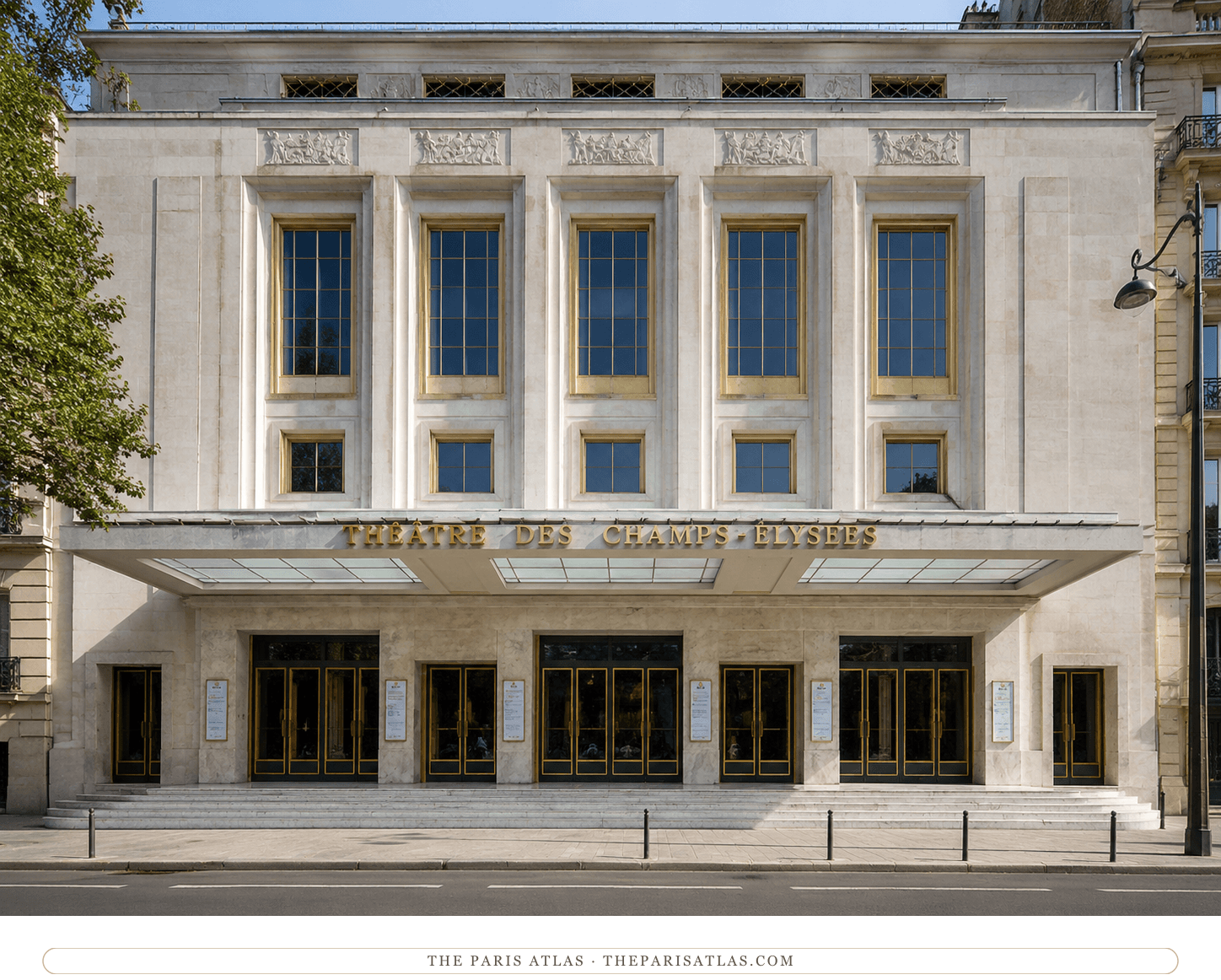
Paris Dada formed around him: André Breton, Paul Éluard, Philippe Soupault and Louis Aragon at the Certa bar in the Passage de l'Opéra, with Picabia as financier, publisher and chief provocateur. He quit the movement he had helped build, denouncing Dada in 1921 as it hardened into a church, and fired a parting attack on Breton in the last issue of 391 in 1924. That December he staged the ballet Relâche at the Théâtre des Champs-Élysées, with a filmed interlude he had scripted, Entr'acte, shot by the twenty-six-year-old René Clair, with Picabia, Duchamp and Man Ray on screen. It became one of the most famous avant-garde films of the decade.[2]

Monsters, Transparencies, and the Côte d'Azur, 1925–1945

In 1925 Picabia turned back to figures with the garish, deliberately ugly Monster paintings, and from 1927 to 1930 layered Renaissance images over popular-culture figures in the Transparencies. Both series baffled his contemporaries and became touchstones later; the German painter Sigmar Polke built openly on the Monsters. In the 1930s he became a close friend of Gertrude Stein, painting her portrait in 1933, and in June 1940, on the day the Germans took Paris, he married Olga Mohler and moved south.

The wartime work was his strangest: paintings copied from the nude photographs of French girlie magazines like Paris Sex-Appeal, in a slick, lurid style that reads as sabotage of academic nude painting. Some were sold through an Algerian dealer and ended up decorating North African brothels under the Occupation. After the war he returned to Paris, to abstraction and to poetry, and a large retrospective at the Galerie René Drouin in 1949 reopened the account.

Death in Paris, 1953

Picabia died in Paris on 30 November 1953, aged 74, in the city where he was born, and was buried in the Montmartre Cemetery. His health had been poor since the New York years, when dropsy and tachycardia, drink and drugs first caught up with him. Gabriële Buffet-Picabia, his first wife, outlived him by more than three decades, decorated for her work in the French Resistance.

How Picabia worked

Picabia's method was serial desertion. Impressionism, Cubism, orphic abstraction, machine drawing, Dada typography, monsters, transparencies, pin-ups, dots: he worked each vein exactly as long as it stayed disreputable and left the moment it earned respect. The one constant is attack, on seriousness above all, delivered with a rich man's independence; he never needed a dealer's approval or a movement's shelter, and burned both repeatedly.

The machine portraits distilled him best: found technical diagrams recopied and mislabelled as people, mechanical drawing as wit. The magazines were works in the same spirit, 391 above all, with its typographic riot and its aphorisms. The most quoted of them is his self-justification for the style changes: if you want to have clean ideas, change them like shirts.

Reception and revaluation

For decades after his death Picabia was filed as Dada's rich amusing uncle, essential to the movement's history but secondary as a painter, with the late figurative work dismissed as decline. The revaluation began when painters of the 1960s onward, Polke among them, treated exactly those styles, kitsch, appropriation, deliberate bad taste, as prophecy. Major retrospectives, including the Museum of Modern Art's in 2016, resettled him near the century's centre.

His works hang in the Museum of Modern Art and the Guggenheim in New York, the Philadelphia Museum of Art, the Art Institute of Chicago, Tate in London and the Centre Pompidou in Paris. The marriage that shaped the early career has its own afterlife: Anne Berest's novel The Postcard (2021) and Gabriële (2025), written with her sister Claire Berest, retell Gabriële Buffet-Picabia's life, including the long triangle with Duchamp.

Life events

  1. 1879

    Born in Paris on 22 January to a French mother and a Cuban diplomat father.

    — Francis Picabia

  2. 1894

    At fifteen, copies his grandfather's Spanish paintings, swaps the copies in, and sells the originals to fund his stamp collection.

    — Francis Picabia

  3. 1903

    Begins five years of Impressionist landscape in the manner of Alfred Sisley, close enough that critics call him a copyist.

    — Francis Picabia

  4. 1909

    Marries the critic Gabriële Buffet and moves toward the painters soon called Cubists.

    — Francis Picabia

  5. 1911

    Joins the Puteaux Group, where he meets Marcel Duchamp and Guillaume Apollinaire.

    — Francis Picabia

  6. 1913

    The only Cubist to attend the Armory Show in New York; Stieglitz gives him a solo show at 291.

    Francis Picabia — the photograph published in Apollinaire's Les Peintres cubistes, 1913. (From Les Peintres cubistes (1913))

    — Francis Picabia

  7. 1915

    Stays in New York on a molasses errand to Cuba and begins the machine portraits.

    — Francis Picabia

  8. 1916

    Founds the journal 391 in Barcelona; in Zurich, meets Tristan Tzara while seeking treatment for depression.

    — Francis Picabia

  9. 1921

    Denounces Dada as it hardens into orthodoxy, and attacks Breton in 391's final issue three years later.

    — Francis Picabia

  10. 1924

    Stages the ballet Relâche with the film Entr'acte, scripted by Picabia and shot by René Clair, in its interval.

    — The Museum of Modern Art — Entr'acte (collection record)

  11. 1925

    Begins the garish Monster paintings, followed by the layered Transparencies of 1927–30.

    — Francis Picabia

  12. 1933

    Paints the portrait of his friend Gertrude Stein.

    — Francis Picabia

  13. 1940

    Marries Olga Mohler on 14 June, the day the Germans take Paris, and moves to the south of France.

    — Francis Picabia

  14. 1949

    The Galerie René Drouin mounts a large Paris retrospective.

    — Francis Picabia

  15. 1953

    Dies in Paris on 30 November, aged 74, and is buried in the Montmartre Cemetery.

    — Francis Picabia

Selected works

Cataloged from the holding institutions' records. Reproductions appear only where the rights are verified.

Paintings

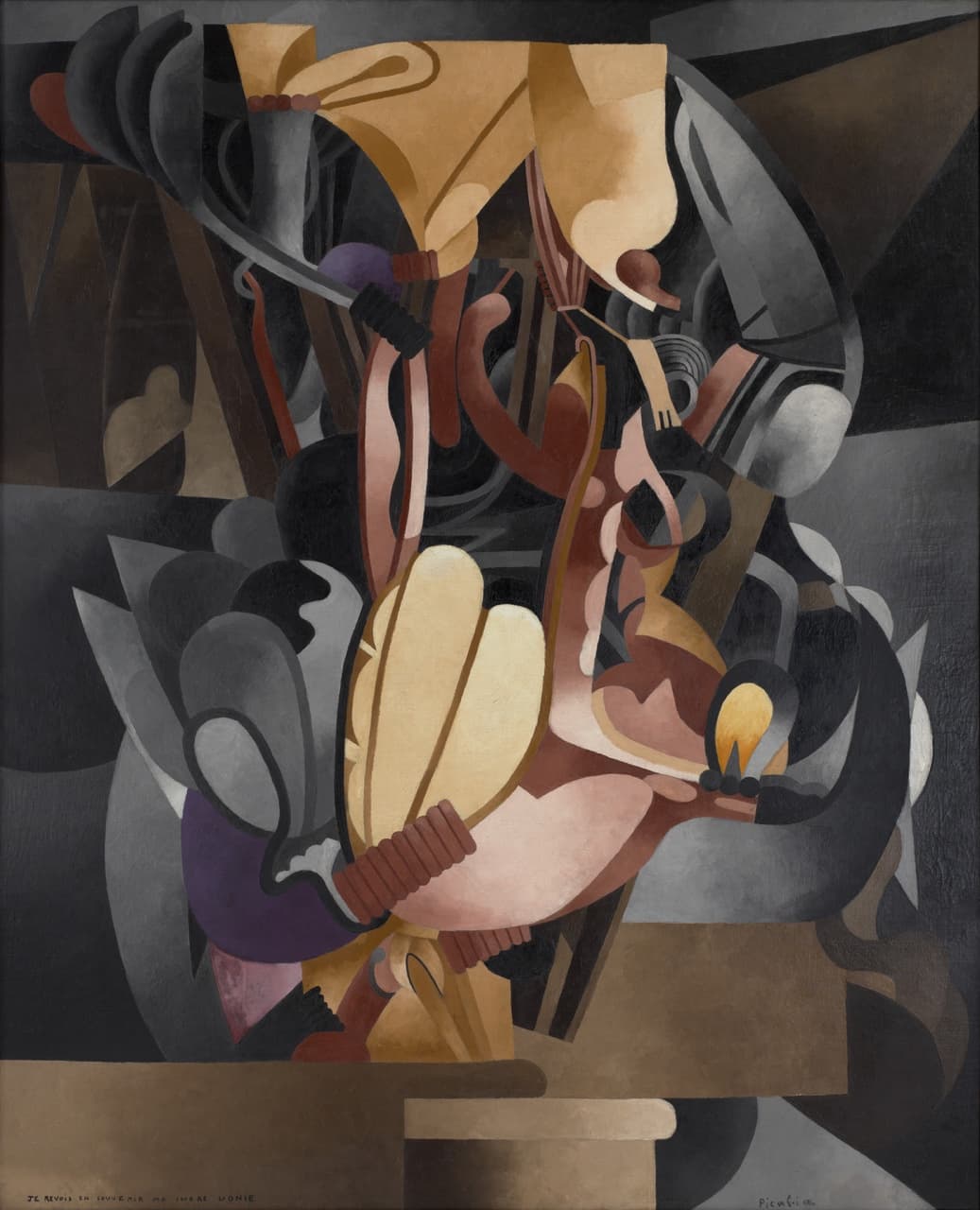
A tall canvas crowded with rounded, overlapping forms in browns, pinks, creams and greys. A tan funnel shape spreads across the top; pink straps, a ribbed black handle, a grey coiled spring and a small tan fork hang below it; a large cream shape divided by thin lines fills the centre, bound by a ribbed rust-red collar, with soft pink curves against it; a yellow flame-like form sits in a black cup at the right and a purple shape at the lower left. The group stands on a pale tan block. Small capitals along the bottom left read JE REVOIS EN SOUVENIR MA CHERE UDNIE

Artwork reproduction

Painting · Orphism

I See Again in Memory My Dear Udnie

1914 · Oil on canvas

A tall canvas is packed with shapes that look half like machine parts and half like the inside of a body: pistons, coils, a ribbed cream fan and soft pink curves, in browns, pinks and greys. Francis Picabia painted the picture in Paris in the summer of 1914 and wrote its title along the bottom. The painting hangs in the Museum of Modern Art in New York.
The Museum of Modern Art

Francis Picabia, I See Again in Memory My Dear Udnie, 1914. The Museum of Modern Art. Image © the rights holder, shown under fair use.

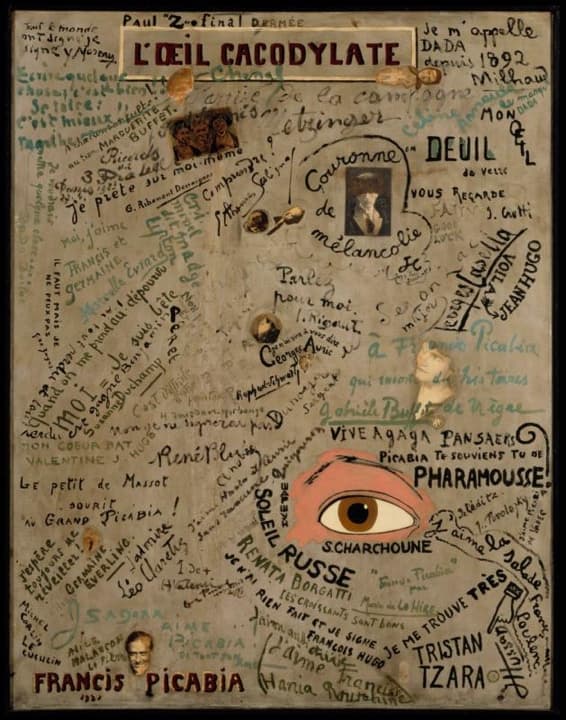
A grey canvas covered edge to edge with handwritten names, phrases and dedications in black, brown and pale green, running in every direction, with a few small photographs pasted among them. L'OEIL CACODYLATE is painted in dark red capitals on a cream plaque at the top. Near the lower right a large brown eye with a pink lid looks out. FRANCIS PICABIA 1921 is written in red capitals at the bottom left, and TRISTAN TZARA in black capitals at the bottom right

Artwork reproduction

Painting · Dada

L'Œil cacodylate

1921 · Oil on canvas with pasted photographs, postcards and cut papers

L'Œil cacodylate, The Cacodylic Eye, is a big grey canvas covered with handwriting: names, jokes and dedications by about fifty of Francis Picabia's friends, with a few pasted photographs and one painted eye. Francis Picabia painted the eye and the title in 1921, while he was ill with an eye infection, and invited his visitors to write the rest. The canvas hung over the bar of Le Bœuf sur le Toit and now belongs to the Centre Pompidou.

Centre Pompidou, Musée national d'art moderne

Francis Picabia, L'Œil cacodylate, 1921. Centre Pompidou, Musée national d'art moderne. Image © the rights holder, shown under fair use.

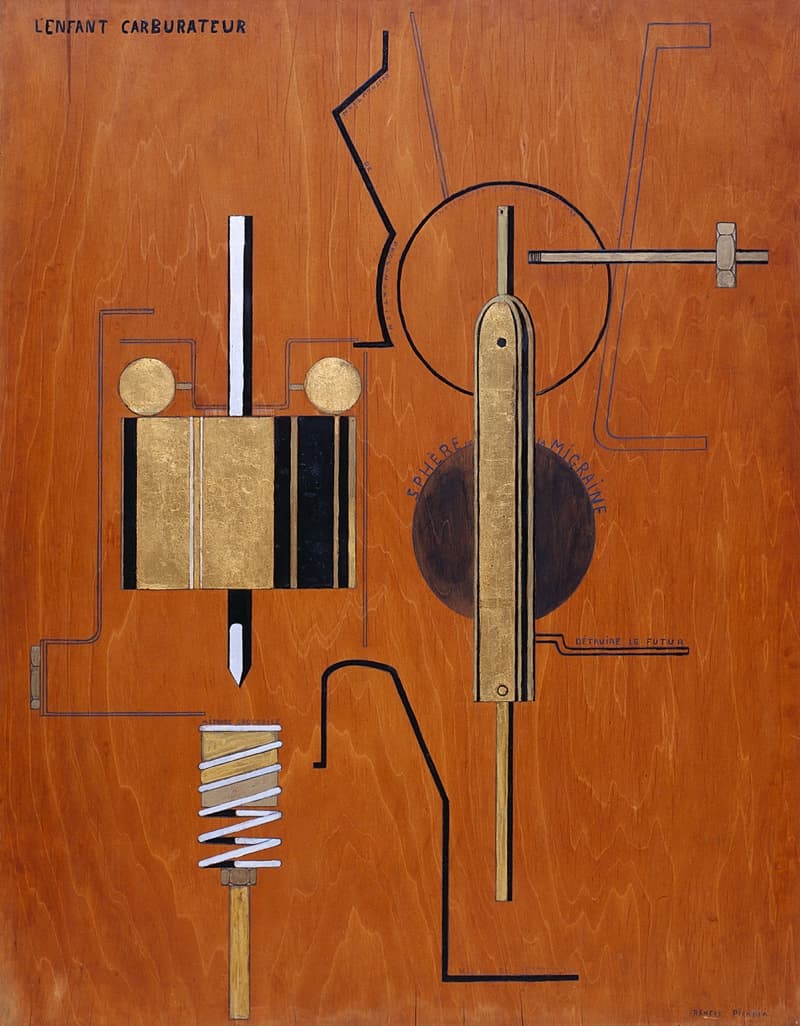
A diagram-like painting on bare orange-brown plywood with the wood grain showing. At left, a box covered in gold leaf with black and white stripes, two gold discs on short stalks above it and a white needle passing through it; below, a white coiled spring on a gold rod. At right, a tall gold bar with two holes stands over a dark brown disc labelled SPHÈRE DE LA MIGRAINE, inside a large black circle, with a bolt running out to the right and a short pipe labelled DÉTRUIRE LE FUTUR. Black lines and thin blue lines zigzag across the board. L'ENFANT CARBURATEUR is written at the top left

Artwork reproduction

Painting · Dada

The Child Carburetor

1919 · Oil, enamel, metallic paint, gold leaf, graphite and crayon on plywood

A carburettor drawn like an engineer's diagram, in gold leaf, black and white on a bare orange-brown plywood board. Francis Picabia labelled its parts with nonsense phrases such as Sphere of Migraine and Destroy the Future, and called the picture The Child Carburetor. He made it in 1919, and it belongs to the Solomon R. Guggenheim Museum in New York.

Solomon R. Guggenheim Museum, New York

Francis Picabia, The Child Carburetor, 1919. Solomon R. Guggenheim Museum, New York. Image © the rights holder, shown under fair use.

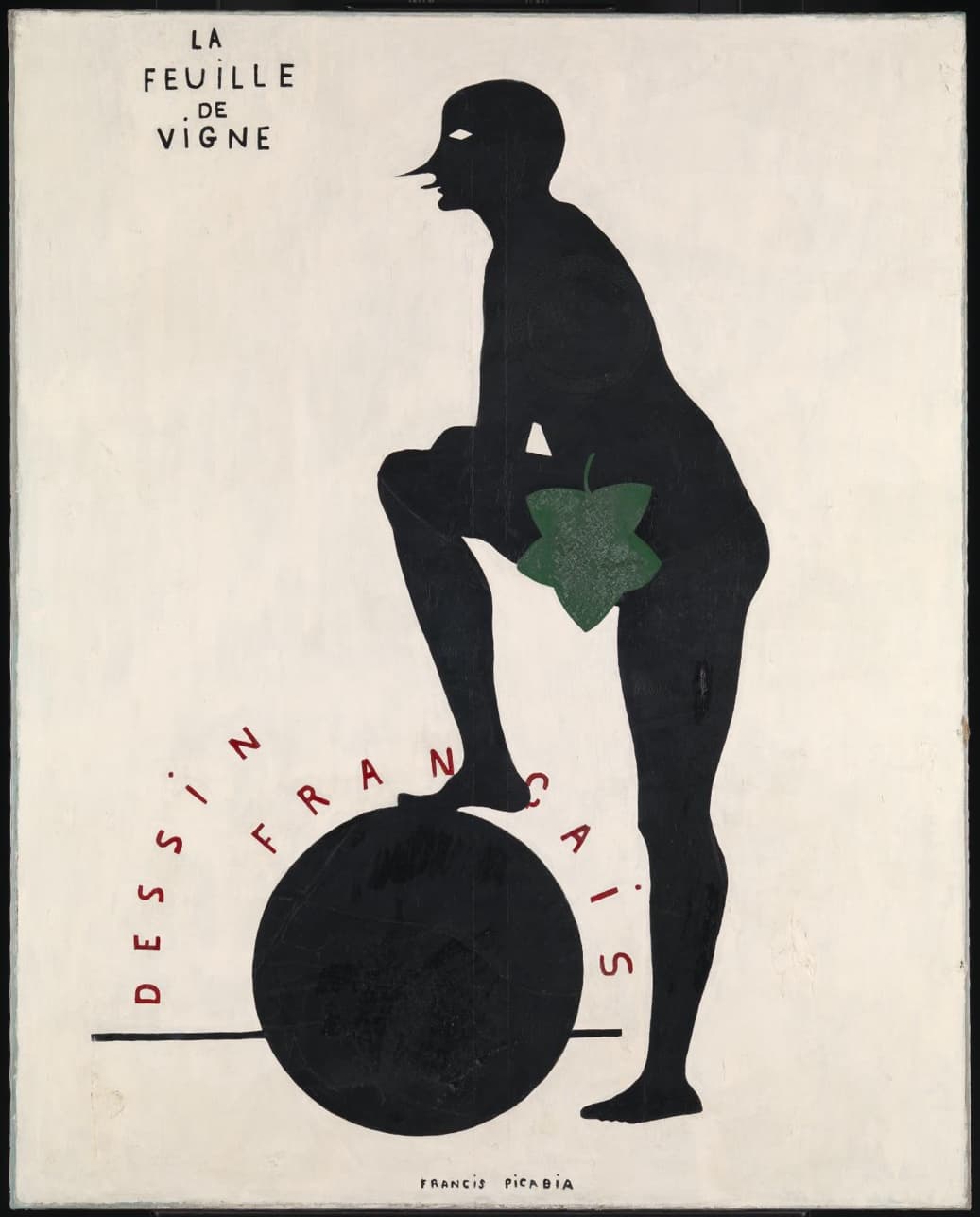
A tall cream canvas with a black silhouette of a naked man in profile facing left, leaning forward with his right foot on a large black ball. His head ends in a long pointed nose like a mask, with one white diamond-shaped eye. A green leaf covers his groin. A thin black bar runs through the ball, and red capitals arc round it reading DESSIN FRANÇAIS. LA FEUILLE DE VIGNE is written at the top left and FRANCIS PICABIA at the bottom

Artwork reproduction

Painting · Dada

The Fig-Leaf

1922 · Enamel paint on canvas

A black silhouette of a naked man with a pointed masked face stands with one foot on a black ball. A single green leaf covers his groin, and red letters round the ball spell DESSIN FRANÇAIS, French drawing. Francis Picabia painted the picture in 1922 over a machine painting that had caused a scandal in Paris the year before. The Fig-Leaf belongs to Tate in London.

Tate

Francis Picabia, The Fig-Leaf, 1922. Tate. Image © the rights holder, shown under fair use.

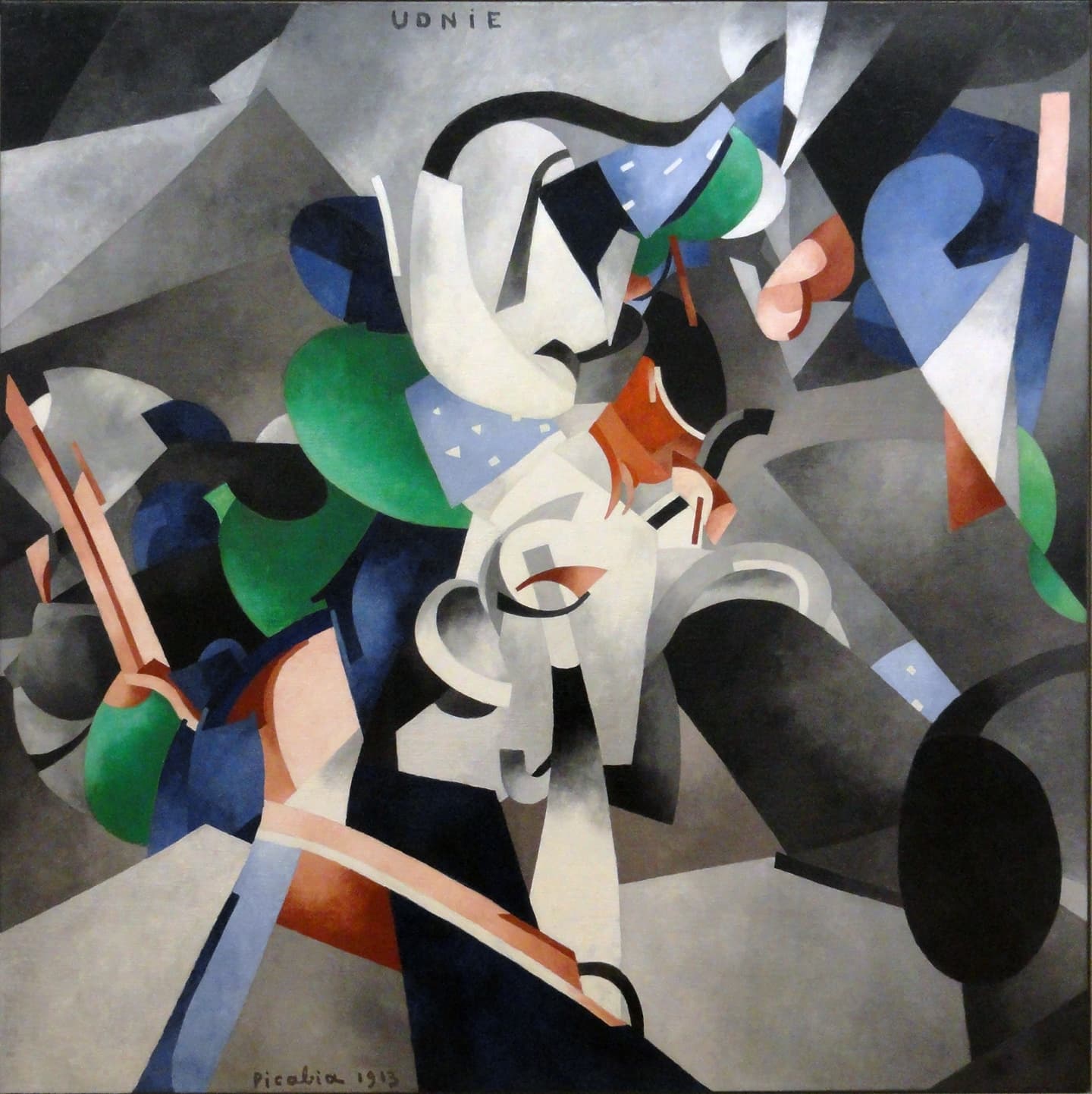
A nearly square canvas crowded with flat, hard-edged shapes that swirl out from the centre: white curls and bands shaded like polished metal, bright green fans, dark and pale blue plates, pale blue pieces dotted with small white marks, rust-orange and pink bars, and a large black oval at the lower right, all against grey planes that shade from light to dark. The word UDNIE is written at the top and Picabia 1913 at the bottom

Artwork reproduction

Painting · Orphism

Udnie

1913 · Oil on canvas

A whirl of flat grey, white, blue, green and pink shapes fills a canvas three metres wide. Francis Picabia painted Udnie in Paris in 1913, after watching a dancer rehearse on the ship that took him to New York. He showed the painting at the Salon d'Automne that November. Udnie belongs to the Centre Pompidou.

Centre Pompidou, Musée national d'art moderne

Francis Picabia, Udnie, 1913. Centre Pompidou, Musée national d'art moderne. Image © the rights holder, shown under fair use.

People Francis Picabia Knew

Relationships with other people, with sources for each connection.

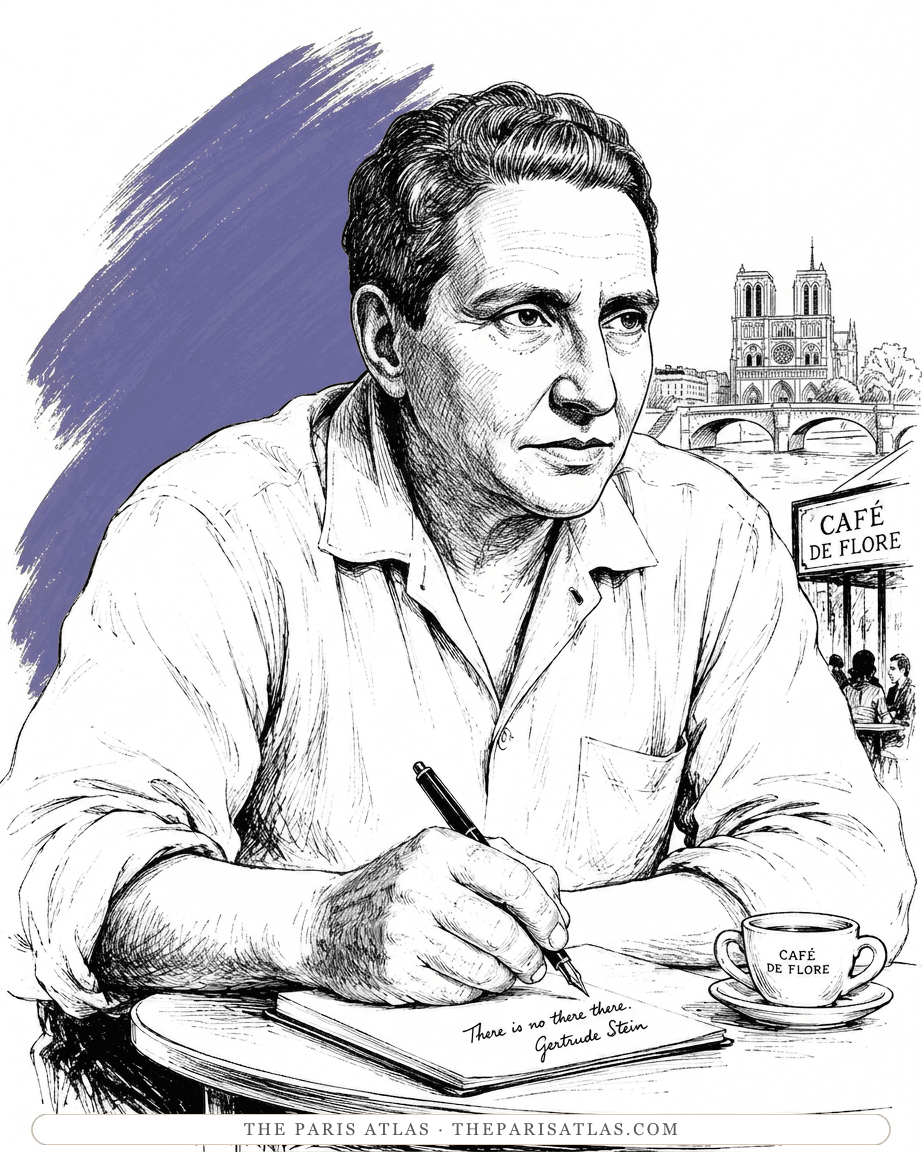
Illustrated portrait of Gertrude Stein

Gertrude Stein

  • Author
  • Salon host
  • Patron

Met · 1930–1953

In the 1930s Picabia became a close friend of Gertrude Stein and drew encouragement from her at a low point in his critical standing. He painted her portrait in 1933, one modernist shape-shifter taking the measure of another.

— Francis Picabia

Illustrated portrait of Rolf de Maré

Rolf de Maré

  • Patron
  • Archivist

Supported by · 1924

Picabia wrote the scenario for Relâche in 1924 and, for its interval, the film Entr'acte that de Maré's company had René Clair direct.

— The Metropolitan Museum of Art, Leonard A. Lauder Research Center — Rolf de Maré, Modern Art Index Project

Illustrated portrait of Marcel Duchamp

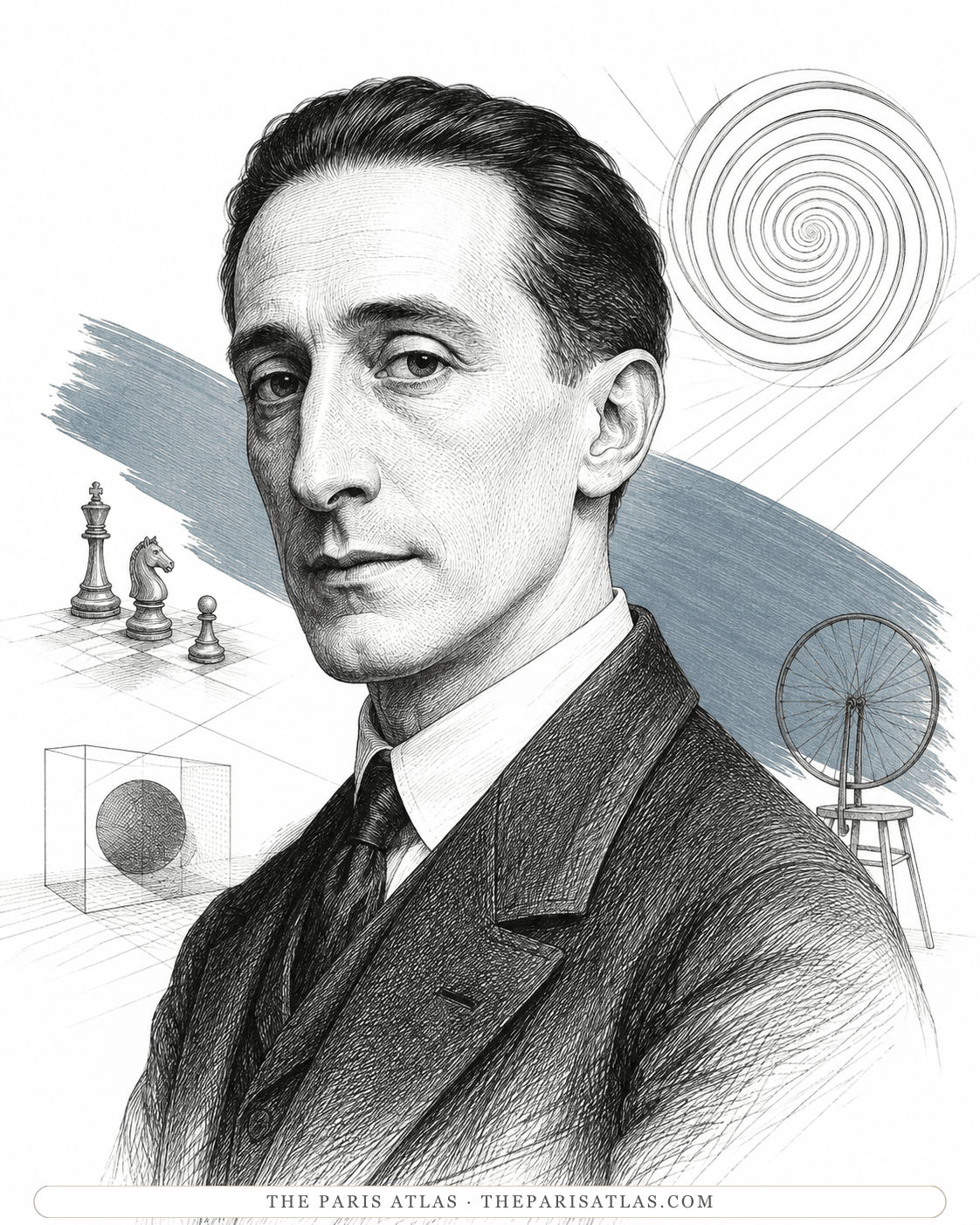
Marcel Duchamp

  • Painter
  • Sculptor
  • Filmmaker

Collaborated with

Duchamp and Picabia were close from around 1911 and central to Dada in New York and Paris, sharing its machine imagery and its attack on artistic seriousness. Picabia's review 391 and the pair's transatlantic activity carried Dada between the two cities.

— Encyclopaedia Britannica — Marcel Duchamp

Illustrated portrait of René Clair

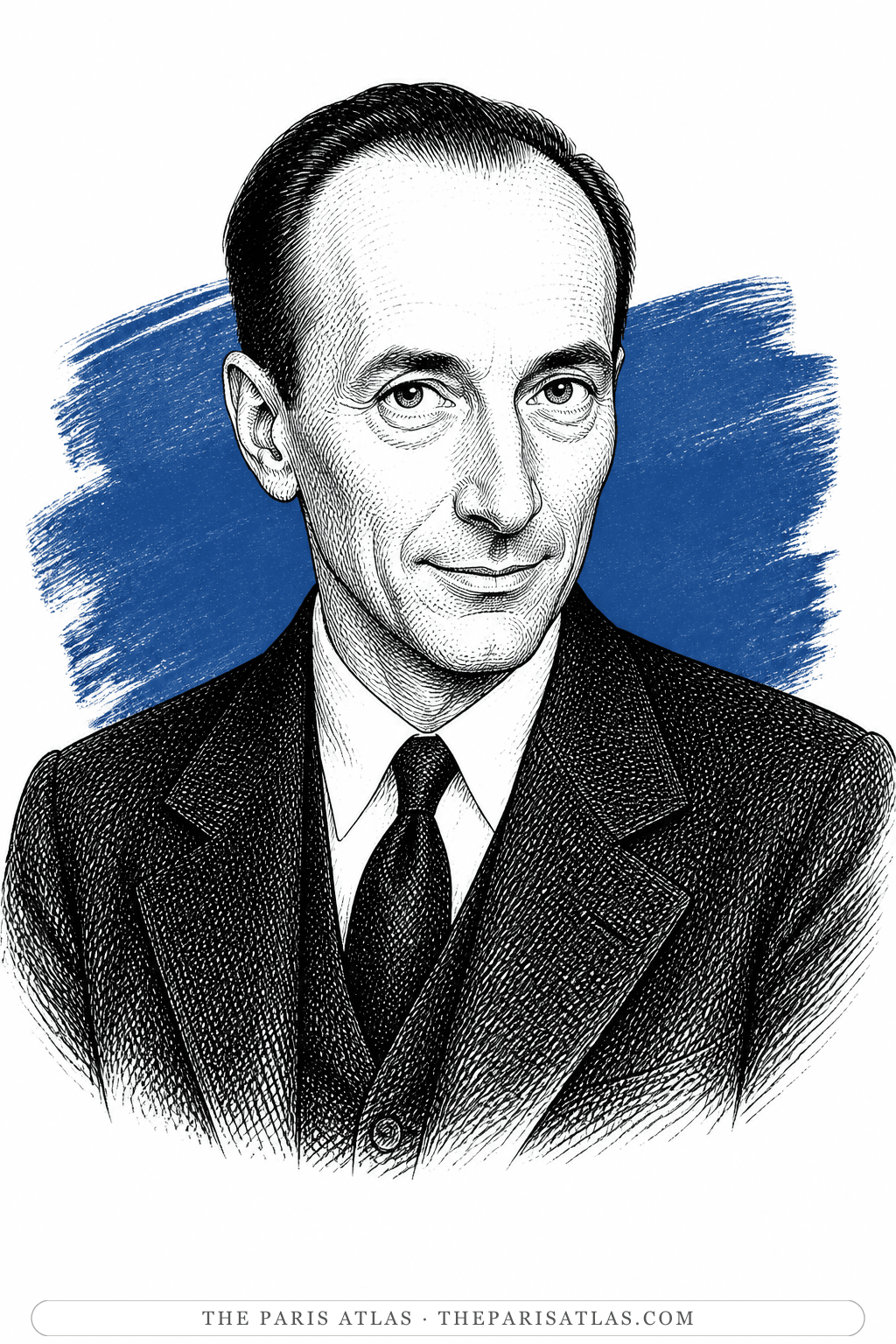
René Clair

  • Filmmaker

Collaborated with · 1924

Picabia wrote the scenario for Entr'acte and handed it to Clair, then twenty-six, to film. It ran between the acts of Picabia's ballet Relâche at the Théâtre des Champs-Élysées in December 1924, and both men appear in it.

— Encyclopaedia Britannica — René Clair; The Museum of Modern Art — Entr'acte (collection record)

Who Inspired Francis Picabia

People whose work inspired Francis Picabia. They did not necessarily meet or know one another.

Illustrated portrait of Alfred Sisley

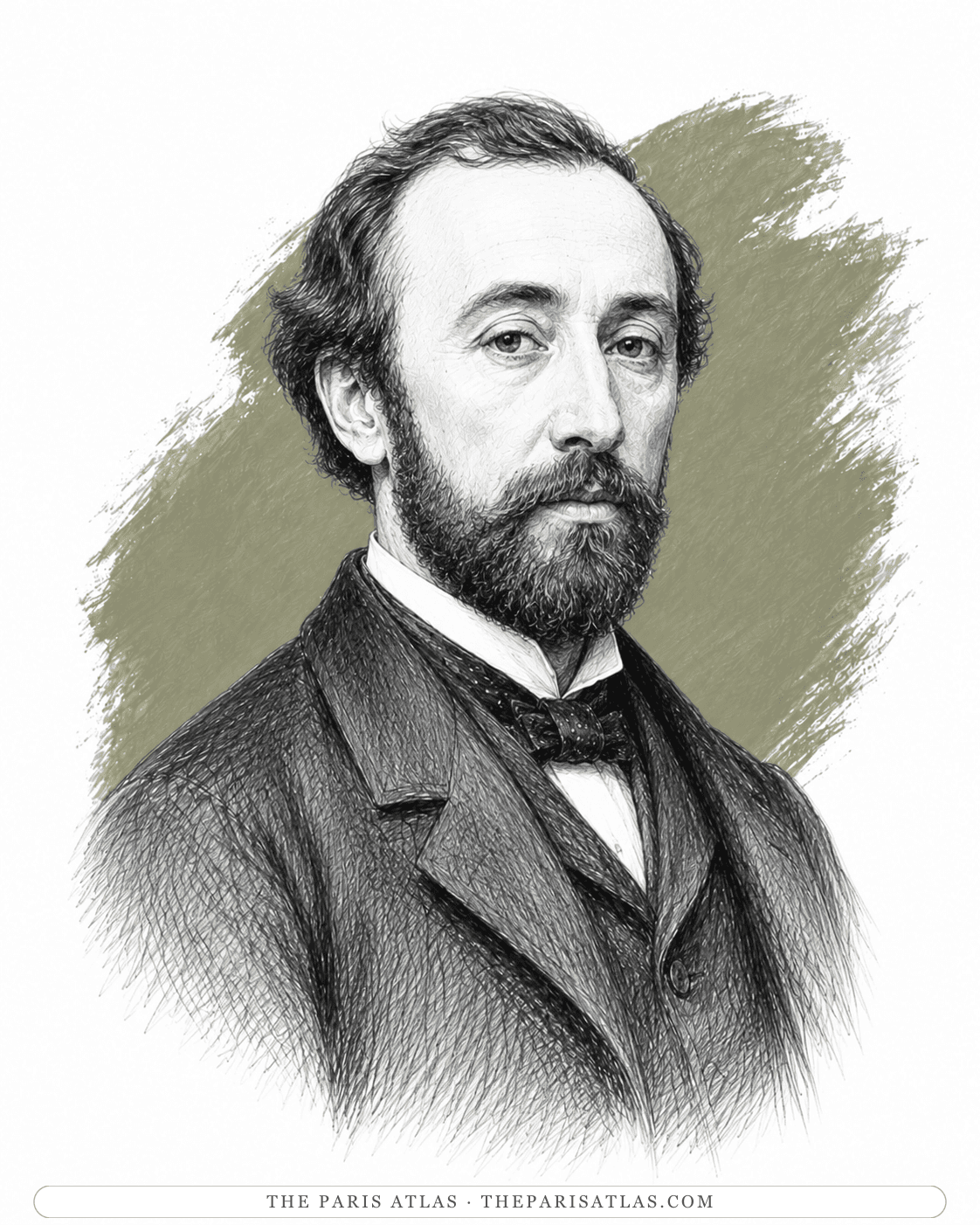
Alfred Sisley

Picabia's first successful manner, from 1903 to 1908, was Impressionist landscape taken straight from Alfred Sisley: small churches, lanes, riverbanks, wash houses and barges. Critics questioned his originality by naming the debt outright, and the discomfort of painting in a dead man's style helped push him toward Cubism and everything after.

— Francis Picabia

Movements

The artistic and literary currents this life ran through.

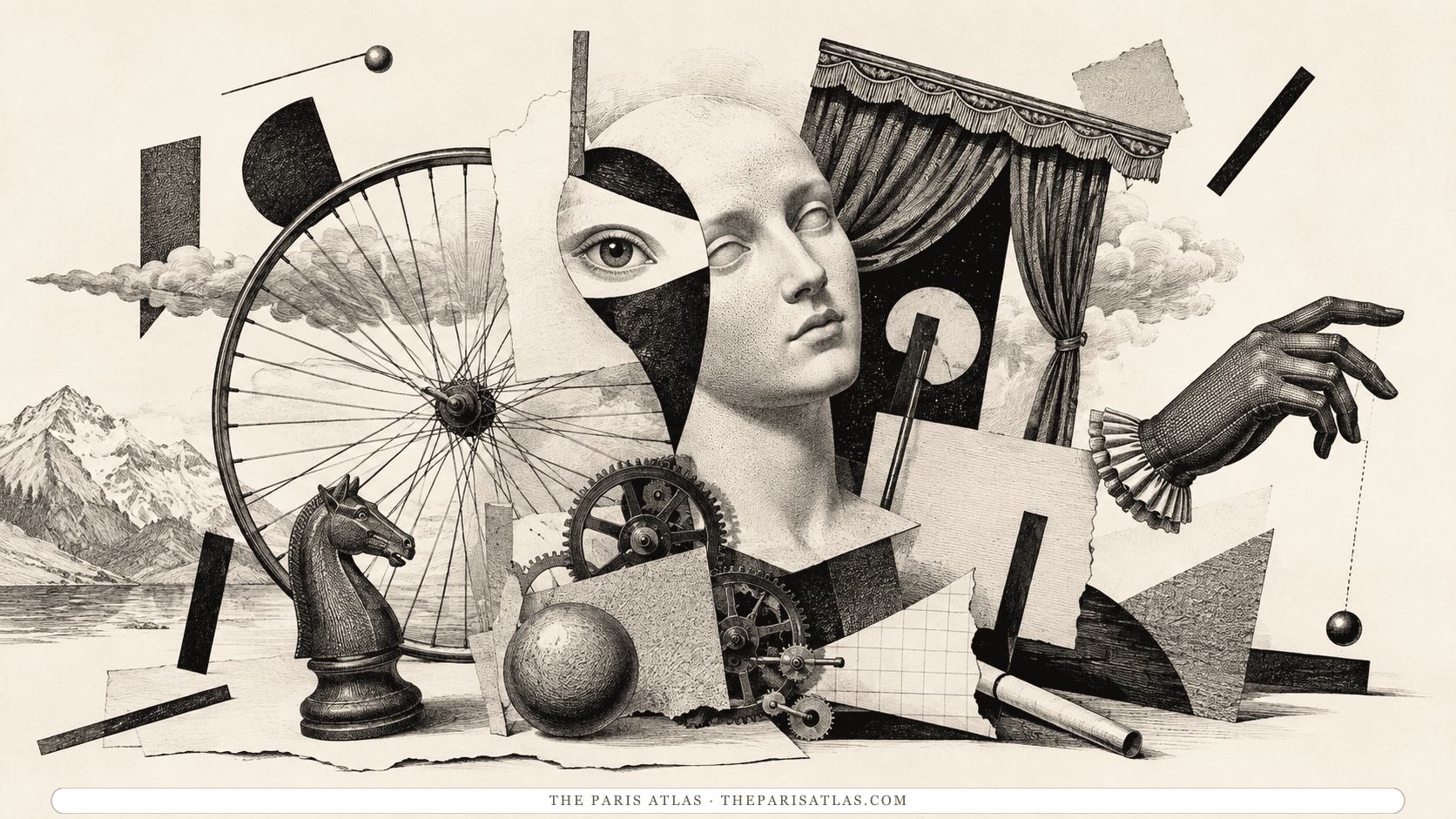
Pen-and-ink Dada collage with a mannequin head, bicycle wheel, chess knight, gears, torn paper, stage curtains, and a suspended gloved hand

Art movement · c. 1916–1924

Dada

Bridge between the New York, Zurich and Paris wings — his machine drawings, reviews and defections shaped every phase of the movement.

— Dada Movement Overview; Tristan Tzara

Francis Picabia’s Places

The cataloged places connected to Francis Picabia — through the books, and through the documented record.

Places you can enter today appear first, followed by addresses to see from outside and sites that have vanished.

Questions about Francis Picabia

Who was Francis Picabia?

Francis Picabia (1879–1953) was a French painter, writer, filmmaker and magazine publisher, one of the founders and financiers of the Dada movement. He moved restlessly through styles, Impressionism, Cubism, the machine portraits, Dada, the Monster paintings, the Transparencies, wartime pin-ups and late abstraction, published the travelling Dada journal 391, and wrote the scenario for the 1924 film Entr'acte. Rich by inheritance, he owned 127 sports cars and answered to nobody, which is much of why the work looks the way it does.

What is Picabia most famous for?

Three things. The machine portraits begun in 1915, in which people become mislabelled technical diagrams, a spark plug as an American girl, Stieglitz as a camera. The journal 391, Dada's most mobile publication, issued from Barcelona, New York, Zurich and Paris between 1917 and 1924. And Relâche with its film interlude Entr'acte (1924), which he scripted for René Clair to shoot, one of the most famous avant-garde films ever made, with Picabia, Duchamp and Man Ray on screen.

Why did Picabia change styles so often?

By conviction, and because he could afford to. His own explanation became his most famous sentence: if you want to have clean ideas, change them like shirts. He left every style at the moment it became respectable, Impressionism when critics placed it, Cubism after the Armory Show made him its spokesman, Dada in 1921 as it turned doctrinaire. An inherited fortune meant he never depended on dealers or fellow artists, so no style ever held him. Critics have settled on the word kaleidoscopic for the result.

What was Picabia's role in Dada?

Financier, publisher, connector and provocateur. His journal 391, founded in Barcelona in 1916, carried the movement's spirit between continents. His meeting with Tristan Tzara in Zurich linked the Swiss and Paris wings. In Paris, the Dada circle of André Breton, Paul Éluard, Philippe Soupault and Louis Aragon formed partly around his energy and his money. Then he blew it up, denouncing Dada in 1921 as a new orthodoxy and attacking Breton personally in 391's last issue in 1924.

What are Picabia's Transparencies?

Paintings made between 1927 and 1930 in which several images are layered over one another like superimposed film frames, figures from High Renaissance art seen through and behind figures from contemporary popular culture. Contemporaries mostly shrugged; later painters and curators read them as an early form of the appropriation and layering that defined much art after the 1960s, and they are now among his most studied works.

How did Francis Picabia die?

He died in Paris on 30 November 1953, at the age of 74, after several years of declining health, and was buried in the Montmartre Cemetery. He had returned to Paris before the end of the war and spent his last years painting abstractions and writing poetry, with a 1949 retrospective at the Galerie René Drouin as the final public summing-up in his lifetime.

Connections and Sources

Francis Picabia’s connections to people, places, and works, with the sources behind each one.

Met · 1930–1953

Gertrude Stein

In the 1930s Picabia became a close friend of Gertrude Stein and drew encouragement from her at a low point in his critical standing. He painted her portrait in 1933, one modernist shape-shifter taking the measure of another.

— Francis Picabia

Associated with

Dada

Bridge between the New York, Zurich and Paris wings — his machine drawings, reviews and defections shaped every phase of the movement.

— Dada Movement Overview; Tristan Tzara

Supported by · 1924

Rolf de Maré

Picabia wrote the scenario for Relâche in 1924 and, for its interval, the film Entr'acte that de Maré's company had René Clair direct.

— The Metropolitan Museum of Art, Leonard A. Lauder Research Center — Rolf de Maré, Modern Art Index Project

Collaborated with

Marcel Duchamp

Duchamp and Picabia were close from around 1911 and central to Dada in New York and Paris, sharing its machine imagery and its attack on artistic seriousness. Picabia's review 391 and the pair's transatlantic activity carried Dada between the two cities.

— Encyclopaedia Britannica — Marcel Duchamp

Collaborated with · 1924

René Clair

Picabia wrote the scenario for Entr'acte and handed it to Clair, then twenty-six, to film. It ran between the acts of Picabia's ballet Relâche at the Théâtre des Champs-Élysées in December 1924, and both men appear in it.

— Encyclopaedia Britannica — René Clair; The Museum of Modern Art — Entr'acte (collection record)

Influenced by · 1903–1908

Alfred Sisley

Picabia's first successful manner, from 1903 to 1908, was Impressionist landscape taken straight from Alfred Sisley: small churches, lanes, riverbanks, wash houses and barges. Critics questioned his originality by naming the debt outright, and the discomfort of painting in a dead man's style helped push him toward Cubism and everything after.

— Francis Picabia

References

References

The sources below include biographies, scholarly essays, interviews, and primary materials that informed this page. They reflect both the historical record and ongoing critical conversations about Francis Picabia and their work.

  1. 1↑Encyclopaedia Britannica — Marcel Duchamp

    Website
    Used for

    Web source consulted for documented facts and historical context presented on the Francis Picabia page.

    View source
  2. 2↑The Metropolitan Museum of Art, Leonard A. Lauder Research Center — Rolf de Maré, Modern Art Index Project

    Website
    Used for

    Web source consulted for documented facts and historical context presented on the Francis Picabia page.

    View source
  3. 3Encyclopaedia Britannica — René Clair

    Website
    Used for

    Web source consulted for documented facts and historical context presented on the Francis Picabia page.

    View source
  1. 4The Museum of Modern Art — Entr'acte (collection record)

    Website
    Used for

    Web source consulted for documented facts and historical context presented on the Francis Picabia page.

    View source
  2. 5Francis Picabia

    Website
    Wikipedia
    Used for

    Reference article cross-checked for the chronology, the style periods, the marriages, and the death.

    View source
i
Why these sources are here

These references anchor the page in the documented record and in the scholarly conversations around Francis Picabia. Every claim on this page traces back to one or more of the works listed here.

Explore more resources