
Displayed at · 1921-11–1921-12
Grand Palais
Shown at the 14th Salon d'Automne in the Grand Palais, 1 November to 20 December 1921, catalogue number 1876.
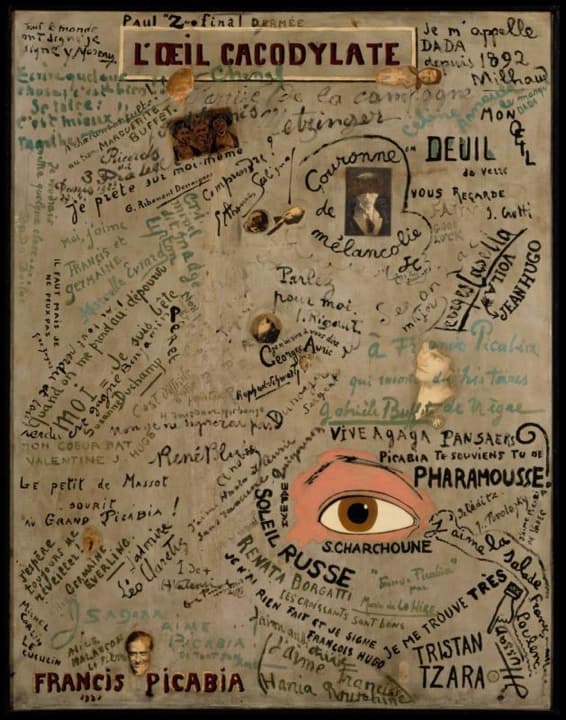
L'Œil cacodylate, The Cacodylic Eye, is a big grey canvas covered with handwriting: names, jokes and dedications by about fifty of Francis Picabia's friends, with a few pasted photographs and one painted eye. Francis Picabia painted the eye and the title in 1921, while he was ill with an eye infection, and invited his visitors to write the rest. The canvas hung over the bar of Le Bœuf sur le Toit and now belongs to the Centre Pompidou.
Most of L'Œil cacodylate is writing. Names, jokes, pieces of poems and dedications cover the canvas in black, brown and pale green, running in every direction. A few small photographs are pasted in among them. Near the bottom right sits one large painted eye, brown, with a pink lid.
The Museum of Modern Art says only three things are thought to be by the hand of Francis Picabia: the title in block letters at the top, the eye, and his name and the date at the bottom left. Everything else was added by other people. The curator Anne Umland counts about fifty of them.
In March 1921 Francis Picabia had shingles in one eye. The Centre Pompidou says the illness obsessed him and led to several paintings about eyes. The Museum of Modern Art says his doctors prescribed a drug called sodium cacodylate, and the painting takes its name from the drug.
Francis Picabia painted an oversized eye on a blank canvas and asked his visitors to write whatever they liked on it. The historian Thierry Lefebvre says the painting may have been started in September 1921.
The photographer Man Ray remembered arriving to find the big canvas in the living room, covered with phrases and signatures, with pots of paint on the floor. Francis Picabia invited him to sign. The Museum of Modern Art says Francis Picabia kept inviting people after he was well again. Anne Umland says he decided the painting was finished when there was no room left.
The Centre Pompidou names Man Ray, Marcel Duchamp and Jean Cocteau among the people who signed. Marcel Duchamp signed with the name of his female alter ego. The Philadelphia Museum of Art says the signature is the first record of the name Rose Sélavy, later spelled Rrose. His inscription is too small to find in the museum's photograph.
Many other signatures can be read in the photograph. Tristan Tzara wrote in large capitals that he found himself very Tristan Tzara. A line at the top right, signed Milhaud, probably by the composer Darius Milhaud, says his name has been Dada since 1892. The name S. Charchoune is lettered under the eye, and Georges Auric and Jean Hugo signed too.
Some lines are dedications. Germaine Everling, who was living with Francis Picabia by then, wrote that she still hoped to wake up. His wife, Gabriële Buffet, signed a dedication to him in pale green.
Francis Picabia showed the canvas at the Salon d'Automne of 1921 in the Grand Palais. He wrote about it in the paper Comœdia on 23 November, under the title L'Œil cacodylate. The New York magazine The Little Review printed the painting the next spring.
On 31 December 1921 the singer Marthe Chenal gave a New Year's Eve party that became known as the réveillon cacodylate, and her guests added more writing. From 10 January 1922, Thierry Lefebvre says, the painting hung above the mahogany bar of Le Bœuf sur le Toit, the new cabaret where Jean Cocteau and his friends met.
The Museum of Modern Art's curator calls the canvas a group portrait and says it was first displayed in a chic Paris bar.
The Centre Pompidou says the picture questions the idea of the artist and of the masterpiece. Art historians, the museum says, see in it the change begun by the readymades of Marcel Duchamp, where an artist's signature alone turns an ordinary object into a work of art. Here the signatures are the work, and most of them are not by Francis Picabia.
The Museum of Modern Art's paintings conservator Michael Duffy points out that the eye plays a trick too. Francis Picabia painted the eye to look as if it had been cut from a magazine illustration, among real cut-out photographs pasted beside it.
The Musée national d'art moderne bought the painting in 1967, in honour, its record says, of the era of Le Bœuf sur le Toit. The canvas went to the Dada exhibition of 2005 and 2006 in Paris, Washington and New York, and to the Museum of Modern Art's Francis Picabia retrospective in 2016 and 2017.
Centre Pompidou, Musée national d'art moderne, Paris, inventory number AM 4408 P. The Centre Pompidou closed in September 2025 for a renovation running to 2030, so check the museum's record for loans before travelling.
Close reading
L'Œil cacodylate is a canvas you read rather than look at. Francis Picabia painted an eye, a title and his own name. About fifty friends wrote the rest: jokes, boasts, dedications and signatures, with a few photographs pasted in. Some of it is easy to read in the museum's photograph. Some of it is too small.
1.The title on a cream plaque
The title is painted in dark red capitals on a cream plaque at the top, like the sign over a shop. The Museum of Modern Art says it is one of the few things on the canvas by Francis Picabia's own hand. Cacodylate was the drug his doctors gave him for an eye infection, so the title means the cacodylate eye: the eye on medicine. Above the plaque someone wrote the name Paul Dermée, with a word in quotation marks that is hard to read.
2.The painted eye
The eye is the painting's only picture. The eye has a brown iris, a black pupil and a flat pink lid, and it stares straight out. The Museum of Modern Art's conservator Michael Duffy says Francis Picabia painted it to look as if it had been cut from a magazine illustration. In 1921 Francis Picabia had shingles in one eye, and the Centre Pompidou says the illness led him to paint several pictures about eyes. Under it the painter Serge Charchoune signed his name in capitals.
3.Dada since 1892
At the top right, a line signed Milhaud reads: Je m'appelle Dada depuis 1892, my name has been Dada since 1892. The signature is probably that of the composer Darius Milhaud. The line sums up the mood of the canvas: everyone here claims to have been Dada from the start.
4.Francis Picabia's own name
Francis Picabia's name and the date are painted in red capitals at the bottom left, 1921 in small figures beneath. The Centre Pompidou records the signature there. Between FRANCIS and PICABIA a small cut-out photograph of a man's face is pasted onto the canvas. It is not clear whose face it is.
5.Very Tristan Tzara
In the bottom right corner Tristan Tzara wrote in big black capitals: Je me trouve très Tristan Tzara, I find myself very Tristan Tzara. Beside it someone drew a hand with a pointing finger. A name running down the right edge includes the word Poulenc, probably the composer Francis Poulenc, though the photograph is too small to be sure.
6.Isadora loves Picabia
In pale green capitals, with a big looping I, someone wrote Isadora aime Picabia, Isadora loves Picabia, and more words that fade into the canvas. Isadora is probably the dancer Isadora Duncan, but the museum's photograph shows no surname. The green writing is harder to read than the black, as if it were written with a thin wash of paint.
7.Suzanne Duchamp and Péret
On the left, phrases slant across each other. The name Duchamp here follows a first name ending in -anne, so the signer is probably Suzanne Duchamp, not Marcel Duchamp. The name Péret, probably the poet Benjamin Péret, runs downward beside it. MOI, me, is written large. Much of the rest in this corner is too small to read.
8.A crown of melancholy
In the upper middle a small photograph of a man in a hat and suit is pasted on, and a looping black line runs round it like a frame or a wreath. The words beside it read Couronne de mélancolie, crown of melancholy. It is not clear who the man is. The Museum of Modern Art's conservator notes how unusual it was to paste real photographs onto an oil painting.
9.A photograph of three laughing faces
Near the top left a small brown photograph shows three faces laughing, pressed close together. It is not clear who they are. Around it the writing thickens. Below it the writer Georges Ribemont-Dessaignes signed a line that reads Je me prête sur moi-même, I lend myself on myself.
10.My eye in mourning of glass
Down the right side runs a sentence in mixed capitals: mon œil, en deuil de verre, vous regarde, my eye, in mourning of glass, is watching you. The sentence seems to answer Francis Picabia's painted eye with a glass one. The signature looks like J. Crotti, probably the painter Jean Crotti, but the letters are small and hard to be sure of.
11.Do you remember Pharamousse?
Above the eye, in black capitals: Picabia te souviens-tu de Pharamousse!, Picabia, do you remember Pharamousse! Above that another line seems to read Vive … Pansaers. It is not clear who wrote them or what Pharamousse was. Private jokes like this are the point of the picture: it is a record of who was in the room.
12.Voilà Jean Hugo
Along the right side the painter Jean Hugo signed in big slanting capitals: Voilà Jean Hugo, here is Jean Hugo. Next to it someone made a large sweeping scrawl that is hard to read. Jean Hugo belonged to the circle around Jean Cocteau, the crowd that later drank at Le Bœuf sur le Toit.
13.Nothing to say
In the centre the writer Jacques Rigaut wrote Parlez pour moi, speak for me. Just below, the composer Georges Auric signed under a line that seems to read Je n'ai rien à vous dire, I have nothing to say to you. A small round photograph is pasted between them. Refusing to say anything was a very Dada way to take part.
14.Russian sun and good croissants
Below the eye the writing turns into a pile of short sentences. Soleil russe, Russian sun. The name Renata Borgatti. Les croissants sont bons, the croissants are good. And, signed François Hugo, Je n'ai rien fait et je signe, I did nothing and I'm signing. The last line could stand for the whole painting.
15.Little de Massot smiles
At the left, a line signed de Massot reads Le petit de Massot sourit au grand Picabia!, little de Massot smiles at the great Picabia. Above it, in faint pale capitals, Valentine Hugo wrote Mon cœur bat, my heart beats. Several signers write about Francis Picabia in the third person, as if signing a guest book.
16.I still hope to wake up
Germaine Everling, who was living with Francis Picabia by then, wrote J'espère toujours me réveiller!, I still hope to wake up! Next to it someone signed J'admire, I admire, with the name Léo Claretie. A small pasted scrap sits above them. The lines tumble in all directions because, as Anne Umland puts it, anyone could write wherever there was room.
17.A dedication from Gabriële Buffet
In pale green, a dedication runs à Francis Picabia and is signed Gabriële Buffet, Francis Picabia's wife. By then Francis Picabia was living with Germaine Everling, but Gabriële Buffet still came to write on the canvas. Beside her lines a cut-out of a pale face, like a photograph of a plaster head, is pasted onto the canvas. It is not clear whose face it is.
18.Everyone has signed
In the top left corner someone wrote, in deliberately bad French, Tout le monde ont signé, je signe: everyone have signed, so I sign. The signature under it is hard to read. Below, in pale green, another hand wrote Écrire quelque chose c'est bien ! Se taire : c'est mieux, writing something is good, keeping quiet is better. The canvas argues with itself about whether to write on it at all.
1921
In March Francis Picabia has shingles in one eye, and his doctors prescribe sodium cacodylate.
1921
He paints an eye on a blank canvas, perhaps in September, and asks visitors to write on it.
1921
Shown at the Salon d'Automne in the Grand Palais; he writes about it in Comœdia on 23 November.
1921
On 31 December guests at the singer Marthe Chenal's réveillon cacodylate add more writing.
1922
From 10 January the canvas hangs above the bar of Le Bœuf sur le Toit. The Little Review prints it that spring.
1967
Bought for the Musée national d'art moderne in honour of the era of Le Bœuf sur le Toit.
2005
Shown in the Dada exhibition in Paris, Washington and New York, until 2006.
2016
Lent to the Museum of Modern Art's Francis Picabia retrospective, until 2017.
Centre Pompidou, Musée national d'art moderne
Paris, France
A public viewing address has not yet been confirmed for this holding.
The Centre Pompidou closed in September 2025 for a renovation running to 2030. Check the museum's record for loans before travelling.
Sodium cacodylate was the drug Francis Picabia's doctors gave him for an eye infection in 1921, according to the Museum of Modern Art. The title means, roughly, the cacodylate eye.
About fifty of Francis Picabia's friends and visitors. The Centre Pompidou names Man Ray, Marcel Duchamp and Jean Cocteau. Signatures by Tristan Tzara, Georges Auric, Jean Hugo and Germaine Everling can be read in the photograph.
The Museum of Modern Art says only the title in block letters, the eye, and his name and the date are thought to be by his own hand.
After the Salon d'Automne of 1921, the canvas hung above the mahogany bar of the cabaret Le Bœuf sur le Toit from January 1922, according to Thierry Lefebvre.
The Centre Pompidou says the painting questions the idea of the artist and of the masterpiece, since most of its surface is by other people. The museum links it to the readymades of Marcel Duchamp.
The canvas belongs to the Centre Pompidou in Paris, inventory number AM 4408 P. The building is closed for renovation until 2030, so check the museum's record for loans.
Displayed at · 1921-11–1921-12
Shown at the 14th Salon d'Automne in the Grand Palais, 1 November to 20 December 1921, catalogue number 1876.

Displayed at · 1922-01
Thierry Lefebvre says the canvas hung above the mahogany bar of the cabaret from 10 January 1922. The Centre Pompidou says the painting became one of the cabaret's ornaments, and bought it in 1967 in honour of the era of Le Bœuf sur le Toit.
Explore painters from the same movements and circles.
Strasbourg-born sculptor and poet — Hans in German, Jean in French, both all his life — who co-founded Dada at the Cabaret Voltaire in 1916, composed collages by dropping torn paper 'according to the laws of chance', and settled at Meudon outside Paris in a house his wife Sophie Taeuber-Arp designed.
View artist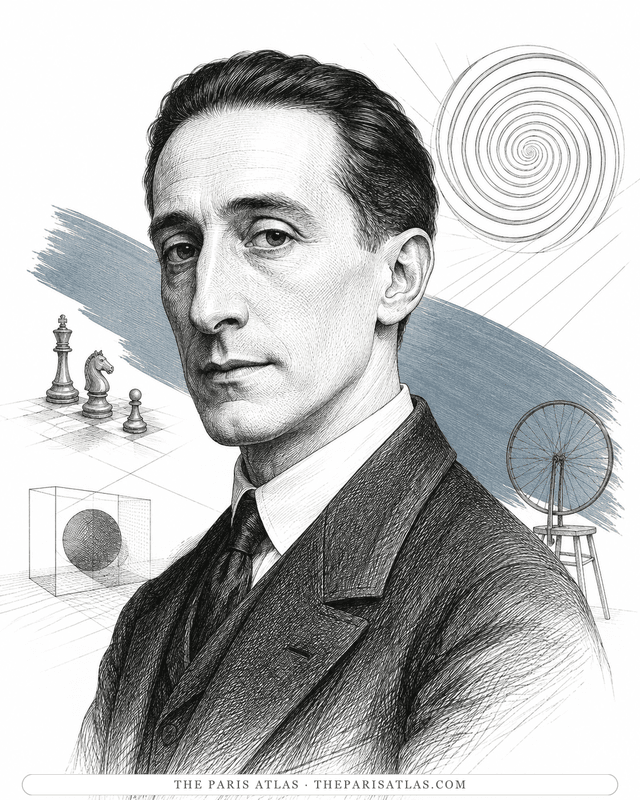
The century's quietest revolutionary — readymades, the abandonment of painting, chess on a Paris rooftop in Entr'acte, and one anemic film of spinning puns signed Rrose Sélavy.
View artist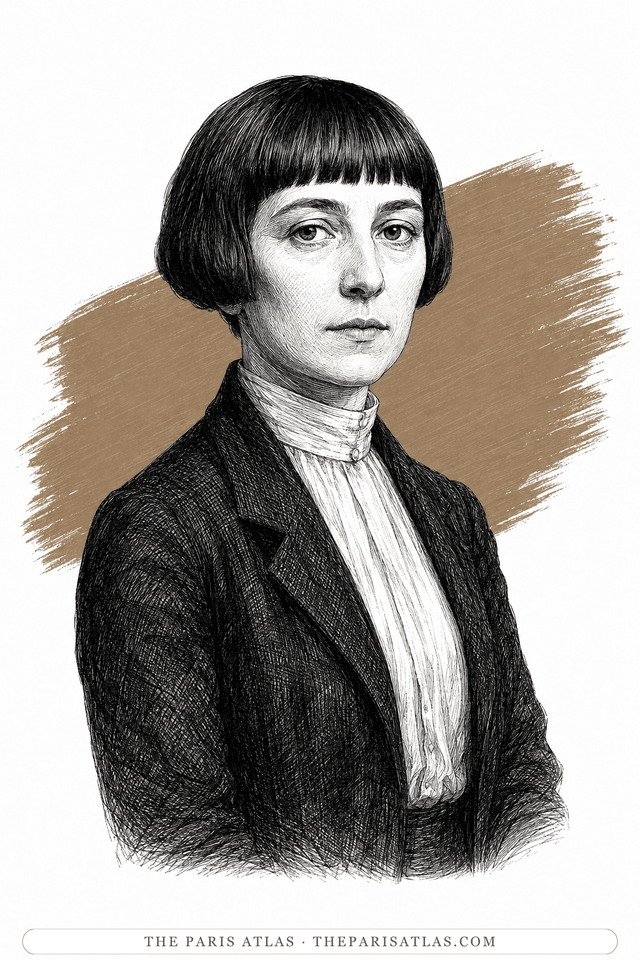
Berlin Dada artist who developed photomontage into a sharp instrument for cutting through politics, mass media, gender roles, and the public faces of the Weimar Republic.
View artistThe sources below include collection records, catalogues, scholarly research, and primary materials that informed this page. They document L'Œil cacodylate, its making, and its place in cultural history.

The holding museum's record: the eye illness, the visitors' signatures, Man Ray's memory, the Salon d'Automne of 1921, the réveillon, Le Bœuf sur le Toit, the 1967 purchase, and the image the close-reading views were cropped from.
Thierry Lefebvre on the start of the painting, the singer Marthe Chenal's réveillon of 31 December 1921, and the canvas above the bar of Le Bœuf sur le Toit from 10 January 1922.
The Museum of Modern Art on sodium cacodylate, the parts painted by Francis Picabia himself, and the group portrait.
The paintings conservator Michael Duffy on the pasted photographs and the eye painted to look like a magazine illustration.
The curator Anne Umland on the fifty contributors, chance, the painting finished when no space was left, and its first display in a Paris bar.
The Philadelphia Museum of Art on Marcel Duchamp's Rose Sélavy signature on the painting.
The Comité Picabia on the Paris apartment Francis Picabia shared with Germaine Everling from 1919.
The Dada exhibition of 2005–2006, which included the painting.
These references provide the documented foundation for this work's history and interpretation. Claim-level citations remain attached to the specific claims they support.
 Explore more resources