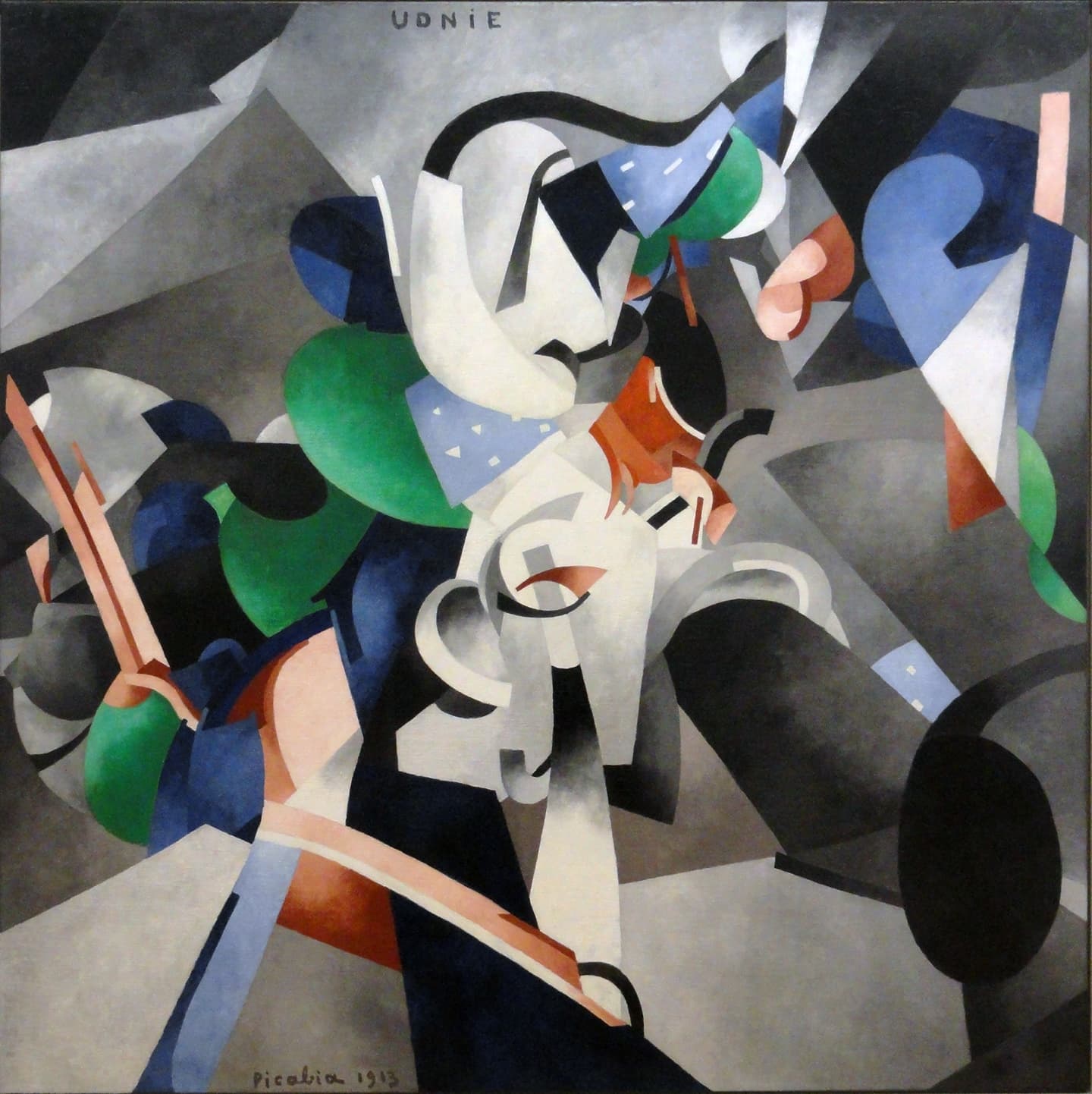
A whirl of flat grey, white, blue, green and pink shapes fills a canvas three metres wide. Francis Picabia painted Udnie in Paris in 1913, after watching a dancer rehearse on the ship that took him to New York. He showed the painting at the Salon d'Automne that November. Udnie belongs to the Centre Pompidou.
Udnie has no dancer you can point to. The canvas is packed with flat shapes that seem to spin out from the middle: white curls, bright green fans, pale blue plates dotted with little white marks, pink bars and a large black oval at the lower right. Grey planes behind them shade from light to dark like polished metal.
The Centre Pompidou says the painting came from a dance Francis Picabia watched on the liner that carried him to the United States in 1913. The dancer was the actress Stasia Napierkowska. The museum describes the shapes as whirled outward, with metallic gleams set against blue, green and ochre forms like wood shavings.
Nothing in the picture is a body, but the title and the story tell you to look for one. A viewer can find a tilted head at the top, a bent arm in the pink bars, a skirt in the green fans. None of those readings is certain.
A name he made up
The word UDNIE is written in capitals at the top of the canvas. Udnie is not a real name. The Centre Pompidou suggests the word may be a scramble of the name of Jean d'Udine, a writer on music who argued that sound, colour and movement could stand for one another.
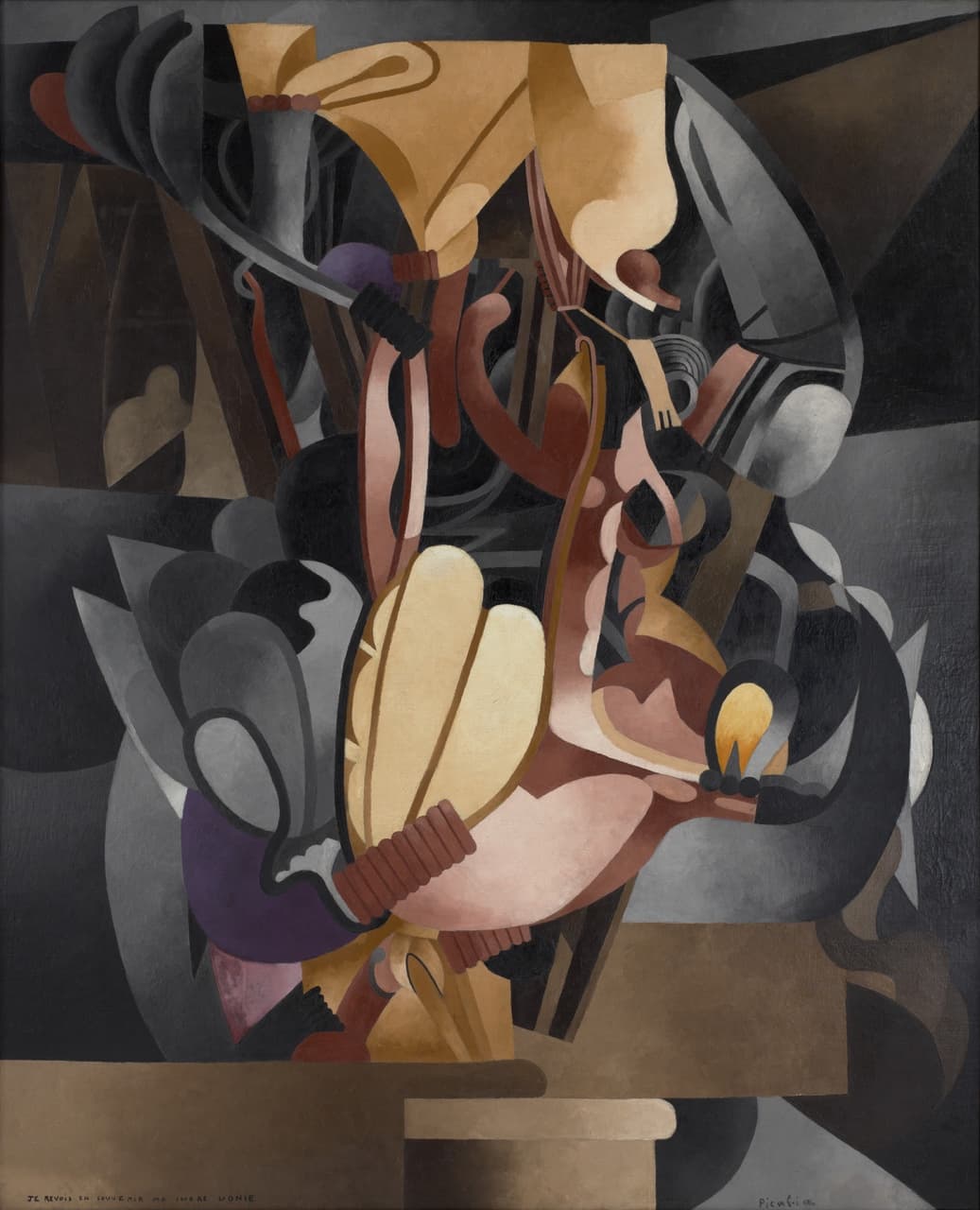
The Museum of Modern Art makes the same suggestion for its own Udnie painting of 1914, I See Again in Memory My Dear Udnie. In the Salon catalogue of 1913 the picture was listed as Udnie (young American girl) (dance). So Francis Picabia gave three clues at once: a made-up name, a nationality and a movement.
Futurist speed, Duchamp's machines
The Centre Pompidou's curator Didier Ottinger traces two debts. In 1912 Francis Picabia, like his friend Marcel Duchamp, had seen the exhibition of the Italian Futurists in Paris. Their paintings broke a dance into bursts of colour, and the museum says Udnie takes its sense of movement from them.
The second debt is to Marcel Duchamp. In 1912 Marcel Duchamp gave Francis Picabia his painting of a bride, which Didier Ottinger describes as a cross between a wasp and a sewing machine. The metal gleam and the machine-like parts of Udnie, he writes, already belong to the world of machines that would soon take over Francis Picabia's work.
In New York in 1913 Francis Picabia described art as putting inner thoughts and feelings onto the canvas. Didier Ottinger links that idea to the painters who met at Puteaux around the Duchamp brothers. He also links it to the Orphism that Guillaume Apollinaire praised in his book on the Cubist painters that year.
The Salon d'Automne of 1913
Francis Picabia came back to Paris from New York in 1913. The Comité Picabia says he showed two important paintings at the Salon d'Automne in the Grand Palais that autumn: Udnie and Edtaonisl, which is now in the Art Institute of Chicago. The Salon ran from 15 November 1913 to 5 January 1914.
The Centre Pompidou says Udnie caused a sensation. Guillaume Apollinaire wrote about the painting in his magazine Les Soirées de Paris on the day the Salon opened. On 1 December the daily paper Le Matin printed Udnie on its front page, under a headline telling readers not to laugh, because this was painting and it showed a young American girl.
Les Soirées de Paris printed the painting in colour on 15 March 1914.
From Francis Picabia to the Musée national d'art moderne
The French state bought Udnie in 1948, five years before Francis Picabia died, and assigned the painting to the Musée national d'art moderne in 1949. In May 1948 the critic Jean Cassou announced that the museum would show two early canvases by Francis Picabia.
Udnie has travelled widely since. The painting went to the São Paulo Bienal of 1953, to the Paris exhibition The Sources of the Twentieth Century in 1960, and to a tour of American museums in 1968 and 1969.
The Centre Pompidou in Paris closed for renovation in 2025. In 2026 Udnie is on loan to the Centre Pompidou Hanwha in Seoul for the exhibition The Cubists: Inventing Modern Vision, which runs until 4 October 2026.
Where to see it
Udnie belongs to the Centre Pompidou, Musée national d'art moderne, in Paris, inventory number AM 2874 P. The canvas is 2.9 metres high and 3 metres wide. Check the museum's record before a visit, since the building is closed until 2030 and the painting travels.
Close reading
Reading the work, detail by detail
Udnie looks like pure abstraction until you go close. Then the shapes start to look like things: a curl of white like a hood, green fans like a skirt, pink bars like arms, grey planes that shine like metal. Francis Picabia never says which is which, and that is the point.
1.The made-up name at the top
Francis Picabia wrote the title on the painting itself, in small dark capitals near the top edge. Udnie is not a real word. The Centre Pompidou suggests it may be a scramble of the name of Jean d'Udine, a writer who argued that music, colour and dance could stand for one another. Putting the word on the canvas turns the title into part of the picture, a label for something we cannot see.
2.Picabia 1913
The signature and date sit at the bottom of the canvas, in the same dark paint as the title. The museum records both: signed and dated at bottom left, titled at top centre. Francis Picabia painted Udnie in Paris after he came back from New York in 1913, and showed it at the Salon d'Automne that November.
3.A white shape like a hood
Near the top a tall white shape curls over like a hood, a sail or a sheet of bent metal. The white shape is the nearest thing in the painting to a head. Grey shading on one side makes the white look rounded and shiny. The Centre Pompidou says the metallic gleams in Udnie already point to the machines Francis Picabia would soon be painting.
4.One black line through the whirl
A single thick black line snakes across the top of the canvas. The line loops over the white hood shape and then waves off to the right. The line looks like a ribbon, a cable or a whip. In a picture made of flat blocks, the line is the one thing that seems to be moving fast.
5.Pale blue plates with white flecks
Pieces of pale blue are sprinkled with small white triangles and dashes, like a patterned fabric or the spangles on a costume. They are the only patterned pieces in the painting. If Udnie is a dancer, these may be bits of her dress catching the light. The painting does not say.
6.Pink rounded shapes at the upper right
At the upper right two rounded pink shapes lie one on another, edged with a rust-red stripe. They could be fingers, lips or the curve of a shoulder. They are the warmest colour in this corner, and the closest the painting comes to skin.
7.Blues and a white triangle on the right
Along the right edge the colours turn cold: a big pale blue curve, a deeper blue below it and a sharp white triangle. A thin pink bar stands upright at the edge like a post. The hard edges here are cut as cleanly as paper. Francis Picabia painted the whole canvas this flatly, with almost no visible brushwork in the colour.
8.A long pink bar at the left
A long pink bar with a dark red stripe down its middle slants up the left side of the canvas. The bar looks like a ruler, a rod or a stiff arm. Next to it sit dark blue humps and the edge of a bright green shape. The bar is one of several straight lines that cut through the curves and keep the whirl from turning soft.
9.Rust orange at the centre
At the centre rust-orange shapes end in thin points, like fingers or flames. A black curve and a grey band wrap round them. The painting feels most crowded here. If the white shape above is a head, this could be a neck or a hand, but the shapes never settle into a body.
10.White rings like polished metal
In the middle of the canvas white and grey bands loop round each other like rings, coils or the pleats of a skirt in motion. They are shaded from white to grey so they look like bent sheet metal. The Centre Pompidou points to exactly these metallic reflections as the sign of the machine world in the painting.
11.A great black oval
The largest single shape in Udnie is a black oval at the lower right. The oval could be a wheel, a drum or a shadow. The oval is the heaviest thing in the painting. The oval pulls the eye down and to the right, against the upward swirl of the rest.
12.A dark tube shaded like a pipe
A thick dark tube runs down toward the black oval. Francis Picabia shaded it from dark to light along one edge, so it looks round, like a pipe or a piston. Most of the painting is flat colour, so the few shaded pieces stand out as solid, machine-made objects.
13.A pink band across the bottom
Near the bottom a long pink band sweeps across the canvas like a rail or the edge of a stage. The band runs over dark blue and rust shapes and ends at a white shape with a black curl. The band is one of the lines that make the picture feel like it is turning.
14.A pale blue strip with white dots
A small strip of pale blue with two white dots lies across the dark tube. The strip repeats the dotted plates near the top of the canvas. Francis Picabia uses these small repeats to tie the far corners of the picture together.
15.Grey planes like sheet metal
The top left corner is all grey planes, overlapping at sharp angles and shading from almost black to pale grey. They could be a background, a sky or panels of steel. The corner holds almost no colour. The greys set off the greens, blues and pinks at the centre, which look brighter against them.
16.Green and dark blue at the lower left
At the lower left a round bright green shape sits among dark blue humps. The same green appears at the top of the painting, so the colour seems to travel round the canvas. A viewer can read the green shapes as the swing of a skirt, but the painting also works as nothing but colour in motion, which is how Guillaume Apollinaire and the Orphist painters wanted it seen.
17.A white column ending in a curl
At the bottom of the canvas a white column ends in a small black curl, like a foot, a hook or the scroll at the end of a violin. The pink band crosses it here. Here the whirl of shapes seems to touch the ground.
Timeline
1913
On the liner to New York for the Armory Show, Francis Picabia watches the actress Stasia Napierkowska rehearse a dance.
1913
Back in Paris, he paints Udnie and shows it at the Salon d'Automne in the Grand Palais, which opens on 15 November.
1913
On 1 December Le Matin prints the painting on its front page.
1914
Les Soirées de Paris prints Udnie in colour on 15 March.
1948
The French state buys the painting.
1949
Assigned to the Musée national d'art moderne.
2026
On loan to the Centre Pompidou Hanwha in Seoul until 4 October, while the Paris building is closed.
Where to see it
Centre Pompidou, Musée national d'art moderne
Paris, France
A public viewing address has not yet been confirmed for this holding.
The Centre Pompidou closed in September 2025 for a renovation running to 2030. The painting is on loan to The Cubists: Inventing Modern Vision at the Centre Pompidou Hanwha in Seoul until 4 October 2026.
Frequently asked questions
What does Udnie show?
No figure you can point to. The Centre Pompidou says Francis Picabia based the painting on a dance he watched on the liner to New York in 1913. The dance is broken into flat, whirling shapes, with grey planes that shine like metal.
What does the word Udnie mean?
Udnie is a name Francis Picabia made up. The Centre Pompidou and the Museum of Modern Art both suggest the word may scramble the name of Jean d'Udine, a writer who linked music, colour and dance.
Who was the dancer?
The Centre Pompidou names the actress Stasia Napierkowska, who performed a dance on board the ship. The Museum of Modern Art adds that her suggestive performances later got her arrested.
Where was Udnie first shown?
At the Salon d'Automne in the Grand Palais in Paris, which opened on 15 November 1913. The Centre Pompidou says the painting caused a sensation, and Le Matin printed it on its front page on 1 December.
How is Udnie related to I See Again in Memory My Dear Udnie?
Francis Picabia used the same invented name again in 1914 for a large painting now at the Museum of Modern Art in New York. The later painting turns the dancer into pistons, coils and soft pink forms.
Where can I see Udnie?
Udnie belongs to the Centre Pompidou in Paris, which is closed for renovation until 2030. In 2026 the painting is on loan to the Centre Pompidou Hanwha in Seoul until 4 October. Check the museum's record before travelling.
In the atlas
What the graph records about this work — every claim carries its citation.
Shown at the 11th Salon d'Automne in the Grand Palais, 15 November 1913 to 5 January 1914, catalogue number 1676, as Udnie (jeune fille américaine) (danse). The Centre Pompidou says the painting caused a sensation there.
— Francis Picabia, UDNIE (Jeune fille américaine), 1913 — collection record, with Didier Ottinger's catalogue text, AM 2874 P; notice and bibliography
Explore painters from the same movements and circles.
Jean Arp
Strasbourg-born sculptor and poet — Hans in German, Jean in French, both all his life — who co-founded Dada at the Cabaret Voltaire in 1916, composed collages by dropping torn paper 'according to the laws of chance', and settled at Meudon outside Paris in a house his wife Sophie Taeuber-Arp designed.
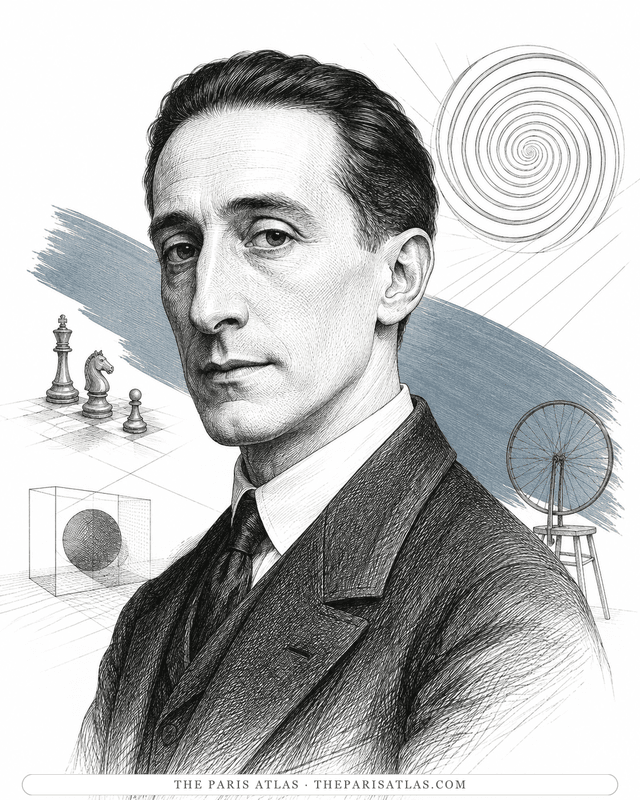
The century's quietest revolutionary — readymades, the abandonment of painting, chess on a Paris rooftop in Entr'acte, and one anemic film of spinning puns signed Rrose Sélavy.
Berlin Dada artist who developed photomontage into a sharp instrument for cutting through politics, mass media, gender roles, and the public faces of the Weimar Republic.
The sources below include collection records, catalogues, scholarly research, and primary materials that informed this page. They document Udnie, its making, and its place in cultural history.
1Francis Picabia, UDNIE (Jeune fille américaine), 1913 — collection record, with Didier Ottinger's catalogue text
Website
Centre Pompidou, Musée national d'art moderne
Used for
The holding museum's record: date, size, inscriptions, the dancer on the liner, the Futurist and Duchamp debts, the Salon d'Automne of 1913, the 1913 and 1914 reproductions, the 1948 purchase and the 2026 loan to Seoul.
These references provide the documented foundation for this work's history and interpretation. Claim-level citations remain attached to the specific claims they support.



 View source