Jeanne Hébuterne
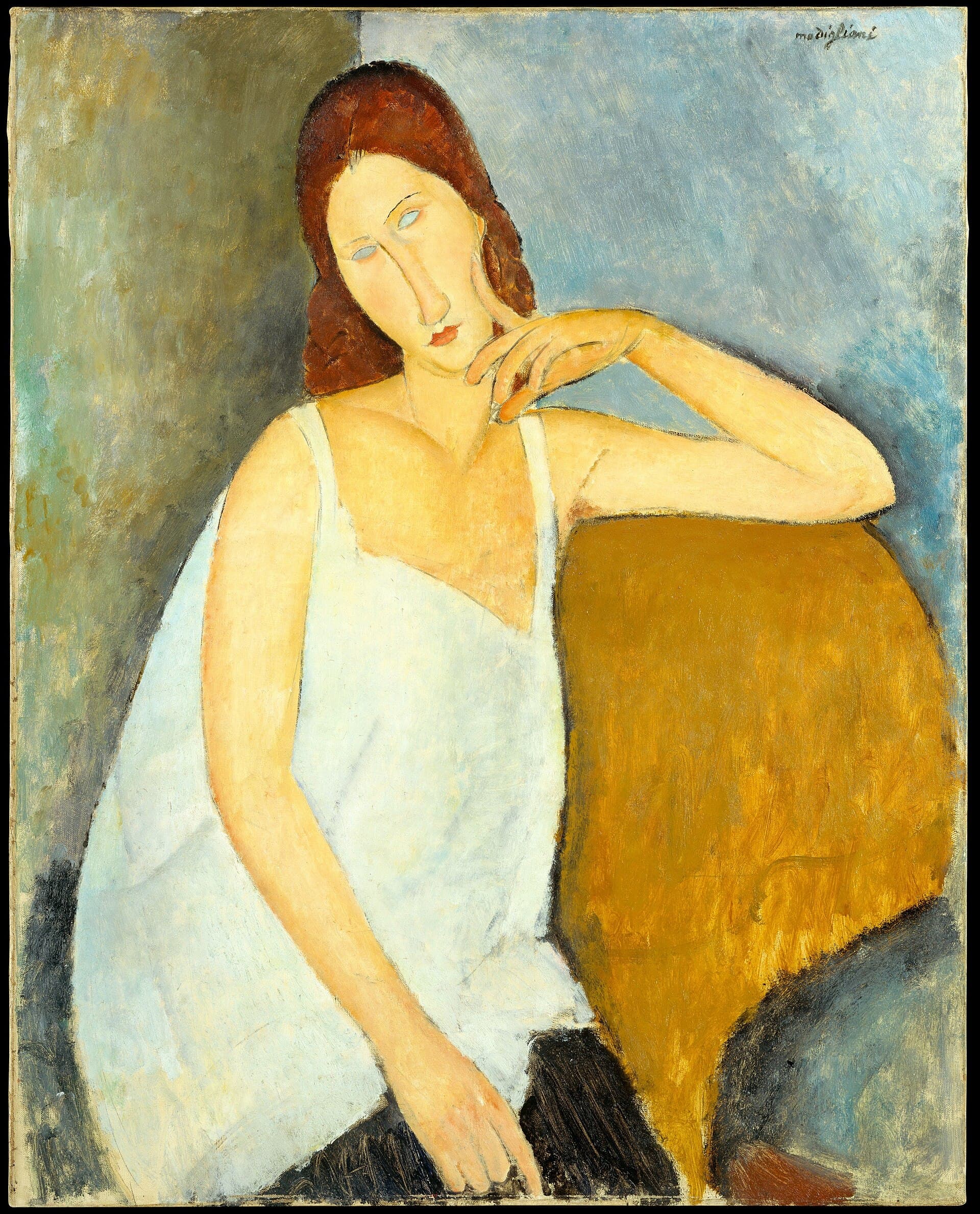
Jeanne Hébuterne sits in a big yellow armchair in a white chemise, her chin resting on the fingers of her left hand and her pale eyes left without pupils. Amedeo Modigliani painted her more than twenty times between 1917 and his death in 1920, and the Met dates this one 1919. The painting belongs to the Metropolitan Museum of Art in New York, 56.184.2.
- 1919
- Oil on canvas
- The Metropolitan Museum of ArtNew York, United States
About Amedeo Modigliani
What the painting shows
Jeanne Hébuterne sits turned a little to our left in a large armchair. The back of the chair is a deep ochre yellow and fills most of the right half of the canvas. She has laid her left arm along the top of the chair and bent the hand up, so her chin rests on the backs of her curled fingers.
Her head tilts to our right. Her face is long and pale, with a long nose drawn in a single line from the brow. Her eyes are two flat almonds of pale blue-gray with no pupils. Her small mouth is coral red. Thick auburn hair, parted in the middle, falls to both sides of her face.
She wears a plain white chemise, a loose slip with thin shoulder straps and a low V at the front. Her right arm hangs straight down, and her right hand comes down onto a dark skirt at the bottom edge of the painting.
The wall behind her changes colour behind her head. The wall is olive brown and gray on the left and a streaky pale blue on the right. Amedeo Modigliani signed the painting in small lowercase letters at the top right: modigliani.
Who Jeanne Hébuterne was
The Metropolitan Museum of Art says Jeanne Hébuterne, who lived from 1898 to 1920, was a young art student when she met Amedeo Modigliani in March 1917. The two fell in love and went south to the Côte d'Azur, where she gave birth to their daughter. They came back to Paris in May 1919.
Tate Modern, in its 2017 Modigliani exhibition, called her his most regular sitter. The two lived together, she was the mother of their child, and they were engaged to be married.
Back in Paris, Jacques Lipchitz remembered, they lived with their little girl in a small apartment. Amedeo Modigliani's health got worse after the return. He died on 24 January 1920. The Met says Jeanne Hébuterne, pregnant with their second child, died by suicide two days later.
The Met says he painted her more than twenty times, and usually made a point of her thick auburn hair and her blue eyes. Kathleen Brunner, writing for the Royal Academy in 2006, put the number at about twenty-five.
1918 or 1919?
The Met dates the painting 1919, but the people who have written about it have not agreed. The Met's own list of references sets out the argument.
John Russell, in the catalogue of a 1963 exhibition in Edinburgh, placed it in the late summer or autumn of 1918, during Jeanne Hébuterne's first pregnancy. The Met's catalogue of 1967, by Charles Sterling and Margaretta Salinger, said it was probably painted before she gave birth in November 1918. Gary Tinterow and his co-authors, in 1987, dated it 1918 and placed it in the south of France.
Osvaldo Patani, in 1991, dated it 1919. Christian Parisot and his co-authors, in 2000, dated it 1919 as well, during her second pregnancy.
Terence Measham wrote in 1986 that she was almost certainly pregnant when it was painted. The painting itself does not settle the question. The loose white chemise hides her shape.
The only portrait of her in a slip
Terence Measham noted in 1986 that among the more than twenty known portraits of her, this is the only one that shows her less than fully dressed.
The painting has carried many titles. At a Modigliani show at Bing & Cie in Paris in 1925 it was listed as Madame Modigliani. When it was sold in 1937 it was called Déshabillé au fauteuil, meaning undressed in an armchair. Joseph Lanthemann's catalogue of 1970 called it Jeanne Hébuterne, le doigt à la joue, meaning with her finger at her cheek.
The Met compares the long, stretched body and the lopsided pose to Italian painting of the sixteenth century, the style called Mannerism, which exaggerated the human figure for the sake of elegance. Marc Restellini, in 2008, compared it with another 1919 portrait of her with bare shoulders, now in a private collection.
From Zborowski to the Met
The Met's record of owners begins with Léopold Zborowski, Amedeo Modigliani's dealer in Paris. The Met says the painting probably then went to the collector Gaston Monteux. Christian Parisot published the memories of Jacques Guérin, who said Gaston Monteux bought a big portrait of Jeanne Hébuterne in 1923.
Gaston Monteux died in 1927, and the painting probably passed to his daughter Germaine and her husband, Bernard Reichenbach. They sold it at the Hôtel Drouot auction house in Paris on 3 June 1937, as Déshabillé au fauteuil. The Galerie Bing bought it for 30,000 francs.
The dealer Jacques Lindon of New York bought it in 1951 and sold it that September to Nate B. Spingold and his wife Frances. The Spingolds gave it to the Metropolitan Museum of Art in 1956.
The painting has travelled to many Modigliani exhibitions. The painting went to the Tate Gallery in 1968, the Jewish Museum in New York in 2004, the Royal Academy in London in 2006 and Tate Modern in 2017. In 2022 it went to Modigliani Up Close at the Barnes Foundation in Philadelphia, a show built on years of research by curators and conservators into how Amedeo Modigliani made his paintings. The catalogue reproduces X-ray and infrared pictures of this canvas.
Close reading
Reading the work, detail by detail
Amedeo Modigliani painted Jeanne Hébuterne more than twenty times. In this one she sits in a white chemise with her chin on her fingers. Up close the painting is made of very few things: two pale eyes with no pupils, a hand, a strap, a big yellow chair and a wall in two colours.
1.Two pale eyes with no pupils
Jeanne Hébuterne's eyes are two flat almonds of pale blue-gray, with no pupils and no whites. Only the eye on our right has a clear dark eyebrow over it. The long nose starts at that eyebrow and runs down in a single line. Because the eyes are blank, it is hard to say where she is looking, or whether she is looking at anything.
2.A small red mouth resting on her fingers
Jeanne Hébuterne's mouth is a small, closed shape of coral red, set far down the long face. Her chin sits right on the bent fingers of her left hand. A dark red-brown patch shows between two of the fingers. The patch is probably her hair behind the hand, but the painting does not make it clear.
3.Auburn hair with a centre parting
Jeanne Hébuterne's thick auburn hair is parted in the middle and falls to both sides of her face. The Met says Amedeo Modigliani usually made a point of this hair. A few dark strands drop from the parting onto her forehead. Behind her head the wall changes colour, olive brown on the left and pale blue on the right.
4.Fingers curled under the chin
Jeanne Hébuterne rests her chin on the backs of her curled fingers. The Met calls the pose pensive. Each finger is a long orange-pink shape edged with a thin dark line. Below the hand, the white strap of her chemise runs down over her shoulder.
5.Her arm laid along the chair back
Jeanne Hébuterne's left arm lies flat along the top of the big yellow chair, and that is what props her hand up to her chin. A soft reddish shadow sits in the hollow under the arm. A dark line separates the arm from the chair.
6.A white chemise with thin straps
Jeanne Hébuterne wears a plain white chemise, a loose slip with thin shoulder straps and a low V at the front. Terence Measham noted in 1986 that this is the only one of her twenty-odd portraits in which she is not fully dressed. Two thin lines mark her collarbones.
7.The big yellow chair
Most of the right half of the painting is the back of one big armchair, painted a deep ochre yellow. The Met calls it a large chair. Where the white chemise meets the chair, Amedeo Modigliani drew a dark, uneven line. The brushstrokes on the chair all run up and down.
8.The long right arm
Jeanne Hébuterne's right arm hangs straight down her side, long and smooth, with almost no elbow. The chemise beside it is painted in pale blue-white with a few gray lines for folds. The Met links this stretching of the body to Italian painting of the sixteenth century.
9.An arm coming down to a dark skirt
Near the bottom of the painting Jeanne Hébuterne's right arm comes down to her lap. Below the white chemise she seems to wear a dark skirt, painted in quick brown-black strokes that let the canvas show through. Her hand rests on the skirt just below this view, near the bottom edge.
10.modigliani, in small letters
Amedeo Modigliani signed in small lowercase letters in the top right corner: modigliani. The signature sits on the blue wall, well away from the figure. The thin black band along the top edge belongs to the museum's photograph, not to the painting.
11.The olive and green wall on the left
The wall on the left is olive brown and gray, with patches of green-blue near the edge and a few drips of ochre lower down. The wall is painted loosely, like the blue wall on the other side. Nothing in the painting says whether these are two walls, a wall and a door, or just two colours.
12.Streaky blue behind the raised arm
Behind Jeanne Hébuterne's raised arm the wall is pale blue, brushed on in short streaks that let a lighter layer show through. The blue sits right beside her pale blue eyes and the white chemise, so the cool colours of the painting all gather in this upper right part.
13.A dark band at the lower left
Down the lower left edge runs a band of dark gray-black paint beside the white chemise. The band may be the shadowed side of the chair or just the room. The painting does not say. At the very edge the paint thins out and the canvas weave shows.
14.Dark blue and a red-brown shape in the corner
In the lower right corner the ochre chair gives way to dark blue-black and blue-gray paint. A red-brown shape sits at the bottom edge. The shape might be the foot of the chair or part of the floor, but it is not clear. Along the bottom and right edges the paint stops short and the canvas shows through.
Timeline
1917
Jeanne Hébuterne, a young art student, meets Amedeo Modigliani in March.
1918
The couple go south to the Côte d'Azur. Their daughter is born there in November. Some scholars date the painting to this year.
1919
They return to Paris in May. The Met dates the painting to this year. Jeanne Hébuterne is pregnant again.
1920
Amedeo Modigliani dies on 24 January. Jeanne Hébuterne dies two days later.
1925
Shown at Bing & Cie in Paris as Madame Modigliani.
1937
Sold at the Hôtel Drouot in Paris as Déshabillé au fauteuil, for 30,000 francs, to the Galerie Bing.
1951
Jacques Lindon sells it to Nate B. and Frances Spingold in New York.
1956
The Spingolds give it to the Metropolitan Museum of Art.
2022–2023
Studied and shown in Modigliani Up Close at the Barnes Foundation in Philadelphia.
Where to see it
The Metropolitan Museum of Art
1000 Fifth Avenue, New York, NY 10028, United States
The Met listed the painting as not on view in 2026. Gallery displays change, so check the museum's page before a visit.
Plan your visit on the museum’s official website (opens in a new tab)Frequently asked questions
Who was Jeanne Hébuterne?
Jeanne Hébuterne was a young art student who met Amedeo Modigliani in March 1917 and became his partner and the mother of his daughter. He painted her more than twenty times. She died two days after him, in January 1920, while pregnant with their second child.
When was the painting made?
The Metropolitan Museum of Art dates it 1919. Several earlier writers dated it to 1918, when the couple were in the south of France. The painting itself does not settle it.
Was Jeanne Hébuterne pregnant when he painted this?
Probably. Terence Measham wrote in 1986 that she was almost certainly pregnant. Writers who date it 1918 place it in her first pregnancy, and writers who date it 1919 place it in her second.
Why are her eyes blank?
Amedeo Modigliani often painted eyes as flat almonds of colour with no pupils. Here they are pale blue-gray. His own explanation, as the painter Léopold Survage remembered it, is on the Amedeo Modigliani page.
How many times did Modigliani paint Jeanne Hébuterne?
More than twenty times, according to the Met. Kathleen Brunner, writing for the Royal Academy in 2006, counted about twenty-five.
How big is the painting?
91.4 by 73 centimeters, about three feet tall. The painting is oil on canvas and signed modigliani at the upper right.
Where can I see it?
At the Metropolitan Museum of Art in New York, accession number 56.184.2. The museum listed it as not on view in 2026, so check its page before a visit.
More by Amedeo Modigliani
If you like Amedeo Modigliani
Explore painters from the same movements and circles.

Arman
French-American artist, lifelong friend of Yves Klein, and a founder of New Realism.
View artist
Jean Arp
Strasbourg-born sculptor and poet — Hans in German, Jean in French, both all his life — who co-founded Dada at the Cabaret Voltaire in 1916, composed collages by dropping torn paper 'according to the laws of chance', and settled at Meudon outside Paris in a house his wife Sophie Taeuber-Arp designed.
View artist
Rosa Bonheur
At the horse markets of Paris and in her studio beside the forest of Fontainebleau, Rosa Bonheur gave animals the presence of great portrait subjects. The success of The Horse Fair helped her build a life shaped by her work, financial independence, and the women she loved.
View artist
References
The sources below include collection records, catalogues, scholarly research, and primary materials that informed this page. They document Jeanne Hébuterne, its making, and its place in cultural history.


1Amedeo Modigliani, Jeanne Hébuterne, 1919 (56.184.2)
WebsiteThe Metropolitan Museum of ArtUsed forThe holding museum's record, read from the Wayback capture of 3 April 2026 because the Met refuses scripted requests. The close-reading views were cropped from the Met's own photograph.
2Exhibition Guide: Modigliani (Tate Modern, 2017–18)
WebsiteTateUsed forTate Modern on Jeanne Hébuterne as his most regular sitter and fiancée.
3Modigliani Up Close (exhibition, 16 October 2022 – 29 January 2023)
WebsiteBarnes Foundation, Philadelphia, 2022Used forThe Barnes Foundation's 2022–23 exhibition on Amedeo Modigliani's working methods and materials, where the painting was shown and studied.
4Amedeo Modigliani (1884–1920)
MemoirHarry N. Abrams, in association with Pocket Books, 1954Used forJacques Lipchitz on the family's small apartment in Paris in 1919.
These references provide the documented foundation for this work's history and interpretation. Claim-level citations remain attached to the specific claims they support.
 Explore more resources