
Depicts · 1918
Chaïm Soutine
The National Gallery of Art titles the portrait Chaim Soutine and describes the sitter as Amedeo Modigliani's younger friend, whom he painted several times and introduced to his dealer Léopold Zborowski in 1916.
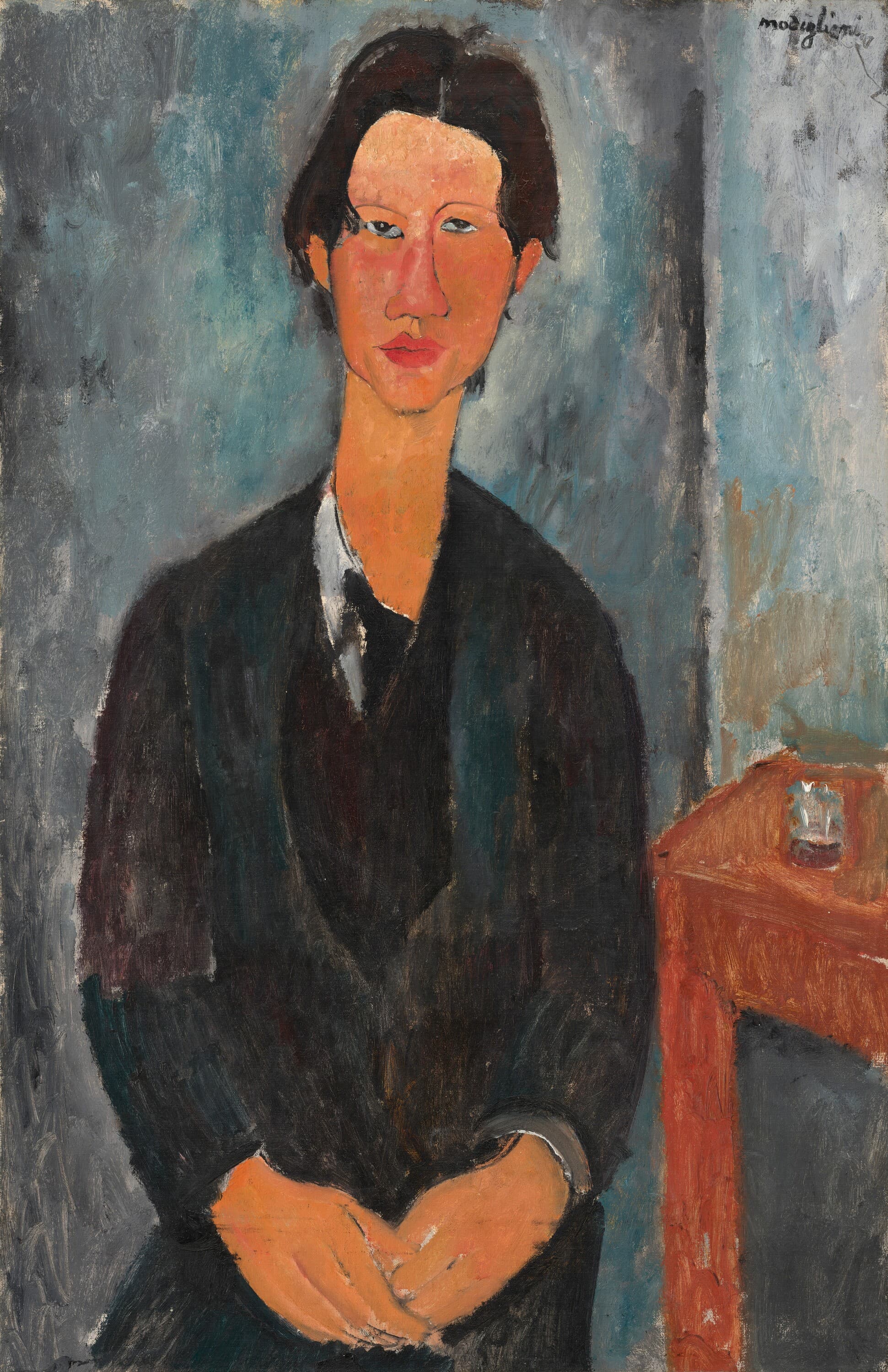
The painter Chaim Soutine sits in a black coat with his hands in his lap and his hair parted down the middle, beside a small red table with a glass on it. Amedeo Modigliani painted his younger friend several times. The National Gallery of Art in Washington dates this portrait 1918 and owns it as 1963.10.47.
Chaim Soutine sits facing us, shown from the lap up. His long face is orange-pink, and the two halves of it do not quite match. His gray-blue eyes have dark pupils and sit at slightly different heights. His nose is wide and his lips are full and rose red.
His dark hair is parted straight down the middle and falls in a heavy mass to his ears. His neck is long, and his shoulders slope steeply down.
He wears a black coat over a dark teal-green waistcoat, with a white shirt collar showing on one side of his neck. The National Gallery of Art says a dark shape at his throat could be the knot of a tie. His hands rest together in his lap, one hand holding the fingers of the other.
To his left, on our right, stands a small red table. On it is what the National Gallery of Art calls possibly a glass, a few dabs of pale blue and white with a dark red band at the bottom. The walls are gray and blue-gray, with a dark vertical line on the right that the Gallery reads as probably the corner of the room. Amedeo Modigliani signed the painting at the top right: modigliani.
Chaïm Soutine was born in 1894, the eleventh child of a Russian Jewish tailor, the National Gallery of Art says. He studied art in Minsk and then Vilna, and came to Paris at seventeen, in 1911 or 1912.
The Musée de l'Orangerie says Chaim Soutine arrived in Paris in 1912, stayed for a while at the La Ruche artists' residence, and later moved to the Cité Falguière.
The National Gallery of Art says he met Amedeo Modigliani in Montparnasse in about 1914. The Musée de l'Orangerie and the Barnes Foundation both say the sculptor Jacques Lipchitz introduced them, and the Barnes gives the year as 1915. The two became close friends. Amedeo Modigliani was ten years older, and the Gallery says he felt protective of the younger man and painted his portrait several times.
The two painted in very different ways. The Gallery says Chaim Soutine's unruly, spontaneous way of painting was foreign to Amedeo Modigliani, and it quotes a joke Amedeo Modigliani made about being drunk: everything dances around me as in a landscape by Soutine.
The sculptor Jacques Lipchitz remembered that in his last years Amedeo Modigliani grew more and more devoted to Chaim Soutine. Chaim Soutine had only a small studio, Jacques Lipchitz wrote, but he was always ready to share what he had with his friend.
In 1916 Amedeo Modigliani introduced Chaim Soutine to his own dealer, the Polish poet Léopold Zborowski, and pressed him to take on Chaim Soutine's work. Léopold Zborowski did, the National Gallery of Art says.
Shortly before he died in January 1920, Amedeo Modigliani is said to have told Léopold Zborowski not to worry, because he was leaving him Soutine. Those words are the National Gallery of Art's version. Jacques Lipchitz, who knew them both, gave it in 1954 as: Don't worry, in Soutine I am leaving you a man of genius.
The Barnes Foundation says Léopold Zborowski sent Chaim Soutine to the south of France in 1918. In 1922 the American collector Albert Barnes saw one of his paintings of a pastry chef and began collecting his work eagerly, which helped make Chaim Soutine's name. The Musée de l'Orangerie says it was through the dealer Paul Guillaume that Albert Barnes found him.
Léopold Zborowski owned this portrait. Léopold Zborowski is the first name in the Gallery's record of owners.
The National Gallery of Art says many of Amedeo Modigliani's portraits are either stylized and impersonal, with the eyes left blank, or close to caricature. The Gallery finds this one both particular and sympathetic.
The Gallery points to Chaim Soutine's tumbling hair, his ill-matched clothes, his hands placed awkwardly in his lap and his nose spreading across his face. The Gallery says the half-closed eyes, one a little higher than the other, might suggest despair and hopelessness, feelings Amedeo Modigliani knew well as a poor artist in Paris.
The Gallery also suggests the portrait may show the special place Chaim Soutine had won in the older painter's affections. Both readings are the museum's, and it offers them as possibilities.
After Léopold Zborowski, the painting belonged to Jacques Netter in Paris. In 1928 it was sold through the Paris dealer Étienne Bignou to Alex Reid & Lefèvre in London, which shared it with de Hauke & Co. of New York.
It was shown at de Hauke & Co. in New York and at Reid & Lefèvre in London in 1929. On 21 May 1929 it was sold to the American collector Chester Dale. The Lefèvre gallery's own sales records, now in the Tate archive in London, record the purchase and the shared ownership.
Chester Dale lent it to Modigliani shows in New York in 1931, Brussels in 1933 and Basel in 1934, and to the Museum of Modern Art and the Cleveland Museum of Art in 1951. He left it to the National Gallery of Art in 1963. The Gallery listed it on view in its East Building, Gallery 103, in 2026.
Close reading
Amedeo Modigliani painted his friend Chaim Soutine several times. In this one Chaim Soutine sits in a black coat with his hands in his lap beside a small red table. Up close the face is lopsided on purpose, the clothes dissolve into loose dark strokes, and a glass on the table is only a few dabs of white.
1.Two eyes at different heights
Chaim Soutine's eyes are gray-blue with dark pupils, and they sit at slightly different heights. The two halves of his face do not quite match. The National Gallery of Art says the half-closed, uneven eyes might suggest despair. Unlike many of Amedeo Modigliani's portraits, the eyes are not blank.
2.Black hair parted down the middle
Chaim Soutine's dark hair is parted straight down the middle, and a thin pale line marks the parting. The hair falls in a heavy mass down to his ears on both sides. His forehead is a broad, smooth patch of orange-pink.
3.Full red lips and a long neck
Chaim Soutine's lips are full and rose red, the brightest colour on his face. Under them a small dark mark sits on the chin. The mark could be a shadow or stubble; it is too small to tell. The neck below is long, in Amedeo Modigliani's usual way.
4.A white collar and something dark at the throat
Chaim Soutine's white shirt collar shows on one side of his neck only. A dark shape sits at his throat. The National Gallery of Art suggests it could be the knot of a tie, and that is the best guess. His black coat closes over both.
5.Black coat, dark green waistcoat
Chaim Soutine wears a black coat over a dark teal-green waistcoat. The National Gallery of Art calls his clothes ill-matched. Up close they are just long, loose strokes of black, brown-red and green, with no buttons or seams drawn in.
6.Hands held together in his lap
Chaim Soutine rests his hands in his lap, one hand holding the fingers of the other. The National Gallery of Art calls the placing awkward. A gray shirt cuff with a white edge shows at one wrist.
7.White touches on the knuckles
Amedeo Modigliani drew Chaim Soutine's fingers with a few dark lines and added small touches of white on the knuckles. Those highlights are almost the only white in the lower half of the painting.
8.A small red table
To Chaim Soutine's left, on our right, stands a small table painted red-orange in loose, visible strokes. The table is the only piece of furniture in the painting. Its edge runs right up against his black coat.
9.A glass made of a few dabs
On the table sits what looks like a glass, made of a few dabs of pale blue and white, with a dark red band at the bottom. The National Gallery of Art says it could be a glass. The red at the bottom might be wine, or it may just be the table showing through.
10.modigliani, and faint lines beside it
Amedeo Modigliani signed in black letters in the top right corner: modigliani. To the right of the signature there are faint gray curling lines. The lines could be an earlier try at the signature or just brushwork; the painting does not say which.
11.A line down the wall
Behind Chaim Soutine's shoulder a dark vertical line runs down the blue-gray wall, with tan and pale blue patches beyond it. The National Gallery of Art reads the line as probably the corner of the room.
12.A narrow, sloping shoulder
Chaim Soutine's shoulder slopes steeply down from his neck, so the black coat makes a long diagonal against the wall. The wall here is gray and blue-gray, brushed in short strokes.
13.Table leg and dark floor
Under the table a single red leg stands against a dark gray area, probably the floor or the lower wall. At the left edge of this view, Chaim Soutine's gray cuff and hand come into the picture.
1894
Chaim Soutine is born, the eleventh child of a Russian Jewish tailor.
1911–1912
Chaim Soutine arrives in Paris at seventeen.
c. 1914
He meets Amedeo Modigliani in Montparnasse.
1916
Amedeo Modigliani introduces him to the dealer Léopold Zborowski.
1918
The National Gallery of Art's date for the portrait.
1920
Amedeo Modigliani dies in January, having told Léopold Zborowski that he was leaving him Chaim Soutine.
1929
Shown in New York and London, then sold on 21 May to Chester Dale.
1951
Shown at the Museum of Modern Art and the Cleveland Museum of Art.
1963
Chester Dale's bequest brings it to the National Gallery of Art.
National Gallery of Art
Washington, United States
A public viewing address has not yet been confirmed for this holding.
The National Gallery of Art listed the painting in the East Building, Gallery 103, in 2026. Gallery displays change, so check the museum's page before a visit.
A painter, born in 1894 into a poor Jewish family in the Russian Empire, who came to Paris in 1911 or 1912. He met Amedeo Modigliani in Montparnasse in about 1914, and the two became close friends.
Yes. The National Gallery of Art says he painted Chaim Soutine's portrait several times.
Amedeo Modigliani set one eye a little higher than the other and made the two halves of the face differ. The National Gallery of Art says the half-closed, uneven eyes might suggest despair and hopelessness. The painting does not explain itself.
Probably a glass. The National Gallery of Art says an area of slate blue and white could be a glass on the table. Up close it is a few dabs of pale blue and white with a dark red band at the bottom.
The National Gallery of Art, which owns it, dates it 1918, near the end of Amedeo Modigliani's life. He died in January 1920.
At the National Gallery of Art in Washington, accession number 1963.10.47, in the Chester Dale Collection. The Gallery listed it in the East Building, Gallery 103, in 2026.
Depicts · 1918
The National Gallery of Art titles the portrait Chaim Soutine and describes the sitter as Amedeo Modigliani's younger friend, whom he painted several times and introduced to his dealer Léopold Zborowski in 1916.
Explore painters from the same movements and circles.
French-American artist, lifelong friend of Yves Klein, and a founder of New Realism.
View artist
Strasbourg-born sculptor and poet — Hans in German, Jean in French, both all his life — who co-founded Dada at the Cabaret Voltaire in 1916, composed collages by dropping torn paper 'according to the laws of chance', and settled at Meudon outside Paris in a house his wife Sophie Taeuber-Arp designed.
View artist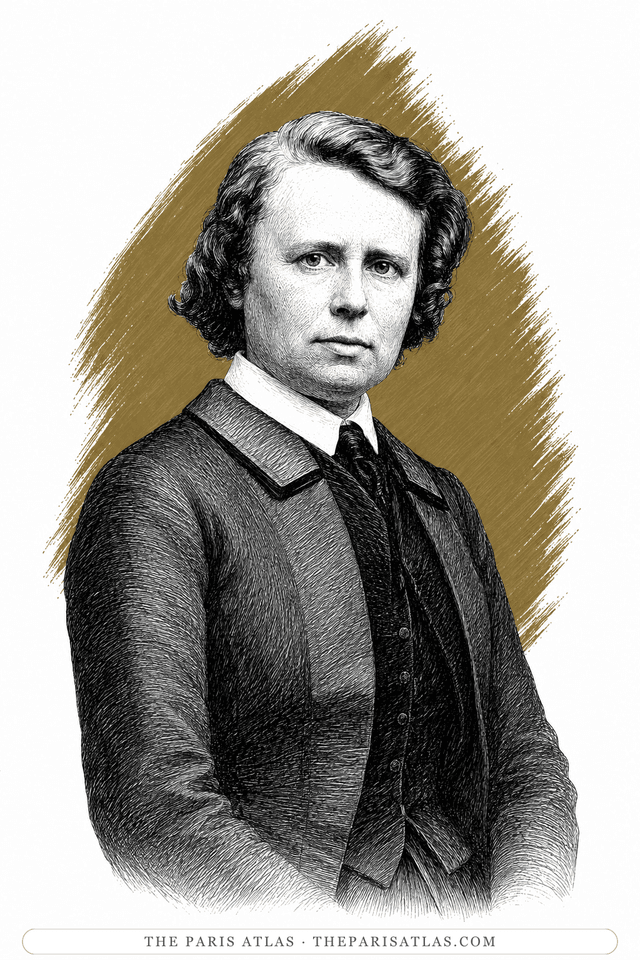
At the horse markets of Paris and in her studio beside the forest of Fontainebleau, Rosa Bonheur gave animals the presence of great portrait subjects. The success of The Horse Fair helped her build a life shaped by her work, financial independence, and the women she loved.
View artistThe sources below include collection records, catalogues, scholarly research, and primary materials that informed this page. They document Chaim Soutine, its making, and its place in cultural history.

The holding museum's record, read from its open data and a Wayback capture of 9 February 2026, and the reproduction the close-reading views were cropped from.
Jacques Lipchitz's memory of the friendship and his version of the deathbed words.
The Musée de l'Orangerie on Chaim Soutine's arrival in Paris, La Ruche, the Cité Falguière, Jacques Lipchitz's introduction and Paul Guillaume.
The Barnes Foundation on the 1915 introduction, the 1918 move south and Albert Barnes's purchases in 1922.
These references provide the documented foundation for this work's history and interpretation. Claim-level citations remain attached to the specific claims they support.
 Explore more resources