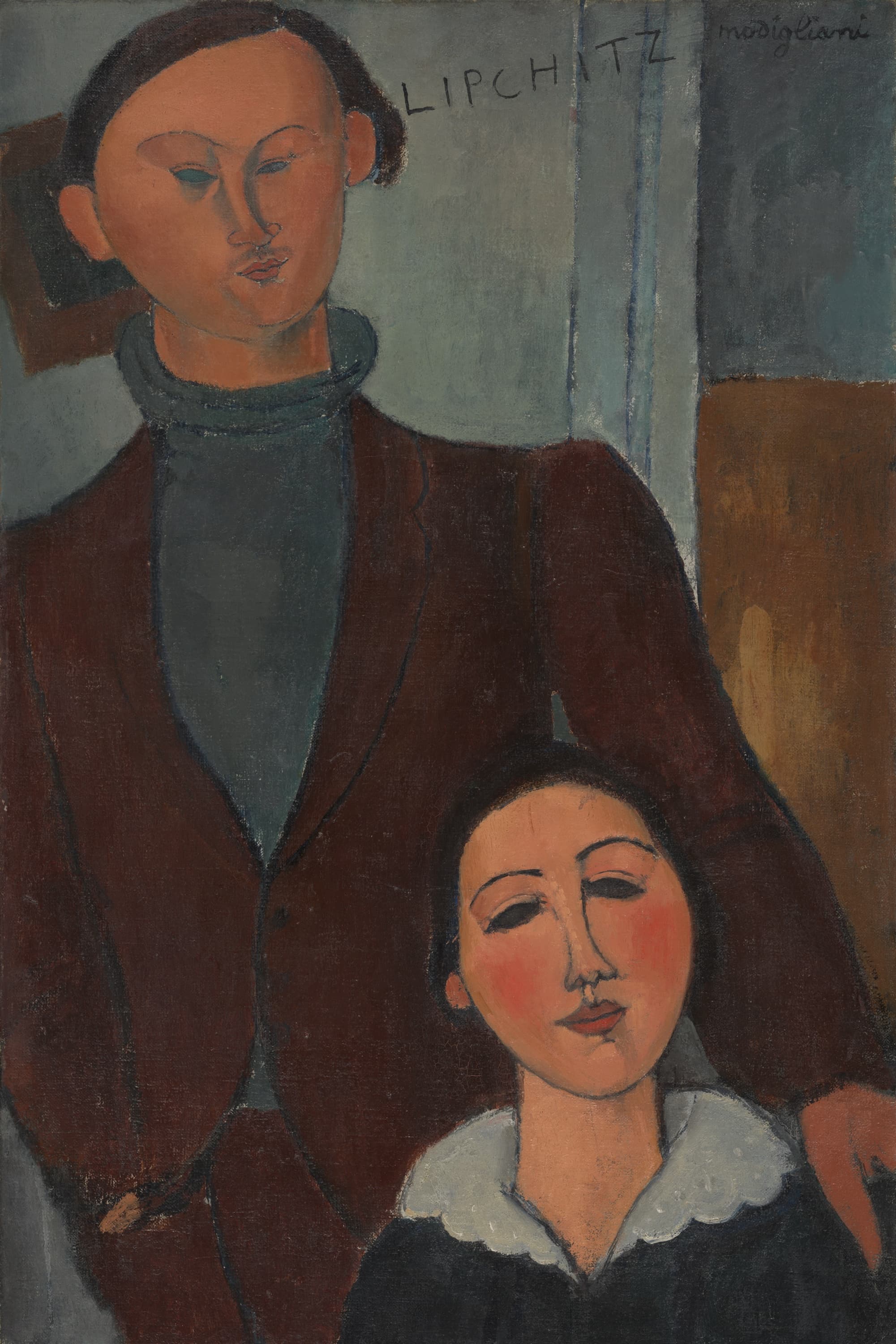
Jacques and Berthe Lipchitz
The sculptor Jacques Lipchitz stands behind his wife, the Russian poet Berthe Kitrosser, one hand beside her white collar, with his name lettered across the wall. Jacques Lipchitz asked Amedeo Modigliani to paint the two of them in 1916, when he was newly married, and Amedeo Modigliani charged ten francs a sitting and a little alcohol. The painting belongs to the Art Institute of Chicago, 1926.221.
- 1916
- Oil on canvas
- Art Institute of ChicagoChicago, United States
About Amedeo Modigliani
What the painting shows
Jacques Lipchitz stands behind and to the left of his wife, filling most of the canvas. He wears a red-brown jacket over a gray-green turtleneck sweater. His face is long, with pale gray-green eyes that have no pupils and a small red mouth pushed forward.
Berthe Lipchitz sits lower down at the right, in a dark dress with a wide pale collar with a scalloped edge. Her black hair is pulled close around her head. Her eyes are filled in dark, so they look half-closed, and her cheeks are pink.
Jacques Lipchitz's hand comes down beside her collar at the right edge of the painting. The hand seems to rest on her shoulder or on the back of her chair, and the edge of the canvas cuts it off.
Across the gray-green wall beside his ear, Amedeo Modigliani lettered the name LIPCHITZ in thin capitals. He signed his own name in lowercase at the top right: modigliani. Behind the couple are a dark square at the upper left, a pale strip with blue lines and a brown panel on the right. What any of these shapes is, the painting does not make clear.
Ten francs a sitting
Jacques Lipchitz told the story himself in his 1954 book on Amedeo Modigliani. In 1916 he had just signed a contract with the dealer Léonce Rosenberg, so he had a little money. He was also newly married, and he and his wife decided to ask Amedeo Modigliani to paint them.
Amedeo Modigliani answered: my price is ten francs a sitting and a little alcohol, you know. The Art Institute of Chicago says Jacques Lipchitz commissioned the portrait to help his friend, who was short of money, on the occasion of his marriage to Berthe Kitrosser.
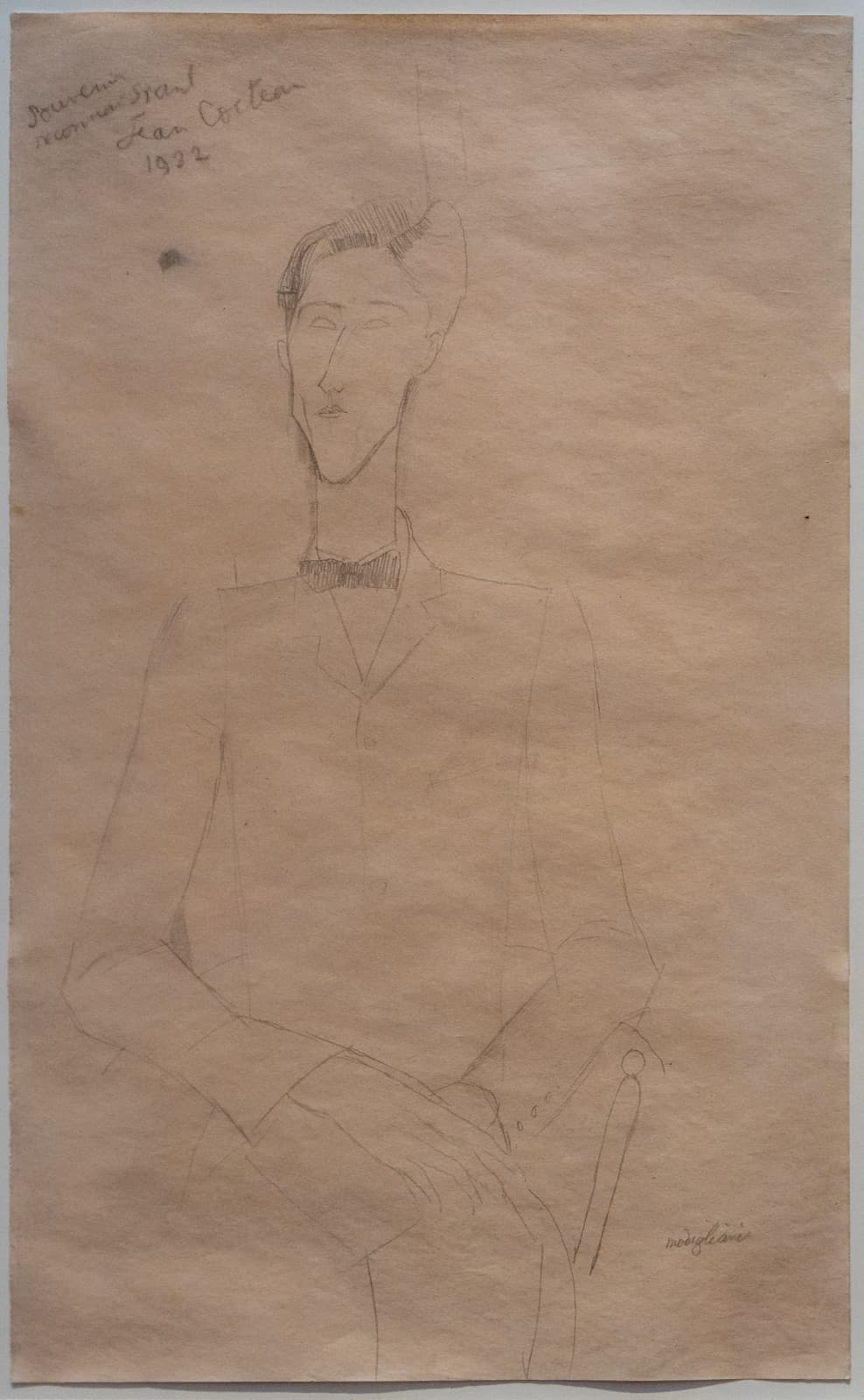
The next day Amedeo Modigliani came and made a lot of drawings, one after the other, very fast and very precise. Two of them, one of each sitter, are reproduced in Jacques Lipchitz's book. In the end they chose a pose based on the couple's wedding photograph.
Finished in a day, stretched to two weeks
The following day, at one o'clock, Amedeo Modigliani arrived with an old canvas and his box of paints. Jacques Lipchitz remembered him sitting in front of the canvas, which he had propped on a chair, working quietly and stopping now and then to take a gulp from the bottle of alcohol beside him.
By the end of the day Amedeo Modigliani said, well, I guess it's finished. Jacques Lipchitz felt uneasy at getting the painting for only ten francs. Jacques Lipchitz had not imagined that two portraits on one canvas could be done in a single session.
So Jacques Lipchitz invented excuses for more sittings. You know, he told his friend, we sculptors like more substance. Amedeo Modigliani answered: well, if you want me to spoil it, I can continue.
As Jacques Lipchitz recalled it, the portrait then took almost two weeks, probably the longest Amedeo Modigliani ever spent on one painting. The Art Institute of Chicago tells the same story: two days to paint, and two more weeks so that Jacques Lipchitz could pay him a larger fee.
The sculptor and the poet
Jacques Lipchitz was a sculptor. He wrote that Max Jacob first introduced him to Amedeo Modigliani, who invited him to his studio at the Cité Falguière, a cluster of artists' studios in the fifteenth arrondissement. Amedeo Modigliani was still carving stone then. Jacques Lipchitz found him outdoors in the courtyard, arranging a few stone heads, maybe five, on the cement floor. Amedeo Modigliani explained that he had thought of them all as one group. Jacques Lipchitz thought the heads were shown at the Salon d'Automne later that year. Tate Modern says a group of seven of Amedeo Modigliani's stone heads was in the Salon d'Automne of 1912.
The Art Institute of Chicago names his wife as Berthe Kitrosser, a Russian poet. The painting shows the difference between the two of them plainly: his pale open eyes and her dark lowered ones, his standing figure and her small seated one.
The death mask
When Amedeo Modigliani died in January 1920, the painter Moïse Kisling and a friend, Conrad Moricand, tried to make a plaster cast of his face. Jacques Lipchitz wrote that they did it very badly and brought him a lot of broken pieces of plaster.
Jacques Lipchitz patiently put the pieces together and rebuilt the missing parts as well as he could. He made twelve plaster copies of the mask, which went to Amedeo Modigliani's family and friends.
The National Gallery of Art in Washington owns a bronze cast of the mask, made in 1929, and credits it to Jacques Lipchitz, assisted by Conrad Moricand and Moïse Kisling.
Traded for stone sculptures
The portrait hung on Jacques Lipchitz's wall for a long time. Then, after Amedeo Modigliani's death, he wanted his dealer to give back some of his stone sculptures that he no longer felt represented his work. The dealer asked more money than he could pay. The only thing Jacques Lipchitz could offer in exchange was the Modigliani portrait.
The dealer accepted, and as soon as Jacques Lipchitz had his stones back, he destroyed them. The Art Institute of Chicago records the exchange: the painting went to Léonce Rosenberg, of the Galerie de l'Effort Moderne in Paris, in about 1921.
The earliest exhibition the Art Institute of Chicago lists is in December 1920, a retrospective of Amedeo Modigliani's work at the Galerie Montaigne in Paris, as Portrait du sculpteur L. et de sa femme, meaning portrait of the sculptor L. and his wife.
Léonce Rosenberg sold it in 1922 to Frederick C. Bartlett and Helen Birch Bartlett of Chicago. After Helen Birch Bartlett died, the painting was given to the Art Institute of Chicago, on 27 January 1926. For years the museum called it simply Double Portrait.
1916 or 1917?
The Art Institute of Chicago dates the painting 1916, and Jacques Lipchitz himself put the commission in 1916. Many books have given 1917 instead, including Christian Parisot's and Osvaldo Patani's catalogues of 1991, according to the museum's list of publications.
The painting has travelled widely. The portrait was at the Museum of Modern Art in New York in 1942 and 1951, at the Tate Gallery in London in 1952, at Tate Modern in 2017 and at the Staatsgalerie Stuttgart in 2023. In September 2026 the Art Institute of Chicago listed it on view in Gallery 391.
Close reading
Reading the work, detail by detail
Jacques Lipchitz said Amedeo Modigliani finished this double portrait in one day, and that he paid him to keep working on it for almost two weeks. Up close you can see the name painted across the wall, two very different pairs of eyes, a hand beside a collar and a few shapes behind the couple that are hard to name.
1.LIPCHITZ, painted across the wall
Across the gray-green wall, just beside Jacques Lipchitz's ear, Amedeo Modigliani lettered the name LIPCHITZ in thin, slightly uneven capitals. The Art Institute of Chicago records it as inscribed at upper centre. The last letters run over a pale upright strip on the wall.
2.modigliani on the dark block
Amedeo Modigliani signed in the top right corner, in dark lowercase script on a dark gray block of wall: modigliani. The signature and the sitters' name sit side by side along the top of the painting.
3.Jacques Lipchitz's blank, pale eyes
Jacques Lipchitz's eyes are pale gray-green almonds with no pupils, set under high, thin brows. His nose is long and his small red mouth is pushed forward, almost pursed. Dark curly hair shows behind his ear.
4.A dark square behind his head
Behind Jacques Lipchitz's head, at the left edge, hangs a dark brown square with a darker shape inside it. The square could be a picture on the wall, a board or a window, but the painting does not make clear what it is.
5.A gray-green turtleneck
Jacques Lipchitz wears a gray-green turtleneck sweater with a thick rolled collar, under a red-brown jacket. A dark line runs down the edge of the jacket. The sweater is almost the same colour as the wall behind him.
6.One button on the jacket
Jacques Lipchitz's lapels meet in a V over his sweater, and below them sits a single dark round button. Berthe Lipchitz's head comes in at the right, set against his jacket. The two faces are painted in the same warm skin colour.
7.A sliver of hand at the lower left
At the lower left a small pale orange stroke appears at the end of a dark line on the jacket. The stroke may be Jacques Lipchitz's other hand, mostly hidden, or a thumb hooked into a pocket. The painting shows too little to be sure.
8.Berthe Lipchitz's dark, lowered eyes
Berthe Lipchitz's eyes are filled in dark, so they look half-closed or lowered, very different from her husband's pale ones. Her brows are long dark arches, and her cheeks are painted pink. Her nose runs in one line down from the brow.
9.Black hair close to the head
Berthe Lipchitz's black hair is pulled close around her head like a cap. Above it a small gray-green wedge shows between her husband's arm and body. A few faint scratch lines cross her forehead.
10.A white collar with a scalloped edge
Berthe Lipchitz wears a wide pale collar with a scalloped edge and small dots, perhaps lace, over a dark dress. Her neck rises long and straight out of it. In the dark red-brown of her husband's jacket behind her, fine cracks from age run across the paint.
11.His hand beside her collar
At the right edge Jacques Lipchitz's hand comes down beside Berthe Lipchitz's collar, an orange-red shape with a few dark lines for fingers. The hand seems to rest on her shoulder or on the back of her chair, and the edge of the painting cuts it off. Jacques Lipchitz said the pose came from their wedding photograph.
12.A pale strip with blue lines
Behind Jacques Lipchitz's shoulder the gray-green wall meets a pale upright strip marked with blue vertical lines. Beyond it is a dark gray block. The strip might be a door frame or the edge of a window, but the painting does not make it clear.
13.A brown panel with a pale shape
To the right of Jacques Lipchitz's sleeve is a brown-ochre panel with a pale yellow upright shape and reddish streaks. The panel could be furniture, a painting or a patch of light. Nothing in the painting settles it.
Timeline
1916
Jacques Lipchitz, newly married and under contract to Léonce Rosenberg, asks Amedeo Modigliani to paint him and Berthe Kitrosser. The portrait is finished in one day and worked on for almost two weeks more.
1920
First shown at the Galerie Montaigne retrospective in Paris, 11–29 December, as Portrait du sculpteur L. et de sa femme.
1920
Amedeo Modigliani dies in January. Jacques Lipchitz pieces together the broken plaster of his death mask and makes twelve copies.
c. 1921
Jacques Lipchitz trades the portrait to Léonce Rosenberg to get back stone sculptures, which he destroys.
1922
Frederick C. Bartlett and Helen Birch Bartlett buy it for their collection in Chicago.
1926
Given to the Art Institute of Chicago on 27 January, after Helen Birch Bartlett's death.
1942
Shown at the Museum of Modern Art in New York in Twentieth-Century Portraits.
2017–2018
Shown at Tate Modern in London.
Where to see it
Art Institute of Chicago
111 South Michigan Avenue, Chicago, IL 60603, United States
The Art Institute of Chicago's record listed the painting as on view in Gallery 391 in September 2026. Gallery displays change, so check the museum's page before a special visit.
Plan your visit on the museum’s official website (opens in a new tab)Frequently asked questions
Who are the two people in the painting?
The sculptor Jacques Lipchitz, standing, and his wife Berthe, born Berthe Kitrosser, a Russian poet, seated in front of him. He asked Amedeo Modigliani to paint them when they were newly married, in 1916.
Why is LIPCHITZ written on the wall?
Amedeo Modigliani lettered the sitter's name across the top of the painting. The Art Institute of Chicago records it as inscribed at upper centre. His own signature, modigliani, is at the upper right.
How much did Modigliani charge?
Ten francs a sitting and a little alcohol, according to Jacques Lipchitz. The painting was finished in one day, and Jacques Lipchitz asked for almost two weeks of extra sittings so he could pay his friend more.
How was the pose chosen?
Amedeo Modigliani made many quick drawings of the couple first. Jacques Lipchitz wrote that the pose they chose was inspired by their wedding photograph.
Why did Jacques Lipchitz give the painting up?
He traded it to his dealer, Léonce Rosenberg, in about 1921 to get back some of his own stone sculptures, which he then destroyed.
Where can I see it?
At the Art Institute of Chicago, accession number 1926.221, in the Helen Birch Bartlett Memorial Collection. In September 2026 the museum listed it on view in Gallery 391.
More by Amedeo Modigliani
If you like Amedeo Modigliani
Explore painters from the same movements and circles.
Arman
French-American artist, lifelong friend of Yves Klein, and a founder of New Realism.
View artist
Jean Arp
Strasbourg-born sculptor and poet — Hans in German, Jean in French, both all his life — who co-founded Dada at the Cabaret Voltaire in 1916, composed collages by dropping torn paper 'according to the laws of chance', and settled at Meudon outside Paris in a house his wife Sophie Taeuber-Arp designed.
View artist
Rosa Bonheur
At the horse markets of Paris and in her studio beside the forest of Fontainebleau, Rosa Bonheur gave animals the presence of great portrait subjects. The success of The Horse Fair helped her build a life shaped by her work, financial independence, and the women she loved.
View artist
References
The sources below include collection records, catalogues, scholarly research, and primary materials that informed this page. They document Jacques and Berthe Lipchitz, its making, and its place in cultural history.


1Amedeo Modigliani, Jacques and Berthe Lipchitz, 1916 (1926.221)
WebsiteArt Institute of ChicagoUsed forThe holding museum's record, and the reproduction the close-reading views were cropped from.
2Amedeo Modigliani (1884–1920)
MemoirHarry N. Abrams, in association with Pocket Books, 1954Used forJacques Lipchitz's own account of the commission, the sitting, the extra two weeks, the trade with his dealer and the death mask.
3Jacques Lipchitz, Death Mask of Amedeo Modigliani, model 1920, cast 1929 (1963.10.237)
WebsiteNational Gallery of Art, WashingtonUsed forThe National Gallery of Art's bronze cast of the death mask Jacques Lipchitz pieced together.
4Exhibition Guide: Modigliani (Tate Modern, 2017–18)
WebsiteTateUsed forTate Modern on the group of seven stone heads at the 1912 Salon d'Automne.
These references provide the documented foundation for this work's history and interpretation. Claim-level citations remain attached to the specific claims they support.
 Explore more resources