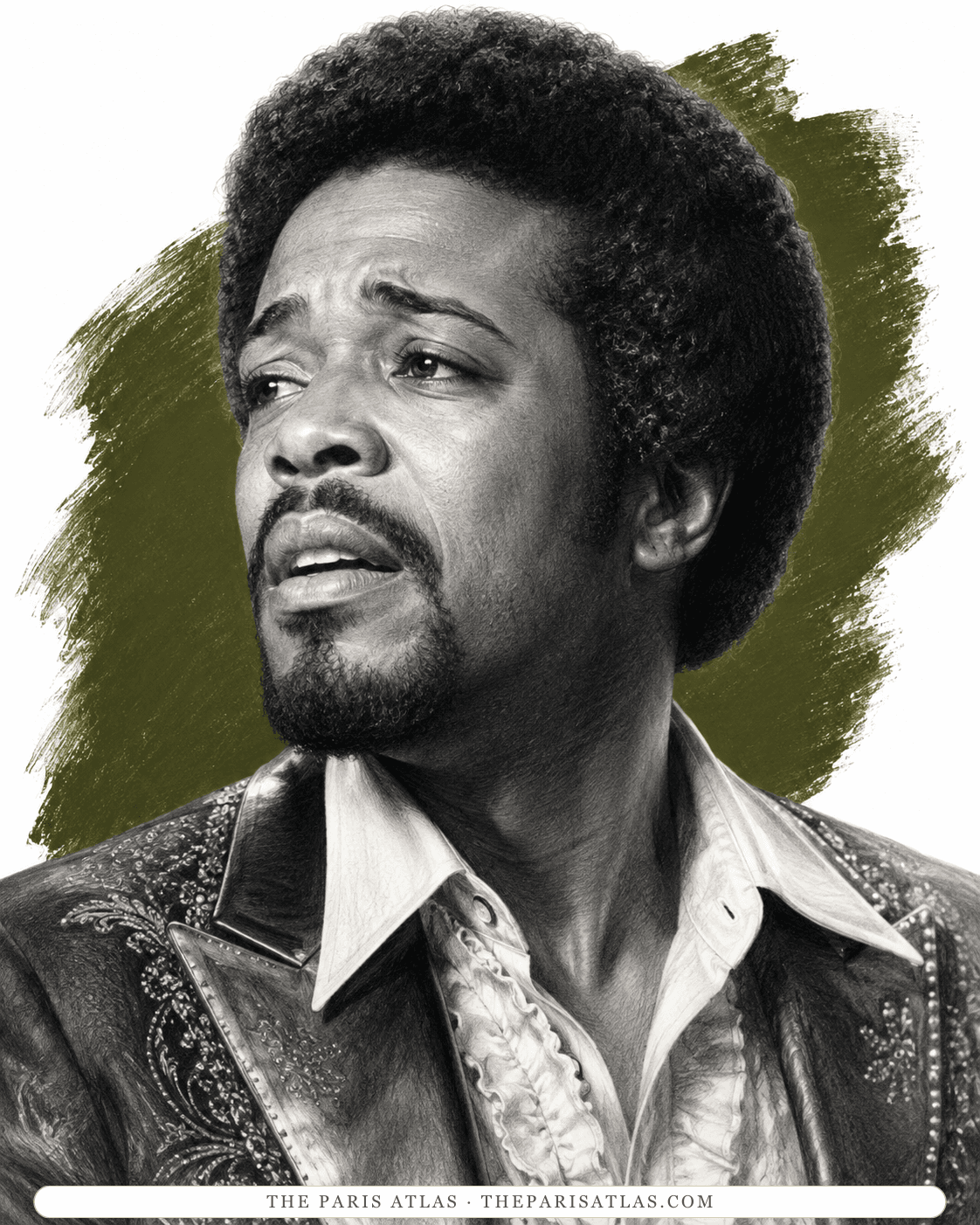
Arthur Montana
A gospel singer famous enough to be called the Emperor of Soul, dead in a London pub basement at thirty-nine before the first page.
To live the life he sings about in his song, a phrase he uses about himself and which Hall takes to mean that he could not afford to live a lie.
The book

At a glance
- Gospel singer, billed as The Soul Emperor; the narrator's younger brother
- New York
- Thirty-nine, two years before the narration begins
- Paul Montana, a pianist, and Florence Montana
- Hall, seven years older; Sylvia, who died at three before Arthur was born
- The Trumpets of Zion, with Peanut, Crunch and Red; lead singer at fifteen
- From 1957
- Crunch as a teenager; Jimmy Miller for the last fourteen years
- Harlem and Southern churches, then Montgomery, Tokyo, Paris, Sydney, the Albert Hall
- The basement lavatory of a London pub
Who they are in the book
Spoiler-freeArthur Montana is an invented character, the younger of the two brothers at the centre of James Baldwin's Just Above My Head. He was a gospel singer, billed as The Soul Emperor, and he is dead when the novel opens: found in the basement lavatory of a London pub at thirty-nine. His older brother, Hall Montana, narrates the book two years later, and one of the first things he tells the reader is that nobody told him how Arthur died.
Arthur was born in New York to Paul Montana, a pianist who played in a bar uptown, and to Florence Montana. A sister, Sylvia, was born between the two brothers and lived three years. Hall thinks her birth and death account for the seven years separating them. Arthur first sang in public at about thirteen, in the Harlem church where Julia Miller was the resident child evangelist, and that song stayed his favourite for the rest of his life.
At fifteen he was lead singer of a boys' gospel quartet called The Trumpets of Zion, with Peanut at the piano and Crunch and Red behind him. The other three were between sixteen and eighteen. They sang in Harlem churches and then took the road through the South, and Arthur's postcards to Hall, who was in Korea, are most of what the novel gives of those tours as they happened.
He went solo in 1957. At twenty-three he had a faithful and growing audience, mostly Black, and was neither making much money nor starving. By twenty-six Hall calls him a tremendous drawing card who had not yet made it, standing at the point where a career goes either up and over or down and out. Fame came after that, and with it Montgomery, Tokyo, Paris, Sydney and the Albert Hall. Hall handled the publicity, and the posters read Hall Montana Enterprises.
Arthur's first love was Crunch, on the quartet's Southern tours. He spent a night with a Frenchman named Guy on his first visit to Paris. For the last fourteen years of his life he lived and worked with Jimmy Miller, Julia's younger brother, who was also his accompanist. Hall's own summary of his brother's private life, given to his teenage son, is that Arthur slept with a lot of people, mostly men but not always.
How Arthur Montana Is Portrayed
- How the book introduces himBy his death. A telephone call and a telegram summon Hall to London without explaining anything. The British press notes only that a nearly forgotten gospel moaner and groaner has been found dead in a men's room in the basement of a London pub; the American press records the passing of an emotion-filled gospel singer, dead at what Hall calls the untidy age of thirty-nine.
- The billingHe is announced from the stage as The Soul Emperor, Mr. Arthur Montana. Publicity was Hall's department, and the posters carry Hall Montana Enterprises above the name.
- His hairHe conked it for a while as a young man, then cut it off abruptly and never conked it again. Through his professional years Hall describes him with a rough, thick head of natural hair, looking like a good-natured basketball player.
- A photograph from the good yearsArthur and Julia at a party: hair natural, a tight blue suit with a Chinese collar, a heavy gold chain at his neck and a heavy gold ring on the middle finger of his right hand. Hall notes that Jimmy has the ring now and that anyone who wants it will have to take the finger with it.
- He did not dress himselfRuth was the first to point out to Hall that Arthur had virtually no clothes. He thought of himself as dressed when he was merely covered, lived in old shirts, slacks, sweaters and heavy boots, and shopped only when he could no longer avoid it. He could not pack a suitcase; his method was to throw in whatever he saw.
- The body Jimmy describesIn Jimmy's account of their fourteen years, the small services are the ones he misses: greasing Arthur's ashy elbows and spiky knees, and telling him not to buy a particular pair of trousers because he had almost no backside to fill them.
- He would not be seen nakedOn the first night he and Crunch shared a room in the South, Arthur kept his undershirt and shorts on and found he could not take them off. Hall says his brother hated being naked in front of anyone, including Hall, who had sometimes bathed him as a child.
- The voiceHall describes it in a dream at the start of the book: a voice that could go high enough to make you shiver and growl low enough to make you moan. In the quartet Arthur sang the lead and set the pace of the song; the others came in behind him.
- What the road costHall's job after a show was to see that Arthur got out of his soaked clothes, bathed, had a stiff drink of Scotch or vodka depending on the night and the city, ate something and slept somewhere. Before Jimmy came back into their lives this was a standing problem, because Arthur was capable of picking up anybody and Hall could not sleep in the same room.
- Beaten on the Civil Rights tourOn a Southern tour with Hall and Peanut he is attacked and comes back with a bleeding, swelling lip, trousers ripped down the back and a jacket fit only for the bin. A church hostess takes his chin in her hand, studies his upper lip, and announces to the congregation that their guest singer has had a small accident and is forbidden to sing more than one or two quiet songs.
- He could not fool anyoneHall says Arthur never managed to fool anybody as long as he lived, and that his mother almost certainly knew what he and Crunch were to each other before the two boys did.
The novel returns to the death in its last pages and does not name a cause.
It had been a bad night before it.
If you like Just Above My Head


If you like James Baldwin
Explore authors with a similar voice, perspective, and influence.

Louis-Ferdinand Céline
The doctor of the Paris slums who wrote the century's blackest, funniest novel — and changed the sound of French prose.
View author
Henry Miller
The Brooklyn dropout who arrived in Paris broke at thirty-eight and wrote the exuberant, banned books that ended American censorship.
View author
Ernest Hemingway
Author of The Sun Also Rises and A Moveable Feast; his pared-down style, developed in 1920s Paris, became the most imitated in American prose.
View author