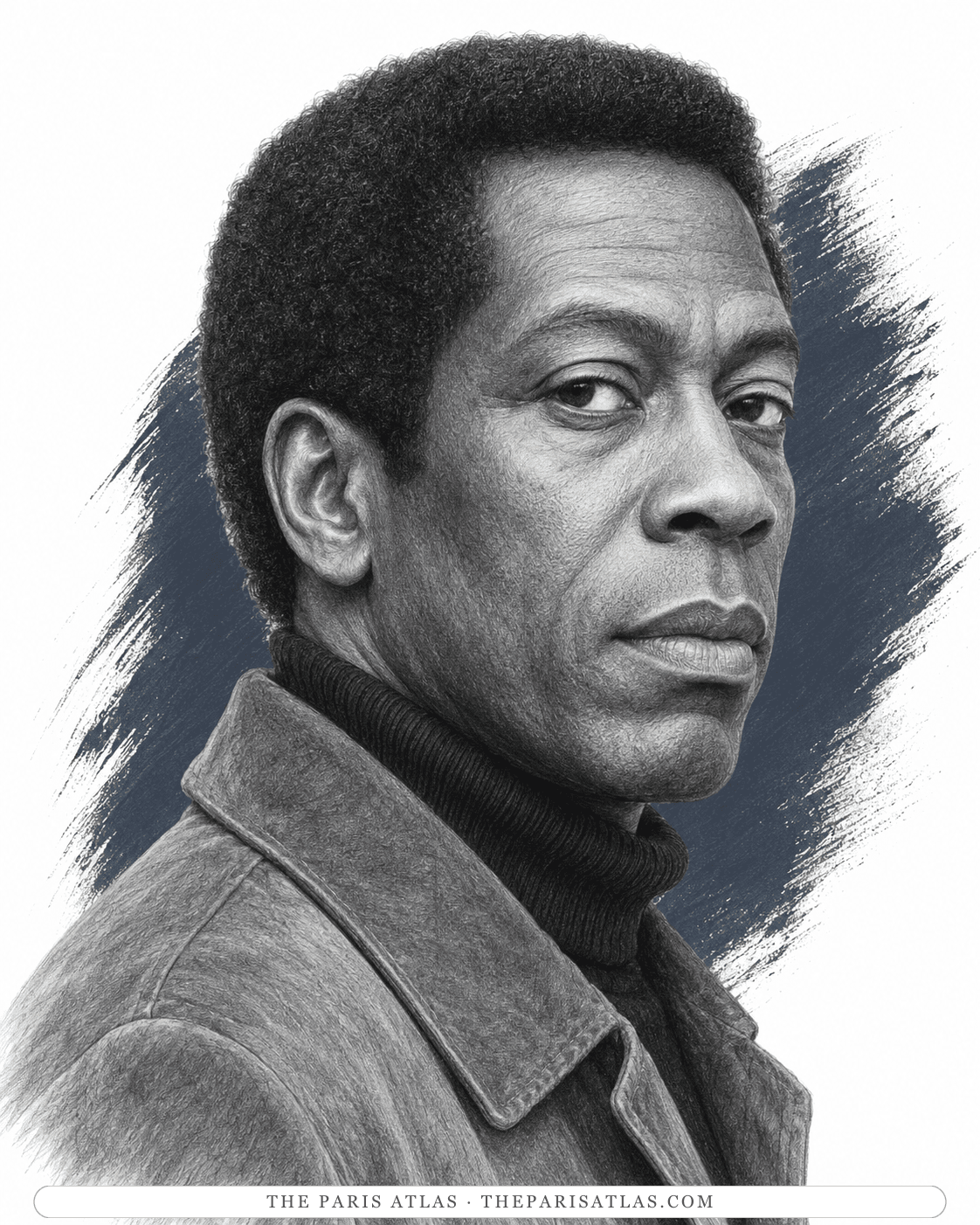
Hall Montana
Arthur's older brother and the narrator. Married, in his forties, and assembling an account of a life he mostly watched from a distance.
To find a way to talk about his brother's death, which two years on he has not managed with his wife, his children, Julia or Jimmy.
The book

At a glance
- Narrator; Arthur Montana's older brother, and his publicity man
- Forty-eight, narrating two years after his brother's death
- California; raised in New York
- Advertising, latterly at a Black magazine; Hall Montana Enterprises on his brother's posters
- Korea
- Ruth Granger, when she was twenty-seven and he was thirty-three
- Tony, fifteen; Odessa, thirteen
- Martha, in his early twenties; later Julia Miller
Who they are in the book
Spoiler-freeHall Montana is an invented character and the narrator of James Baldwin's Just Above My Head. He introduces himself by name on his first page: born in California, raised in New York, seven years older than his brother Arthur Montana, the gospel singer whose death two years earlier is the reason the book exists.
He is forty-eight. His wife, Ruth Granger, is forty-two. Their son Tony is fifteen and their daughter Odessa is thirteen. They live in a house outside the city, and the present-tense sections of the novel are set over a single Sunday there. Hall describes himself as dark-brown-skinned, taller than Ruth but not as heavy, built on the lightweight side and beginning to pick up some weight, with a high forehead his daughter has inherited.
He served in Korea while Arthur was on the road with the quartet. Afterwards he went into advertising, first at a white agency and then in the advertising department of a Black magazine, and he is candid that he thought the work a shell game and thought less of himself for doing it. Alongside it he ran his brother's publicity, and in time the billing on Arthur's posters read Hall Montana Enterprises.
The novel's method is a problem Hall states rather than hides. He was in Korea, or at work, or living his own life for most of what he narrates, and he says so: Arthur was his principal and unreliable informer. Where he was not present he reconstructs, and he tells the reader which is which.
How Hall Montana Is Portrayed
- How he introduces himselfBy name, in the middle of the first chapter, and with the family geography: he was born in California, Arthur was born in New York, and they grew up in New York. He gives his age as forty-eight and notes that Arthur would be approaching forty-one if he were alive.
- What he looks likeBy his own description, a pleasant-enough-looking man, dark-brown-skinned, built a little on the lightweight side and starting to put on weight. He is taller than Ruth and less heavy. He gives Odessa his high forehead, and credits his Indian ancestors with the bend of her nose and the slight slant of her eyes.
- The morning the news cameHe had been shaving. Ruth came home to find him naked and flat on his back on the bathroom floor with his razor still in his hand, and the telephone ringing. Afterwards he walked from telephone to telephone in the house, the black one, the grey one in the bathroom, the light-blue one in the kitchen, waiting for one of them to ring.
- The dream the book opens withHe wakes on a Sunday morning convinced the ceiling has dropped to within two inches of his face. The dream underneath it has Arthur at about five running down a road after a wagon Hall cannot stop, crying, with snot coming out of his nose, and ends with Hall carrying two vodka martinis through a subway car looking for his brother.
- The jobAdvertising, which he says he could never take seriously and found demeaning: a shell game built on the sucker principle. He treated it as a game he had to play and did not dare think about the implications, and he assumes his colleagues sensed his real attitude to the work and to them.
- KoreaHe was there while Arthur was in Nashville with The Trumpets of Zion. He came home in uniform, and a Black woman he did not know passed him on the street and said, quietly, welcome home. Climbing the stairs to his parents' door, he says he was their little boy again, because he had been spared.
- The sister between themSylvia was born after Hall and before Arthur, had a kidney ailment and lived three years. Hall says the seven-year gap between him and his brother is almost certainly due to her birth and death.
- What the church children called himJulia tells his own children that she and the others never dared call him Hall to his face and thought of him as Mister Ha, because he always looked at everything as though he could not understand any of this foolishness at all.
- The bad yearAt thirty-two, after Julia left for Abidjan, he asked his agency to put him on sick leave without pay. He describes bumping into walls, drinking, picking himself up off the floor at midnight, and realising that he knew many people and had no friends. It is the state he is in when he agrees to go south with Arthur and Peanut.
- Two years of not talkingHe says early on that he has never really talked about Arthur's death — not to Ruth, not to Tony and Odessa, who loved their uncle, not to Julia and not to Jimmy — and that none of them can talk about it until he can.
He never gets the answer he set out for.
If you like Just Above My Head


If you like James Baldwin
Explore authors with a similar voice, perspective, and influence.
Louis-Ferdinand Céline
The doctor of the Paris slums who wrote the century's blackest, funniest novel — and changed the sound of French prose.
View author
Henry Miller
The Brooklyn dropout who arrived in Paris broke at thirty-eight and wrote the exuberant, banned books that ended American censorship.
View author
Ernest Hemingway
Author of The Sun Also Rises and A Moveable Feast; his pared-down style, developed in 1920s Paris, became the most imitated in American prose.
View author