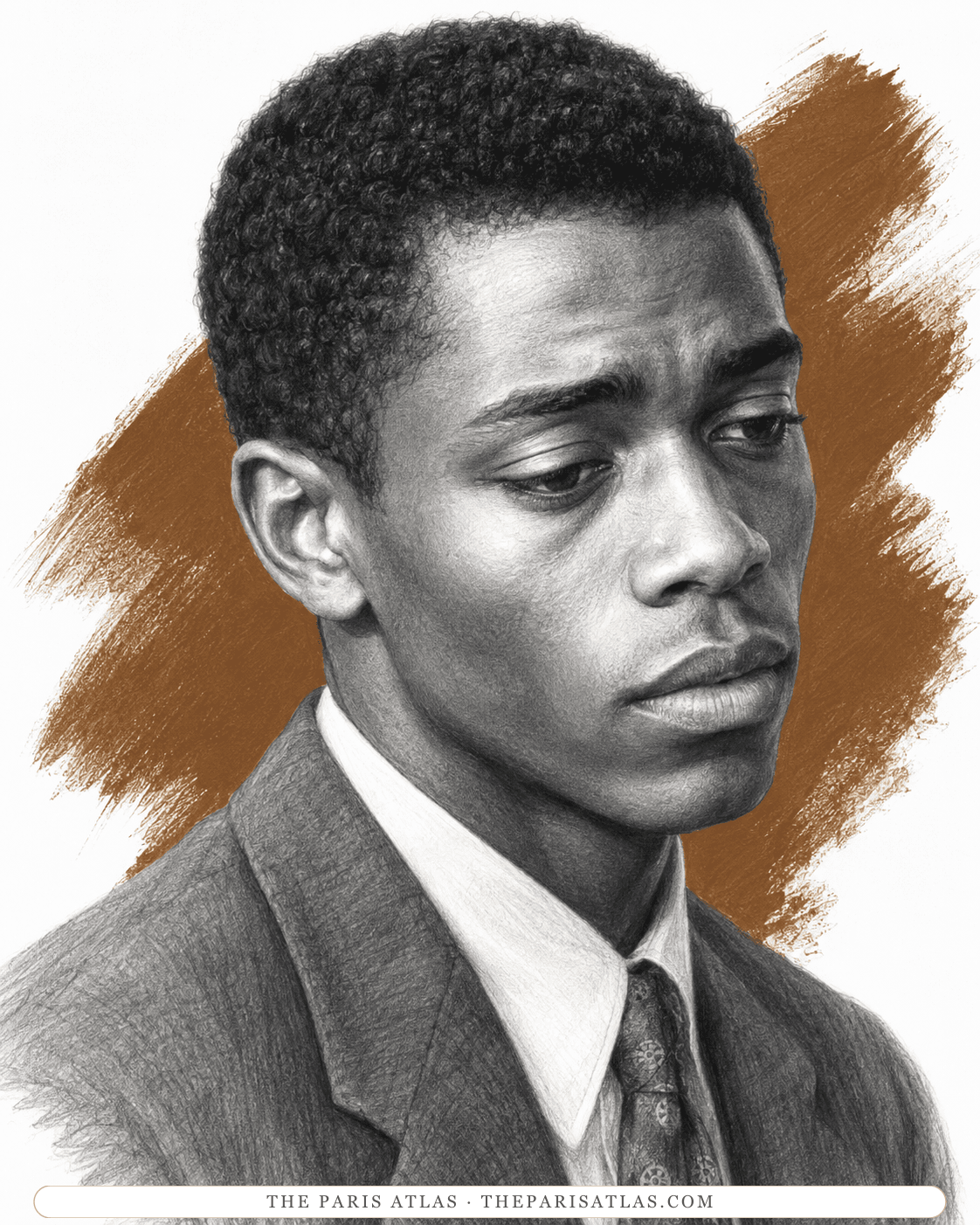
Crunch
Jason Hogan, a fellow member of the Trumpets of Zion and Arthur's first love. Drafted to Korea, and not the same afterwards.
Some corroboration that he is a man, which Arthur understands he cannot give him.
The book

At a glance
- Guitarist and singer in The Trumpets of Zion; Arthur Montana's first love
- Jason Hogan
- New York City
- Oldest of five; mother a barmaid; the fathers came and went
- Between sixteen and eighteen when Arthur is fifteen
- Guitar; lead on some numbers, with Arthur backing him
- Drafted to Korea
Who they are in the book
Spoiler-freeCrunch is an invented character in James Baldwin's Just Above My Head, one of the four Harlem boys who make up the gospel quartet The Trumpets of Zion, and the first person Arthur Montana loves. His name is Jason Hogan and he was born in New York City. He is the oldest of five children, three girls and two boys; their fathers came and went, and their mother worked mainly as a barmaid.
He is the biggest boy in the quartet and plays the guitar in it, and at rehearsal he is the one who proposes the next number. Red is his best friend and a distant cousin, and he calls Red his heart. Hall Montana, the novel's narrator, knew him only through Arthur and says so plainly: his account of Crunch is second-hand and he does not pretend otherwise.
Crunch and Arthur become lovers in a rooming house on the quartet's first tour of the South. Crunch is the older of the two, and the book gives him more to be frightened of: he is afraid of what he wants, privately afraid that he is more in love than Arthur is, and about to be drafted. He is also the person Julia Miller chooses to tell about her father, and he does not know what to do with what she tells him.
How Crunch Is Portrayed
- The nameJason Hogan, born in New York City, the oldest of five children — three girls and two boys. Their fathers came and went. Their mother was, in the main, a barmaid. The landlady of the rooming house on Fourteenth Street calls him Mr. Hogan.
- SizeThe biggest boy in the quartet. Hall writes that if thunder could be seen it would look like Crunch, and so would innocence. Thick, tangled black hair, a wide nose, heavy lips, a wide grin with a lot of straight white teeth; skinny, but powerful, and a basketball player.
- The face, close upArthur studies it the morning after their first night together: high cheekbones, long narrow eyes slanting slightly upward, one eyebrow always faintly lifted so that he looked about to make fun of you, a long hooked nose, and two small knobs of bone gleaming on either side of the forehead below the hairline.
- The one who did best with the girlsBy his own phrase, he made out best with the ladies, and he is the one the church sisters gravitate to on tour. Hall's summary of what that made of him is unsentimental: a boy treated as an object by people who wanted his innocence, and who eventually said he was tired of being handled that way.
- Red is his heartRed is his best friend and a distant cousin, and they grew up together, and Crunch calls him his heart and means it. Peanut and Red understand Crunch and Arthur in exactly those terms — two boys who have something deep going, the way Red is Peanut's heart — and treat the rest as private.
- What he woreA grey turtleneck sweater and green corduroy trousers, on the late-summer Sunday he goes to see Julia. On the road he is the one whistling low in his throat while he undresses, because he is happy to be in the room.
- The draftKorea hangs over the whole of the quartet's first summer. Crunch has a mother, brothers and sisters keeping him in New York, and could have been reconciled to leaving them. What he cannot be reconciled to is leaving Arthur. He goes a week after their last Sunday together, and Hall describes it as a hole opening under him.
- JuliaHe visits her because she asks him to, and she tells him that her father has been sleeping with her. His first response is that he feels he is going to be sick. He becomes her friend, then her lover, and Arthur's reading of it afterwards is that Crunch wanted proof of his manhood more than he wanted Julia.
- The missing teethIn a photograph from the quartet years Crunch has all his teeth. For years before the end of the book the two front ones are missing: a Black policeman kicked them out, and Crunch would not have them replaced, because he wanted Black people to see what a Black policeman had done to him.
The quartet does not survive the war, and Crunch does not survive much longer.
If you like Just Above My Head


If you like James Baldwin
Explore authors with a similar voice, perspective, and influence.

Louis-Ferdinand Céline
The doctor of the Paris slums who wrote the century's blackest, funniest novel — and changed the sound of French prose.
View author
Henry Miller
The Brooklyn dropout who arrived in Paris broke at thirty-eight and wrote the exuberant, banned books that ended American censorship.
View author
Ernest Hemingway
Author of The Sun Also Rises and A Moveable Feast; his pared-down style, developed in 1920s Paris, became the most imitated in American prose.
View author