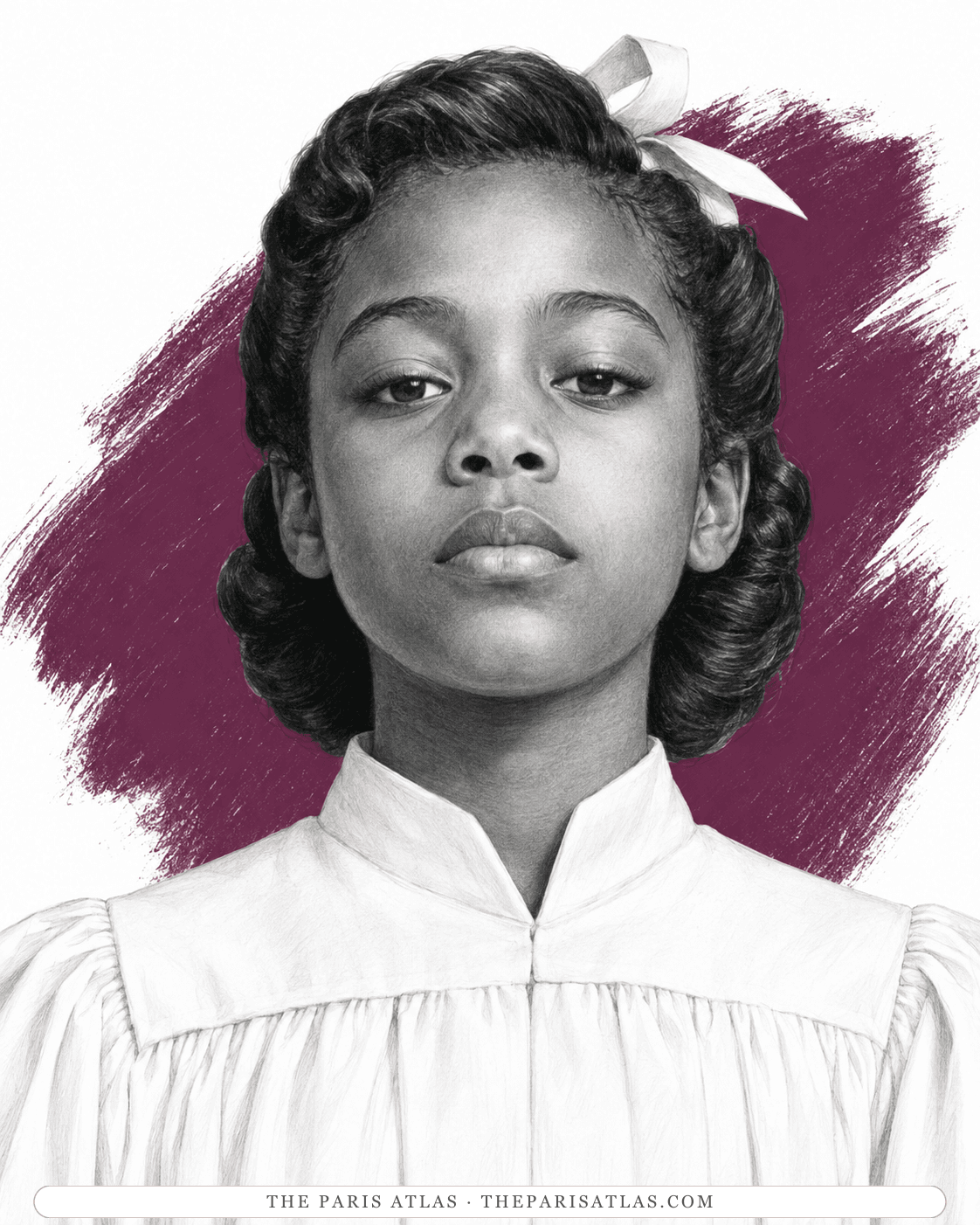
Julia Miller
A child evangelist preaching to adult congregations, and being abused at home by her father. The novel's other centre in its first half.
To keep the promise she made her mother to look after her younger brother, which she thinks is the only reason she has to live.
The book

At a glance
- Child evangelist, later a fashion model
- Joel and Amy Miller; younger brother Jimmy
- About nine when she first appears; two years younger than Arthur
- A brownstone on 129th Street and Park Avenue, Harlem
- Modelling, at the start of a vogue for African fashion
- Harlem, New Orleans, New York, Abidjan
- Together from 1957, and again as friends in the present-day chapters
Who they are in the book
Spoiler-freeJulia Miller is an invented character in James Baldwin's Just Above My Head, and for the first half of the novel she carries as much of it as Arthur Montana does. She is a child evangelist. She was about eleven when Arthur, then about thirteen, sang in public for the first time in her Harlem church, and she was already preaching to grown congregations in a white robe from a seat in the pulpit.
She is the daughter of Joel and Amy Miller and the older sister of Jimmy Miller. Her mother believed in the calling completely, and her father carried her from church to church. He was also sexually abusing her at home, and the novel establishes that through her own account to Crunch rather than through anyone's suspicion.
Her mother's illness and death end her ministry. She preaches her mother's funeral sermon and never preaches again, and the rest of her life in the book is a series of departures: New Orleans with her grandmother, then New York and a career as a fashion model, then Abidjan on the coast of West Africa, then New York again. Hall Montana, the novel's narrator, is her lover from 1957, and by the present-tense chapters she is a friend of his household, at the table with his wife and children.
How Julia Miller Is Portrayed
- What she was calledThe fire-baptized child evangelist, Little Sister Julia. Everybody, including boys three years older than she was, addressed her as Sister Julia. Her own summary is that in her heyday Billy Graham would not have come near a town she was preaching in.
- The churchA dilapidated brownstone on 129th Street and Park Avenue, in the shadow of the elevated New York Central tracks. A train roars past while Arthur is singing. It is her home church, and she has a royal seat in the pulpit.
- In the pulpit at thirteenHall watches her at a Christmas service: a thin face and burning eyes visible from the back of the church, a neck faintly throbbing, and, under the long white robe, breasts just beginning. She is weary in a way he can hear in her voice, and he notices it because she is only thirteen.
- Fetching Mother BessieHer pastor had stopped two church members from bringing an old woman named Bessie out to services. He could not stop Julia, so she climbed the stairs to Mother Bessie's room Sunday after Sunday, got her ready, earrings and all, and brought her.
- The Montanas could not stand herHall is blunt about it. Nobody in his family liked her. They granted that she could rock a church, but so could Arthur, and in a world that included the Apollo Theatre that was not the achievement she seemed to want it to be. The quartet accepted her invitation to refreshments only because Arthur wanted to go.
- The photograph of her beforeA snapshot from about thirty years earlier, which she shows to Hall's children: Julia bareheaded with a ribbon in her curled hair, in a white middy blouse, a black pleated skirt and flat patent-leather shoes, holding her mother's hand and looking happy enough to burst.
- Her fatherJoel Miller. She tells Crunch that she lies next to her father listening to him snore, that it is not her fault and not his either because he cannot help it, and that he told her it happens all the time. She asks Crunch whether that is true. He says he would not know.
- The last sermonShe preaches her mother's funeral and stops. Her account of what she said includes what she thought of the ministers around her: that they smelled of corruption, that she could see it when they ate their Sunday chicken and when they looked at her, and that she could not deal with it. People still talk about that sermon, and she says she never topped it.
- ThinEveryone remarks on it. Arthur's letters call her so skinny she looks like a razor. Grown up and dressed to go out — a green bandanna, a chocolate-coloured fitted dress, a small green pocketbook, beige heels — she is thin enough that the dress can only accentuate a certain reckless gallantry, and she barely escapes looking like a little girl in her older sister's clothes.
- Her denIn the house she lives in later, a room nobody enters without being asked. She calls it a meditation room and Hall takes her seriously. It holds two tape recorders, a baby grand, a tambourine, a desk, a typewriter, a chair, a cot, several Bibles, hymnbooks, and books ranging from Foxe's Book of Martyrs to Valley of the Dolls, which she says are connected.
Her father's abuse is not what ends it.
If you like Just Above My Head


If you like James Baldwin
Explore authors with a similar voice, perspective, and influence.

Louis-Ferdinand Céline
The doctor of the Paris slums who wrote the century's blackest, funniest novel — and changed the sound of French prose.
View author
Henry Miller
The Brooklyn dropout who arrived in Paris broke at thirty-eight and wrote the exuberant, banned books that ended American censorship.
View author
Ernest Hemingway
Author of The Sun Also Rises and A Moveable Feast; his pared-down style, developed in 1920s Paris, became the most imitated in American prose.
View author