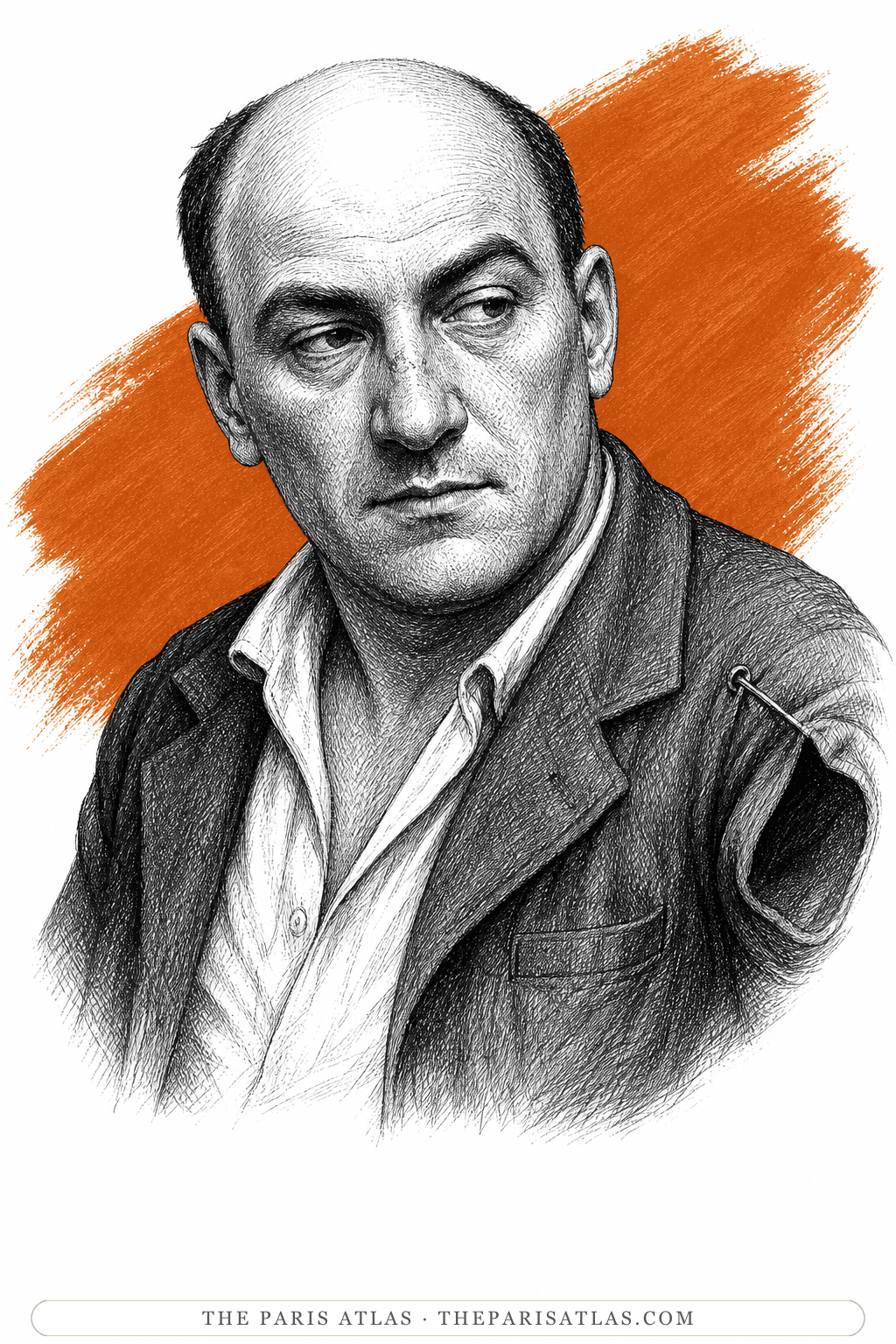
Blaise Cendrars
The author, inside his own novel — a mechanic in an aircraft shed at Chartres, a fellow amputee in a hospital at Cannes, and throughout the man holding the narrator's papers.
Blaise Cendrars — books, places, and lifeThe book

At a glance
- The author, under his own name — the editor of the narrator's papers, and a mechanic at the Chartres airfield
- La Mimoseraie, April–November 1925
- Bastien Champcommunal, an inventor building a tailless aeroplane in a log cabin on a bought-up potato field
- His right arm — in the novel at Cannes, in life with the Foreign Legion in Champagne in 1915
- Moravagine's manuscripts, and the narrator's
- The preface, the Chartres chapters, a hospital in Cannes, the note on the Martian scenario, and the postface
- Blaise Cendrars, born Frédéric-Louis Sauser · 1887–1961 · La Chaux-de-Fonds, Switzerland
Who they are in the book
Spoiler-freeBlaise Cendrars wrote Moravagine, and he also appears in it. The preface is his. He explains that a prisoner in Spain left a trunk with a false bottom in the attic of his country house, a syringe in the hidden compartment and a heap of manuscripts in the trunk itself. He prints the letter that came from the condemned cell, and tells the reader to take the signature R. as standing for Raymond la Science, on the grounds that a name is needed to make sense of what follows.
He turns up in person two hundred pages later, at an airfield outside Chartres. The inventor Bastien Champcommunal introduces him as his second in command; he is at the workbench with a compass, marking out a wooden propeller, and does not turn his head when three visitors and a shouting drunk come through the hangar door. When Moravagine buys into the aeroplane and draws up a flight around the world, Cendrars is written into the programme as the lecturer who will face the crowds at Interlaken and San Francisco.
The war cancels the flight and takes the arm. The narrator runs into him again in a hospital at Cannes, where Cendrars has had his right arm amputated and has the news that Champcommunal was killed at the Maison du Passeur. The wound is not invented. Cendrars lost his own right arm with the French Foreign Legion in Champagne in 1915 and taught himself to write with the left hand.
How Blaise Cendrars Is Portrayed
- In the prefaceHe signs it from La Mimoseraie and dates it April to November 1925, and sets out the hiding place as a chain: a village in the Île-de-France, an old steeple, a little house, a locked attic, a trunk, a false bottom.
- The letter he printsHe says he was on a coffee plantation in Brazil when it reached him, that the blue tropical sky and the red earth went dark around him as he read, and that he started back for Europe at once.
- At the workbenchA young man tracing guide-marks on a propeller with a compass, so absorbed that he never once looks up. The inventor tells him to leave his logarithms and come and eat breakfast.
- On the flight programmeMoravagine's round-the-world scheme has him down for the lectures: Interlaken after the landing on the Jungfrau, then London, then San Francisco, listed between the press releases, the wagers and the prize money.
- The armThe narrator, who has just lost a leg, finds him in a hospital at Cannes with the right arm gone. The two amputees exchange what news they have and neither has any of Moravagine.
- The executorMoravagine leaves him the Martian film scenario, The End of the World, with instructions to see it published and perhaps produced. The postface reports what became of the rest: the house pillaged, the files emptied out of the windows, the surviving pages printed with the studs of German police boots.
Cendrars is the reason the book exists inside its own fiction. The narrator is executed at Montjuïc in May 1924 after asking him to do as he likes with the papers; the preface is dated the following year, and everything after it is the file. He ends that preface promising to publish Moravagine's complete works one day, when he has time to put them in order.
The postface, written in Paris on 20 September 1951, withdraws the promise. He went back to the country house after twelve years away and found it empty and looted: barely two or three thousand books left of twenty-five thousand, the trunk with the false bottom gone, and with it The Year 2013, which he calls, looking back from the other side of a second war, an anticipation of the atomic age. The last thing he mentions is the only photograph he still had of his mother, which he found in the garden, buried in the mud.
If you like Moravagine


If you like Blaise Cendrars
Explore authors with a similar voice, perspective, and influence.

Henry Miller
The devoted heir — Miller crowned Cendrars above every living writer, and the torrential first-person prose is the family resemblance.
View author
Louis-Ferdinand Céline
The other voyager at the end of the night — spoken rhythm, black exuberance, and a war wound at the center of everything.
View author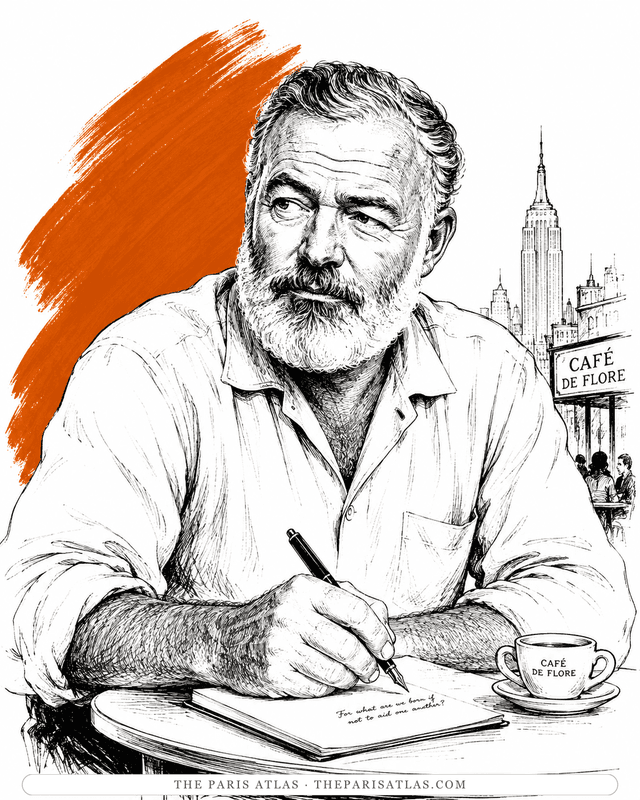
Ernest Hemingway
Author of The Sun Also Rises and A Moveable Feast; his pared-down style, developed in 1920s Paris, became the most imitated in American prose.
View author