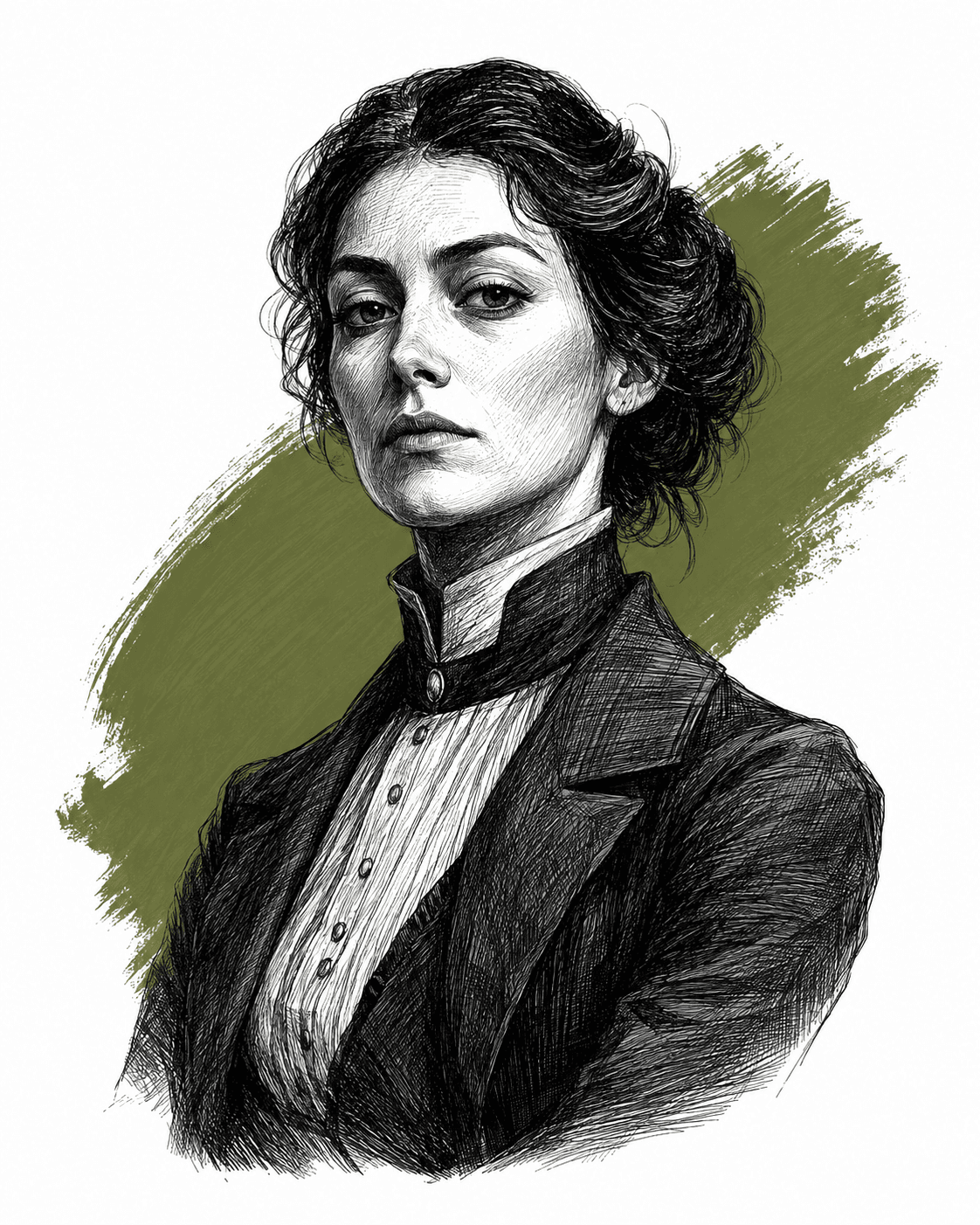
Mascha Uptschak
The Lithuanian scholar who runs the revolutionary party's underground press and plans its assassinations to the second — and the only woman in the group.
To be wanted back. She hunts Moravagine through the streets whenever he disappears, begs the other comrades to say where he has gone, and tells herself she has lost him for ever.
The book

At a glance
- A Lithuanian Jewish revolutionary, met in Warsaw running the party's main underground press
- Between thirty-five and thirty-eight, by the narrator's guess
- In Germany — mathematics, and a book on perpetual motion
- Propagandist and planner, and the only woman in the inner group
- A villa at Terrioki on the Finnish frontier, a few miles from St Petersburg, to have her child
- The Russian chapters — Warsaw, Lodz, Kiev, Odessa, and the attic of the Moscow Polytechnical Institute
Who they are in the book
Spoiler-freeMascha Uptschak is met in Warsaw, running the main clandestine printing press of the Russian revolutionary party that Moravagine and the narrator join in 1904. She had been a serious student in Germany, has a solid training in mathematics and a published book on perpetual motion behind her, and she writes the proclamations that set off strikes across the empire. She also plans the operations: who covers which ground, who stoops, who runs, who throws the bomb, timed minute by minute, and the narrator says events fell out exactly as she had calculated they would.
In the field she has no fear at all. In private she attaches herself to Moravagine, who beats and humiliates her and enjoys doing it, and the narrator watches the pair with the same detached interest he gives to everything else. When she becomes pregnant the group votes to send her away to a house at Terrioki, on the Finnish frontier; some of them argue for killing her instead, and it is the combat leader Ropschin who talks them out of it.
The chapter that carries her name spends much of its length on the narrator's theory of love as masochism, which he extends to women in general and to Jews in particular, and which he says he owes largely to her.
How Mascha Uptschak Is Portrayed
- The plannerEvery operation worked out second by second: the position taken, the gesture made, the leap with the bomb, and, if it comes to that, the revolver fired into one's own mouth.
- The speakerFrom the platform she counts the dead aloud, names who fell where and who chose a dungeon over betrayal, then works down to the small daily humiliations of bosses and landlords. The narrator calls that last part the surest way to put a crowd in a rage.
- How she looksA heavy body with an opulent bosom, and on a long soft neck a small bony head with drawn features, frizzled hair and staring pale blue eyes. She is extremely short-sighted.
- The cover storyThe disguise that protects Moravagine for years is hers. She has him pass as Samuel Simbirsky, a celebrated terrorist escaped from the Sakhalin penal colony, after the real Simbirsky died of bone tuberculosis in a Paris attic.
- The scenesTen and twenty times a day she rounds on Moravagine, spits in his face, calls him a police informer and swears she will turn the whole group in herself. By evening she is back in the doorway apologising to the comrades and asking where he has gone.
- The other version of herThe woman who is fearless in the street is the one the narrator follows at four in the morning to the riverbank at Nizhny during the fair, and finds crouched among half-submerged logs with her feet in the water, crying without being able to explain why.
The plot against the Czar collapses. In a single day the organisation is arrested, hanged, shot or driven to suicide, and Moravagine tells the narrator, with no evidence at all, that Mascha informed on them. Neither man can find her name in any newspaper. She turns up on the escape route: hanging from the roof of the sealed freight car the two of them have broken into among the barrels of sauerkraut, with the foetus hanging beneath her. Moravagine refuses to cut her down, on the reasoning that the men who open the car at Riga will be too occupied with the body to search the casks. The narrator throws the party's money at her head and shuts himself into his own barrel.
The book never settles whether she did it. The narrator states flatly that only she could have given the police such precise information, and a few pages earlier admits there are simply gaps in his memory and that he cannot make one fact follow another. He does not know whether Moravagine went to Terrioki, worked on her from a distance, or invented the accusation from beginning to end.
If you like Moravagine


If you like Blaise Cendrars
Explore authors with a similar voice, perspective, and influence.

Henry Miller
The devoted heir — Miller crowned Cendrars above every living writer, and the torrential first-person prose is the family resemblance.
View author
Louis-Ferdinand Céline
The other voyager at the end of the night — spoken rhythm, black exuberance, and a war wound at the center of everything.
View author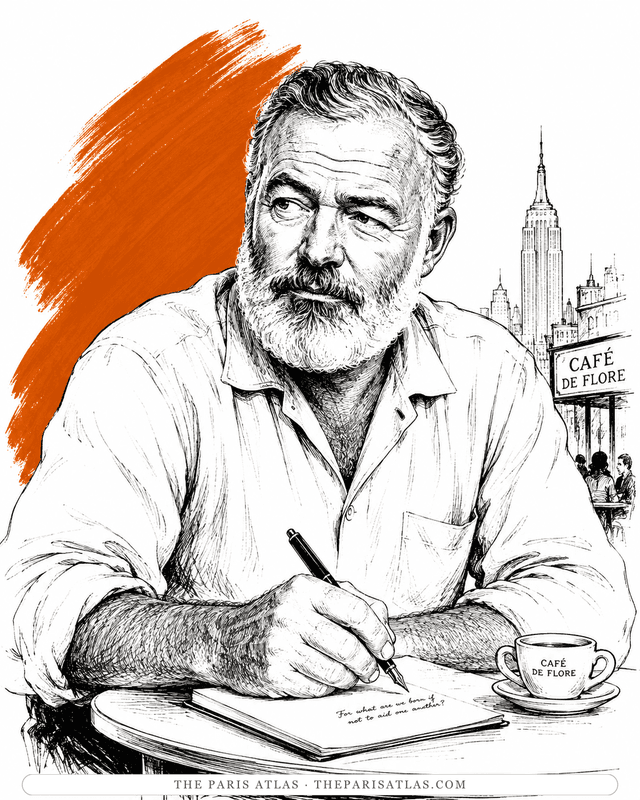
Ernest Hemingway
Author of The Sun Also Rises and A Moveable Feast; his pared-down style, developed in 1920s Paris, became the most imitated in American prose.
View author