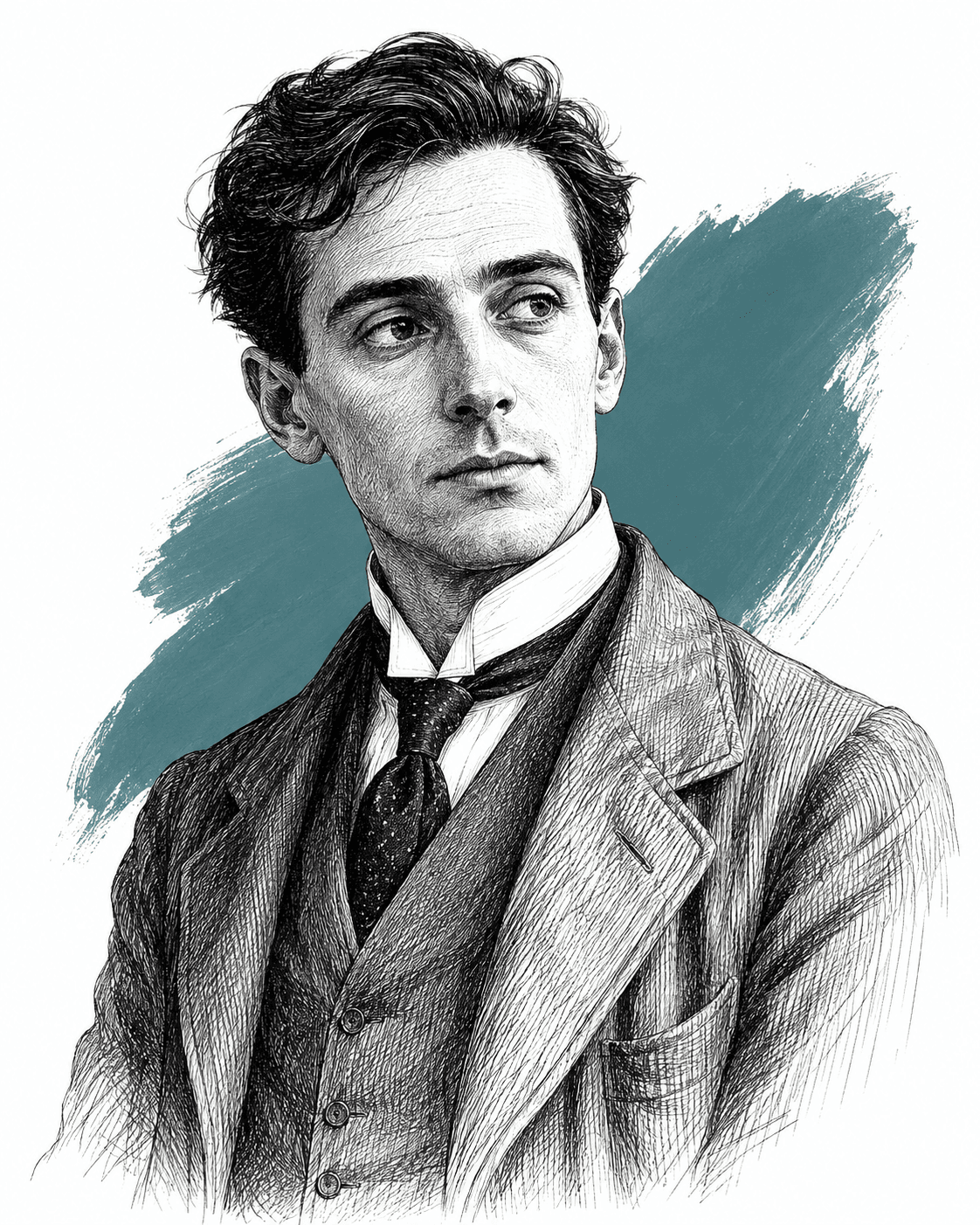
Raymond la Science
The narrator — a young psychiatrist who breaks his most dangerous patient out of the asylum, gives up medicine, and spends the next thirteen years travelling in his wake.
To watch a completely unrestrained human being at close range. Before he has met Moravagine he writes that he would like to open every cage, zoo, prison and asylum, set the great wild ones loose and study the kind of life that develops.
The book

At a glance
- The narrator — a French psychiatrist, chief assistant at the Waldensee sanatorium from 1900
- Nothing, for most of the book; the preface supplies Raymond la Science, and Moravagine uses the first name only in the Amazon chapter
- A thesis on the chemistry of deranged states of the subconscious, enough to make his name in specialist circles
- Treasurer — he leaves Russia with close to a million roubles wadded into a suitcase
- Infantry; wounded coming back from Navarin Farm, left leg amputated
- Every page — Waldensee, Berlin, Russia, the American south-west, the Orinoco, Paris, Chartres, the Western Front and Cannes
Who they are in the book
Spoiler-freeThe narrator finishes his medical studies in 1900 and takes a post as chief assistant at Waldensee, a fashionable sanatorium near Berne, carrying a thesis on the chemistry of deranged states and a private plan to write the book that will destroy his own profession. He argues that diseases are not accidents to be fought but a form of activity, possibly health itself, and that psychiatrists have made themselves servants of the police and of embarrassed rich families. Then he is handed the file of patient 1731, whose name is Moravagine, and stops caring about any of it.
He never gives his own name. Blaise Cendrars supplies one in the preface, taking it from the initial on a letter, and says plainly that the reader needs a name to follow the book: Raymond la Science. Moravagine uses the first name only in the Amazon chapter, when the narrator is delirious with malaria and has to be called back to himself.
Everything else in the novel is his account of the friendship, and the reader has to decide how much of it to trust. He resigns his post to organise the escape. In Russia he is the party treasurer, and it is he who sets off the Moscow explosion that signals the rising. He amputates Moravagine's gangrenous toe with the knife from his boot in a field outside Tver. He nearly dies of fever in the Amazon and loses his left leg on the Western Front. He is not a neutral witness: within a page of deciding to free his patient he asks himself what one murder more or less in the world means to him, and he never revises the answer.
How Raymond la Science Is Portrayed
- The trainingMedical studies finished in Paris in 1900, a thesis on the chemistry of deranged states of the subconscious, and a warm recommendation from his teacher, Professor d'Entraigues. His first duties are the incurables' wing and mixing the evening sedatives.
- What he came to proveThat doctors have organised the destruction of everything independent, that alienists are the lackeys of the rich man's crime, and that the striking individuals they lock away are the health of tomorrow. Waldensee was chosen as the best possible place to prove it.
- The bedside mannerHe drops his seventeen other patients within a day of meeting 1731, ignores his director's repeated orders to stay away from him, and hands in his resignation once the escape is agreed.
- The false namesMr John Stow, English merchant, in a Moscow hotel; Arcadie Porphirovich Matoschkin, a third-class merchant of Voronezh, on the train out; an illiterate peasant whose passport is signed with a cross. In America he is known only as Monsieur l'Anglais.
- The one time the medicine is any useHe cuts off Moravagine's gangrenous toe with a boot knife, dresses it with a strip torn from his own shirt, and, having no antiseptic, urinates on the wound.
- After the legHe comes back wounded from Navarin Farm using two rifles as crutches, and afterwards is always the last man onto the boat at Sainte-Marguerite Island, because he insists on climbing the two hundred steps to the fort without stopping to breathe.
The preface has already given away his ending, though a first-time reader has no way of knowing it. The letter Cendrars prints there is dated two in the morning on 11 May 1924, from cell 7 of the condemned wing at Montjuïc: the writer will be garrotted at dawn for an attempt on the King of Spain, is spending his last hours with a Spanish grandee who kneels and prays beside him, thanks Cendrars for getting the execution brought forward, and signs himself R. One line in the Amazon chapter gives the plan away years in advance, in a parenthesis about Jivaro history: he read that up, he says, in the archives at Seville ten years later, while preparing the attempt.
Between the two he loses the friendship as well as the leg. He finds Moravagine again by accident in the army asylum on Sainte-Marguerite Island, recognises the raving morphine addict a nurse is trying to inject, and tells her the man is his brother. Moravagine dies on a day that is not a Thursday and is buried on a Wednesday, and since the narrator's visits fall on Thursdays he misses both. What he inherits is the trunk of manuscripts, and the book the reader has just finished is what he made of it.
If you like Moravagine


If you like Blaise Cendrars
Explore authors with a similar voice, perspective, and influence.

Henry Miller
The devoted heir — Miller crowned Cendrars above every living writer, and the torrential first-person prose is the family resemblance.
View author
Louis-Ferdinand Céline
The other voyager at the end of the night — spoken rhythm, black exuberance, and a war wound at the center of everything.
View author
Ernest Hemingway
Author of The Sun Also Rises and A Moveable Feast; his pared-down style, developed in 1920s Paris, became the most imitated in American prose.
View author