
The Self-Taught Man
A Bouville library regular whose faith in humanism offers Roquentin an earnest but compromised counterargument.
To educate himself completely, belong to a moral idea of humanity, and gain the recognition and contact he lacks in ordinary social life.
The book

At a glance
- Reads library books alphabetically
- Humanism and progress
- Expelled from the library
Who they are in the book
Spoiler-freeThe Self-Taught Man reads the library alphabetically as part of an enormous program of self-education. His optimism about humanity appears generous beside Roquentin’s disgust, but it also relies on broad abstractions.
His removal from the library after sexual contact with a schoolboy creates a sharp contradiction between declared universal love and respect for an actual vulnerable person.
How The Self-Taught Man Is Portrayed
- Earnest library regularHe appears diligent and socially awkward.
- Modest 1930s suitHis clothing is respectable but unremarkable.
- Open optimistic expressionFaith in progress is sincere.
- Underlying uneaseThe portrait does not turn him into a harmless mascot.
- Close engraved bustNo books, library, or child appears.
- Muted olive accentThe color supports his earnestness.
A librarian catches the Self-Taught Man making sexual contact with a schoolboy, assaults him, and expels him. The event exposes a serious contradiction beneath his abstract humanism.
If you like Nausea


If you like Jean-Paul Sartre
Explore authors with a similar voice, perspective, and influence.

Louis-Ferdinand Céline
The doctor of the Paris slums who wrote the century's blackest, funniest novel — and changed the sound of French prose.
View author
Henry Miller
The Brooklyn dropout who arrived in Paris broke at thirty-eight and wrote the exuberant, banned books that ended American censorship.
View author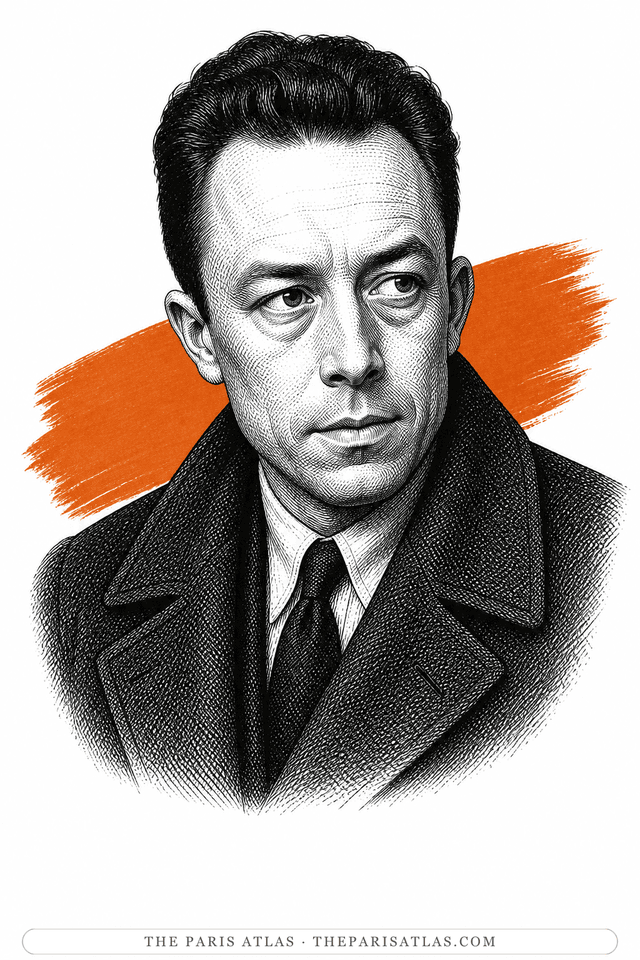
Albert Camus
French Algerian novelist, essayist, journalist and playwright who used the absurd and revolt to ask how people should live without false consolation.
View author