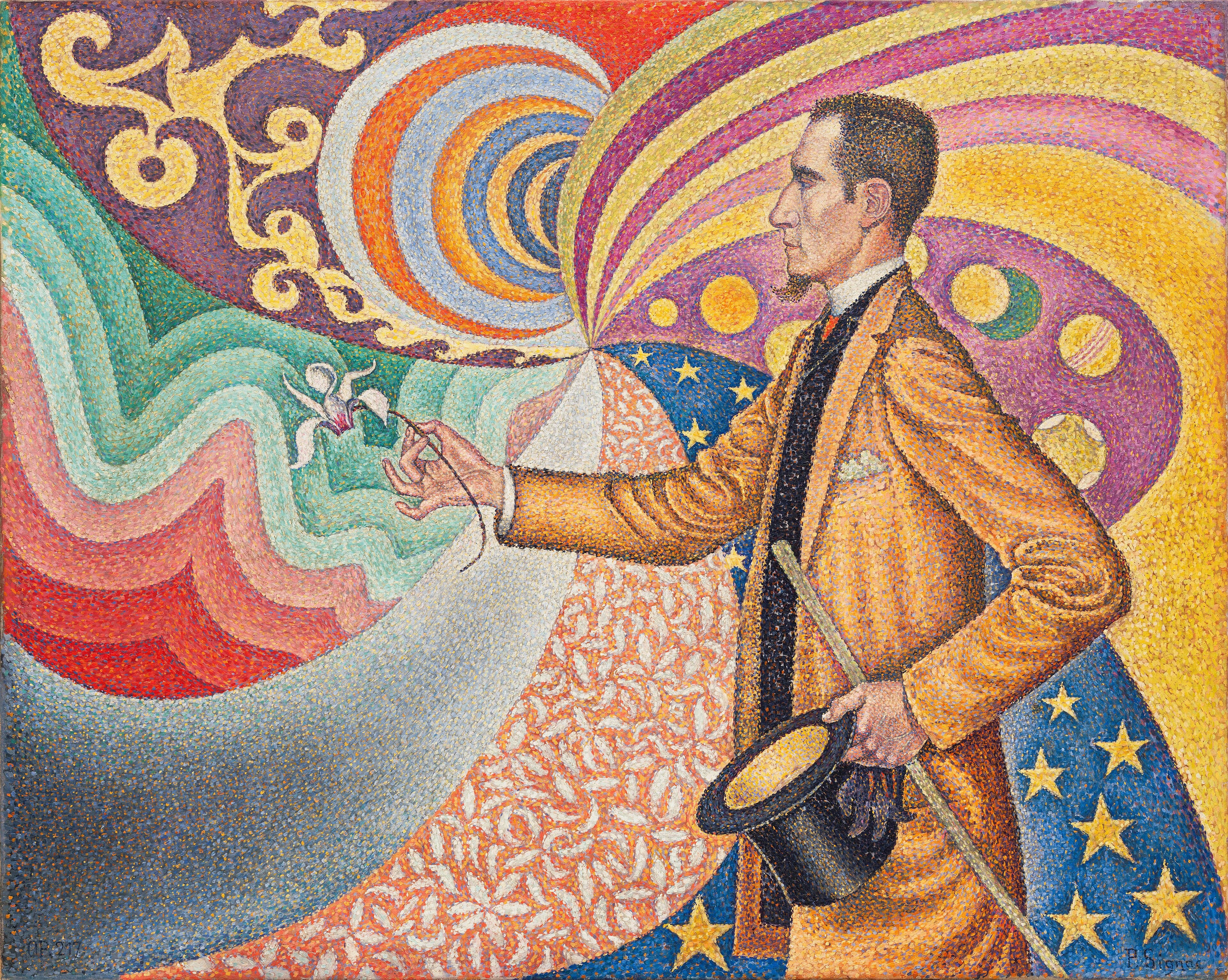
Opus 217. Against the Enamel of a Background Rhythmic with Beats and Angles, Tones, and Tints, Portrait of M. Félix Fénéon in 1890
by Paul Signac
Félix Fénéon stands in profile facing right, in a gold-ochre suit, holding a top hat and cane in one hand and a white flower in the other. Behind him a pinwheel of coloured bands spins out from a point just past his fingers. The critic who named Neo-Impressionism is set against a diagram of the theory he named. The Museum of Modern Art holds it as object number 85.1991.
- 1890
- Oil on canvas
- The Museum of Modern ArtNew York, United States
About Paul Signac
What the painting shows
Fénéon occupies the right third of the canvas, cut off at the thigh, facing right in strict profile. He wears a gold-ochre suit and a long dark coat, with a black cravat and a small red flash at the collar. His right hand holds a black top hat and a pale cane; his left arm reaches across the canvas, offering a white flower with swept-back petals and a crimson throat.
The background is not a room. Bands of colour wheel out from a point just beyond his outstretched fingers: orange, pale blue, red, lemon, magenta, violet, green. A yellow arabesque in the Japanese manner fills the upper left. A deep blue field scattered with gold stars runs down the right edge and behind his coat, and a panel of white petal shapes on orange fills the lower centre.
The canvas is 73.5 by 92.5 centimetres. Signac inscribed Op. 217 at the lower left and signed at the lower right.
The man in the profile
Félix Fénéon was a clerk at the War Office and, in his own hours, the sharpest critic of the new painting. Reviewing the eighth Impressionist exhibition in 1886, he described what Georges Seurat and Paul Signac were doing and supplied the term Neo-Impressionism. The name held.
Fénéon later ran the Bernheim-Jeune gallery and edited the anarchist and literary press. Signac shared those politics. The portrait is a gift between allies, not a commission.
A title that is an argument
The Museum of Modern Art records the full title, which is longer than most paintings can carry: Opus 217. Against the Enamel of a Background Rhythmic with Beats and Angles, Tones, and Tints, Portrait of M. Félix Fénéon in 1890. Shorter forms circulate, and the picture is often just called Portrait of Félix Fénéon.
Two claims are packed into it. The opus number treats painting as composers treat music, a habit Signac kept through these years and applied to canvases he considered part of a numbered sequence. The words measures, angles, tones and tints name the four variables a painter can set, which is the vocabulary of his own theory.
The background pattern derives from a diagram in Charles Henry's work on the emotional effect of line direction and colour. Signac knew Henry and illustrated his publications. The pinwheel is a working aid drawn at full size.
The dot at its most disciplined
Of the Signac canvases in the Atlas this is the one with the most even touch. The dots are round, small and consistent in size across the whole surface, laid in a regular mesh with barely any variation between the face, the coat and the background bands.
None of the fields is a single colour. The orange band carries blue and gold dots, the pale blue band carries gold and orange, the magenta band carries blue and yellow. Each band is contaminated with its neighbours and its complement, which is what keeps a flat decorative shape from going dead.
The drawing is done in dots too. The profile edge of the nose, the nostril, the eyelid and the lips are strings of ultramarine and violet dots on peach; the hand is outlined in red-orange and violet. The hair and beard, black at arm's length, are black, dark blue, orange and green at close range. Only the gold stars break the system: those are laid on thickly as whole shapes on top of the dot field.
Where the painting is now
The Museum of Modern Art in New York acquired it in 1991 as a gift of Mr. and Mrs. David Rockefeller, and records it as object number 85.1991. The museum's record lists it on the fifth floor in the Alfred H. Barr, Jr. Galleries, gallery 501, alongside Georges Seurat's Evening, Honfleur.
MoMA prints a blanket copyright line for the Artists Rights Society across its Signac holdings, including works from the 1890s. The painting itself is out of copyright: Signac died in 1935 and the canvas was painted in 1890.
Close reading
Reading the work, detail by detail
This is the most disciplined dot Paul Signac ever laid down, and it is worth seeing how far the discipline goes. Twelve close views show contours drawn in strings of coloured dots rather than lines, every background band contaminated with its complement, black hair that turns out to contain orange and green, and the two places where Signac abandoned the system entirely.
1.The profile is drawn in blue and violet dots
There is no drawn line anywhere in the face. The edge of the nose, the nostril, the eyelid and the lips are strings of ultramarine and violet dots running through a field of cream, peach and pale yellow. The drawing and the colour are the same operation.
2.Black hair with orange in it
At arm's length the hair and beard are black. Close in they are black, dark blue, orange and green dots packed together, and the orange is what stops the mass going dead. The ear is drawn with red-orange and blue dots over pink.
3.A hand outlined in red-orange dots
The outstretched hand is peach and salmon dots, and its whole contour is a continuous string of red-orange and violet dots. The knuckles and finger divisions are marked the same way. The stem crossing the fingers is drawn in red-brown and dark blue dots.
4.White petals swept back from a crimson throat
The flower has petals swept sharply backwards from a crimson-magenta throat streaked with dark red. The white is laid thickly, in longer strokes than the dots around it. It is the palest thing in the canvas and sits against the green at its most saturated.
5.Green made to vibrate with gold
The green wave behind the flower is emerald, turquoise and pale mint, with yellow and gold dots scattered right through it and a few violet ones. The gold is not a highlight. It is spread evenly across the field, and it is what makes the green move.
6.Every band carries its neighbour's colour
None of the bands is a single hue. The orange band carries blue and gold dots, the pale blue band carries gold and orange, the red band carries blue. The dots are round and consistent in size, yet the edges between bands stay hard, so the arcs were plotted before the dotting began.
7.The Japanese scroll at the upper left
A scrolling motif in the Japanese manner fills the corner: cream-yellow ground in thick flat dots, the scrolls themselves in violet shot through with orange and crimson. Their edges are picked out with a line of near-black dots, the closest the picture comes to conventional drawing.
8.The stars break the system
The blue field is cobalt, cerulean and pale blue with orange and gold dots set through it. The stars are the exception: thick creamy yellow laid on as whole shapes over the finished dot field, standing higher than everything around them. Signac drew them, he did not build them.
9.A second place where the dots stop
The lower centre is a ground of vermilion, orange and gold dots with small violet ones between. Over it lie white petal or feather shapes, again laid on thickly as solid strokes. The stars and these petals are the only forms in the picture not assembled from dots.
10.Black silk lit by gold
The hat is dark blue, slate grey and black dots with bright orange and gold dots worked all through it. The sheen along its crown is a band of paler slate-blue. Nothing in the hat is actually black paint used alone.
11.The gold suit and its violet shadows
The suit is ochre and gold dots with violet and blue-grey through the folds, and the deep edge where the coat turns is a band of maroon, crimson and orange. The fabric is described entirely by where the violets thicken.
12.Op. 217 written into the wet dots
Signac lettered Op. 217 in dark blue directly into the slate-blue dot field at the lower left. The field around it is grey-blue with orange and gold dots throughout. The opus number is part of the painted surface, not an addition to the frame or the label.
Timeline
1886
Félix Fénéon reviews the eighth Impressionist exhibition and gives the new painting the name Neo-Impressionism.
1890
Paul Signac paints the portrait and numbers it Opus 217, inscribing Op. 217 at the lower left.
1891
Georges Seurat dies at thirty-one, and leadership of the movement passes to Signac.
1899
Signac publishes D'Eugène Delacroix au néo-impressionnisme, the movement's statement of method.
1991
The Museum of Modern Art receives the painting as a gift of Mr. and Mrs. David Rockefeller; it becomes object number 85.1991.
Where to see it
The Museum of Modern Art
11 West 53 Street, New York, NY 10019, United States
The museum's record gives floor 5, gallery 501. Displays rotate, so check the collection page before travelling to see it.
Plan your visit on the museum’s official website (opens in a new tab)Frequently asked questions
Who is the man in Opus 217?
Félix Fénéon, the critic who named Neo-Impressionism in his review of the eighth Impressionist exhibition in 1886. He worked as a clerk at the War Office, later ran the Bernheim-Jeune gallery, and edited anarchist and literary journals.
Why is the title of Opus 217 so long?
Because it states the argument. The opus number treats the canvas as a numbered musical composition, and the words measures, angles, tones and tints name the four variables Paul Signac believed a painter sets. The Museum of Modern Art records the full form.
What is the pattern behind Félix Fénéon?
A pinwheel of coloured bands spinning out from a point beyond his outstretched hand, with a yellow arabesque in the Japanese manner at the upper left and a blue field of gold stars at the right. It derives from a diagram by Charles Henry, whose work on line and colour Signac illustrated.
What is Félix Fénéon holding?
A top hat and a pale cane in one hand, and in the other a white flower with swept-back petals and a crimson throat, held out on a thin stem toward the left edge of the canvas.
Where is Opus 217, Portrait of Félix Fénéon?
The Museum of Modern Art in New York, object number 85.1991, a gift of Mr. and Mrs. David Rockefeller. The museum's record places it on the fifth floor in gallery 501.
How large is Opus 217?
73.5 by 92.5 centimetres, about 29 by 36 and a half inches. The Museum of Modern Art records it as oil on canvas, painted in 1890.
Is Opus 217 painted entirely in dots?
Almost. The dots are round, small and unusually even across the face, the coat and the background bands, and even the contours are drawn as strings of coloured dots. The gold stars are the exception: they are laid on thickly as whole shapes over the dot field.
More by Paul Signac
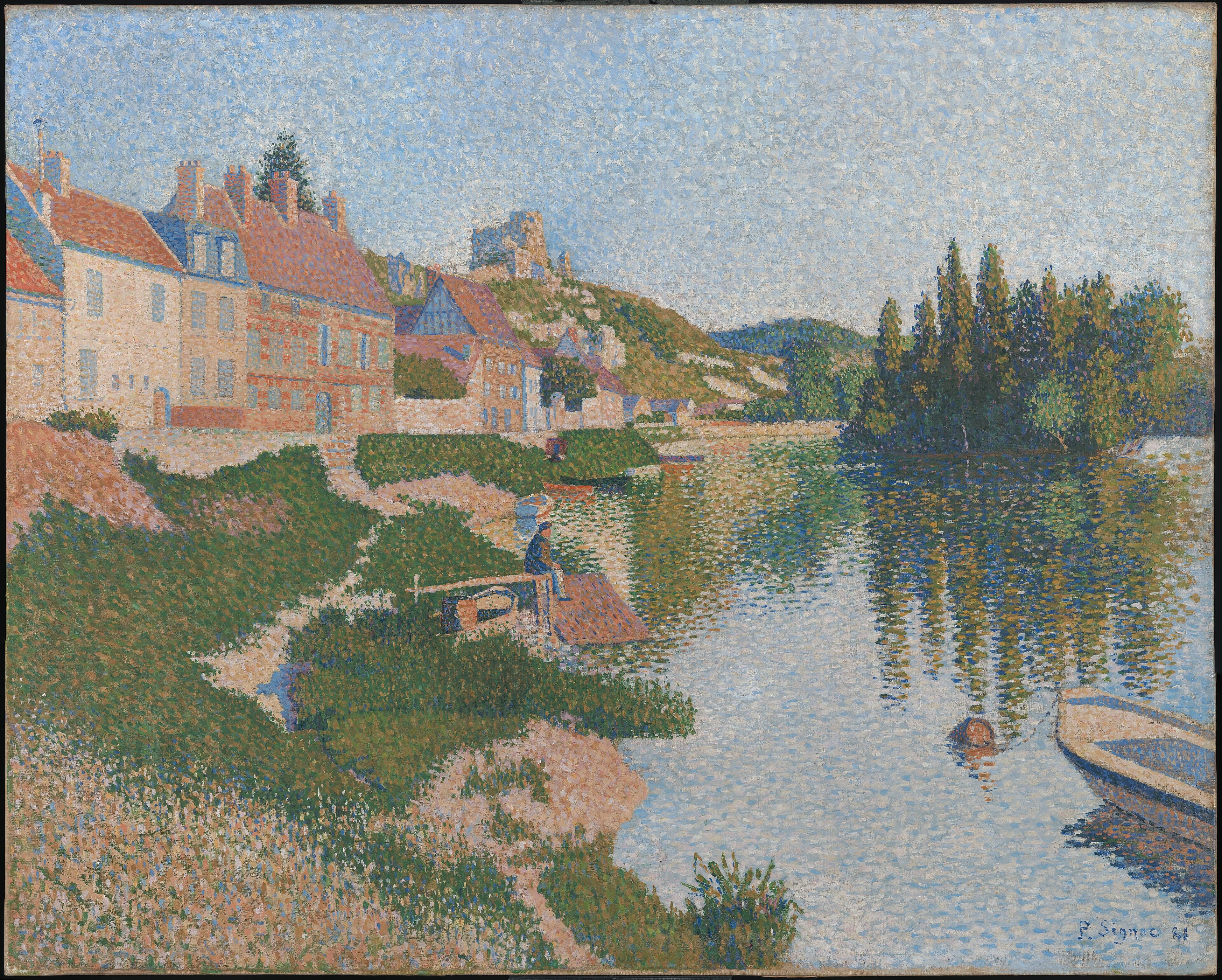
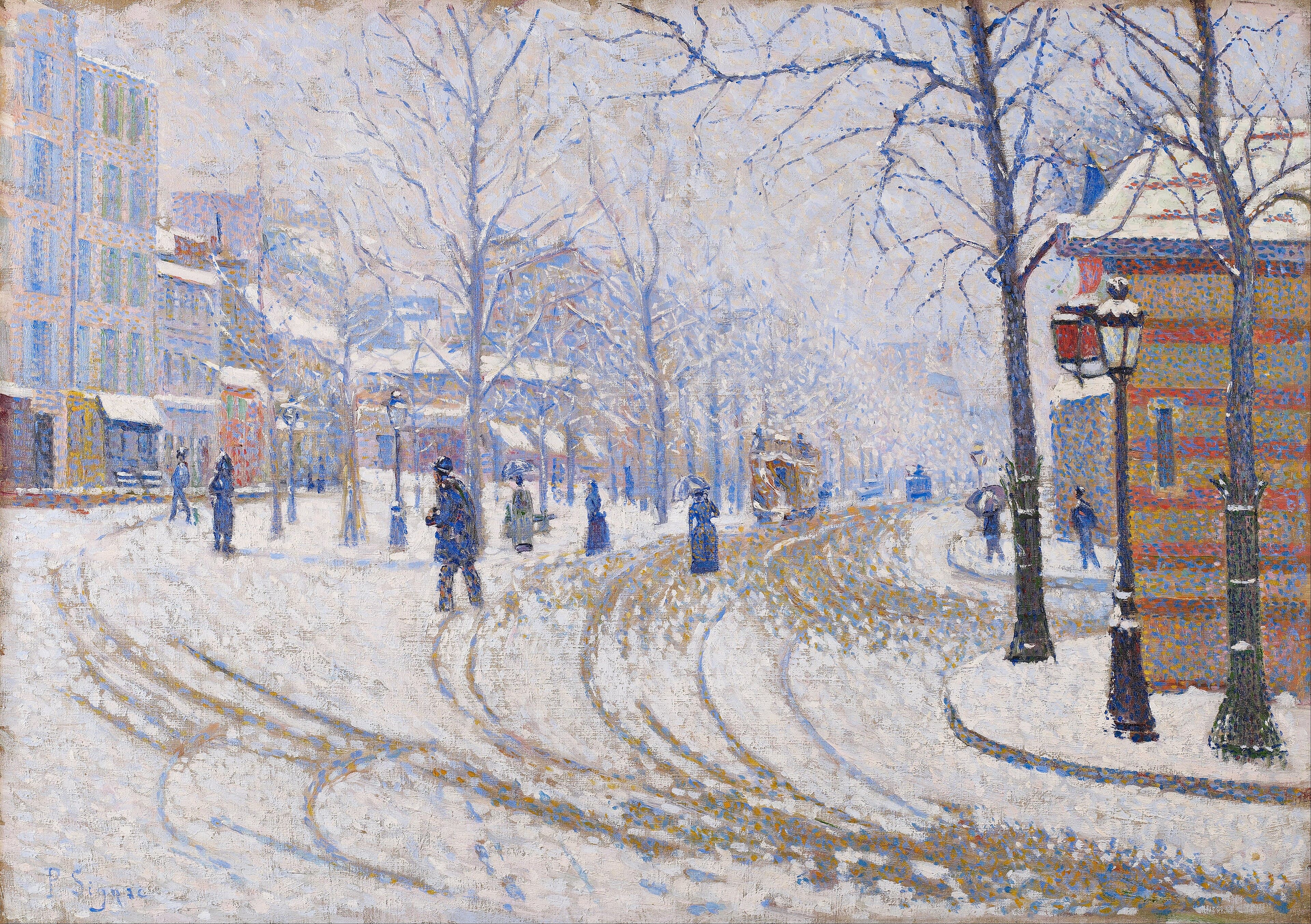
If you like Paul Signac
Explore painters from the same movements and circles.
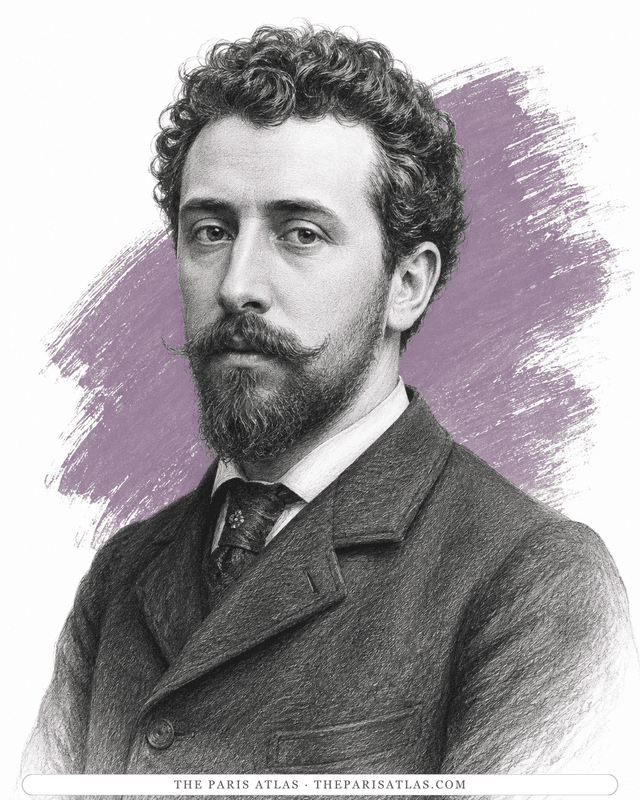
Georges Seurat
Parisian painter who built pictures from small dots of pure colour on optical principle, co-founded the Salon des Indépendants, and detonated the last Impressionist exhibition of 1886 with A Sunday on La Grande Jatte. He died at thirty-one.
View artist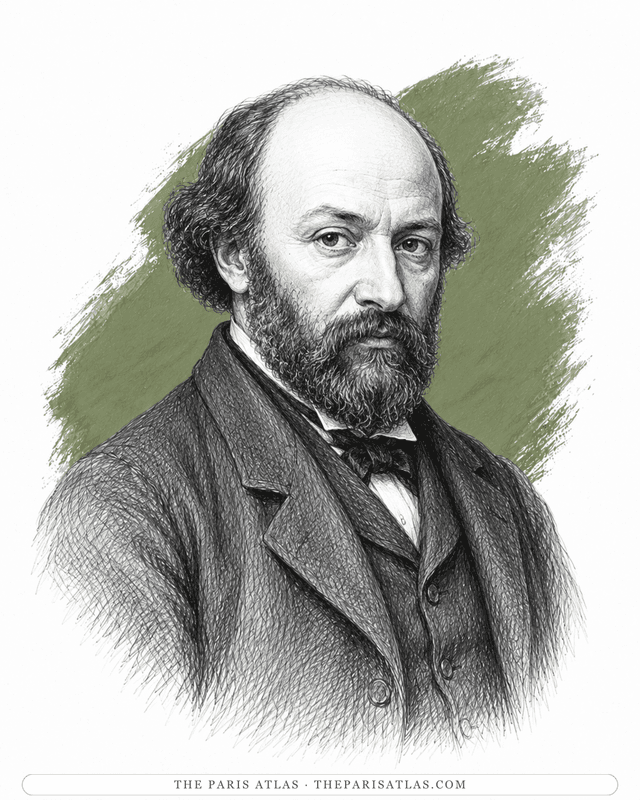
Paul Cézanne
Painter between Impressionism and everything after — shown in the independents' exhibitions, emulated by the Cubists, and present at the Orangerie through 15 works in the Walter-Guillaume collection.
View artist
Henri-Edmond Cross
French Neo-Impressionist who carried divided colour to the Mediterranean, enlarged the dot into a bright mosaic-like stroke, and influenced the young Henri Matisse.
View artist
References
The sources below include collection records, catalogues, scholarly research, and primary materials that informed this page. They document Opus 217. Against the Enamel of a Background Rhythmic with Beats and Angles, Tones, and Tints, Portrait of M. Félix Fénéon in 1890, its making, and its place in cultural history.


1Opus 217: Portrait of M. Félix Fénéon in 1890
WebsiteMuseum of Modern ArtUsed forWeb source consulted for documented facts and historical context presented on the Opus 217. Against the Enamel of a Background Rhythmic with Beats and Angles, Tones, and Tints, Portrait of M. Félix Fénéon in 1890 page.
2Georges Seurat (1859–1891) and Neo-Impressionism
WebsiteThe Metropolitan Museum of ArtUsed forWeb source consulted for documented facts and historical context presented on the Opus 217. Against the Enamel of a Background Rhythmic with Beats and Angles, Tones, and Tints, Portrait of M. Félix Fénéon in 1890 page.

3D'Eugène Delacroix au néo-impressionnisme
NonfictionWikisource, 1911Used forPublished analysis and historical context used in preparing the Opus 217. Against the Enamel of a Background Rhythmic with Beats and Angles, Tones, and Tints, Portrait of M. Félix Fénéon in 1890 page.
4Paul Signac
WebsiteThe Museum of Modern ArtUsed forWeb source consulted for documented facts and historical context presented on the Opus 217. Against the Enamel of a Background Rhythmic with Beats and Angles, Tones, and Tints, Portrait of M. Félix Fénéon in 1890 page.
These references provide the documented foundation for this work's history and interpretation. Claim-level citations remain attached to the specific claims they support.
 Explore more resources