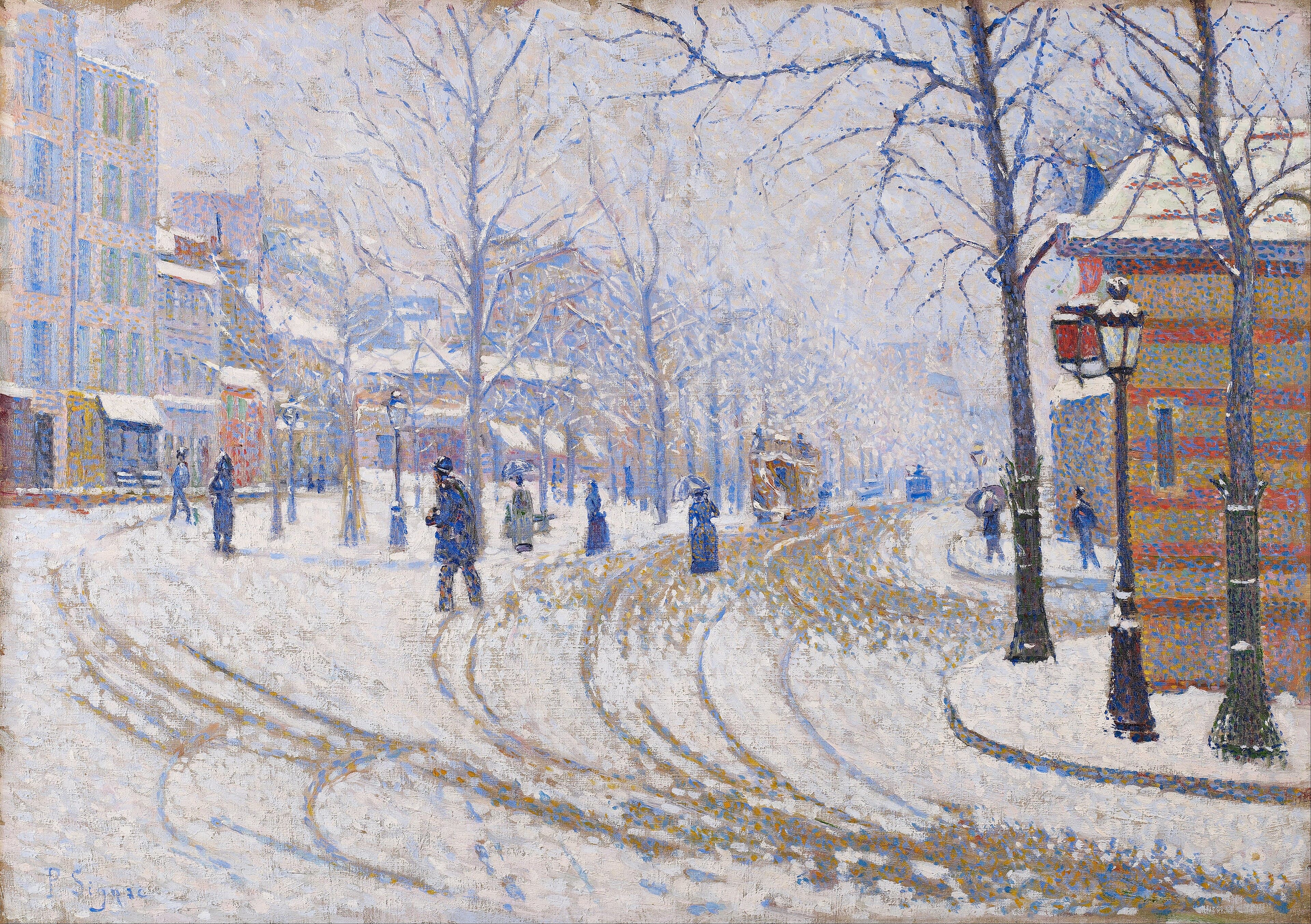
Snow, Boulevard de Clichy, Paris
by Paul Signac
Snow lies across the boulevard de Clichy in the north of Paris, cut by the curving ruts of cab and omnibus wheels. Bare plane trees run up the centre, a horse omnibus stands in the middle distance, and a red-brick corner building with a gas lamp closes the right side. Paul Signac painted it in 1886, the year the new method got its name. It is at the Minneapolis Institute of Art.
- 1886
- Oil on canvas
- Minneapolis Institute of ArtMinneapolis, United States
About Paul Signac
What the painting shows
The boulevard sweeps from the lower left to the right edge. Wheel ruts curve across the foreground snow in long parallel arcs. A man in a blue overcoat and bowler hat walks toward the viewer at the left of centre, hands held in front of him, with figures under umbrellas behind him and a woman in dark blue further along.
Bare plane trees run up the middle of the road. A horse omnibus with a pale roof stands among them, and smaller vehicles are indicated beyond it. At the right a corner building in red brick and ochre carries a tall cast-iron lamp standard, its glass lantern capped with snow. A flag in red and blue hangs from the wall above it.
The canvas is 48.1 by 65.56 centimetres. Signac signed it at the lower left in blue: P. Signac. The Minneapolis Institute of Art dates it 1886.
Painted in the year of the name
Signac lived and worked in this quarter, and the boulevard de Clichy was his own street in practice: Montmartre below, the Batignolles behind. He painted the gasworks at Clichy and the road to Gennevilliers in the same years.
1886 is the hinge. In May, Georges Seurat showed A Sunday on La Grande Jatte at the eighth and last Impressionist exhibition, with Signac and Camille Pissarro in the same room, and Félix Fénéon supplied the name Neo-Impressionism in his review. Signac was twenty-two and had met Seurat only two years earlier, at the first Salon des Indépendants.
Three different handlings in one canvas
The picture is not uniformly pointillist, and the differences are easy to see at close range. The corner building at the right is a regular lattice of separate round dots in cobalt, gold, vermilion and green over an orange ground, about as systematic as Signac ever got.
The omnibus is the opposite. It is built from loose dragged strokes of ochre-brown, cobalt and white, with the snow on its roof laid on thickly with a loaded brush and no dots at all. The tall block at the left is a third thing again, thin vertical scumbles of pale blue and cream-pink with gold dots scattered in rows across the façade.
The snow itself is barely painted. It is a dry, thin cream-ivory with the canvas weave showing through almost everywhere, and the ruts are strung across it as beads of gold-ochre and cobalt blue laid in pairs. The brightest whites in the picture are small impasto flecks on the lamp and the omnibus roof, not the road.
Where the painting is now
The Minneapolis Institute of Art holds the canvas as accession number 61.36.16, from the bequest of Putnam Dana McMillan. The museum's record gives gallery G359 and an audio stop for the painting.
The museum states the object's rights as public domain and publishes the reproduction at full resolution.
Close reading
Reading the work, detail by detail
The interest of this canvas is that Paul Signac had not settled on one way of putting paint down. Ten close views find three handlings sharing a single picture: a strict lattice of round dots on the corner building, loose dragged strokes on the omnibus, and snow so thinly scrubbed that the canvas weave carries most of the light.
1.The one passage painted by the rule
The corner building is a regular lattice of separate round dots in cobalt, gold, vermilion and green over an orange-ochre ground. The dots are evenly spaced and roughly equal in size. It is the most systematic square metre in the painting, and it sits beside passages with no dots at all.
2.Snow as the thickest paint in the picture
The lantern is cream and yellow glass panes with blue glazing bars, on a dark blue-black iron standard. The snow capping it is laid on in thick white impasto, and together with the omnibus roof it holds the only true whites in the canvas. The road has none.
3.No dots at all on the omnibus
The omnibus is built from loose, wet, dragged strokes of ochre-brown, cobalt and white, with the snow on its roof pushed on by a loaded brush. Nothing here is divided into touches. Signac is painting like an Impressionist a few centimetres from his strictest dot lattice.
4.Ruts strung as beads of gold and blue
The ruts are long diagonal streaks with gold-ochre, cobalt and warm brown dots strung along them, the warm and cool notes set in pairs. They are drawn across the snow rather than dug into it, and they give the foreground its only saturated colour.
5.Snow that is mostly bare canvas
The snow is a dry cream-ivory scrubbed so thinly that the canvas weave shows through nearly everywhere. It is not white, and it is the least worked surface on the canvas. The picture's brightness comes from the ground, not from lead white.
6.A coat of blue with green worked in
The walker's overcoat is ultramarine and cobalt with green and violet-red strokes worked along its edges, not black. His bowler carries a cream highlight along the brim and his face is a small warm ochre patch. He holds something dark in both hands at waist height.
7.A pale umbrella over an olive coat
Behind and to the right of the walker a figure in a pale olive-green coat carries an open umbrella painted in blue-white with thick cream strokes across its ribs. A purple-grey hem shows below the coat. The whole group is drawn with strokes, not dots.
8.Vertical scumble with gold dropped on
The block at the left is a third handling again: thin dry vertical strokes of pale blue and cream-pink, with small gold and orange dots scattered in rows across the façade. The windows are cerulean slabs, several carrying green. Paint is at its thinnest here and the weave dominates.
9.Branches drawn as strings of blue dots
The bare branches are drawn as strings of cobalt and violet dots running across a thin cream sky, thinning as they reach the twigs. Along the snow-covered roof ridges below, rows of small red and blue dots alternate, the only strongly saturated colour in the upper canvas.
10.Signed in blue, not black
Signac signed at the lower left in blue, on the thin cream of the snow. The Minneapolis Institute of Art records the inscription as lower left in blue, and dates the painting 1886. The signature sits on bare-looking ground with the weave visible around the letters.
Timeline
1884
Meets Georges Seurat at the first Salon des Indépendants and helps found the Société des Artistes Indépendants.
May 1886
Exhibits with Georges Seurat and Camille Pissarro at the eighth Impressionist exhibition; Félix Fénéon names the tendency Neo-Impressionism.
1886
Paints the boulevard de Clichy under snow, signing it at the lower left in blue.
1961
Enters the Minneapolis Institute of Art through the bequest of Putnam Dana McMillan, as accession number 61.36.16.
Where to see it
Minneapolis Institute of Art
Minneapolis, United States
A public viewing address has not yet been confirmed for this holding.
The museum's record gives Gallery G359. Displays rotate, so check the collection page before travelling to see it.
Frequently asked questions
Where is Snow, Boulevard de Clichy, Paris?
The Minneapolis Institute of Art, accession number 61.36.16, from the bequest of Putnam Dana McMillan. The museum's record gives gallery G359 and carries an audio stop for the painting.
What does the painting show?
The boulevard de Clichy in the north of Paris under snow. Wheel ruts curve across the foreground, bare plane trees run up the middle of the road, and a horse omnibus stands in the middle distance. A red-brick corner building with a gas lamp closes the right side.
Is Snow, Boulevard de Clichy painted in dots?
Only in places. The corner building at the right is a regular lattice of round dots, the omnibus is built from loose dragged strokes with no dots at all, and the snow is thin dry scumbling with the canvas weave showing through. Three handlings share one canvas.
Why does 1886 matter?
It is the year Neo-Impressionism was named. Georges Seurat showed A Sunday on La Grande Jatte at the eighth Impressionist exhibition in May, Paul Signac and Camille Pissarro hung in the same room, and Félix Fénéon supplied the term in his review.
How large is the canvas?
48.1 by 65.56 centimetres, roughly 19 by 26 inches. The Minneapolis Institute of Art records it as oil on canvas, signed at the lower left in blue.
Is the snow painted white?
Not really. Close to the surface it is a thin, dry cream-ivory laid over visible canvas weave, with gold-ochre and cobalt blue dots strung along the ruts. The brightest whites are small thick flecks on the lamp and the omnibus roof.
Did Paul Signac know this part of Paris?
He worked in it. The boulevard de Clichy runs along the foot of Montmartre, and he painted the gasworks at Clichy and the road to Gennevilliers in the same period.
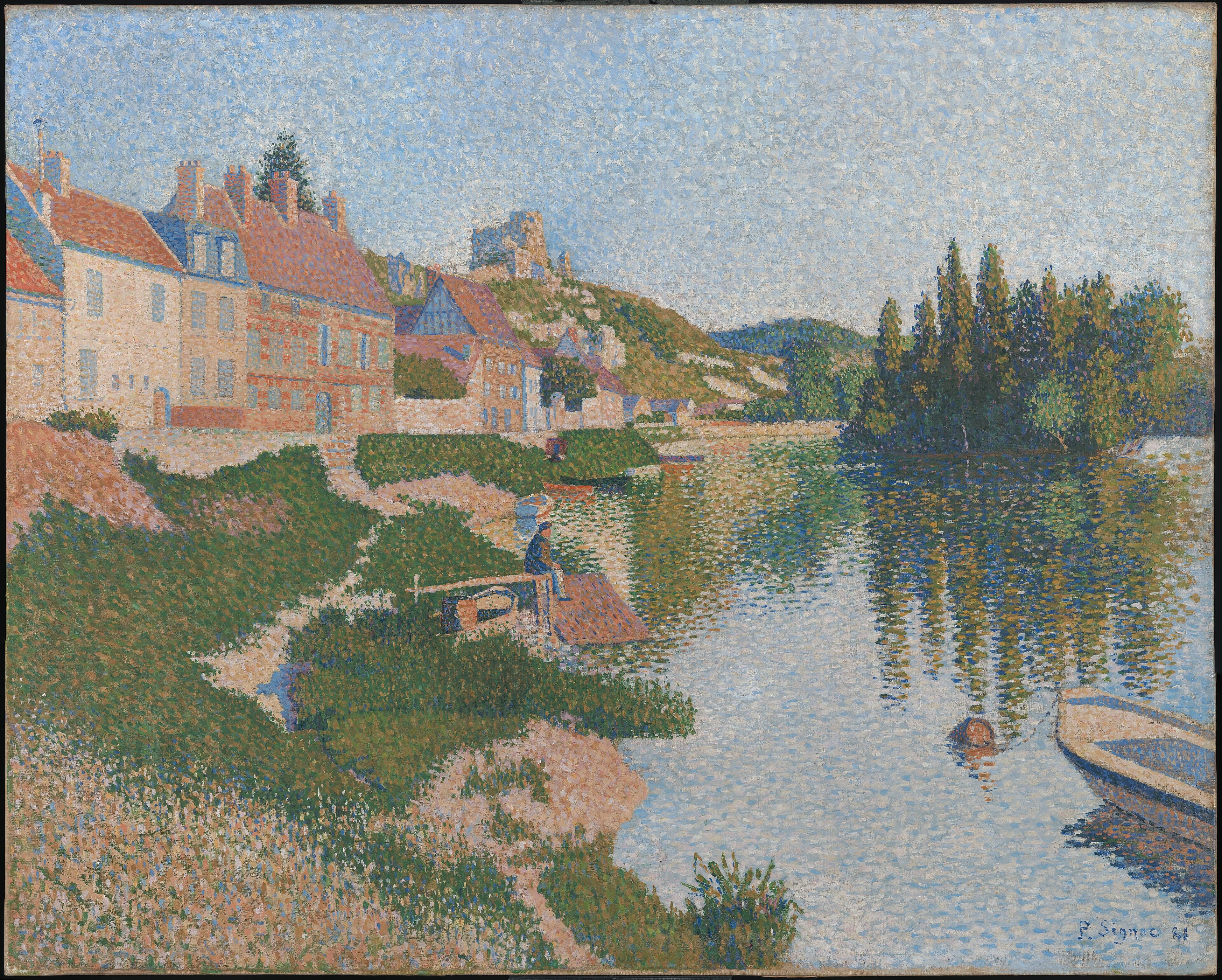
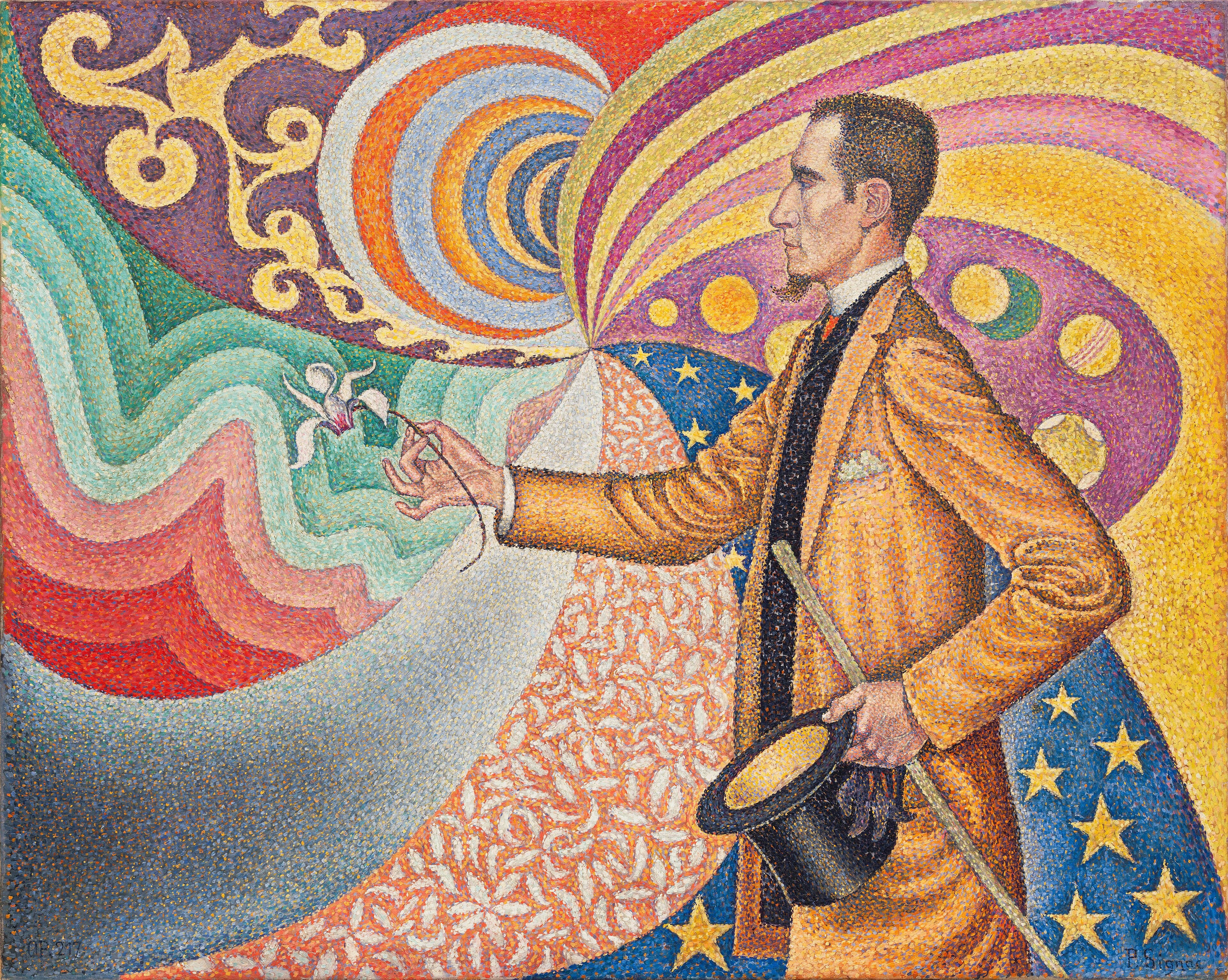
More by Paul Signac
If you like Paul Signac
Explore painters from the same movements and circles.
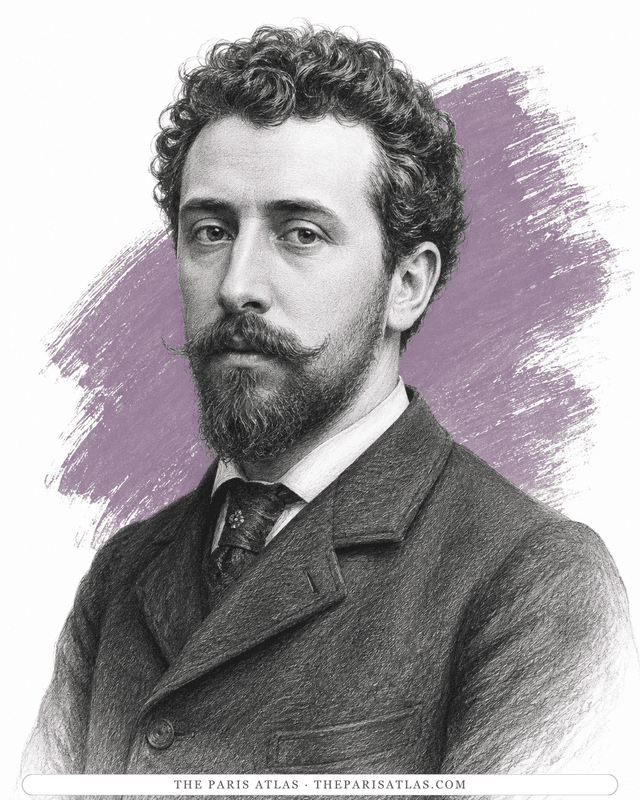
Georges Seurat
Parisian painter who built pictures from small dots of pure colour on optical principle, co-founded the Salon des Indépendants, and detonated the last Impressionist exhibition of 1886 with A Sunday on La Grande Jatte. He died at thirty-one.
View artist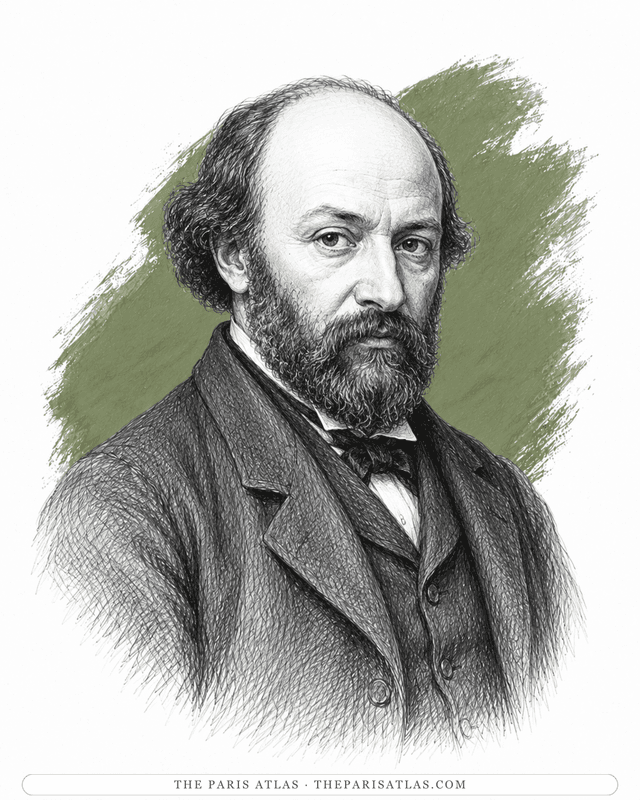
Paul Cézanne
Painter between Impressionism and everything after — shown in the independents' exhibitions, emulated by the Cubists, and present at the Orangerie through 15 works in the Walter-Guillaume collection.
View artist
Henri-Edmond Cross
French Neo-Impressionist who carried divided colour to the Mediterranean, enlarged the dot into a bright mosaic-like stroke, and influenced the young Henri Matisse.
View artist
References
The sources below include collection records, catalogues, scholarly research, and primary materials that informed this page. They document Snow, Boulevard de Clichy, Paris, its making, and its place in cultural history.

1Snow, Boulevard de Clichy, Paris (Paul Signac)
WebsiteMinneapolis Institute of ArtUsed forWeb source consulted for documented facts and historical context presented on the Snow, Boulevard de Clichy, Paris page.
2Georges Seurat (1859–1891) and Neo-Impressionism
WebsiteThe Metropolitan Museum of ArtUsed forWeb source consulted for documented facts and historical context presented on the Snow, Boulevard de Clichy, Paris page.
3The founding of the Société des Artistes Indépendants
WebsiteSociété des Artistes Indépendants — “Notre histoire”Used forWeb source consulted for documented facts and historical context presented on the Snow, Boulevard de Clichy, Paris page.
4Paul Signac
WebsiteEncyclopaedia BritannicaUsed forWeb source consulted for documented facts and historical context presented on the Snow, Boulevard de Clichy, Paris page.
These references provide the documented foundation for this work's history and interpretation. Claim-level citations remain attached to the specific claims they support.
 Explore more resources