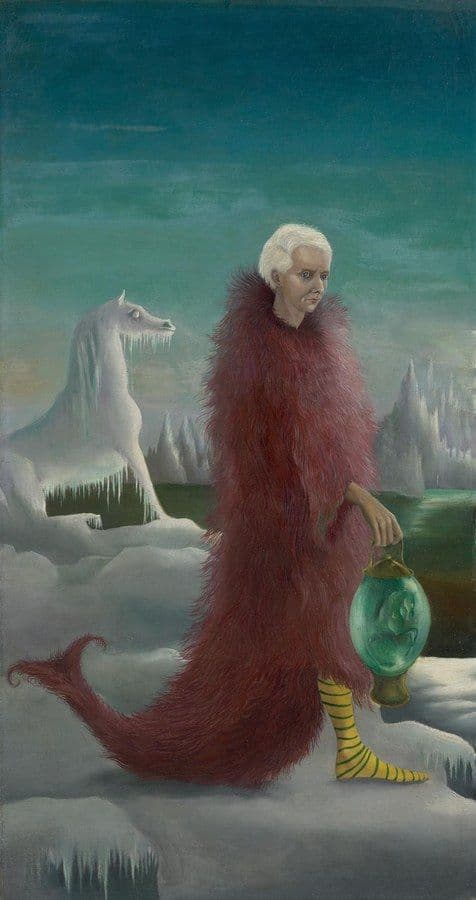
A figure in a floor-length coat of dark red fur walks to the right across a frozen plain, carrying a green glass lantern with a small white horse standing inside it. One leg shows a stocking striped yellow and dark green. Leonora Carrington painted it about 1939 at the farmhouse she and Max Ernst kept in the Ardèche. The National Galleries of Scotland bought it in 2018.
The canvas is tall and narrow, fifty centimetres by twenty-seven, and one standing figure fills most of it. The body is in profile walking right; the head is turned back towards the viewer. The hair is white and swept off a high forehead, the skin pale, the eyes blue, the mouth closed, the lines from nose to mouth deeply cut.
The coat is shaggy fur in dark red and purple, high at the collar and long to the ground. Behind the walking figure it does not stop at the hem: it runs on across the snow as a thick tail and curls upward at the tip.
One hand hangs at the side and holds a lantern by a thin brass loop. The lantern has a brass cap above and a flared brass foot below, and between them an ovoid body of green glass. Inside the glass a small pale horse stands in profile with its head lowered and one foreleg raised. The National Galleries of Scotland's own notice names the lantern and the horse in it.
Below the coat, one leg is visible in a stocking striped yellow with diagonal dark-green bands. It runs on over the foot and ends in a point resting on the snow.
At the left a white horse's head and neck rise out of an ice bank, ears up, mouth open, the eye a blank pale oval. Icicles hang from its jaw and from the shelf of ice beneath it, and its body is not separable from the ice it stands in. Pale spiky pinnacles run along the middle distance, a strip of dark green water lies to the right, and the sky goes from deep teal at the top through pale green to cream at the horizon.
Painted at Saint-Martin-d'Ardèche
The National Galleries of Scotland records that Leonora Carrington and Max Ernst moved in 1938 to the village of Saint-Martin-d'Ardèche, near Avignon, and that the painting was made there. They had met at a dinner party in London in 1937, when she was twenty and he forty-six, and she had moved to Paris soon afterwards.
The farmhouse was the second half of the Paris years rather than a break from them. They covered it inside and out with cement figures and painted creatures.
The household ended in 1939 and 1940. Max Ernst, a German national, was interned by France as an enemy alien and later held by the Gestapo. Leonora Carrington left for Spain, where she was hospitalised after a period of acute mental stress and then committed by her family to an asylum in Santander.
The horse in the lamp
Horses recur across the paintings and the short stories Leonora Carrington wrote in the same years, and the National Galleries of Scotland reads them as her alter ego. Two appear here, and neither is free. One is sealed inside the glass of the lantern. The other is set into the ice at the left, with icicles hanging off its jaw.
The museum states the ambiguity rather than resolving it. The horse in the lantern could be lighting the way forward, or it could be imprisoned and at the carrier's mercy. Both readings are available in the paint, and the museum says the picture holds the ambivalence of the relationship at the time.
That is as far as the documented reading goes. The frozen horse at the left carries no institutional gloss at all.
An exchange of portraits
Both of them eventually reached New York, and the National Galleries of Scotland records that they exchanged portraits of each other there. Leonora Carrington gave this one to Max Ernst.
The painting stayed in private hands for the next several decades. The National Galleries of Scotland bought it in 2018 with help from the Henry and Sula Walton Fund and Art Fund, and it carries the accession number GMA 5600.
It hangs at Modern One, the museum's building at 75 Belford Road in Edinburgh, and the museum lists it as on display.
Close reading
Reading the work, detail by detail
The canvas is twice as tall as it is wide and almost everything in it is either fur or ice. The National Galleries of Scotland's own notice names the lantern and the horse inside it, and leaves the meaning open. The close views separate the figure, the lantern and the frozen landscape behind.
1.White hair and a face turned back
The hair is white and swept straight back off a high forehead. The eyes are bright blue and turned out at the viewer while the body walks the other way. Deep lines run from the nose to the corners of the closed mouth, and the dark red fur rises around the throat like a collar.
2.A hand comes out of the fur
A pale hand and forearm come straight out of the shaggy red sleeve with no cuff between them. The fingers hang loose and slightly curled. Behind the hand the ground changes from white ice to a band of dark green water.
3.A horse stands inside the lantern
The lantern has a brass cap above and a flared brass foot below, with an ovoid of translucent green glass between them. Inside the glass a small pale horse stands in profile, head lowered and one foreleg lifted. The National Galleries of Scotland names it and says the horse may be guiding the figure or may be imprisoned.
4.The leg is striped yellow and green
One leg shows below the coat in a stocking striped yellow with diagonal dark green bands. It runs on over the foot without a break and ends in a point on the snow. The stripes narrow as they wrap the ankle.
5.The coat ends in a curled tail
The coat does not stop at a hem. It runs on behind the walking figure as a thick tail of the same dark red fur, lies flat across the snow, and curls upward at the tip. A grey shadow follows it along the ground.
6.A horse frozen into the ice
A white horse's head and neck rise out of an ice bank at the left, ears up, mouth open, the eye a blank pale oval with no pupil. Icicles hang in a row from the jaw and from the shelf of ice beneath. The body does not separate from the ice it stands in.
7.Ice pinnacles and green water
Pale spiky formations of ice stand in a row along the middle distance, lit from the left. Below them the ground gives way to a strip of dark green water. The sky above shifts from deep teal at the top through pale green to a warm cream at the horizon.
8.How the fur is painted
The coat is painted hair by hair. Thousands of long fine strokes in dark red and purple lie in parallel down the length of the garment, breaking into loose ends at the edges. Against them the snow behind is laid in flat, almost unmarked grey.
Where is Leonora Carrington's Portrait of Max Ernst?
The National Galleries of Scotland in Edinburgh, accession number GMA 5600, on display at Modern One, 75 Belford Road. The museum bought it in 2018 with assistance from the Henry and Sula Walton Fund and Art Fund.
What is in the lantern in Portrait of Max Ernst?
A horse. The lantern is an ovoid of green glass with brass fittings above and below, and inside it a small pale horse stands in profile with its head lowered. The National Galleries of Scotland names it, and reads horses throughout her early work as her own alter ego.
When and where was Portrait of Max Ernst painted?
About 1939, at Saint-Martin-d'Ardèche near Avignon, where Leonora Carrington and Max Ernst had settled in 1938. The National Galleries of Scotland dates the work to about 1939 and names the village on its object record.
How big is Portrait of Max Ernst?
The canvas is 50.3 by 26.8 centimetres — tall and narrow, about twenty inches by eleven. Framed, the object measures 67.7 by 44.5 by 5.2 centimetres and weighs five kilograms.
What does the painting mean?
The National Galleries of Scotland declines to settle it. The horse inside the lantern, the museum writes, could be guiding the figure forward or could be imprisoned and at his mercy, and the painting captures some of the ambivalence in the relationship at the time. No reading beyond that is documented.
Did Max Ernst own the painting?
Yes. The National Galleries of Scotland records that after both of them escaped to New York they exchanged portraits of each other, and that Leonora Carrington presented this work to him. The museum acquired it in 2018.
In the atlas
What the graph records about this work — every claim carries its citation.
The National Galleries of Scotland's object record for GMA 5600 carries a Depicted field, and the name in it is Max Ernst. The museum's own text describes the painting as showing him holding a lantern with a horse inside it. The date is approximate because the museum gives it as about 1939.
— Leonora Carrington, Portrait of Max Ernst, about 1939 — GMA 5600, GMA 5600
Explore painters from the same movements and circles.
Jean Arp
Strasbourg-born sculptor and poet — Hans in German, Jean in French, both all his life — who co-founded Dada at the Cabaret Voltaire in 1916, composed collages by dropping torn paper 'according to the laws of chance', and settled at Meudon outside Paris in a house his wife Sophie Taeuber-Arp designed.
French photographer who turned a pocket-sized 35mm camera into an instrument of split-second composition — the idea the world knows as 'the decisive moment'. He trained as a painter, was taken prisoner in 1940 and escaped on his third try, photographed the Liberation of Paris in August 1944, co-founded the photographer-owned agency Magnum Photos in 1947, gave up reporting for drawing in the 1970s, and left Paris a foundation in the Marais that deliberately hangs no permanent display of his own pictures.
The self-made icon of Surrealism — melting watches and manicured scandal — who arrived in Paris by way of two films written with Buñuel, dreamed together before the movement claimed them.
The sources below include collection records, catalogues, scholarly research, and primary materials that informed this page. They document Portrait of Max Ernst, its making, and its place in cultural history.
1Leonora Carrington, Portrait of Max Ernst, about 1939 — GMA 5600
Website
National Galleries of Scotland
Used for
The National Galleries of Scotland's object record — title, date, medium, measurements, credit line, display status, curatorial text and copyright notice.
These references provide the documented foundation for this work's history and interpretation. Claim-level citations remain attached to the specific claims they support.


 View source