And Then We Saw the Daughter of the Minotaur
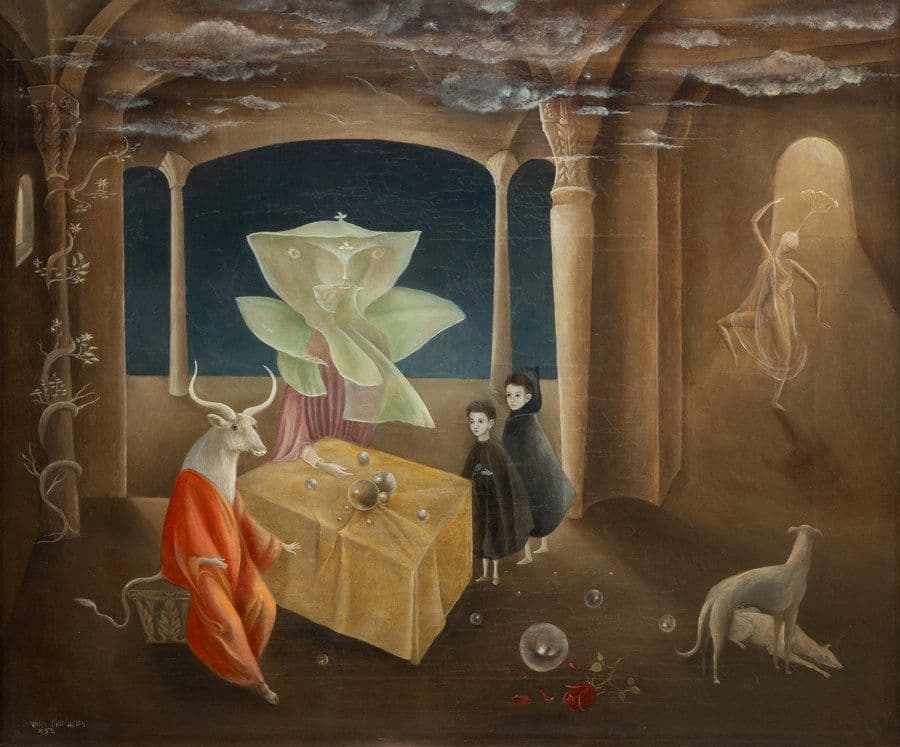
A bull-headed figure in an orange robe sits at a draped yellow table strewn with glass spheres, facing a figure built of pale green leaves. Two cloaked children stand to one side and two hounds wait at the right. Leonora Carrington painted it in Mexico City in 1953. The Museum of Modern Art bought it in 2019 and shows it on Floor 5.
- 1953
- Oil on canvas
- The Museum of Modern ArtNew York, United States
About Leonora Carrington
What the painting shows
The room is brown and vaulted. Ribs curve across a low ceiling, and grey-white clouds drift along it indoors. A tall arched opening at the centre gives onto a night sky of dark blue-black, flanked by slender pale columns, and a carved column with a foliate capital stands at each side of the picture.
At the left a figure with a white bull's head sits on a small carved stool. Two long white horns curve up and out, the ears are small and upright, the eyes blue-grey, the muzzle long and open. A full orange-red robe falls from the neck to the floor in heavy folds, and two thin pale hands come out of it, one gesturing towards the table.
The table fills the middle, covered to the floor in a plain yellow cloth. On it sit glass spheres, one large with several smaller ones clustered round it, and more lie scattered across the brown floor.
Behind the table stands a figure made of broad pale green leaves. The uppermost leaf spreads like a hood, and two round yellow-rimmed eyes look out of its shadowed inner face. A thin white stem rises between them to a small three-lobed flower, and a second tiny flower sits on the crown of the hood. Two more leaves spread left and right, and below them a pleated rose-pink column drops to the tabletop. A pale hand rests on the cloth.
To the right of the table two children stand side by side, both barefoot, both with short dark curly hair, in full-length dark cloaks fastened at the neck. The nearer one faces the viewer with a small blue clasp at the chest; the taller one wears a raised pointed hood and looks back over its shoulder.
At the far right a lit niche is cut into the wall. In front of it a translucent figure dances clear of the ground, drawn in fine white lines, one arm raised and a spray of small white flowers held above the head. Below, two pale hounds wait: one standing in profile, one lying flat with its head stretched out. A red rose with a thorny stem and loose petals lies on the floor at the bottom centre, and a pale two-line signature sits at the lower left.
The canvas is 60 by 70 centimetres, or 23 5/8 by 27 9/16 inches.
It is not at the Metropolitan Museum of Art
The painting is routinely placed at the Metropolitan Museum of Art. It belongs to the Museum of Modern Art, which bought it on 18 June 2019 and holds it as 146.2019.
The error has a traceable source. The Consejo Leonora Carrington, the body that manages the artist's legacy, gives the location on its own catalogue page as the Metropolitan Museum, with the address 1000 5th Avenue. The Metropolitan Museum of Art's collection contains four works by Leonora Carrington and this is not among them; its search for the title returns nothing, and the accession number adjacent to her Self-Portrait belongs to a Jean Dubuffet.
The Museum of Modern Art's own record, and the museum's published collection dataset, both carry the object with its number, its credit line and its gallery.
The title, without the exclamation mark
The literature usually prints the title with an exclamation mark: And Then We Saw the Daughter of the Minotaur! The Museum of Modern Art prints it without one, both on the object page and in its published dataset, and the museum's form is the one used here.
The title is a sentence out of a story, and Leonora Carrington was writing stories throughout the years she was painting. It names something the picture does not settle. A minotaur has a bull's head, and the seated figure at the left of the canvas has a bull's head; the figure it faces is built of leaves.
The Museum of Modern Art publishes no description of the painting, so no institutional reading assigns the title to a figure. What can be said is what is on the canvas, which is set out above.
Mexico City, 1953
Leonora Carrington had lived in Mexico for eleven years when she painted it. She had married the Hungarian photographer Emerico Weisz in 1946 and had two sons, and she worked through the 1950s in close parallel with the Spanish painter Remedios Varo, who had also left occupied France.
The canvas belongs to that decade rather than to the European years. Its vocabulary is the one she built in Mexico: interiors with their own weather, animal-headed figures at a table, hounds, and objects treated as instruments.
The Museum of Modern Art shows it on Floor 5 in gallery 517, in the Alfred H. Barr, Jr. Galleries, and its installation photographs record it in a display called Surrealist Objects.
Close reading
Reading the work, detail by detail
The Museum of Modern Art publishes no description of this painting, so nothing here names a figure the museum does not name. What follows is what is on the canvas: a bull's head, a head built of leaves, two children, two hounds, and glass spheres on a yellow cloth in a room with its own weather.
1.A white bull's head, horns up and out
The head is white and shaggy, with two long horns curving up and outward and small upright ears set beneath them. The eyes are blue-grey and set wide. The muzzle is long and the mouth open, and the white fur of the neck runs down into a band of red cloth.
2.The orange robe and a thin hand
The robe is orange-red and falls in heavy rounded folds to the floor. A thin pale hand with long fingers comes out of it and turns towards the table. Behind and below, a small carved stool with a foliate panel takes the weight of the seated figure.
3.Two eyes inside a leaf
The uppermost leaf spreads like a hood, and two round eyes with yellow rims look out of its shadowed inner face. A thin white stem rises between them and opens into a small three-lobed flower, and a second tiny flower sits on the crown of the hood. Two further leaves spread left and right below.
4.Glass spheres on the yellow cloth
One large clear sphere sits on the yellow cloth with several smaller ones clustered against it, each catching a small highlight. A pale hand with long thin fingers lies flat on the cloth above them. More spheres lie scattered across the floor beyond the table.
5.Two children in dark cloaks
Both children have short dark curly hair and pale faces, and both wear full-length dark cloaks fastened at the neck. The nearer and shorter one faces the viewer with a small blue clasp at the chest. The taller one behind wears a raised pointed hood and looks back over its shoulder.
6.A translucent figure dances in a niche
The figure is drawn in fine white lines and the brown wall shows straight through it. One arm is raised above the small round head and the other flung down and out, the feet are pointed and off the ground, and a veil of thin strokes wraps the body. A spray of small white flowers rises above the head on a stalk.
7.Two hounds at the right
Two pale grey hounds occupy the lower right. One stands in profile with a long neck, a deep chest, folded ears and a thin tail curving down. The other lies flat beneath it with its head stretched out along the floor. Neither is looking at the table.
8.Clouds under the ceiling
Grey and white clouds drift along the underside of the vault, following its ribs. Small pale points are scattered among them. The ceiling is solid brown masonry and the weather is inside the room rather than beyond it.
9.An arch opens on a night sky
A tall arched opening at the centre gives onto a flat dark blue-black sky. Slender pale columns with carved capitals stand inside it, dividing the opening. The masonry around the arch is warm brown and unlit.
10.A rose and a sphere on the floor
A large clear sphere rests on the brown floor at the bottom centre. Beside it lies a red rose on a thorny stem with pale leaves, and loose red petals are scattered on the floor around it. Nothing in the room accounts for either.
11.A plant climbs the carved column
A carved stone column stands at the left edge with a foliate capital above. A pale climbing plant winds up its shaft, putting out small white flowers along the way. A narrow slit window is cut into the wall beside it, lit pale.
12.The signature and the year
A pale two-line signature is painted into the dark brown floor at the lower left, the name above and the year below it. It is set well in from the edge, where the floor is darkest, and reads only at close range.
Timeline
1942
Leonora Carrington reaches Mexico, where she lives for the rest of her life.
1946
Marries the photographer Emerico Weisz in Mexico City; two sons follow.
1953
Painted, in oil on canvas, 60 by 70 centimetres.
2019
Acquired by the Museum of Modern Art on 18 June as 146.2019, a gift of Joan H. Tisch by exchange, alongside Green Tea of 1942.
2025
Hung in the Surrealist Objects display in gallery 517, per the museum's installation photographs.
2026
On view on Floor 5, gallery 517, in the Alfred H. Barr, Jr. Galleries.
Where to see it
The Museum of Modern Art
11 West 53 Street, New York, NY 10019, United States
On view on Floor 5, gallery 517, in the Alfred H. Barr, Jr. Galleries as of September 2026. The museum marks its own record a work in progress and publishes no provenance or exhibition history.
Plan your visit on the museum’s official website (opens in a new tab)Frequently asked questions
Where is And Then We Saw the Daughter of the Minotaur?
The Museum of Modern Art in New York, object number 146.2019, on view on Floor 5 in gallery 517 in the Alfred H. Barr, Jr. Galleries. It is not at the Metropolitan Museum of Art, which many sources give and which holds four other works by Leonora Carrington.
Does the title have an exclamation mark?
Not in the museum's own record. The Museum of Modern Art prints And Then We Saw the Daughter of the Minotaur, without punctuation at the end, on the object page and in its published collection dataset. Much of the literature adds an exclamation mark.
Who is the figure with the bull's head?
The Museum of Modern Art publishes no description of the painting and names nobody. What is on the canvas is a seated figure with a white bull's head, two long curving horns and blue-grey eyes, wearing a full orange-red robe, with two thin pale hands resting on and gesturing towards the table.
How big is And Then We Saw the Daughter of the Minotaur?
60 by 70 centimetres, or 23 5/8 by 27 9/16 inches, in oil on canvas. The museum records the medium as oil on canvas rather than the egg tempera she used for other works of the period.
When did the Museum of Modern Art buy it?
18 June 2019, as a gift of Joan H. Tisch by exchange. The museum acquired a second Leonora Carrington painting on the same day, Green Tea of 1942, accessioned as 145.2019.
What are the glass balls in the painting?
Clear spheres, one large with several smaller ones beside it on the yellow tablecloth, and more scattered across the brown floor around the children's bare feet. The museum offers no reading of them, and nothing in the picture explains what they are for.
More by Leonora Carrington
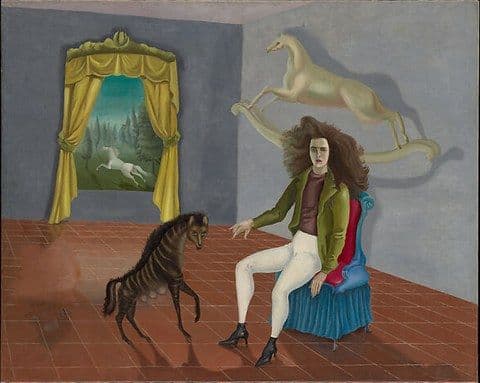
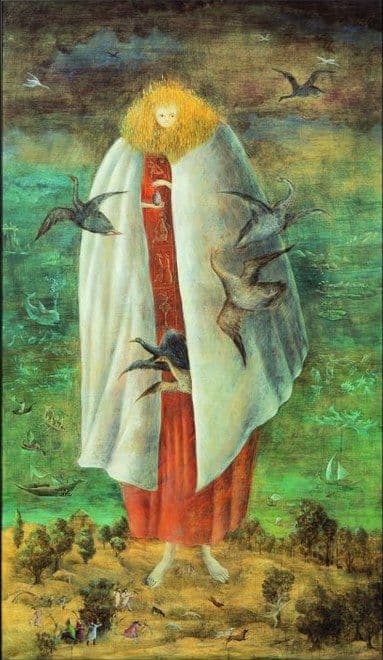
If you like Leonora Carrington
Explore painters from the same movements and circles.
Jean Arp
Strasbourg-born sculptor and poet — Hans in German, Jean in French, both all his life — who co-founded Dada at the Cabaret Voltaire in 1916, composed collages by dropping torn paper 'according to the laws of chance', and settled at Meudon outside Paris in a house his wife Sophie Taeuber-Arp designed.
View artist
Henri Cartier-Bresson
French photographer who turned a pocket-sized 35mm camera into an instrument of split-second composition — the idea the world knows as 'the decisive moment'. He trained as a painter, was taken prisoner in 1940 and escaped on his third try, photographed the Liberation of Paris in August 1944, co-founded the photographer-owned agency Magnum Photos in 1947, gave up reporting for drawing in the 1970s, and left Paris a foundation in the Marais that deliberately hangs no permanent display of his own pictures.
View artist
Salvador Dalí
The self-made icon of Surrealism — melting watches and manicured scandal — who arrived in Paris by way of two films written with Buñuel, dreamed together before the movement claimed them.
View artist
References
The sources below include collection records, catalogues, scholarly research, and primary materials that informed this page. They document And Then We Saw the Daughter of the Minotaur, its making, and its place in cultural history.

1Leonora Carrington, And Then We Saw the Daughter of the Minotaur, 1953
WebsiteThe Museum of Modern Art, New YorkUsed forThe Museum of Modern Art's object record — title, date, medium, dimensions, credit line, gallery, installation views and copyright notice.

2The Museum of Modern Art collection dataset (Artworks.csv)
ArchiveThe Museum of Modern Art, New YorkUsed forThe museum's own published collection dataset, which corroborates the catalogue row and supplies the acquisition date.
3Leonora Carrington, Self-Portrait, ca. 1937–38
WebsiteThe Metropolitan Museum of ArtUsed forThe Metropolitan Museum of Art's collection, searched to confirm that the painting is not among the four Leonora Carrington works it holds.
4Leonora Carrington — Gallery Wendi Norris
WebsiteGallery Wendi Norris, San FranciscoUsed forGallery Wendi Norris, for the Mexican decades and the Weisz marriage.
5Leonora Carrington: Revelación — Fundación MAPFRE (2023 exhibition)
WebsiteFundación MAPFRE, MadridUsed forFundación MAPFRE's retrospective, for the working friendship with Remedios Varo.
These references provide the documented foundation for this work's history and interpretation. Claim-level citations remain attached to the specific claims they support.
 Explore more resources