The Giantess
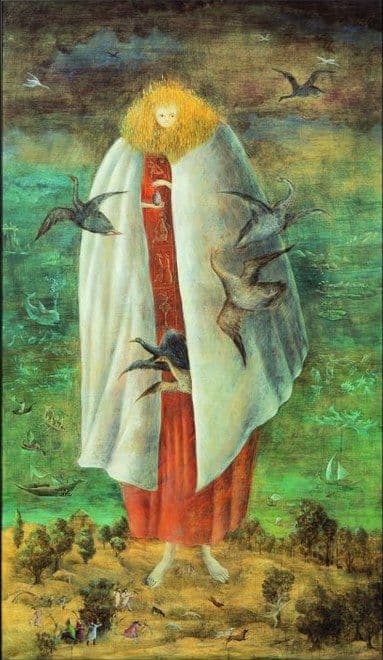
A woman stands taller than the trees, her head a small pale face inside a wide disc of wheat-coloured gold, a white cape spread from her shoulders and geese flying out of it. Two small hands hold a dark speckled egg against the red robe beneath. Leonora Carrington painted it in Mexico around 1947. Edward James bought it, and it has been in private hands ever since.
- circa 1947
- Tempera on wood panel
About Leonora Carrington

What the painting shows
The panel is tall and narrow, and one figure occupies its whole height. She stands facing forward, bare feet planted on a golden-ochre plain, with the horizon somewhere around her knees.
Her head is a small pale round face, with dark dots for eyes and a small closed mouth. It sits at the centre of a broad oval of golden-yellow that stands up in fine spikes all round it, more like a standing crop than like hair.
A cream-white cape falls from her shoulders and spreads outward on both sides in stiff, heavy folds, opening down the front. Beneath it a rust-red robe runs to the ground. A vertical band down the front of the robe is divided into stacked rectangular compartments, each holding small pale figures drawn in outline, several of them bird-headed and turned towards one another.
High on her chest two small pale hands come out of the cape, one reaching down and one up, and cup a small dark speckled egg against the red band.
Geese leave the cape on both sides. A slate-blue one with a yellow bill flies out to the left with its neck stretched forward, and a tawny speckled one follows below it. A larger tawny bird with spread wings comes out of the right-hand opening. More fly in the sky above her.
Behind her is a flat green sea. Pale ghostly shapes float on it — a large fish or whale near the top, translucent forms below — and small dark boats with sails and tiny rowing figures work across the lower part. The sky above is dark olive-brown with cloud.
At her feet the plain is dotted with small scrubby dark-green trees. Tiny figures in coloured robes move about between them: a group at the lower left in green, red and blue, three pale figures together at the centre, another in pink, and small running animals.
Two titles and two measurements
The painting carries two titles in circulation, and the auction house that sold it printed both: The Giantess, and below it, also known as The Guardian of the Egg. The shorter form is used here and the longer one recorded.
The dimensions do not agree either. Christie's measured the panel for the 2009 sale at 47¼ by 27¼ inches, or 120 by 69.2 centimetres. The Irish Museum of Modern Art's press caption for its 2013 retrospective gives 117 by 68 centimetres, and that is the figure the exhibition literature generally repeats. Both are recorded above; neither is preferred here.
The medium is not in dispute. Christie's catalogued it as tempera on wood panel and the Irish Museum of Modern Art's caption agrees. A commercial image agency's record for the same painting prints tempera on wood panel in its title and oil on canvas in its medium field. The same record attributes the 1986 Edward James dispersal to Sotheby's, where the auction house's own catalogue shows the sale was Christie's.
Edward James bought it
The first owner recorded in the Christie's provenance is Edward James, the English poet and collector, at West Dean Park in Chichester, West Sussex. He is the same collector who had commissioned the Lobster Telephone from Salvador Dalí a decade earlier, and who spent the last decades of his life building the concrete garden at Las Pozas in Mexico.
The painting went into the sale of the Edward James Collection at West Dean Park, held by Christie's in London on 5 June 1986 as lot 1656. From there it passed to the Galería Theo in Barcelona, then to a private collection in New York, and then to the owner who consigned it in 2009.
It was first shown in New York at the Pierre Matisse Gallery, in a Leonora Carrington exhibition that ran from 24 February to 13 March 1948, where it was number 7. Town and Country magazine reproduced it in colour the following January.
Where it is now
Christie's sold the painting in New York on 28 May 2009, in the Latin American Sale, as lot 29. The estimate was 800,000 to 1,200,000 dollars and it realised 1,482,500 dollars.
The Irish Museum of Modern Art borrowed it for Leonora Carrington: The Celtic Surrealist, which opened in Dublin on 18 September 2013, and its press caption names the lender as the Collection Miguel S. Escobedo. That is the most recent published account of who holds it.
No museum owns it, and no public viewing address exists for it.
Close reading
Reading the work, detail by detail
The panel is tall and narrow and one figure fills it from the ochre plain at the bottom to the clouded sky at the top. The painting has no museum record, so nothing here is glossed by a curator; the close views describe what the paint shows, from the head of wheat down to the small figures at her feet.
1.A small face inside a disc of gold
The face is small, pale and round, with dark dots for eyes and a closed mouth. It sits at the centre of a broad oval of golden-yellow that stands up in fine spikes in every direction, worked stroke by stroke so it reads as a standing crop rather than as hair.
2.Two hands hold a small dark egg
Two small pale hands come out of the white cape high on the chest, one reaching down from above and one up from below. Between them they cup a small dark speckled egg against the rust-red band of the robe. The hands are the only skin visible apart from the face and feet.
3.Small figures in the robe's red band
The band down the front of the robe is divided into stacked rectangular compartments. Each holds small pale figures drawn in thin outline over the red: a pair facing one another in one cell, a single standing figure in the next, another pair below. Several of the heads are bird-shaped.
4.Two geese leave the cape at the left
Two geese come out of the cape's left opening. The upper one is slate-blue with a yellow bill and its neck stretched straight forward; the lower one is tawny and speckled, its wings angled down. Both are painted over the red band rather than beside it.
5.A larger goose on the right
A larger tawny goose comes out of the cape's right-hand opening with its wings spread, neck curved and wing feathers tipped dark. The cape's folds close behind it. The birds all leave the garment rather than settle on it.
6.Two bare feet on the plain
Two bare pale feet are planted side by side on the golden-ochre plain, the rust-red hem falling between them. They are larger than the scrub trees beside them, which fixes the scale of the figure. No shadow is cast from either.
7.Tiny figures move at her feet
Small figures in coloured robes move about on the plain: one in green with a pointed hood, one in dark red beside it, one in pale blue with an arm raised. Each is a few brushstrokes tall. Dark scrub trees and small running animals are scattered around them.
8.Boats on a flat green sea
Behind the figure the ground is a flat green sea. Pale translucent shapes float across it, among them a large fish near the top. Small dark boats with sails and tiny rowing figures work across the lower part, painted at a scale that puts the horizon at her knees.
Timeline
1942
Leonora Carrington reaches Mexico, where she paints for the rest of her life.
1947
Painted, in tempera on a wood panel. Christie's dates it to about this year.
1948
Shown as number 7 in the Leonora Carrington exhibition at the Pierre Matisse Gallery, New York, 24 February to 13 March.
1949
Reproduced in colour in Town and Country magazine, volume 103, number 4316, January, page 30.
1986
Sold from West Dean Park in the Edward James Collection sale at Christie's, London, on 5 June, as lot 1656.
1994
Shown as number 17 in Leonora Carrington: Una Retrospectiva at the Museo de Arte Contemporáneo de Monterrey, September to November.
2004
Catalogued by Susan L. Aberth in Leonora Carrington: Surrealism, Alchemy and Art, page 78, number 50.
2009
Sold at Christie's, New York, on 28 May, Latin American Sale, lot 29, for 1,482,500 dollars against an estimate of 800,000 to 1,200,000.
2013
Lent to Leonora Carrington: The Celtic Surrealist at the Irish Museum of Modern Art, Dublin, from 18 September. The press caption names the lender as the Collection Miguel S. Escobedo.
Where to see it
Private collection
No public viewing address is listed for this private collection.
No museum holds the painting. The Irish Museum of Modern Art's 2013 press caption names the lender as the Collection Miguel S. Escobedo; no later change of hands has been published.
Frequently asked questions
Where is Leonora Carrington's The Giantess?
In a private collection. It has never belonged to a museum. The Irish Museum of Modern Art's press caption for its 2013 retrospective names the lender as the Collection Miguel S. Escobedo, and that is the most recent published account of who holds it. There is no public viewing address.
Is The Giantess the same painting as The Guardian of the Egg?
Yes. Christie's catalogued it as The Giantess, also known as The Guardian of the Egg, and both titles are in circulation. The Irish Museum of Modern Art used the two together. The shorter form is used here.
How much did The Giantess sell for?
1,482,500 dollars, at Christie's in New York on 28 May 2009, in the Latin American Sale, as lot 29. The estimate had been 800,000 to 1,200,000 dollars.
How big is The Giantess?
The two published figures differ. Christie's measured the panel for the 2009 sale at 120 by 69.2 centimetres, or 47¼ by 27¼ inches. The Irish Museum of Modern Art's 2013 caption and most of the exhibition literature give 117 by 68 centimetres.
What is The Giantess painted in?
Tempera on a wood panel. Christie's catalogued it that way and the Irish Museum of Modern Art's caption agrees. A commercial image agency's record gives oil on canvas in one field and tempera on wood panel in another; the auction catalogue and the museum caption are the sources followed here.
Who owned The Giantess first?
Edward James, the English poet and collector, at West Dean Park in West Sussex — the same collector who commissioned the Lobster Telephone from Salvador Dalí. It was sold out of his collection at Christie's in London on 5 June 1986 as lot 1656, then passed through the Galería Theo in Barcelona and a private collection in New York.
More by Leonora Carrington
If you like Leonora Carrington
Explore painters from the same movements and circles.

Jean Arp
Strasbourg-born sculptor and poet — Hans in German, Jean in French, both all his life — who co-founded Dada at the Cabaret Voltaire in 1916, composed collages by dropping torn paper 'according to the laws of chance', and settled at Meudon outside Paris in a house his wife Sophie Taeuber-Arp designed.
View artist
Henri Cartier-Bresson
French photographer who turned a pocket-sized 35mm camera into an instrument of split-second composition — the idea the world knows as 'the decisive moment'. He trained as a painter, was taken prisoner in 1940 and escaped on his third try, photographed the Liberation of Paris in August 1944, co-founded the photographer-owned agency Magnum Photos in 1947, gave up reporting for drawing in the 1970s, and left Paris a foundation in the Marais that deliberately hangs no permanent display of his own pictures.
View artist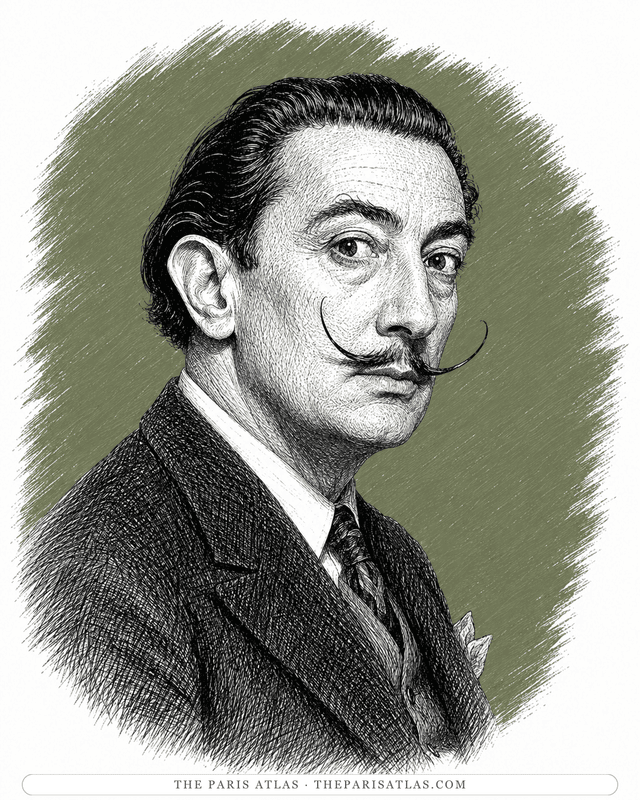
Salvador Dalí
The self-made icon of Surrealism — melting watches and manicured scandal — who arrived in Paris by way of two films written with Buñuel, dreamed together before the movement claimed them.
View artist
References
The sources below include collection records, catalogues, scholarly research, and primary materials that informed this page. They document The Giantess, its making, and its place in cultural history.


1Leonora Carrington, The Giantess, also known as The Guardian of the Egg — Latin American Sale 2173, lot 29
WebsiteChristie's, New York, 2009Used forThe auction catalogue entry — title, medium, dimensions, date, provenance, exhibition history, literature and price realised.
2Leonora Carrington: The Celtic Surrealist
WebsiteIrish Museum of Modern Art, Dublin, 2013Used forThe Irish Museum of Modern Art's 2013 retrospective, whose press caption names the lender, the dimensions used in the exhibition literature, and the copyright line.
3Leonora Carrington: Surrealism, Alchemy and Art
BiographyLund Humphries, 2004Used forSusan L. Aberth's monograph, which catalogues and reproduces the painting.
4H is for The House Opposite
WebsiteWest Dean College of Arts and Conservation, 2016Used forWest Dean College, on Edward James buying paintings directly from Leonora Carrington.
5Represented artists
WebsiteArtists Rights Society, New YorkUsed forThe Artists Rights Society's list of the artists it represents, which includes Leonora Carrington.
These references provide the documented foundation for this work's history and interpretation. Claim-level citations remain attached to the specific claims they support.
 Explore more resources