Self-Portrait
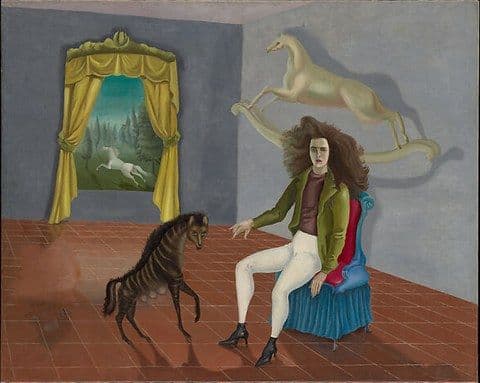
A young woman sits on the edge of a blue chair in a grey room, one hand out towards a striped animal that faces her. A rocking horse hangs on the wall behind, and a white horse gallops through a curtained window. Leonora Carrington painted it around 1937 and 1938, in her early twenties, during the Paris years. The Metropolitan Museum of Art has owned it since 2002.
- ca. 1937–38
- Oil on canvas
- The Metropolitan Museum of ArtNew York, United States
About Leonora Carrington
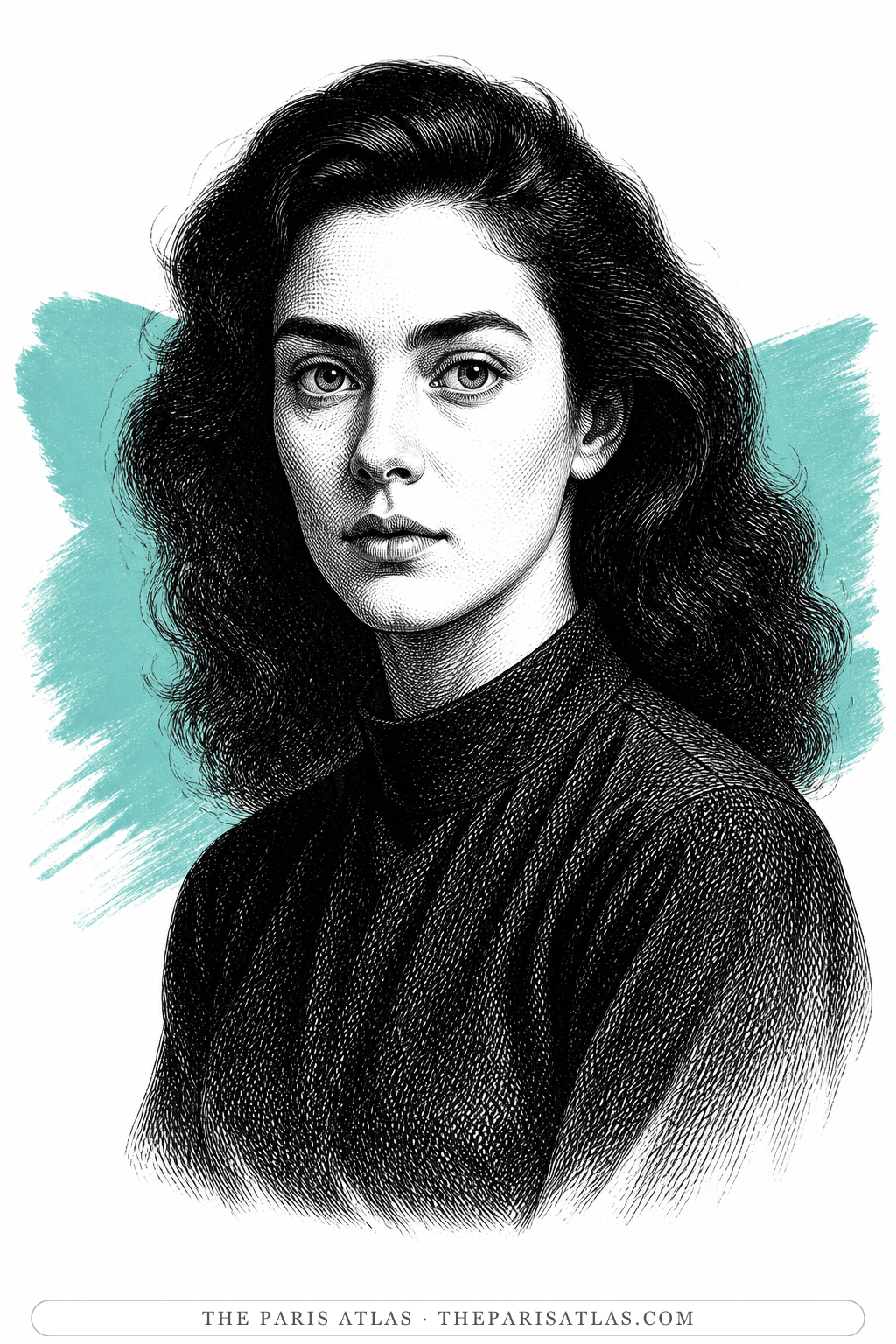
What the painting shows
The room is bare. Grey walls meet a floor of terracotta tiles laid on the diagonal, and nothing stands in it but one chair. Leonora Carrington sits forward on the chair's edge rather than back in it, in white jodhpurs, a green jacket over a plum-coloured top, and black high-heeled ankle boots. Her hair stands out from her head in a wide dark mass.
Her right hand reaches out, palm down, towards an animal in the middle of the floor. The Metropolitan Museum of Art's notice calls it a hyena. It has four thin legs, a coat striped dark brown and black, a black mane along its neck and spine, a bushy black tail, pale blue eyes and a row of pale swollen teats along its belly. Its body faces right and its head is turned to the viewer.
Behind her a rocking horse hangs against the wall, cream-white, mouth open, legs stretched front and back, its curved rocker still attached and its feet clear of the floor. It has no tail. A hard grey shadow falls from it across the wall.
At the left a window is hung with heavy yellow curtains, tied back at each side under a scalloped pelmet and an olive-green finial. Through the opening is a green landscape with dark conifers under a turquoise sky, and a white horse galloping away to the left with all four hooves off the ground.
The canvas is 65 by 81.3 centimetres, about twenty-six by thirty-two inches.
The museum calls it Self-Portrait
The Metropolitan Museum of Art's title field holds two words: Self-Portrait. The longer form that circulates — Self-Portrait (Inn of the Dawn Horse) — is not the museum's. It appears on the museum's own record only inside the exhibition history, and always as another institution's wording.
That history shows how far the variants spread. The Serpentine Gallery in London listed it in 1991 as The Inn of the Dawn Horse [Self Portrait]. The Musée cantonal des Beaux-Arts in Lausanne showed it in 1987 as Autoportrait [A l'Auberge du cheval d'Aube], dated 1936–37. The Los Angeles County Museum of Art printed Inn of the Dawn Horse [Self-Portrait] in 2012.
The museum's own form is used here, and the others are recorded above rather than chosen between.
Painted in the Paris years
Leonora Carrington was twenty when she left England in 1937 and settled in Paris, where she joined the Surrealist circle around André Breton. She showed with the group at the Exposition Internationale du Surréalisme in Paris in 1938. The painting belongs to those two or three years, and the Metropolitan Museum of Art dates it to about 1937 and 1938.
The museum's notice reads the white horse in the window as her own symbolic surrogate, and points to the country childhood she spent among animals and fairy tales. Horses run through the paintings and the stories she wrote at the same time.
The period ended in 1939. France interned Max Ernst as an enemy alien, Leonora Carrington left for Spain, and her family had her committed to an asylum in Santander. The painting left Europe without her.
How it reached New York
The Metropolitan Museum of Art's provenance records that she left the painting with Max Ernst at the onset of the war, and that he took it to New York in 1941. At some point after December 1942 he gave it for safekeeping to the dealer Pierre Matisse, who kept it until his death in 1989.
It passed to his widow, Maria-Gaetana Matisse, and then to the Pierre and Maria-Gaetana Matisse Foundation, which gave it to the museum in 2002. The credit line names that collection, and the object number is 2002.456.1.
The museum marks the painting a highlight of its collection and shows it in Gallery 965.
Not a muse
Leonora Carrington was routinely described in her lifetime as Max Ernst's muse. The art historian Whitney Chadwick asked her what she made of the Surrealist muse. The Metropolitan Museum of Art quotes the reply in the audio guide beside the painting. She had thought it nonsense, had not had time to be anyone's muse, and had been too busy rebelling against her family and learning to be an artist.
The painting is one piece of evidence for that. She made it in her early twenties, gave herself the centre of the composition, and put the animals around her rather than herself among theirs.
Close reading
Reading the work, detail by detail
Leonora Carrington put four animals in one small room: a striped one on the floor, a rocking horse on the wall, a white horse through the window, and herself in riding clothes on a chair. The Metropolitan Museum of Art's own notice names the one on the floor a hyena and calls the rocking horse tailless. The close views take the room a corner at a time.
1.The face looks straight out
The eyes look straight out of the canvas. The mouth is open a little, the brows are dark and level, and the hair lifts away from the head on both sides in a mass wider than the shoulders. A green jacket with broad lapels opens over a plum-coloured high-necked top.
2.The hand is held out flat
The right hand comes out of the green sleeve palm down, fingers spread and slightly curled. It is held at the height of the animal's head and stops short of it. Nothing passes between them.
3.The animal's head turns to the viewer
The body faces right and the head is turned out at the viewer. The muzzle is long and pale, the ears small and rounded, the eyes pale blue. A coarse black mane runs from the crown back along the neck and spine. The Metropolitan Museum of Art's notice calls the animal a hyena.
4.A row of teats along the belly
A row of pale swollen teats runs along the belly, lit against the dark striped coat. The four legs are thin and dark and end in small feet. The stripes run vertically down the flanks and horizontally along the back.
5.The rocking horse hangs on the wall
The rocking horse is pale cream tinged with green, its mouth open and its legs stretched front and back. It has no tail and no mane. It hangs clear of the floor against the grey wall and throws a hard shadow onto it.
6.A white horse gallops in the window
Through the window is a green landscape with dark conifers under a turquoise sky. A white horse gallops to the left across it, all four hooves off the ground and its tail streaming. The Metropolitan Museum of Art reads this horse as her own symbolic surrogate.
7.The curtains carry a carved crown
The yellow curtains hang from a scalloped pelmet under an olive-green ruffled band, with a single rounded finial at the centre of the top. The whole assembly is fixed to the flat grey wall, and the curtain falls in thick vertical folds on both sides.
8.The chair is blue with a crimson back
The chair has a turquoise-blue painted frame, a crimson upholstered back panel and a pleated blue skirt falling to thin blue legs. Her left hand rests flat on the seat edge, fingers apart. She is sitting on the front of the seat, not back in it.
9.Riding clothes end in heeled boots
The white jodhpurs taper into black ankle boots with pointed toes and curved heels. One foot is set forward and one back. The floor beneath is terracotta tile laid on the diagonal, its pale grout lines running away to the corners of the room.
Timeline
1937
Leonora Carrington, aged twenty, leaves England for Paris and joins the Surrealist circle around André Breton.
1937–38
Painted in oil on canvas, 65 by 81.3 centimetres. The Metropolitan Museum of Art dates it to about these two years.
1938
She exhibits with the group at the Exposition Internationale du Surréalisme in Paris.
1939
Left with Max Ernst at the onset of the war, per the museum's provenance, as she leaves France for Spain.
1941
Taken to New York by Max Ernst.
1942–43
Lent to Twentieth Century Portraits at the Museum of Modern Art, 9 December to 24 January, and then on tour through 1944.
1989
Pierre Matisse, who had held it for safekeeping since the 1940s, dies; it passes to Maria-Gaetana Matisse.
2002
Given to the Metropolitan Museum of Art by the Pierre and Maria-Gaetana Matisse Foundation as 2002.456.1.
2021–22
Shown in Surrealism Beyond Borders at the Metropolitan Museum of Art, 11 October to 30 January, and then at Tate Modern in London.
Where to see it
The Metropolitan Museum of Art
1000 Fifth Avenue, New York, NY 10028, United States
On view at The Met Fifth Avenue in Gallery 965 as of September 2026. The museum's audio module beside the painting still prints an older gallery number, 901.
Plan your visit on the museum’s official website (opens in a new tab)Frequently asked questions
Where is Leonora Carrington's Self-Portrait?
The Metropolitan Museum of Art in New York, object number 2002.456.1, on view in Gallery 965. The museum marks it a highlight of the collection. It came as a gift from the Pierre and Maria-Gaetana Matisse Foundation in 2002.
Is it called Self-Portrait or Inn of the Dawn Horse?
The Metropolitan Museum of Art titles it Self-Portrait, and that is the form used here. Inn of the Dawn Horse is a second title carried by other institutions' catalogues, among them the Serpentine Gallery in 1991 and the Los Angeles County Museum of Art in 2012. It appears on the museum's own record only inside its exhibition history.
What animal is in Leonora Carrington's Self-Portrait?
The Metropolitan Museum of Art's notice calls it a hyena. It stands on the tiled floor facing her, striped dark brown and black, with a shaggy mane, a bushy tail, pale blue eyes and a row of pale swollen teats along its belly. There are two horses as well: a tailless rocking horse on the wall and a white horse galloping through the window.
How big is Leonora Carrington's Self-Portrait?
65 by 81.3 centimetres, or 25 9/16 by 32 inches, in oil on canvas. It is a small painting for how widely it is reproduced.
When did Leonora Carrington paint her Self-Portrait?
The Metropolitan Museum of Art dates it to about 1937 and 1938, when she was twenty or twenty-one and living in Paris. Other catalogues have dated it 1936–37 and 1938. She showed with the Surrealists at the Exposition Internationale du Surréalisme in Paris in 1938.
How did the painting get to the United States?
The museum's provenance records that she left it with Max Ernst when the war began and that he brought it to New York in 1941. After December 1942 he gave it to the dealer Pierre Matisse for safekeeping. It stayed in the Matisse family until the foundation gave it to the museum in 2002.
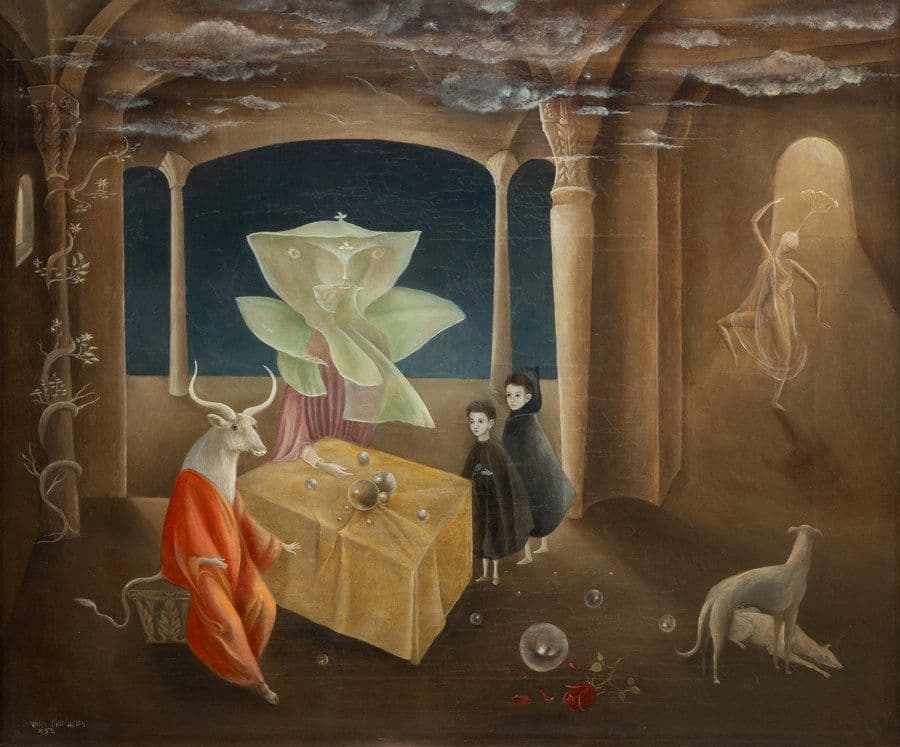
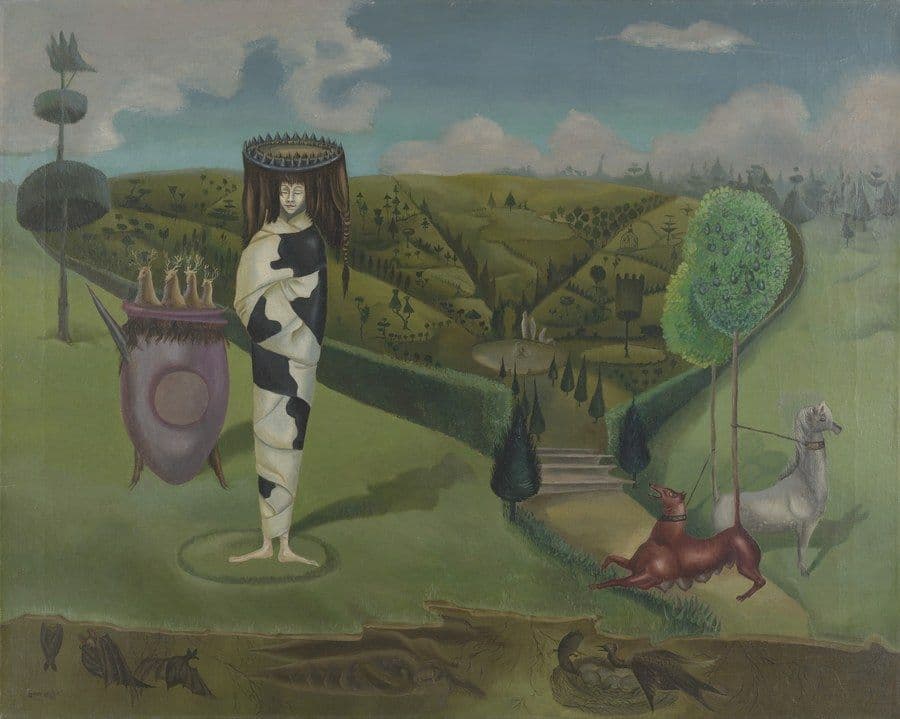
More by Leonora Carrington
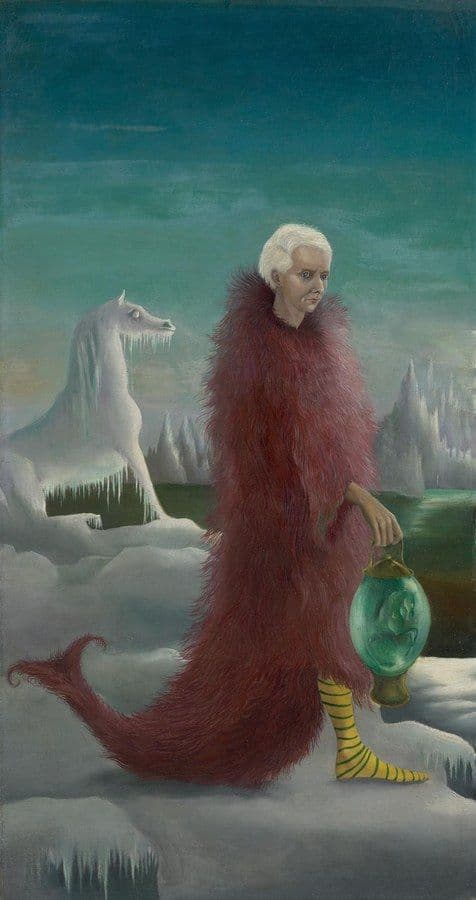
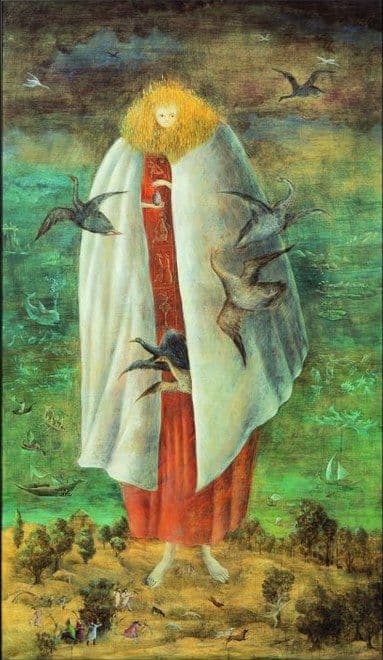
If you like Leonora Carrington
Explore painters from the same movements and circles.
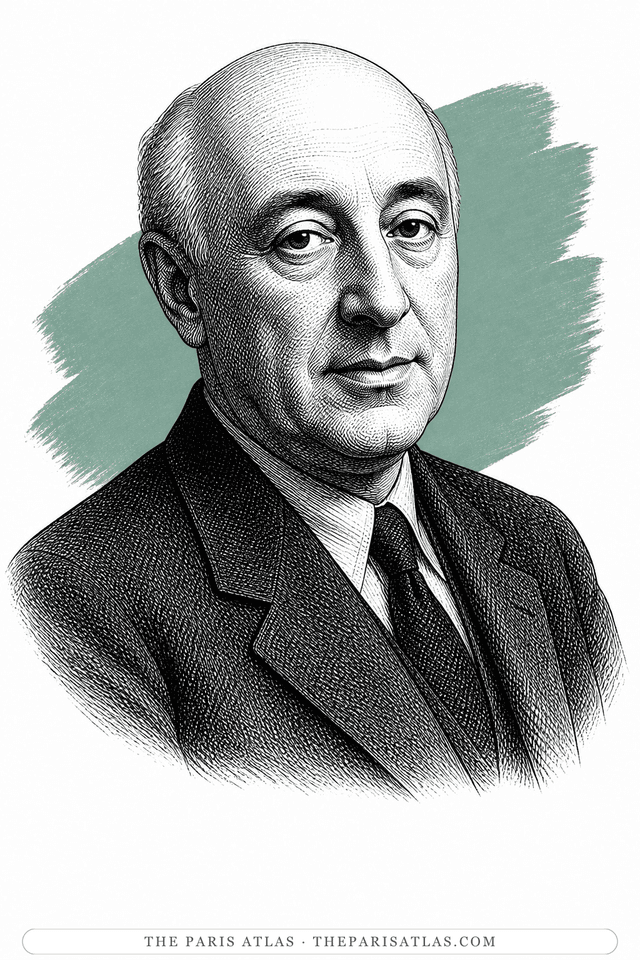
Jean Arp
Strasbourg-born sculptor and poet — Hans in German, Jean in French, both all his life — who co-founded Dada at the Cabaret Voltaire in 1916, composed collages by dropping torn paper 'according to the laws of chance', and settled at Meudon outside Paris in a house his wife Sophie Taeuber-Arp designed.
View artist
Henri Cartier-Bresson
French photographer who turned a pocket-sized 35mm camera into an instrument of split-second composition — the idea the world knows as 'the decisive moment'. He trained as a painter, was taken prisoner in 1940 and escaped on his third try, photographed the Liberation of Paris in August 1944, co-founded the photographer-owned agency Magnum Photos in 1947, gave up reporting for drawing in the 1970s, and left Paris a foundation in the Marais that deliberately hangs no permanent display of his own pictures.
View artist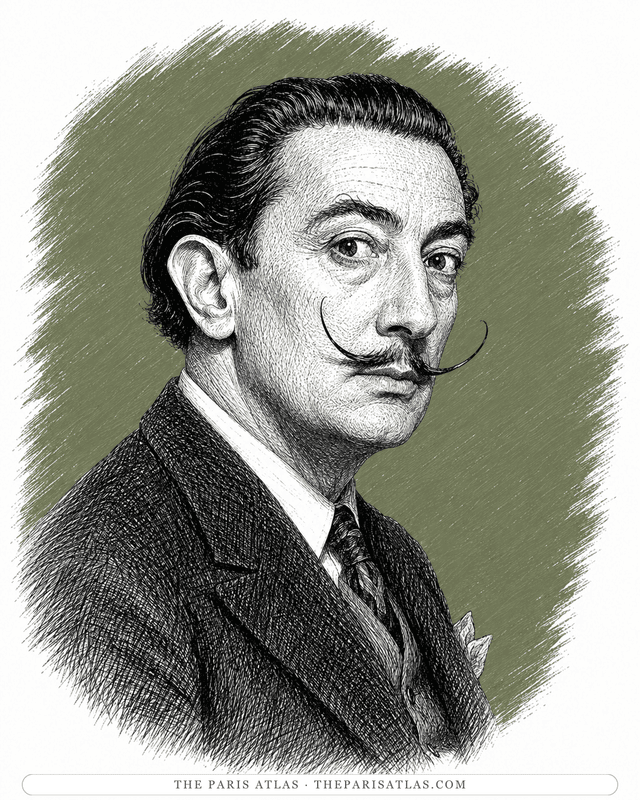
Salvador Dalí
The self-made icon of Surrealism — melting watches and manicured scandal — who arrived in Paris by way of two films written with Buñuel, dreamed together before the movement claimed them.
View artist
References
The sources below include collection records, catalogues, scholarly research, and primary materials that informed this page. They document Self-Portrait, its making, and its place in cultural history.

1Leonora Carrington, Self-Portrait, ca. 1937–38
WebsiteThe Metropolitan Museum of ArtUsed forThe Metropolitan Museum of Art's object record — title, date, medium, dimensions, credit line, provenance, exhibition history and copyright notice.
2Represented artists
WebsiteArtists Rights Society, New YorkUsed forThe Artists Rights Society's list of the artists it represents, which includes Leonora Carrington.
3Leonora Carrington — artist record, ARTS000177
WebsiteDesign and Artists Copyright Society, LondonUsed forThe Design and Artists Copyright Society's artist record, which states that it represents her for copyright licensing through a sister society.
4Leonora Carrington: Surrealism, Alchemy and Art
BiographyLund Humphries, 2004Used forSusan L. Aberth's monograph, for the Paris years and the flight to Spain.
5Leonora Carrington: Revelación — Fundación MAPFRE (2023 exhibition)
WebsiteFundación MAPFRE, MadridUsed forFundación MAPFRE's retrospective, for the femme-enfant label and her rejection of it.
These references provide the documented foundation for this work's history and interpretation. Claim-level citations remain attached to the specific claims they support.
 Explore more resources