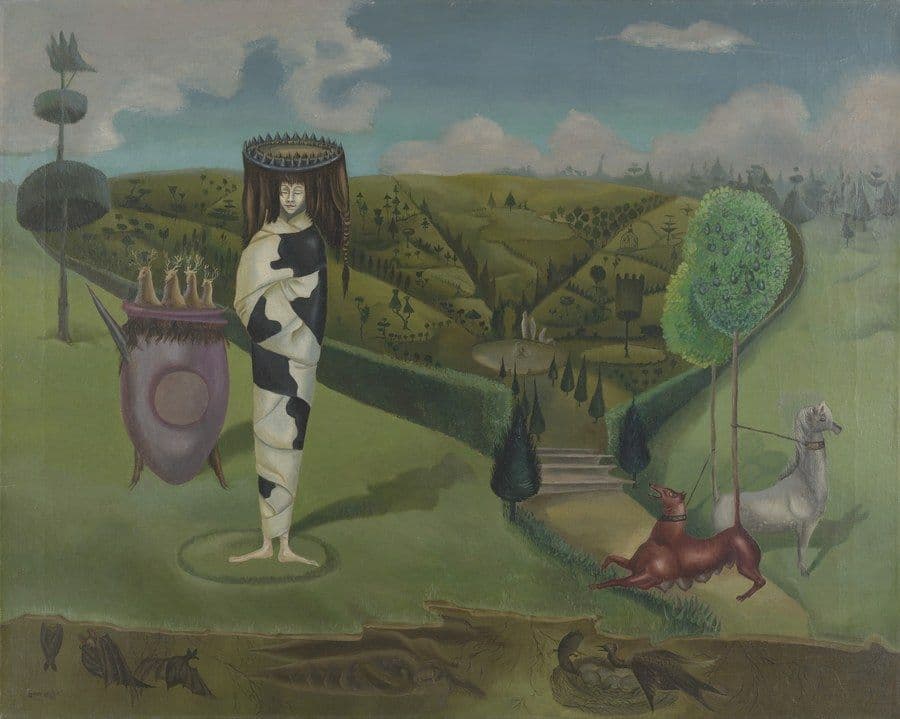
Green Tea
A figure stands wrapped from shoulders to ankles in a white cloth blotched with black, a spiked crown on her head, inside a ring drawn on the grass. Around her is a formal park of clipped hedges and topiary; along the bottom edge the ground is cut away to show what is under it. Leonora Carrington painted it in 1942, her first year in Mexico. The Museum of Modern Art bought it in 2019.
- 1942
- Oil on canvas
- The Museum of Modern ArtNew York, United States
About Leonora Carrington
What the painting shows
The bound figure stands left of centre on a green lawn. A cream cloth blotched with large irregular black patches winds around her from the shoulders down, binding her arms to her sides and ending at the ankles. Bare pale feet show below it, side by side, standing inside a faint circle scratched on the grass. Her shadow falls to the right.
Her hair hangs straight down each side of her face in flat dark curtains, with one long plait on the right ending in a tuft. Her eyes are closed and her mouth is small and closed. On her head sits a ring of dark blue triangular spikes with a shallow dish inside it, studded with small gold marks around the inner rim.
To her left is a large mauve body shaped like an egg, wider at the top, with a pale disc set into its front and a fringe of coarse brown bristles round its upper edge. A long dark spike projects up and to the left. Shaggy brown legs with small dark hooves come out beneath it, and four pale antlered animals with long necks stand along the flat rim on top.
Behind stretches a formal park in green. Clipped hedges divide the ground into sharp-angled plots, and the topiary is cut into cones, spheres, goblets and a crenellated tower. A domed wire cage stands at the right, and an oval pool holds a fountain jet with three tall white figures at its far edge. Pale stone steps run down towards the viewer between dark cypresses.
At the right two animals are tethered by cords to bare poles. One is dark red and lies on the grass with its front legs out and its head thrown back, jaws open, a studded collar at its throat and a row of pale lobes along its underside. The other, which the Museum of Modern Art calls a white horse, stands on four legs with a long neck, upright pointed ears, a shaggy chest and a studded collar.
The bottom fifth of the canvas is a cross-section of the ground below the turf. Bats hang and fly in the soil at the left, one folded and two with wings spread. Fine black roots thread down through it. At the right a woven nest holds about five pale eggs. A dark bird stands over the nest, neck arched and beak open. A large dark body lies buried between them, and a two-line signature in dark paint sits at the lower left, in the soil.
The canvas is 61 by 76.2 centimetres, or 24 by 30 inches.
What the museum says it is about
The Museum of Modern Art states the case for a reading and marks it as possible rather than settled: the painting is possibly a meditation on her confinement. The museum identifies the bound figure as the one often interpreted as the artist, describes the wrapping as a restrictive cowhide-like straitjacket, and names the tethered white horse as another of her autobiographical symbols.
The confinement in question is documented. After Max Ernst was interned in France, Leonora Carrington fled to Spain, suffered a series of psychological crises, and was placed by her family in a sanatorium against her will, where she was subjected to severe treatments.
The museum also records what came between the sanatorium and the painting. She reached New York, where André Breton encouraged her to write about the experience for the Surrealist journal VVV, and she made Green Tea shortly afterwards.
Not La Dame Ovale
Some sources give La Dame Ovale as a second title for this painting. The Museum of Modern Art records no alternative title for it at all, either on the object page or in the museum's published collection dataset.
La Dame ovale is a book: Leonora Carrington's collection of stories, published in Paris by G.L.M. in 1939 with collages by Max Ernst. The Museum of Modern Art separately catalogues a work by Max Ernst titled La dame ovale (The Oval Woman) of 1939, and the Metropolitan Museum of Art holds an illustration from the 1939 book as 68.665.1.
The pairing is recorded here rather than adopted. Where a museum holds the object and prints one title, that title is the one used.
How it reached the museum
The Museum of Modern Art acquired Green Tea on 18 June 2019 and records the credit line as a gift of the Drue Heinz Trust, by exchange. Its object number is 145.2019 and it belongs to the Department of Painting and Sculpture.
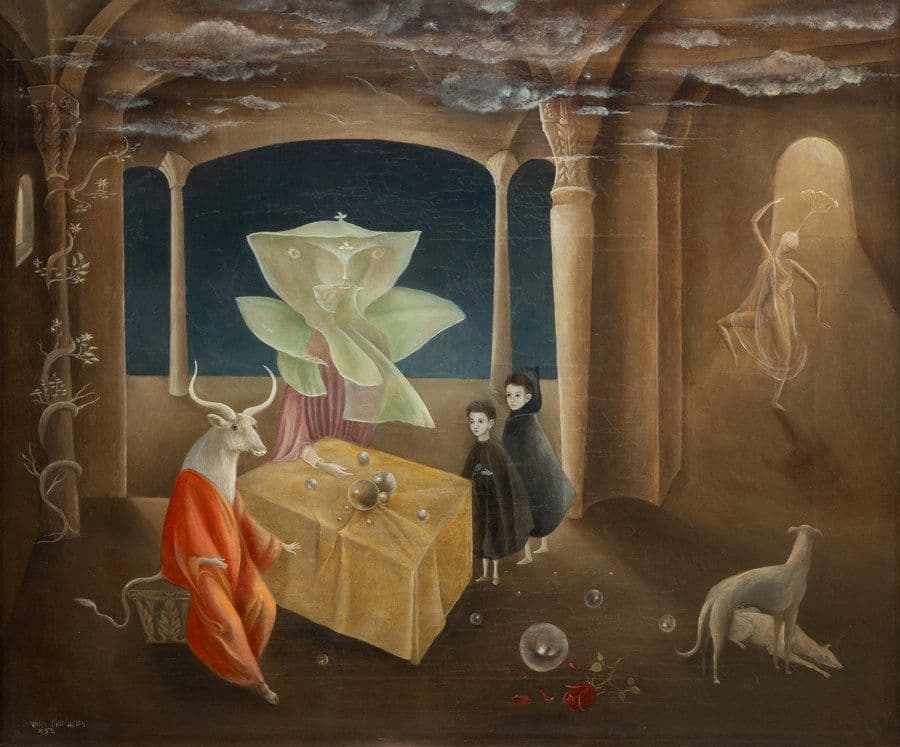
The museum bought a second Leonora Carrington painting on the same day: And Then We Saw the Daughter of the Minotaur of 1953, accessioned as 146.2019.
Green Tea hangs on Floor 5 in gallery 522, in the Alfred H. Barr, Jr. Galleries. The museum publishes no provenance and no exhibition history for the object.
Close reading
Reading the work, detail by detail
A bound figure stands in a clipped formal park, and along the bottom edge the ground is cut open so the soil is visible in section. The Museum of Modern Art calls the wrapping a restrictive cowhide-like straitjacket and names the tethered white horse. The close views take the lawn above the cut and the earth below it.
1.A ring of spikes on the head
The headpiece is a ring of dark triangular spikes standing upright, with a shallow olive dish inside and small gold marks studding the inner rim. It sits flat on the crown of the head like an open vessel rather than a hat.
2.The cloth binds the arms in
The cloth is cream with large irregular black blotches, wound in overlapping turns from the chest downward. The turns cross at the waist and hold the arms in against the sides. No hands are visible anywhere in the wrapping.
3.Bare feet inside a drawn circle
The wrapping ends at the ankles and two bare pale feet stand side by side on the grass. A thin circle is scratched into the turf around them, closing just behind the heels. The shadow of the figure falls to the right across it.
4.Four antlered animals on a rim
Four pale cream animals stand in a row along the flat mauve rim. Each has a long neck and a set of branching white antlers, and the two at the left face left while the two at the right face right. Their bodies are not visible below the rim.
5.The mauve body and its pale disc
The body is mauve and egg-shaped, wider at the top than the bottom. A pale circular disc is set into its front inside a darker pink rim. A fringe of coarse brown bristles runs round the upper edge, and a long dark spike projects up and to the left. Shaggy brown legs with small dark hooves come out below.
6.The red animal has a frill underneath
The dark red animal lies with its front legs stretched forward and its head thrown back, jaws open. A studded dark collar sits at its throat and a thin cord runs from it up to a bare pole. A row of pale grey scalloped lobes runs along the underside of its body.
7.The white horse is collared and tethered
The white animal stands on four thin legs with a long neck, a shaggy chest and a lightly spotted belly. A studded collar sits at its throat and a thin cord runs from it up to the same pole. The Museum of Modern Art calls it a white horse and one of her autobiographical symbols.
8.A pool with a fountain and three pale figures
An oval pool lies in a fold of the park with a small fountain jet at its centre. Three tall pale figures stand at its far edge, one of them seated. Clipped hedges and conical topiary run back from it into hills divided into sharp-angled plots.
9.Pale steps come down to the lawn
A short flight of pale stone steps comes down towards the viewer between a clipped hedge on one side and a dark cypress on the other. The steps land on sandy ground rather than on a path. Nothing stands on them.
10.Bats hang in the soil
Below a thin brown crust of turf the soil is shown in section. One dark bat hangs folded at the left; two more are spread open, each with large ears and hooked claws at the wing joints. Fine black roots thread down through the earth around them.
11.A nest of eggs underground
A woven twig nest sits buried in the soil with about five pale grey-green eggs in it. A dark bird stands over the nest with its neck arched and its beak open, long wing and tail feathers spread to the right. A single pale feather lies loose in the earth beside it.
12.The signature is buried in the earth
A two-line signature is painted in small dark script into the olive-brown soil at the lower left, the name above and a shorter line below it. It sits underground with the bats rather than on the lawn, and is not legible at reproduction size.
Timeline
1940
After Max Ernst is interned in France, Leonora Carrington flees to Spain and is placed by her family in a sanatorium against her will.
1941
She escapes Europe through Lisbon and reaches New York, where André Breton encourages her to write about the sanatorium for the Surrealist journal VVV.
1942
Painted, in oil on canvas, 61 by 76.2 centimetres. She reaches Mexico the same year.
2019
Acquired by the Museum of Modern Art on 18 June as 145.2019, a gift of the Drue Heinz Trust by exchange, alongside And Then We Saw the Daughter of the Minotaur.
2026
On view on Floor 5, gallery 522, in the Alfred H. Barr, Jr. Galleries.
Where to see it
The Museum of Modern Art
11 West 53 Street, New York, NY 10019, United States
On view on Floor 5, gallery 522, in the Alfred H. Barr, Jr. Galleries as of September 2026. The museum publishes no provenance or exhibition history for the object.
Plan your visit on the museum’s official website (opens in a new tab)Frequently asked questions
Where is Leonora Carrington's Green Tea?
The Museum of Modern Art in New York, object number 145.2019, on view on Floor 5 in gallery 522 in the Alfred H. Barr, Jr. Galleries. The museum acquired it on 18 June 2019 as a gift of the Drue Heinz Trust, by exchange.
What is Green Tea about?
The Museum of Modern Art calls it possibly a meditation on her confinement, and marks that reading as possible rather than certain. Her family had placed her in a sanatorium in Spain against her will in 1940, after Max Ernst was interned in France. The museum identifies the bound figure as the one often interpreted as the artist.
What is the figure in Green Tea wrapped in?
A cream cloth blotched with large black patches, wound from her shoulders to her ankles so that her arms are bound to her sides. The Museum of Modern Art calls it a restrictive cowhide-like straitjacket. Her bare feet stand inside a faint circle drawn on the grass.
Is Green Tea also called La Dame Ovale?
Not by the museum that owns it. The Museum of Modern Art records no alternative title for the painting. La Dame ovale is Leonora Carrington's 1939 book of stories, published in Paris by G.L.M. with collages by Max Ernst, and the museum separately catalogues a 1939 work by Max Ernst under that name.
How big is Green Tea?
61 by 76.2 centimetres, or 24 by 30 inches, in oil on canvas. It is a landscape-format picture, wider than it is tall.
What is happening at the bottom of Green Tea?
The ground is cut open. The bottom fifth of the canvas shows the soil in cross-section beneath the turf. Bats hang and fly in it at the left and fine black roots run down through the earth. At the right a woven nest of pale eggs has a dark bird standing over it, and a large dark body lies buried between the two.
More by Leonora Carrington
If you like Leonora Carrington
Explore painters from the same movements and circles.
Jean Arp
Strasbourg-born sculptor and poet — Hans in German, Jean in French, both all his life — who co-founded Dada at the Cabaret Voltaire in 1916, composed collages by dropping torn paper 'according to the laws of chance', and settled at Meudon outside Paris in a house his wife Sophie Taeuber-Arp designed.
View artist
Henri Cartier-Bresson
French photographer who turned a pocket-sized 35mm camera into an instrument of split-second composition — the idea the world knows as 'the decisive moment'. He trained as a painter, was taken prisoner in 1940 and escaped on his third try, photographed the Liberation of Paris in August 1944, co-founded the photographer-owned agency Magnum Photos in 1947, gave up reporting for drawing in the 1970s, and left Paris a foundation in the Marais that deliberately hangs no permanent display of his own pictures.
View artist
Salvador Dalí
The self-made icon of Surrealism — melting watches and manicured scandal — who arrived in Paris by way of two films written with Buñuel, dreamed together before the movement claimed them.
View artist
References
The sources below include collection records, catalogues, scholarly research, and primary materials that informed this page. They document Green Tea, its making, and its place in cultural history.

1Leonora Carrington, Green Tea, 1942
WebsiteThe Museum of Modern Art, New YorkUsed forThe Museum of Modern Art's object record — title, date, medium, dimensions, credit line, gallery, curatorial text and copyright notice.

2The Museum of Modern Art collection dataset (Artworks.csv)
ArchiveThe Museum of Modern Art, New YorkUsed forThe museum's own published collection dataset, which corroborates the catalogue row and supplies the acquisition date.
3Leonora Carrington, Self-Portrait, ca. 1937–38
WebsiteThe Metropolitan Museum of ArtUsed forThe Metropolitan Museum of Art's collection, which holds an illustration from the 1939 book La dame ovale as 68.665.1.
4Leonora Carrington: Surrealism, Alchemy and Art
BiographyLund Humphries, 2004Used forSusan L. Aberth's monograph, for the Santander asylum and the arrival in Mexico.
5Leonora Carrington: Britain's Lost Surrealist — Tate
WebsiteTateUsed forTate's account of the flight from France and the escape through Lisbon.
These references provide the documented foundation for this work's history and interpretation. Claim-level citations remain attached to the specific claims they support.
 Explore more resources