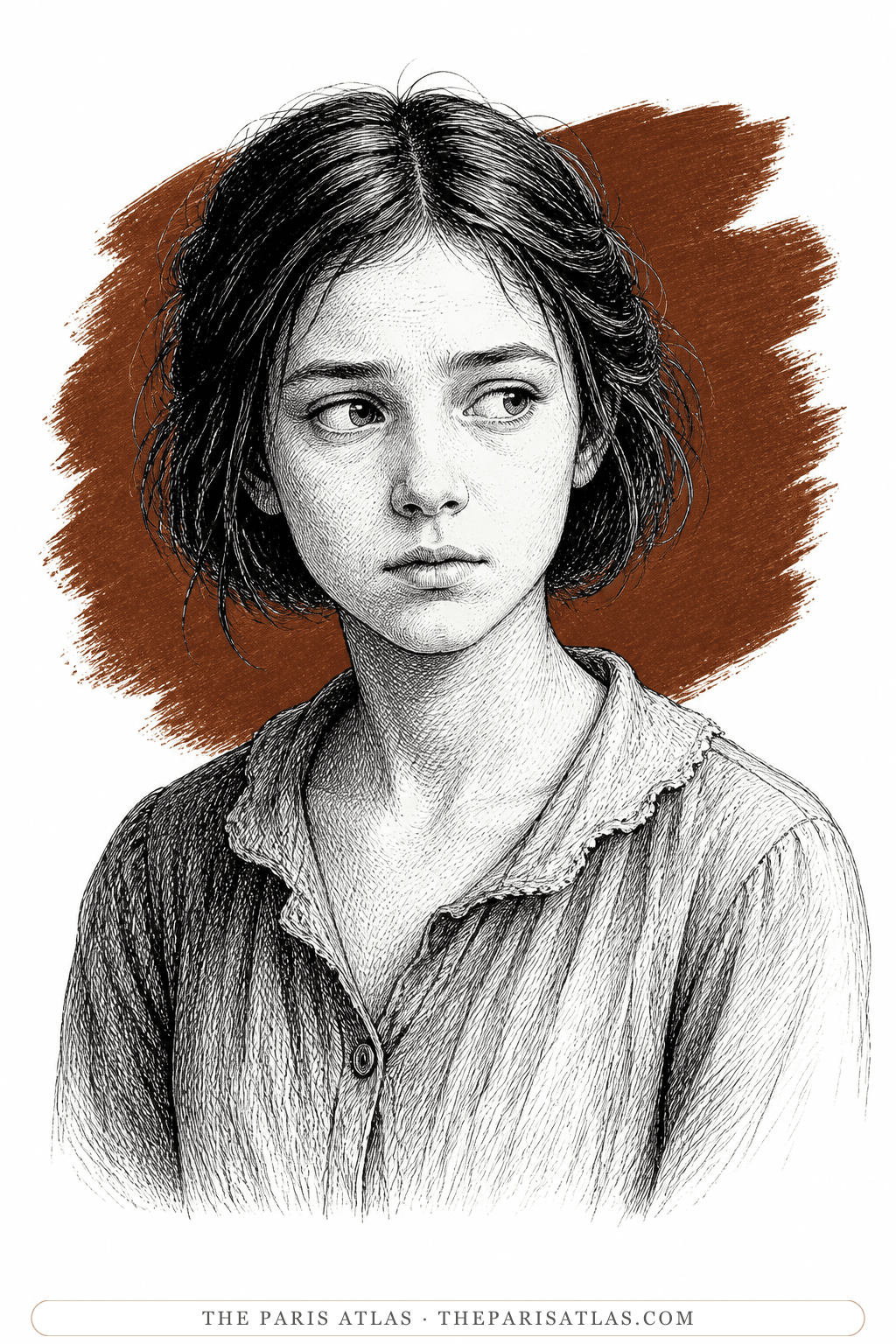
Colette
A fifteen-year-old runaway that Carl brings back to the flat and keeps there for weeks. She shares a first name with the French novelist Colette and has nothing to do with her.
The book

At a glance
- 'Colette' — a runaway living in the two men's flat
- Fifteen, according to her legal guardian; Carl guessed fourteen, she claimed seventeen
- The French novelist Colette, who has no connection to this book
- Cooking, housework, and waiting up for Carl's return from his night shift
Who they are in the book
Spoiler-freeColette is a character in Quiet Days in Clichy, a short book by the American writer Henry Miller, written in 1940 and published in 1956. She is a runaway girl whom the narrator's flatmate, a writer he calls Carl, picks up and brings home to the flat the two men share in Clichy, a district on the northern edge of Paris. She stays for several weeks.
She is not the French novelist Colette, the author of Chéri and Gigi, who has no connection to this book of any kind. Colette is an ordinary French first name, and the girl in Miller's book is an anonymous teenager whose real identity has never been established.
Her age is the fact the episode turns on. Carl guesses fourteen when he introduces her; she claims seventeen; her legal guardian eventually states that she is fifteen and has run away from home before. Both men have sex with her, and Carl asks the narrator to take his turn when he is worn out. The book states all of this plainly and does not treat it as a crisis until the police become a possibility, at which point Carl is told that a court case would carry a ten-year sentence.
Everything the reader learns about her comes through the narrator, who found her stupid and said so at length, and who was not a fair witness about any woman in the book. She is given very little chance to speak for herself.
This profile is drawn from the text of the Flamingo 1995 printing, read in the Internet Archive's scan.
How Colette Is Portrayed
- How Carl introduces herShe puts her head round the bedroom door, Carl jumps up and brings her over to the bed, says her name, and asks the narrator what he thinks of her. He then talks about her in English in front of her, guesses her age at fourteen, and reports that she claims to be seventeen and that he does not believe her.
- She thinks Carl is FrenchHearing the two men speak English, she cannot take in that Carl might not be French, and finally asks him outright whether he really is. Miller notes that it seemed to matter a great deal to her. Carl says yes and offers to show her his passport. He is Austrian.
- Kept in the flatMiller describes her as a homeless waif who became "a combination of Cinderella, concubine and cook." The two men had to teach her everything, he writes, including how to brush her teeth. She was at an awkward age, constantly dropping things, tripping and getting lost.
- The cover storyCarl's plan for keeping her is to tell the concierge she is a cousin visiting from out of town. He asks the narrator to take her to the cinema or for walks on the nights he works, suggests teaching her geography because she knows nothing, and warns him against getting her pregnant, since there is no money for an abortion and he has lost track of where his Hungarian doctor lives.
- She keeps disappearingEvery so often she vanishes for a couple of days at a stretch, and neither man can find out where she goes. Miller writes that the more they questioned her about it the blanker she became. Sometimes she went out for a morning walk and simply did not come back.
- The Japanese shiftShe waits up at night in a Japanese shift Carl picked up at a bazaar, because they never manage to raise the money for a pair of pyjamas. The narrator often comes home to find her about to eat something, trying to stay awake until Carl finishes his shift, and sits down to eat with her.
- What the narrator thinks of herHe writes that she had no ambitions, dreams or desires, and that she was "as cheerful as a cow, obedient as a slave, attractive as a doll." He draws a distinction he clearly means as decisive: "She was not stupid, she was dumb." He is comparing her, unfavourably, to Nys, the woman he was seeing at the time.
- Carl talks about marrying herAt one point Carl starts saying he will marry her as soon as she is old enough. Miller's picture of the two of them at their best is a morning when they leaned out of separate windows, she from the bedroom and he from the kitchen, calling good morning to a neighbour loudly enough for the whole building to hear.
She walks out one afternoon without taking any of her belongings, and the two men assume she has run off. The next day around noon there is a knock at the door: Colette, her mother, her legal guardian and a police officer, ostensibly looking for a missing watch that was a family keepsake. It is never found.
The guardian tells Carl privately that she is fifteen, that she has run away before, and that a court case would carry a ten-year sentence. What defuses the visit is the bookshelf. The mother hands the guardian a volume of Proust from the work table, and the discovery that both men are writers turns the mood around. The mother's only condition is that Carl never attempt to see the girl again.
The narrator says goodbye to her as though she were an orphan being returned to her parents. Carl's response to the whole business is to fall in love with the mother, write the episode up as a story a few months later, and forget Colette completely.
If you like Quiet Days in Clichy


If you like Henry Miller
Explore authors with a similar voice, perspective, and influence.

Louis-Ferdinand Céline
Miller's acknowledged master at making literature out of the gutter. Journey gave him permission; Cancer is what he did with it.
View author
Ezra Pound
Pound read Cancer and sent Miller a famously backhanded postcard. Both believed literature's job was to wake the reader by any means necessary.
View author
Simone de Beauvoir
French writer and philosopher whose novels, memoirs, and social analysis examined freedom, gender, responsibility, aging, and the material conditions that shape a life.
View author