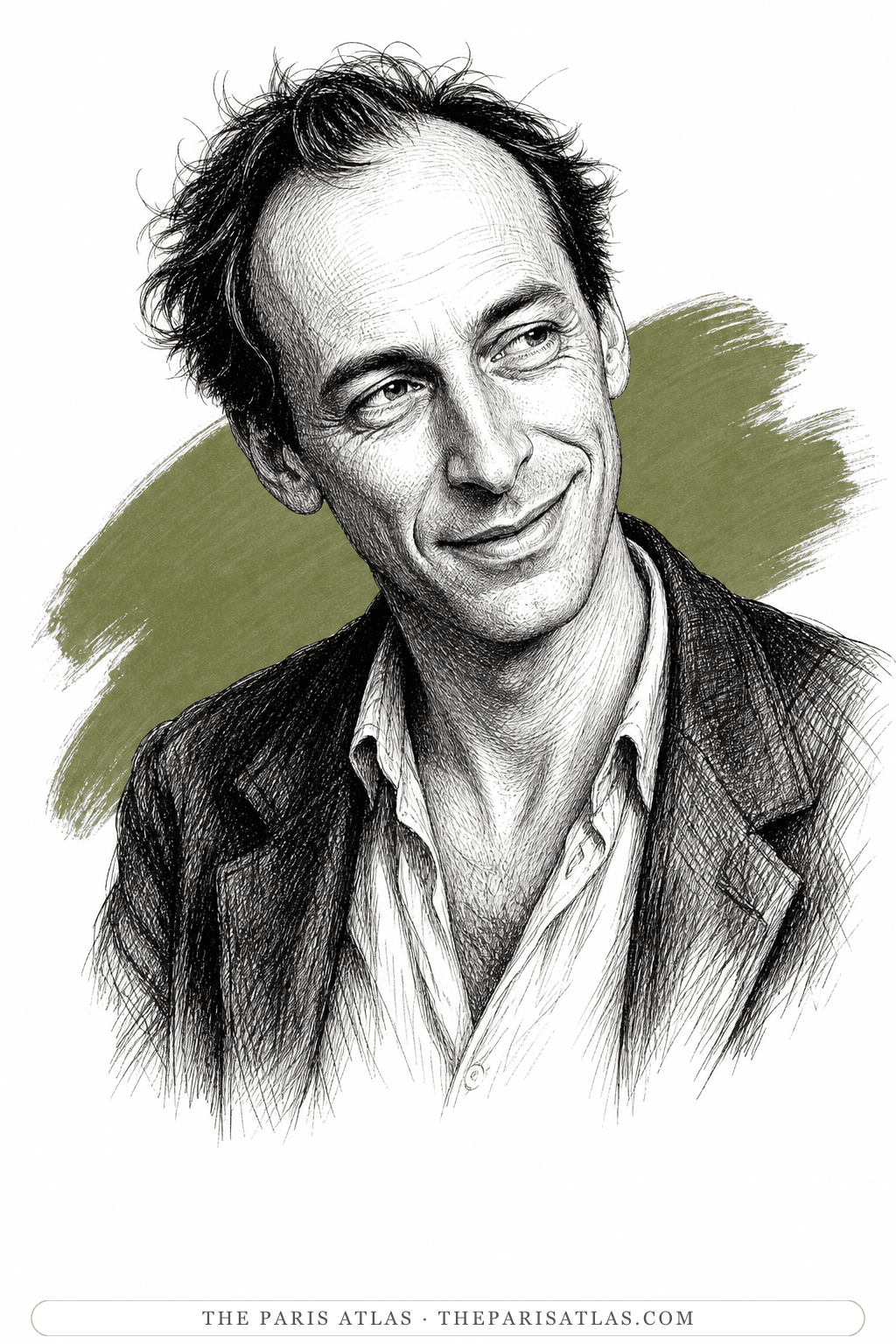
Joey
The narrator, who tells the whole book in the first person: an American writer living in Paris with no money, sharing a flat with his friend Carl and writing a novel in it. He is Henry Miller, under the nickname his friends used.
To keep his own writing going through a year with no money, no privacy, and a flat that is never empty.
The book

At a glance
- 'Joey' — the narrator, and the name Carl calls him
- A shared flat in Clichy, beyond the old city gates, about half an hour's walk from the Place Clichy
- The Café Wepler, on a corner of the Place Clichy, first entered in 1928
- Black Spring, plus an unfinished story about an axe murder
- Henry Miller · 1891–1980 · Yorkville, Manhattan
Who they are in the book
Spoiler-freeJoey is the narrator of Quiet Days in Clichy, a short book by the American writer Henry Miller. Miller wrote it in 1940 and it was published in 1956, so the book looks back at events roughly a decade and a half old. It is autobiography told as a story, with some of the names changed, and Joey is Miller himself — the name is the one his friend Carl calls him aloud throughout the book.
For about a year he shares a flat with that friend in Clichy, a district on the northern edge of Paris, just beyond the line of the old city gates. He describes the walk home from the Place Clichy, the square at the foot of Montmartre, as a good half hour. Both men are writers, both work irregularly or not at all, and money arrives in small unpredictable amounts. The book is mostly made of what fills a year like that: meals, walks, borrowed francs, and the women who come through the flat.
He is Henry Miller, and the year in question was productive. He says outright that he wrote Black Spring during it, along with bicycle rides along the Seine and trips south, and that the stretch ended with a drunken jaunt to Luxembourg.
The book is sexually explicit from beginning to end, and Joey narrates that material as flatly as he narrates a meal. It was kept out of American bookshops until 1965 for exactly that reason. Miller is also the only witness to everything in it, and he is not a neutral one, particularly about the women he describes.
This profile is drawn from the text of the Flamingo 1995 printing, read in the Internet Archive's scan.
How Joey Is Portrayed
- His table at the Café WeplerThe Café Wepler stood at one corner of the Place Clichy, and he calls it his favourite haunt for a long period. He says he sat there inside and out at all hours in all weather, and knew the waiters, the managers, the cashiers, the prostitutes, the regular customers and the lavatory attendants by sight. He first went in during 1928.
- The night he goes hungryAfter spending everything he has on a woman he has just met, he walks back to Clichy with one sou in his pocket, stopping to read the menu outside a fish restaurant on the Avenue de Clichy. At home he opens the cupboard under the sink, takes the dry crust of bread out of the garbage can, scrapes off the spoiled parts and soaks it under the tap. He follows it with a piece of old Roquefort.
- Writing Black Spring in the flatHe names the book he was working on during the year the story covers. In the same sentence he lists the bicycle rides up and down the Seine and the trips to the south of France and the château country that went with it.
- The story about the axe murderLying in bed one night he plans out a story he has already started: a drunk sitting beside the headless body of a wife he never loved. He considers lifting the details from a newspaper report and beginning at the moment the head rolls off the table, then setting it against a passage about an armless, legless man who wheeled himself through the streets at night on a low platform.
- The money hidden in FaustHe has worked out that Carl keeps hundred-franc notes pressed between the pages of a German copy of Goethe's Faust, having come across them by accident while looking for a dictionary, and he has gone back several times since to check the hoard is still there. One night the two of them bring home a woman who writes poems on the walls and asks for her revolver, and who wants two hundred francs. He takes the money out of the book, hands it to her, then lifts it back out of her handbag while she is in the bathroom and returns it to Faust.
- Introduced as a famous American writerWhen a girl's family and her legal guardian arrive at the flat, Carl tells them the American in the next room is a well-known writer. Between that and the books on the table the visit turns from an interrogation into something closer to a literary conversation.
- What he makes of French composureOn his first visit to the Café Wepler he watched a prostitute collapse drunk across a table on the terrace while nobody moved to help, and heard the explanation that it was nothing, she was only drunk. He writes that it still makes him shudder, and that a visitor who cannot accept it will not enjoy France.
The book's second and shorter piece, 'Mara-Marignan,' ends with Joey walking away from a woman he has spent the evening with. He empties his pocket into her hand and leaves; she runs after him, tries to sink to her knees in the street, and he pulls her up and asks angrily whether anyone has ever treated her decently. She stands in the dark with her hands over her face, sobbing, and he bolts and walks faster and faster with the sound still in his ears.
Walking it off near the Place des Vosges he works out who she reminded him of: a woman he had known as Christine, who left for Copenhagen years earlier and never wrote. He gets out his notebook and writes down the hour, the date and the place, and wonders whether Christine might be crying somewhere at that same moment.
If you like Quiet Days in Clichy


If you like Henry Miller
Explore authors with a similar voice, perspective, and influence.

Louis-Ferdinand Céline
Miller's acknowledged master at making literature out of the gutter. Journey gave him permission; Cancer is what he did with it.
View author
Ezra Pound
Pound read Cancer and sent Miller a famously backhanded postcard. Both believed literature's job was to wake the reader by any means necessary.
View author
Simone de Beauvoir
French writer and philosopher whose novels, memoirs, and social analysis examined freedom, gender, responsibility, aging, and the material conditions that shape a life.
View author