
Eliane
Carl's mistress, whose husband is in prison for passing counterfeit money, and who is left supporting two children. She fills one long afternoon in the second half of the book.
For Carl to become the provider she and her two children now have nobody else to be.
The book

At a glance
- 'Eliane' — Carl's mistress, in the second piece, 'Mara-Marignan'
- In prison for passing counterfeit money; an old friend of Carl's from Budapest
- Two young children, and a job Carl found for her
Who they are in the book
Spoiler-freeEliane appears in 'Mara-Marignan,' the second of the two pieces printed together in Quiet Days in Clichy, a book by the American writer Henry Miller. She is the mistress of Carl, the narrator's flatmate and closest friend, and the book gives her a single sustained scene: one afternoon and evening at her home, with the narrator brought along because Carl has grown too bored with her to face the visit alone.
Her situation is set out plainly. Her husband is in prison for passing counterfeit money, she has two young children, and she looks to Carl to take the place of a provider. Carl's solution is to find her a job instead. Miller's own sympathy is visibly with her and against his friend, and at one point in the afternoon he says he felt more like tormenting Carl than obliging him.
This profile is drawn from the text of the Flamingo 1995 printing, read in the Internet Archive's scan.
How Eliane Is Portrayed
- How Miller describes her"Eliane was young, slim, attractive, except that she was liberally peppered with moles and had a coat of down on her upper lip." Carl found those marks charming at first and irritating later, and made jokes about them that made her flinch. Miller adds that she looked better crying than not: with her face in tears she looked like a grown woman rather than the slight, boyish figure Carl had fallen for.
- How Carl met herHer husband and Carl were old friends from Budapest, where the man had saved Carl from starving and then given him the money to get to Paris. Carl's gratitude turned to contempt once he decided the man was stupid. When the two met by chance on a Paris street ten years later, Carl only accepted the dinner invitation because the husband had shown off a photograph of his young wife. He was infatuated straight away.
- The husband, the money and the dogsHe was jailed for passing counterfeit notes. He was also caught stealing a pair of dachshunds he had seen running loose, intending to demand a reward for their return — and by the time a detective knocked, he had become so fond of them that he had forgotten the plan and was feeding them their breakfast. He thought it hard luck to be arrested for being kind to animals.
- Two children and no providerWith the husband behind bars she is left supporting two children on her own and naturally turns to Carl. Miller writes that Carl was not ungenerous but was in no sense a provider, and that although he liked children he had no wish to play father to the children of a man he despised. His answer was to find her work, and then to complain that she was working too hard and spoiling her looks — while being privately pleased, because a tired Eliane made fewer demands on his time.
- The afternoon that ends in tearsCarl makes a joke about her poverty that lands badly, apologises by kissing her forehead, and then, rather than talk about it, starts clowning behind her back to get out of going to bed with her. When she objects he does it openly, imitating the children until everyone is howling with laughter. He pushes her onto the divan and tickles and bites her while chattering in the Austrian dialect she cannot stand, the children piling on top of her. She is laughing and furious at the same time, and when she finally gets free she breaks into violent sobs. Carl sits down beside her looking baffled and mutters to himself.
- German songs she does not want to singLater in the evening, once the mood has recovered, the three of them sing German songs. She joins in, though Miller notes that she despised the German language.
- Why she believes himMiller's explanation for how easily Carl handled her is blunt: "Eliane was strangely gullible; it was probably the fault of the moles, which were a constant reminder that her beauty was not untarnished." Pretending to love her because of them, he writes, was Carl's approach and left her without a defence.
If you like Quiet Days in Clichy


If you like Henry Miller
Explore authors with a similar voice, perspective, and influence.

Louis-Ferdinand Céline
Miller's acknowledged master at making literature out of the gutter. Journey gave him permission; Cancer is what he did with it.
View author
Ezra Pound
Pound read Cancer and sent Miller a famously backhanded postcard. Both believed literature's job was to wake the reader by any means necessary.
View author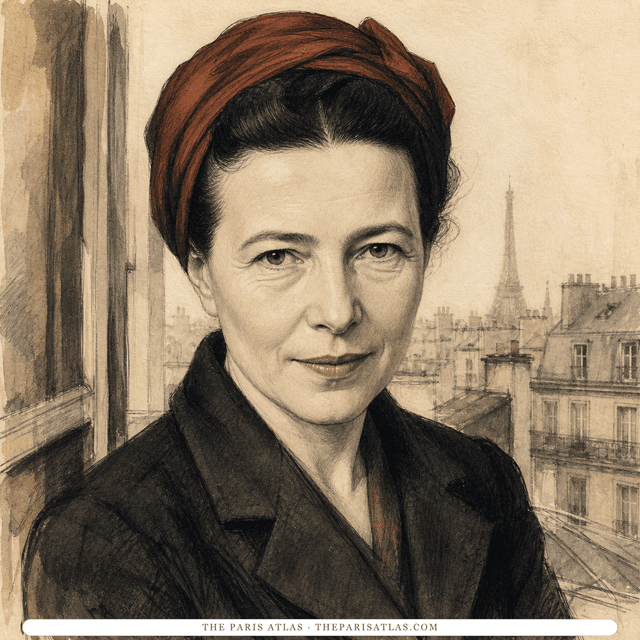
Simone de Beauvoir
French writer and philosopher whose novels, memoirs, and social analysis examined freedom, gender, responsibility, aging, and the material conditions that shape a life.
View author