The Abandoned Doll
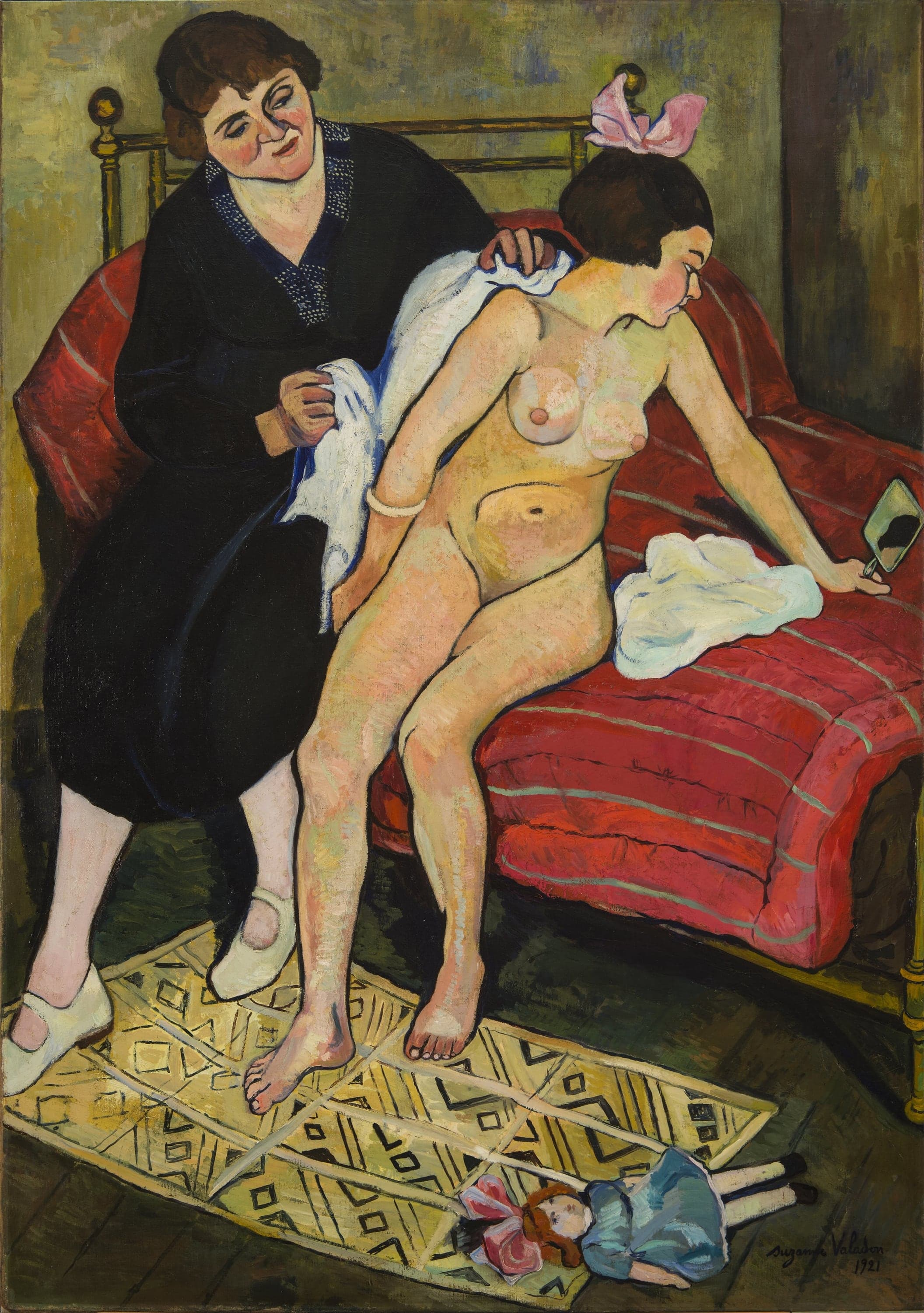
A woman in a black dress holds a towel against the back of a naked girl who has turned away from her to look into a hand mirror. A doll in a blue dress lies on the rug at the girl's feet. Suzanne Valadon painted it in 1921 in Montmartre, and the National Museum of Women in the Arts in Washington has owned it since 1986.
- 1921
- Oil on canvas
- National Museum of Women in the ArtsWashington, D.C., United States
About Suzanne Valadon
What the painting shows
Two figures sit on a brass bed with a red striped cover. On the left a heavy-set woman in a black dress leans in, her head tilted, looking down at the girl beside her. Her collar is deep navy scattered with small white dots, and her cream shoes with a strap across the instep rest on a rug.
The girl is naked. She sits on the edge of the bed with her back half turned, her head in profile, looking down and to the right. A large pink bow is tied on top of her dark hair, and a pale bangle circles one wrist. The National Museum of Women in the Arts describes her as clad only in a pink hair ribbon.
The woman holds a white towel with blue borders in both hands, one high at the girl's shoulder and one low. The girl's other arm is stretched out straight to the right, low over the bed, holding a small hand mirror by its short green handle. Inside the glass, a patch of dark hair and a pale face are painted in.
A doll lies on the rug at the lower right, head to the left and feet to the right. It wears a blue dress, white stockings and dark shoes, has ginger hair, and has a pink bow of its own. Suzanne Valadon signed and dated the canvas on the dark floorboards at the lower right.
The two pink bows
The bow on the girl's head and the bow on the doll's head are the same colour and roughly the same size. The National Museum of Women in the Arts treats the match as the picture's hinge: the doll is childhood, dropped on the floor, and the girl with the mirror is looking at someone else.
The museum reads the moment as a transition rather than a bath. It points to the girl's maturing body, her turn away from the woman, and her interest in her own reflection.
What the picture withholds is agreement. The woman is still drying a child; the child is already checking a face.
Who the two figures are
The museum says the figures are Suzanne Valadon's niece and the girl's mother, and that the artist declined to present the canvas as a portrait. It gives no names.
Beatrice Loayza, reviewing the Centre Pompidou's 2025 retrospective for 4Columns, names them: the woman is Marie Coca and the girl is her daughter Gilberte. Suzanne Valadon had painted the two of them together before, in Marie Coca et sa fille Gilberte of 1913, which belongs to the musée des Beaux-Arts de Lyon.
The two accounts do not conflict on the relationship, only on whether to print the names. The museum's own wording for the kinship is niece.
Painted at 12 rue Cortot
Suzanne Valadon was fifty-five in 1921 and was working in the apartment-studio at 12 rue Cortot in the 18th arrondissement, where the Centre Pompidou records her as living from 1911 to 1925. The building is now the Musée de Montmartre.
The household there was her own: André Utter, her husband, and her son Maurice Utrillo. Her sitters came from that circle and from her family rather than from a professional model's book.
Two published sizes
The canvas is catalogued at two different widths. The Centre Pompidou's 2025 exhibition checklist gives 135 by 95 centimetres. The National Museum of Women in the Arts gives 51 by 32 inches, which is about 130 by 81 centimetres.
The two figures are not the same shape. The Washington museum's own photograph of the painting is proportioned like the Pompidou measurement rather than like its own caption.
Who owns it and where it hangs
The National Museum of Women in the Arts at 1250 New York Avenue NW in Washington owns the painting, under accession number 1986.336. Wallace and Wilhelmina Holladay gave it to the museum, whose collection was built on their gifts.
The museum's collection record marked the canvas as not on display when it was checked in September 2026. It travelled to Paris for the Centre Pompidou's Valadon retrospective in 2025, listed there as La Poupée délaissée.
Close reading
Reading the work, detail by detail
Two pink bows, a hand mirror and a bangle carry the picture. Follow them, then the towel gripped in two fists and the doll dropped where the rug meets the floorboards.
1.The bow in her hair
The bow is the only thing the girl is wearing above the waist, and it is painted at almost the size of her head. A hand grips the towel at her shoulder behind it.
2.The dotted collar
The woman's black dress is relieved only by this navy collar and its scatter of white marks. The National Museum of Women in the Arts lists textile patterns among the marks of Suzanne Valadon's mature style, and this is the plainest of the three in the picture.
3.The towel in her fist
The towel is white with blue selvedges, and the woman holds it in two places at once, low in this fist and high at the girl's shoulder. The museum describes her as towelling the girl dry.
4.The bangle
A pale ring sits on the girl's forearm, painted as a flat band with a shadow under it. The National Museum of Women in the Arts describes her as clad only in a pink hair ribbon, which leaves the bangle unaccounted for.
5.The hand mirror
The mirror is held low and far out, at the end of a straight arm, rather than up to the face. Inside the glass Suzanne Valadon painted a dark mass and a pale oval, so the reflection is visible although the girl's own face is turned away.
6.The doll on the rug
The doll is dressed and shod, and its pink bow matches the one in the girl's hair. The museum reads it as childhood forgotten on the floor near the bed, and the repeated bow as the link between the two.
7.A shoe and a bare foot
The woman is dressed down to her shoes; the girl stands barefoot on the same rug. The rug's black lozenges and pale grey bands are the busiest pattern in the painting.
8.The signature
The signature and the date sit on the bare floor to the right of the doll. They are the only writing in the picture, and they are placed at the end of the same diagonal the doll lies along.
Timeline
1921
Painted, signed and dated at the lower right, in Suzanne Valadon's apartment-studio at 12 rue Cortot in Montmartre.
1986
Given to the National Museum of Women in the Arts by Wallace and Wilhelmina Holladay and accessioned as 1986.336.
2025
Lent to the Centre Pompidou's Valadon retrospective, 15 January to 26 May, catalogued there as La Poupée délaissée and measured at 135 by 95 centimetres.
Where to see it
National Museum of Women in the Arts
Washington, D.C., United States
A public viewing address has not yet been confirmed for this holding.
The museum's collection record marked the painting as not on display when it was checked in September 2026.
Frequently asked questions
Where is The Abandoned Doll by Suzanne Valadon?
The National Museum of Women in the Arts in Washington owns it, under accession number 1986.336. The museum's record marked it as not on display when it was checked in September 2026, so check before travelling. It was in Paris for the Centre Pompidou's Valadon retrospective in 2025.
Who are the woman and the girl in The Abandoned Doll?
The National Museum of Women in the Arts says they are Suzanne Valadon's niece and the girl's mother, and that the artist did not present the canvas as a portrait. Beatrice Loayza, writing in 4Columns in 2025, names them as Marie Coca and her daughter Gilberte.
What is the girl in The Abandoned Doll looking at?
A small hand mirror, held at the end of her outstretched arm, low over the bed. Suzanne Valadon painted a patch of dark hair and a pale face into the glass, so the reflection is visible even though the girl's own face is turned away in profile.
Why is there a doll on the floor in The Abandoned Doll?
It carries a pink bow that matches the one in the girl's hair. The National Museum of Women in the Arts calls the doll a symbol of childhood forgotten on the floor, and reads the repeated bow as the link between the discarded toy and the girl at the mirror.
How big is The Abandoned Doll?
The Centre Pompidou's 2025 exhibition checklist gives 135 by 95 centimetres, upright. The National Museum of Women in the Arts gives 51 by 32 inches. The two figures describe differently shaped canvases, and the museum's own photograph matches the Pompidou measurement.
Is The Abandoned Doll a nude?
The girl is painted naked, seen from the front, with a pink bow in her hair and a pale bangle on one wrist. The National Museum of Women in the Arts describes Suzanne Valadon's nudes as unidealised and active women rather than sexualised and passive ones.
More by Suzanne Valadon
If you like Suzanne Valadon
Explore painters from the same movements and circles.
Kiki de Montparnasse
Alice Prin — model for Soutine, Foujita and Modigliani, Man Ray's partner and the back with the violin f-holes, cabaret singer at Le Jockey, memoirist introduced by Hemingway, painter of a sold-out show, and, by acclamation in 1929, Queen of Montparnasse.
View artist
Meret Oppenheim
German-born Swiss artist who arrived in Paris in 1932 at eighteen and fell in with the Surrealists. In 1936 a lunch with Pablo Picasso and Dora Maar at the Café de Flore led directly to Object — a teacup, saucer and spoon covered in gazelle fur — which made her internationally famous at twenty-two and then followed her for the rest of her life, to her considerable irritation.
View artist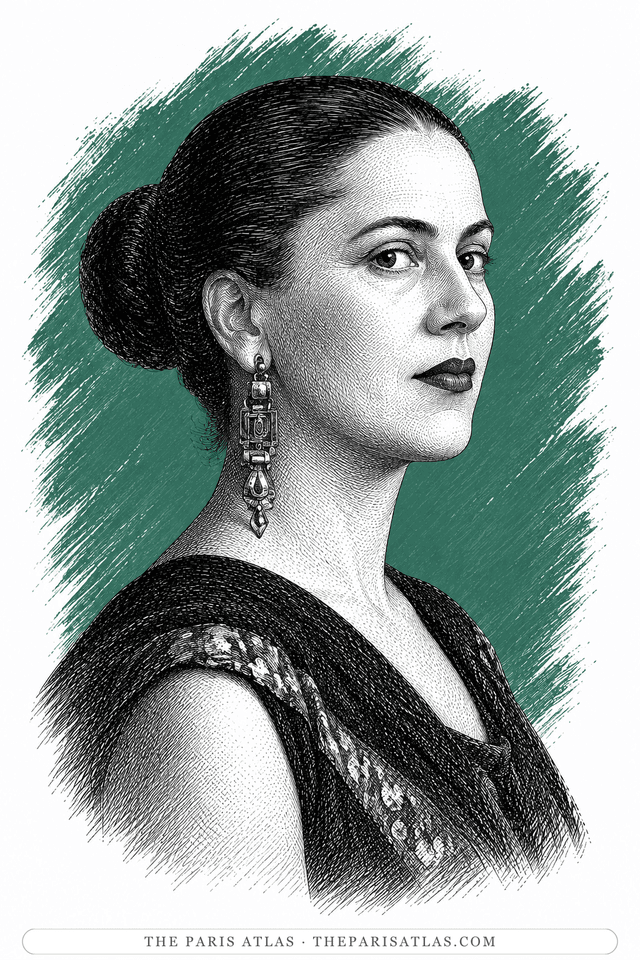
Tarsila do Amaral
Brazilian painter who spent the 1920s moving between São Paulo and Paris, studied Cubism under André Lhote, Albert Gleizes and Fernand Léger, and used what she learned to paint Brazilian towns, railways, plants and bodies. Her 1928 painting Abaporu prompted the manifesto that gave the Anthropophagic movement its name.
View artist
References
The sources below include collection records, catalogues, scholarly research, and primary materials that informed this page. They document The Abandoned Doll, its making, and its place in cultural history.


1Suzanne Valadon, The Abandoned Doll (1921) — collection record
WebsiteNational Museum of Women in the ArtsUsed forWeb source consulted for documented facts and historical context presented on the The Abandoned Doll page.
2Suzanne Valadon — artist record
WebsiteNational Museum of Women in the ArtsUsed forWeb source consulted for documented facts and historical context presented on the The Abandoned Doll page.
35 Fast Facts: Suzanne Valadon
WebsiteNational Museum of Women in the ArtsUsed forWeb source consulted for documented facts and historical context presented on the The Abandoned Doll page.
4Suzanne Valadon — exhibition press kit, Centre Pompidou (2025)
WebsiteCentre Pompidou, Paris, 2025Used forWeb source consulted for documented facts and historical context presented on the The Abandoned Doll page.

5Suzanne Valadon — review of the Centre Pompidou retrospective
Periodical4Columns, 2025Used forContemporary reporting or criticism used to document the historical reception and context of The Abandoned Doll.
6Suzanne Valadon — AWARE: Archives of Women Artists, Research and Exhibitions
WebsiteAWARE, from the Dictionnaire universel des creatrices, Editions des femmes - Antoinette Fouque, 2013Used forWeb source consulted for documented facts and historical context presented on the The Abandoned Doll page.
These references provide the documented foundation for this work's history and interpretation. Claim-level citations remain attached to the specific claims they support.
 Explore more resources