The Casting of the Net
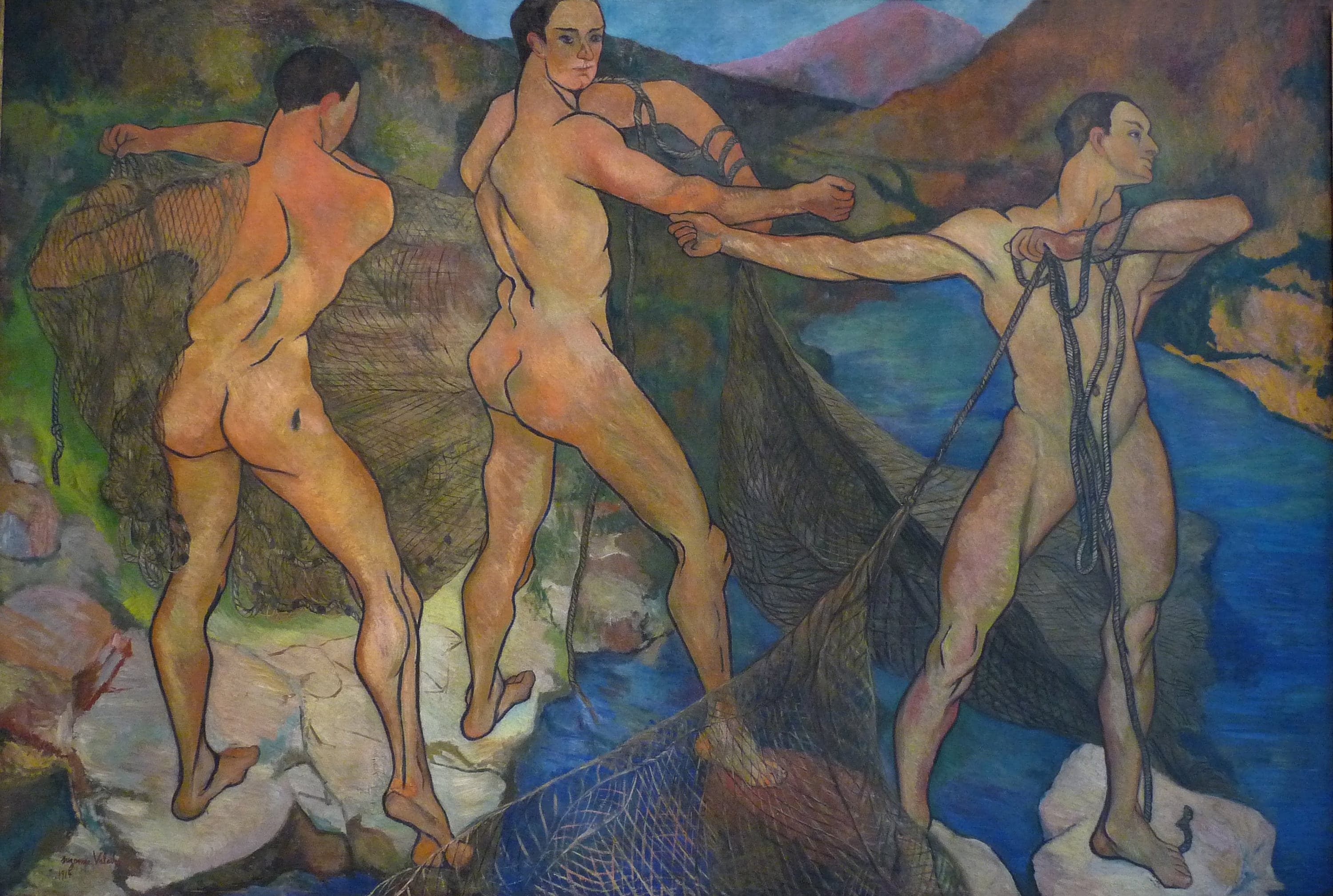
Three naked men stand on rocks above blue water, working a fishing net that sweeps across the bottom of a canvas three metres wide. André Utter modelled all three of them. Suzanne Valadon painted it early in 1914 and showed it at the Salon des Indépendants that spring; the Centre Pompidou owns it and keeps it on deposit in Nancy.
- 1914
- Oil on canvas
- Centre Pompidou, Musée national d'art moderneParis, France
About Suzanne Valadon
What the painting shows
Three naked men occupy a canvas 201 centimetres high and 301 wide. The one on the left is seen from behind, bent forward, his dark head turned to the right. His raised left arm ends in a closed fist that holds the top edge of a brown mesh net.
The man in the middle strides forward with one arm thrust out to the right, ending in a closed fist. A dark rope is looped over that shoulder and coiled twice around the upper arm. His face turns back towards the viewer, and his other arm is hidden behind his body.
The man on the right stands frontally with his head in strict profile, looking away to the right. His arms are held out level and wide, and twisted cords hang from his hands and forearms down across his body. He stands on a pale rock.
His left arm reaches the whole way across towards the middle figure. Near the centre of the canvas two closed fists stop short of each other, the middle figure's above and the reaching one below, with a hand's width of painted hillside between them.
Behind them the ground rises into olive and brown hills with a pink peak at the centre, under blue sky. Blue water runs between the rocks, and the net sweeps across the lower third of the canvas as a fine grey mesh laid over that water. Suzanne Valadon signed and dated the picture at the lower left.
One model, three poses
All three men are André Utter. The Centre Pompidou's collection record names him as the figure represented and describes the picture as one male body studied in three different poses.
The museum's teaching notes call the device something Suzanne Valadon had noticed in the work of Pierre Puvis de Chavannes, for whom she had modelled. The notes read the three figures as a single action turned through a rotation, and compare the stiff postures to figures drawn on ancient vases.
The notes also say she painted the canvas from charcoal sketches made in Corsica during the summer of 1913, where she had watched fishermen working on a beach. They add that the work takes its cue from a painting of 1868 by Frédéric Bazille, brought up to date.
The Centre Pompidou holds a charcoal study for it on tracing paper, Étude pour le lancement du filet, measuring 62 by 82 centimetres under inventory number AM 1492 D.
What the net covers
No genitals are visible in the finished painting. The man on the left is turned away, the man in the middle is seen from the side with the net hanging beside him, and the ropes fall across the third man.
The Centre Pompidou's teaching notes record that the sketches made before the painting do not hide the caster's sex behind the net. The arrangement in the finished canvas is therefore a decision taken between the drawings and the picture.
Arthur Cravan and a libel conviction
The painting went to the Salon des Indépendants in the spring of 1914. The Centre Pompidou's catalogue says the monumental academic panel irritated the avant-garde critics.
The poet and boxer Arthur Cravan reviewed that Salon in the fifth number of his occasional review Maintenant, and turned on Suzanne Valadon.
“[Elle] connaît bien les petites recettes, mais simplifier, ce n'est pas faire simple, vieille salope !”
In English: she knows the little tricks well, but simplifying is not the same as being simple, old bitch. Arthur Cravan was convicted of defamation for it.
“Contrairement à mon affirmation, Mme Suzanne Valadon est une vertu.”
In English: contrary to my assertion, Madame Suzanne Valadon is a virtue. The museum calls the retraction ferocious rather than contrite.
The last male nude
The Centre Pompidou states that The Casting of the Net is the last work Suzanne Valadon devoted to the male nude. After it she worked mainly on nudes of women and children.
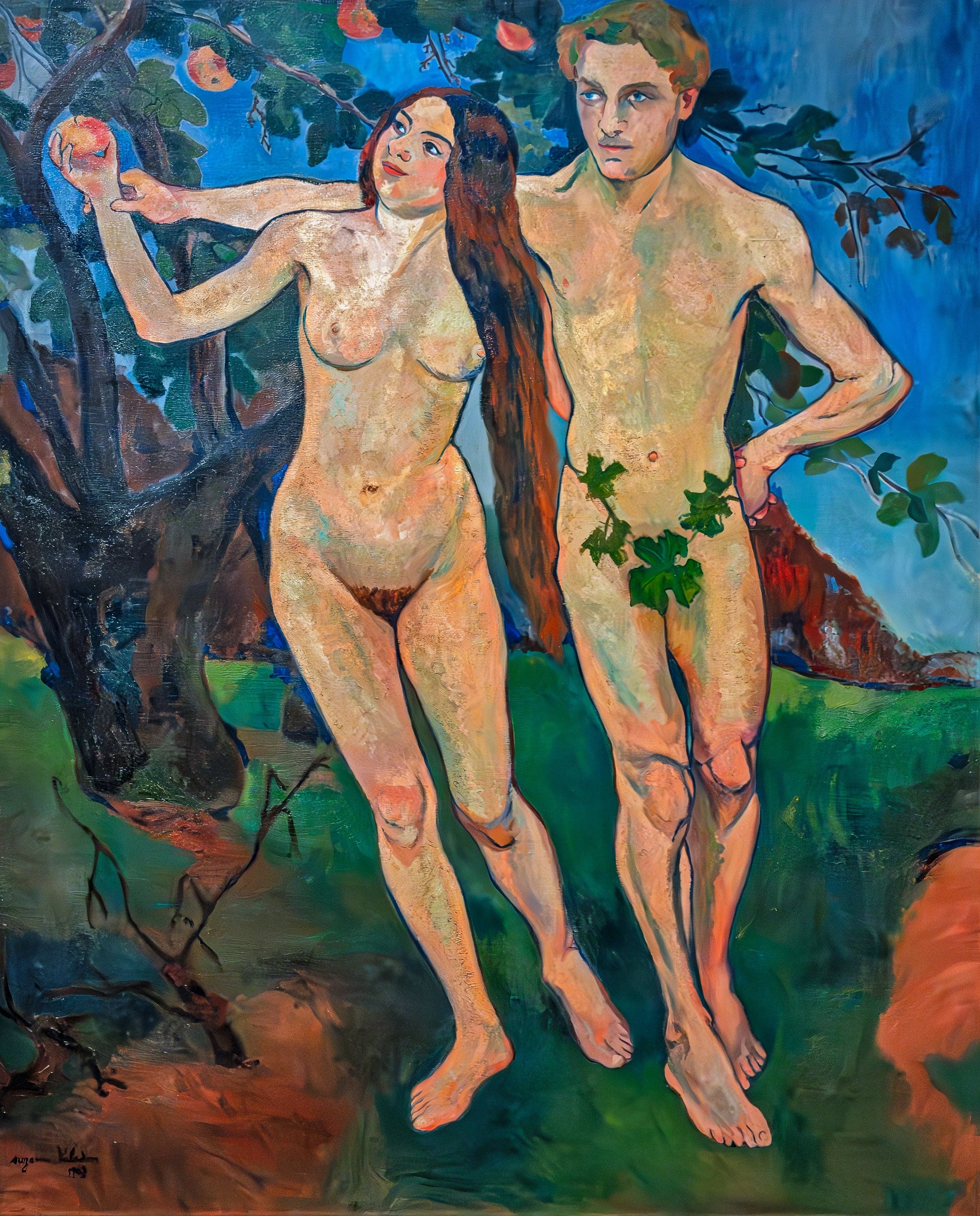
She had opened that subject five years earlier with Adam and Eve of 1909, in which she painted André Utter frontally and naked. The vine leaves over him in that picture were added later, most likely so that it could be hung.
She married André Utter in 1914, the year of this canvas.
Catalogued under other titles and other dates
The painting's record is untidy. The Centre Pompidou's bibliography cites the catalogue of the 37th Salon des Indépendants, a retrospective of 1884 to 1914 held at the Grand Palais des Champs-Élysées from 20 February to 21 March 1926. It appears there as number 2556, dated 1912, and still belonging to the artist.
The catalogue of the 1948 tribute at the Musée national d'art moderne lists it as number 17 under the plural title Les lanceurs de filet. The 1967 retrospective in the same museum, organised by Pierre Georgel, gives it number 18.
Paul Pétridès numbered it P55 when he catalogued Suzanne Valadon's paintings in 1971. The canvas itself carries the date 1914 at the lower left.
Who owns it and where it hangs
The Centre Pompidou owns The Casting of the Net under inventory number AM 2312 P. The French state bought it in 1937 and assigned it to the national collections the same year.
The museum's record places the canvas on deposit at the musée des Beaux-Arts de Nancy since 26 October 1998, which is where a visitor would look for it between loans. It returned to Paris for the Centre Pompidou's Valadon retrospective in 2025.
A deposit of this kind is a long-term loan between French public collections rather than a sale. At three metres wide the picture is not easily moved, and the Nancy museum has shown it for more than twenty-five years.
Close reading
Reading the work, detail by detail
One man posed three times, and the give-away is the hands. Count the fists, follow the rope from a shoulder to a fistful of cord, then the net laid over the water at the bottom.
1.The fist on the net
The left-hand figure is seen from behind, bent forward, and his raised fist takes the net's top edge. The diamond mesh is drawn stroke by stroke rather than suggested.
2.The rope on his shoulder
The rope crosses the shoulder and takes two turns around the upper arm before running off. That arm is the only one the middle figure shows; his other is hidden behind his body.
3.Two fists, not touching
The upper fist ends the middle figure's arm; the lower one ends the long arm the right-hand figure reaches across. A hand's width of painted hillside stays between them.
4.A fistful of cord
Three or four twisted cords run through the hand and fall in loops down the body. Whatever they are attached to is out of the picture, so the weight is implied rather than shown.
5.The pink peak
The one bright note in the landscape is a pink peak set between blue sky and brown hills. The Centre Pompidou's teaching notes describe the setting as a primitive nature at daybreak.
6.Bare feet on the rock
All three men are barefoot on wet grey rock, with the water running between the stones. A rope drops vertically through this part of the canvas and disappears into the net below.
7.The net over the water
The net is painted as a transparent film with the water showing through its mesh. The Centre Pompidou's teaching notes record that the preparatory sketches do not hide the caster's sex behind it, which the finished canvas does.
8.The signature
The signature is brushed onto the pale rock in the bottom left corner, small against a canvas three metres wide. The Centre Pompidou records the inscription as signed and dated at the lower left, 1914.
Timeline
1913
Suzanne Valadon makes charcoal sketches of fishermen on a beach in Corsica during the summer, according to the Centre Pompidou's teaching notes.
1914
Painted early in the year with André Utter as the model for all three figures, signed and dated at the lower left, and shown at the Salon des Indépendants that spring.
1914
Arthur Cravan attacks Suzanne Valadon over the painting in the fifth number of his review Maintenant, is convicted of defamation, and prints a mock retraction in a supplement.
1926
Number 2556 in the 37th Salon des Indépendants retrospective at the Grand Palais des Champs-Élysées, 20 February to 21 March, dated 1912 and still owned by the artist.
1937
Bought by the French state and assigned to the Musée national d'art moderne as AM 2312 P.
1948
Number 17 in Hommage à Suzanne Valadon at the Musée national d'art moderne, 28 May to 11 July, under the title Les lanceurs de filet.
1971
Catalogued by Paul Pétridès as painting number 55.
1998
Placed on deposit at the musée des Beaux-Arts de Nancy on 26 October.
2025
Recalled from Nancy for the Centre Pompidou's Valadon retrospective, 15 January to 26 May.
Where to see it
Centre Pompidou, Musée national d'art moderne
Paris, France
A public viewing address has not yet been confirmed for this holding.
On deposit at the musée des Beaux-Arts de Nancy since 26 October 1998, per the Centre Pompidou's collection record.
Frequently asked questions
Where is The Casting of the Net by Suzanne Valadon?
The Centre Pompidou owns it under inventory number AM 2312 P and has kept it on deposit at the musée des Beaux-Arts de Nancy since 26 October 1998. It came back to Paris for the Centre Pompidou's Valadon retrospective in 2025. Check with either museum before travelling, since a deposit is not a promise of display.
Who modelled for the three men in The Casting of the Net?
André Utter, Suzanne Valadon's partner from 1909 and her husband from 1914. The Centre Pompidou names him as the figure represented and describes the painting as one male body studied in three poses. The museum's teaching notes say she had seen the device used by Pierre Puvis de Chavannes.
Where is the scene in The Casting of the Net set?
The Centre Pompidou's teaching notes say Suzanne Valadon worked from charcoal sketches of fishermen made on a Corsican beach in the summer of 1913. The painted setting is rocks and blue water below olive and brown hills, with a pink peak behind.
How big is The Casting of the Net?
201 by 301 centimetres, oil on canvas, in landscape format. That is almost exactly two metres by three, which makes the three standing men larger than life and explains why the Centre Pompidou calls it a monumental panel.
Why was Arthur Cravan convicted over The Casting of the Net?
He reviewed the 1914 Salon des Indépendants in his review Maintenant and called Suzanne Valadon an old bitch who knew the little tricks. The Centre Pompidou records that he was convicted of defamation, and that he answered with a supplement declaring that she was, contrary to his assertion, a virtue.
Is The Casting of the Net Suzanne Valadon's last male nude?
The Centre Pompidou says so. Its catalogue calls the painting the last work she devoted to male nudity, after which she turned mainly to nudes of women and children. She had begun the subject with Adam and Eve in 1909.
More by Suzanne Valadon
If you like Suzanne Valadon
Explore painters from the same movements and circles.
Kiki de Montparnasse
Alice Prin — model for Soutine, Foujita and Modigliani, Man Ray's partner and the back with the violin f-holes, cabaret singer at Le Jockey, memoirist introduced by Hemingway, painter of a sold-out show, and, by acclamation in 1929, Queen of Montparnasse.
View artist
Meret Oppenheim
German-born Swiss artist who arrived in Paris in 1932 at eighteen and fell in with the Surrealists. In 1936 a lunch with Pablo Picasso and Dora Maar at the Café de Flore led directly to Object — a teacup, saucer and spoon covered in gazelle fur — which made her internationally famous at twenty-two and then followed her for the rest of her life, to her considerable irritation.
View artist
Tarsila do Amaral
Brazilian painter who spent the 1920s moving between São Paulo and Paris, studied Cubism under André Lhote, Albert Gleizes and Fernand Léger, and used what she learned to paint Brazilian towns, railways, plants and bodies. Her 1928 painting Abaporu prompted the manifesto that gave the Anthropophagic movement its name.
View artist
References
The sources below include collection records, catalogues, scholarly research, and primary materials that informed this page. They document The Casting of the Net, its making, and its place in cultural history.


1Suzanne Valadon, Le Lancement du filet (1914) — collection notice
WebsiteCentre Pompidou, Musée national d'art moderneUsed forWeb source consulted for documented facts and historical context presented on the The Casting of the Net page.
2Le Lancement du filet — Suzanne Valadon teaching dossier
WebsiteCentre PompidouUsed forWeb source consulted for documented facts and historical context presented on the The Casting of the Net page.
3Suzanne Valadon, Etude pour le lancement du filet (1914) — collection notice
WebsiteCentre Pompidou, Musée national d'art moderneUsed forWeb source consulted for documented facts and historical context presented on the The Casting of the Net page.
4Suzanne Valadon — exhibition press kit, Centre Pompidou (2025)
WebsiteCentre Pompidou, Paris, 2025Used forWeb source consulted for documented facts and historical context presented on the The Casting of the Net page.

5L'oeuvre complet de Suzanne Valadon
Exhibition catalogueCompagnie francaise des arts graphiques, Paris, 1971Used forCatalogue scholarship used to verify attribution, provenance, chronology, and interpretive context for The Casting of the Net.
6Suzanne Valadon — AWARE: Archives of Women Artists, Research and Exhibitions
WebsiteAWARE, from the Dictionnaire universel des creatrices, Editions des femmes - Antoinette Fouque, 2013Used forWeb source consulted for documented facts and historical context presented on the The Casting of the Net page.
These references provide the documented foundation for this work's history and interpretation. Claim-level citations remain attached to the specific claims they support.
 Explore more resources