The Blue Room
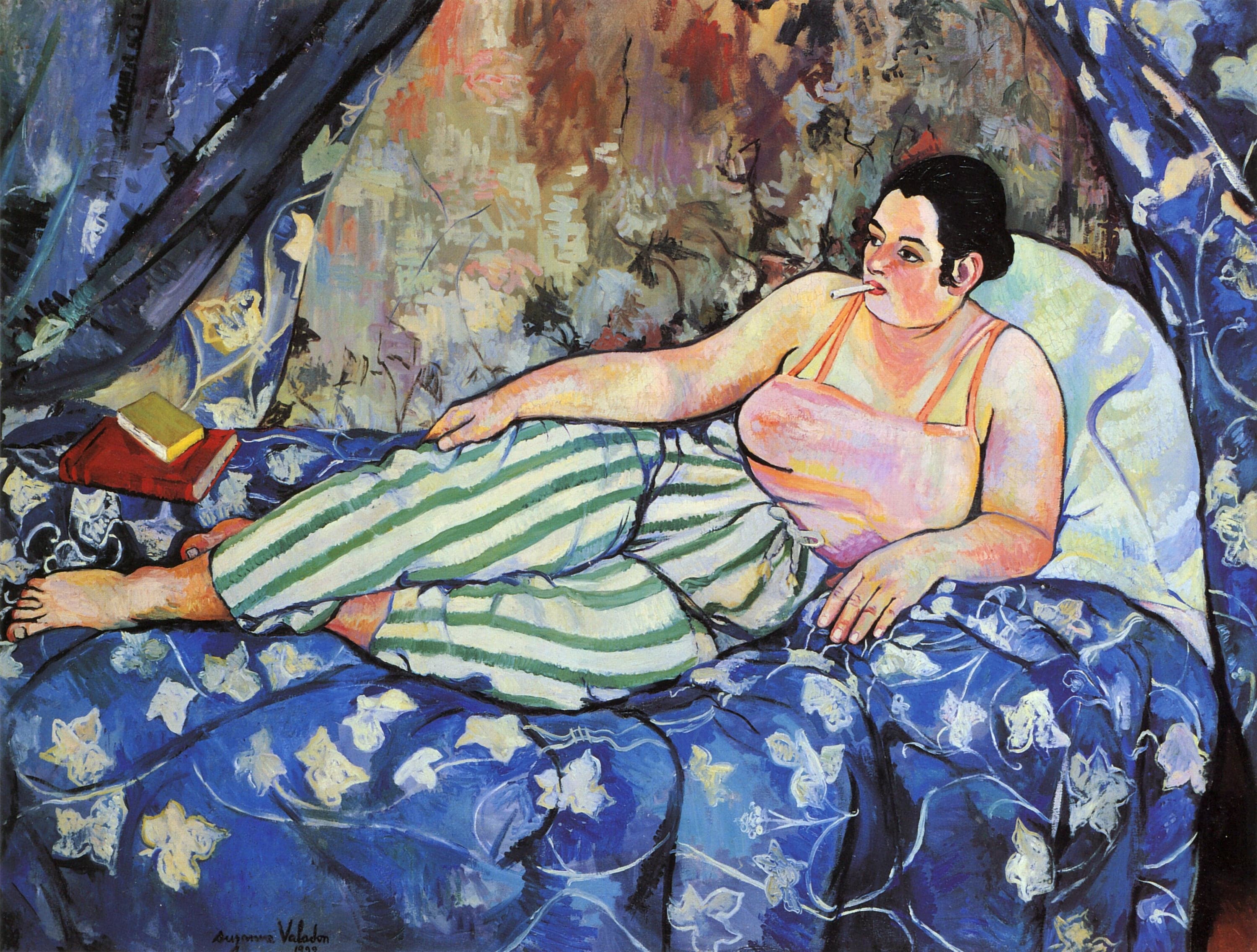
A dark-haired woman lies across a bed in striped pajama trousers with a cigarette in her mouth and two books stacked behind her one bare foot. Suzanne Valadon painted it in 1923 and showed it at the Salon d'Automne that November. The Centre Pompidou owns it and keeps it on long-term deposit at the musée des Beaux-Arts de Limoges.
- 1923
- Oil on canvas
- Centre Pompidou, Musée national d'art moderneParis, France
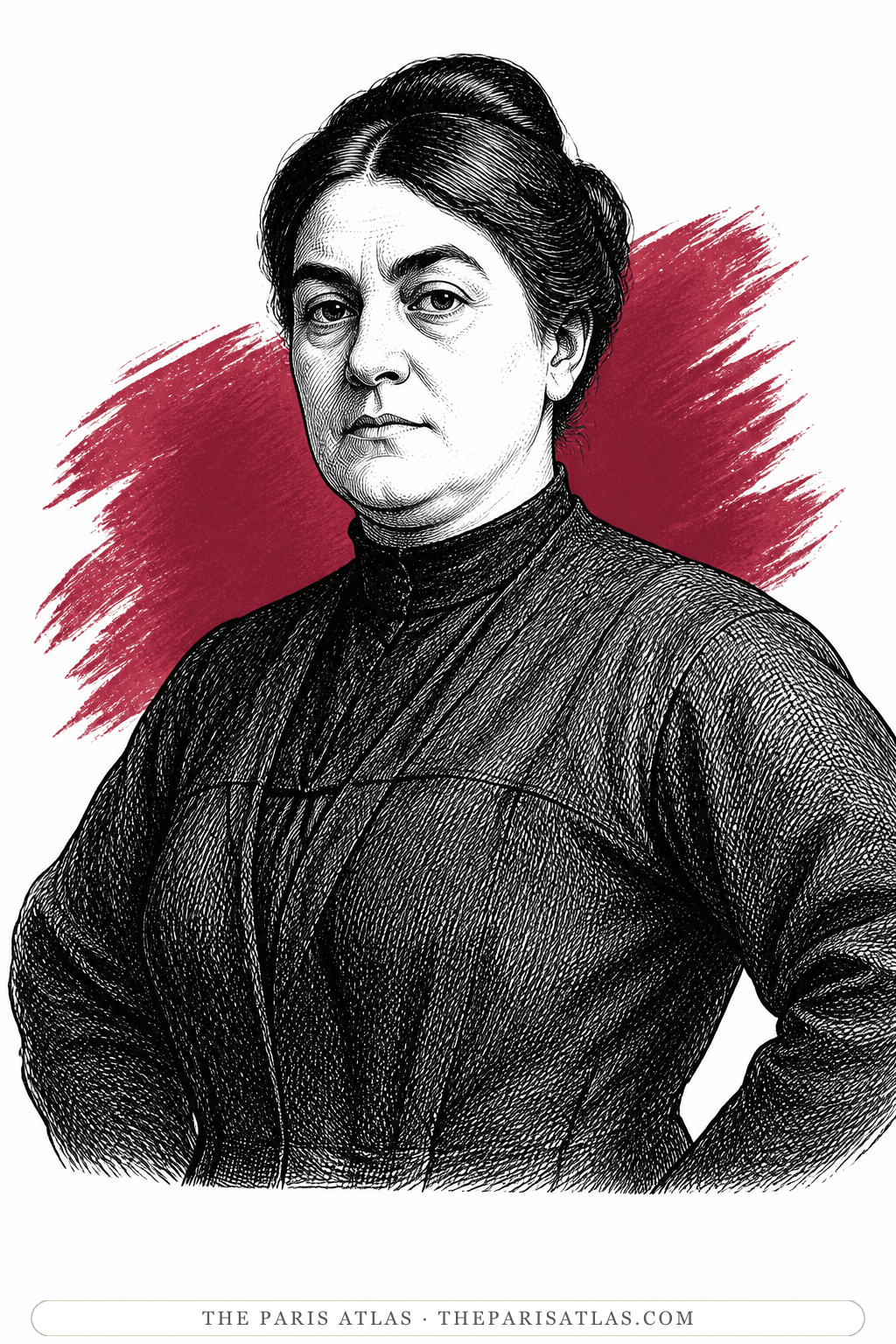
About Suzanne Valadon
What the painting shows
A woman lies across a bed, leaning back against a pale pillow, a cigarette hanging from her lips. She wears a pale pink camisole with thin coral straps and loose trousers striped in green and cream. One hand lies flat and open on the bedspread at the lower right; her other arm stretches away to the left along the top of her legs.
A single bare foot comes out of the trouser cuff at the left edge of the canvas. Two books are stacked just behind it, a large red one lying flat with a smaller yellow one on top.
Blue dominates. The bedspread and the curtains at both edges carry the same pale cream flowers and curling stems on deep blue. The wall between the curtains is a different pattern altogether, in rust, coral, olive, cream and mauve, and the Centre Pompidou's teaching notes call it decrepit. The museum's catalogue describes the sitter plainly: thick hands, a tired and heavy body, heavy breasts.
Suzanne Valadon signed and dated the canvas at the lower left. It measures 90 by 116 centimetres.
Books where Manet put a cat
The pose is borrowed. A woman stretched on a bed between curtains is the standard shape of the odalisque, the reclining harem figure that French painters had been producing for a century.
Suzanne Valadon changed two things. Her woman is clothed rather than nude, and the clothes are ordinary indoor wear rather than costume. The Centre Pompidou's teaching notes point to the second change: where Édouard Manet set a cat at the foot of Olympia, Suzanne Valadon stacked two books, a French paperback novel and a bound volume of art history.
The museum states that the woman is not a self-portrait, and reads her instead as the symbolic alter ego of the artist. Suzanne Valadon herself put the working rule this way, in a line the Centre Pompidou prints beside the picture.
“Il faut avoir le courage de regarder le modèle en face si l'on veut atteindre l'âme. Ne m'amenez jamais pour peindre une femme qui cherche l'aimable ou le joli, je la décevrais tout de suite.”
In English: you have to have the courage to look the model in the face if you want to reach the soul. Never bring her a woman who is after the agreeable or the pretty, because she would disappoint her at once.
From the Salon d'Automne to the French state
The painting went into public view the year it was made. The catalogue of the 16th Salon d'Automne, held at the Grand Palais from 1 November to 16 December 1923, lists it as number 1955 under the title La Chambre bleue. Le Canard enchaîné carried a notice of it on 7 November.
Three years later Lord Joseph Duveen gave it to the French state. It entered the Musée national du Luxembourg, then the state museum for living artists, and still carries that museum's inventory number, LUX.1506 P. Charles Masson listed it in the Luxembourg catalogue of 1927.
Paul Pétridès numbered it P275 when he catalogued Suzanne Valadon's paintings in 1971.
Who owns it and where it hangs
The Centre Pompidou owns The Blue Room. Its checklist for the 2025 Valadon retrospective records the canvas as on deposit at the musée des Beaux-Arts de Limoges, which is where a visitor would look for it between loans.
A deposit of this kind is a long-term loan between French public collections rather than a sale. The owner does not change, and the work can be recalled for exhibitions in Paris, as it was in 2025.
Close reading
Reading the work, detail by detail
The odalisque's props have been swapped out one by one. Follow the cigarette, the two books, the single bare foot and the hand flat on the bedspread, then the three different patterns that crowd behind them.
1.The cigarette
The cigarette is a plain white bar with a blunt end, painted with no ember and no smoke. The Centre Pompidou's teaching notes say it hangs nonchalantly from her lips, and that a cigarette in 1923 marked out women artists and women of easy virtue alike.
2.Two books, stacked
The red book lies flat and the yellow one sits on top, squared up and closed. The Centre Pompidou identifies them as a French paperback novel and a bound art-history book, standing where Édouard Manet put a cat at the foot of Olympia.
3.One bare foot
Only one foot is visible in the whole painting. The striped cuff ends at the ankle, the foot turns on its side, and the two books sit just behind it rather than beside the toes.
4.The open hand
The hand rests flat and open, carrying no weight and holding nothing. Above it the trouser waistband shows a small metal hook and eye, painted in grey, which is the only fastening anywhere in the picture.
5.The cracked wall
The wall behind the bed carries its own flower pattern in warm colours, quite unlike the blue fabrics on either side. A crack runs down through it, and the Centre Pompidou's teaching notes count the flaws of a decrepit wall among the picture's deliberate visual overload.
6.The curtain and the pillow
The curtain repeats the bedspread's pattern exactly, which is what makes the room read as one blue field. The pillow between the curtain and her shoulder is what actually holds her upright.
7.The signature
The signature sits low on the left, written straight onto the painted bedspread rather than into a clear margin. The Centre Pompidou records the inscription as signed and dated at the lower left.
Timeline
1923
Painted, signed and dated. Shown that autumn as number 1955 in the 16th Salon d'Automne at the Grand Palais, under the title La Chambre bleue.
1926
Given to the French state by Lord Joseph Duveen and taken into the Musée national du Luxembourg as LUX.1506 P.
1948
Number 54 in Hommage à Suzanne Valadon at the Musée national d'art moderne, Paris, 28 May to 11 July.
1967
Number 60 in the Valadon retrospective at the Musée national d'art moderne, 17 March to 30 April, organized by Pierre Georgel.
1971
Catalogued by Paul Pétridès as painting number 275.
2005–06
Number 40 in Self Portrait: Renaissance to Contemporary, National Portrait Gallery, London, then the Art Gallery of New South Wales, Sydney.
2009–10
Hung in elles@centrepompidou, the museum's rehang of its collection around women artists.
2025
Recalled from Limoges for the Centre Pompidou's Valadon retrospective, 15 January to 26 May.
Where to see it
Centre Pompidou, Musée national d'art moderne
Paris, France
A public viewing address has not yet been confirmed for this holding.
On long-term deposit at the musée des Beaux-Arts de Limoges, per the Centre Pompidou's 2025 exhibition checklist.
Frequently asked questions
Where is The Blue Room by Suzanne Valadon?
The Centre Pompidou in Paris owns it, under inventory number LUX.1506 P, and keeps it on long-term deposit at the musée des Beaux-Arts de Limoges. It returned to Paris for the Centre Pompidou's Valadon retrospective in 2025. Check with either museum before travelling, since a deposit is not a promise of display.
Who is the woman in The Blue Room?
The Centre Pompidou does not name her and states that the painting is not a self-portrait. The museum reads the figure as the symbolic alter ego of Suzanne Valadon rather than a likeness of her. Suzanne Valadon was fifty-eight in 1923 and usually painted people from her own household.
What is she wearing in The Blue Room?
A pale pink camisole with thin coral shoulder straps and loose trousers striped in green and cream. The Centre Pompidou calls them indoor clothes rather than an odalisque's costume, and treats the choice as the point: the figure is dressed for her own comfort.
Why are there books in The Blue Room?
They take the place of the cat that Édouard Manet painted at the foot of Olympia in 1863. The Centre Pompidou identifies them as a French paperback novel and a bound art-history book, and reads both as symbols of intellectual emancipation. In the painting the red one lies flat with the yellow one stacked on top.
How big is The Blue Room?
90 by 116 centimetres, oil on canvas, in landscape format. Suzanne Valadon signed and dated it at the lower left.
When was The Blue Room first shown in public?
At the 16th Salon d'Automne in the Grand Palais, which ran from 1 November to 16 December 1923, where it hung as catalogue number 1955. Lord Joseph Duveen gave it to the French state three years later.
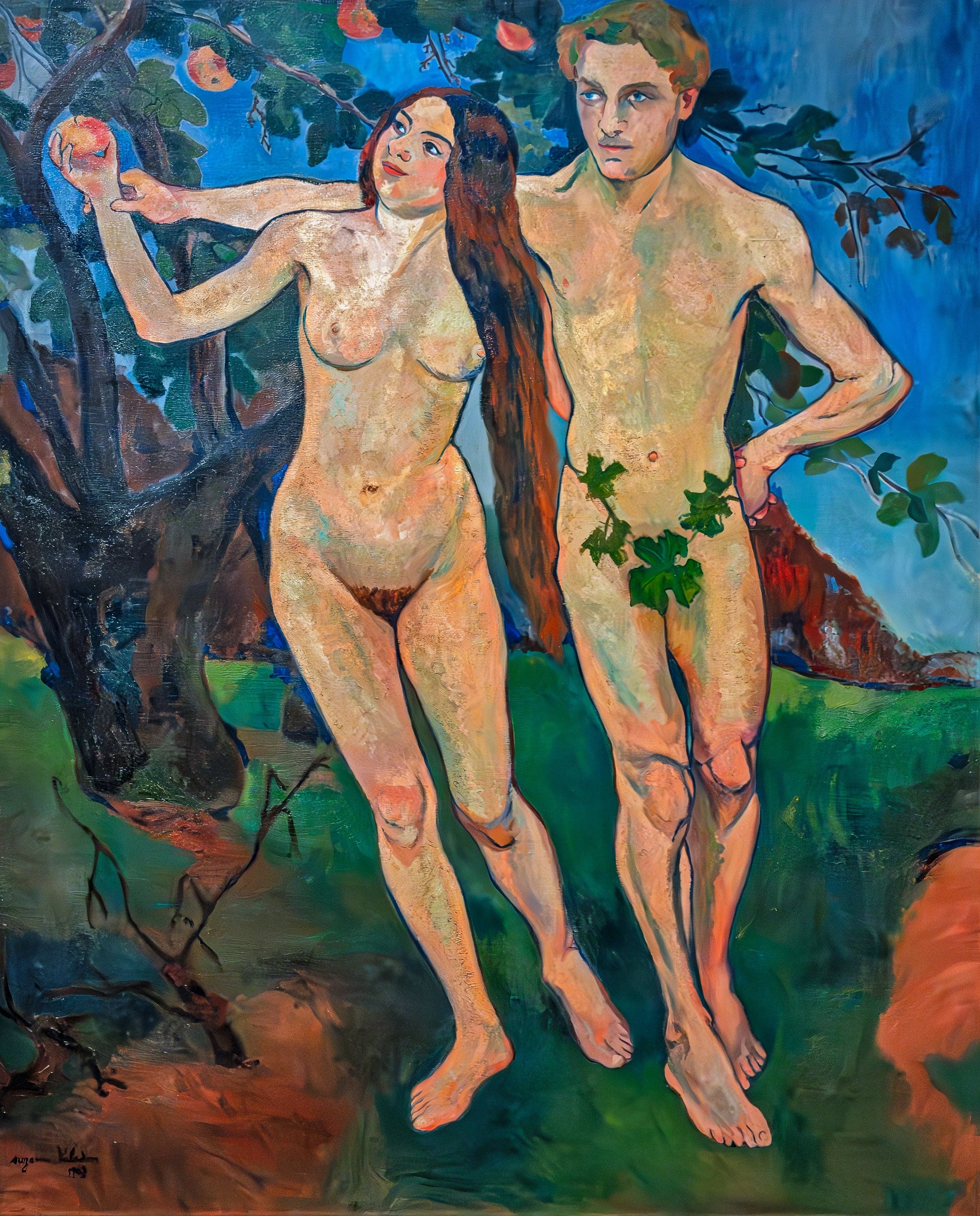
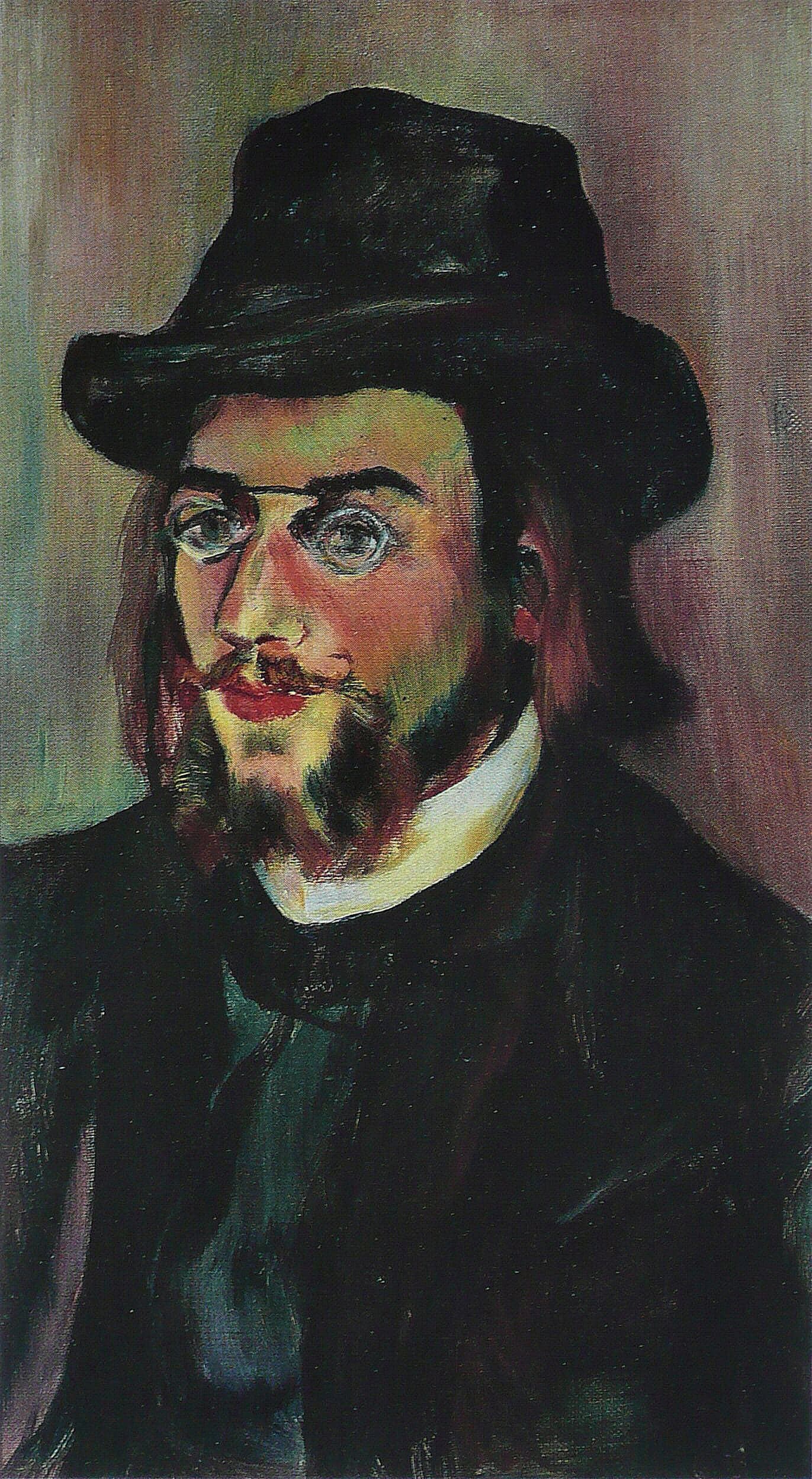
More by Suzanne Valadon
If you like Suzanne Valadon
Explore painters from the same movements and circles.
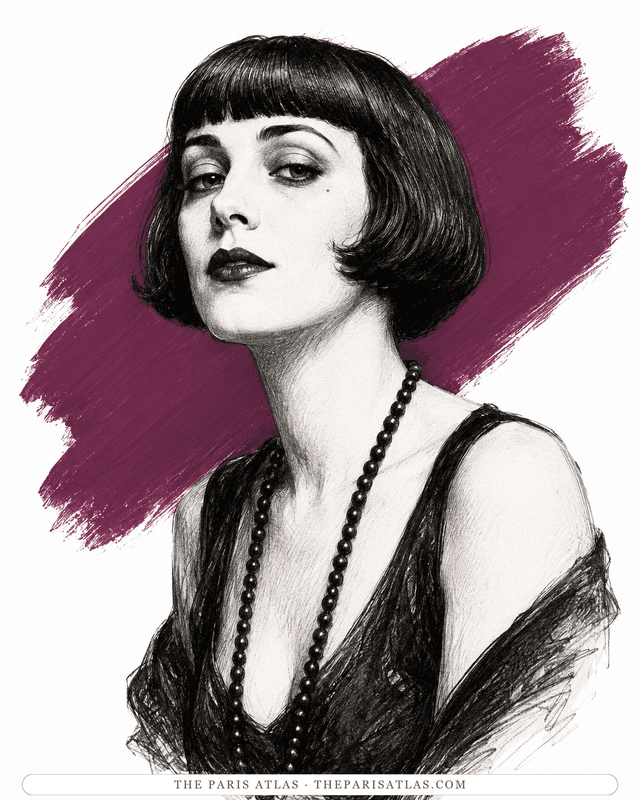
Kiki de Montparnasse
Alice Prin — model for Soutine, Foujita and Modigliani, Man Ray's partner and the back with the violin f-holes, cabaret singer at Le Jockey, memoirist introduced by Hemingway, painter of a sold-out show, and, by acclamation in 1929, Queen of Montparnasse.
View artist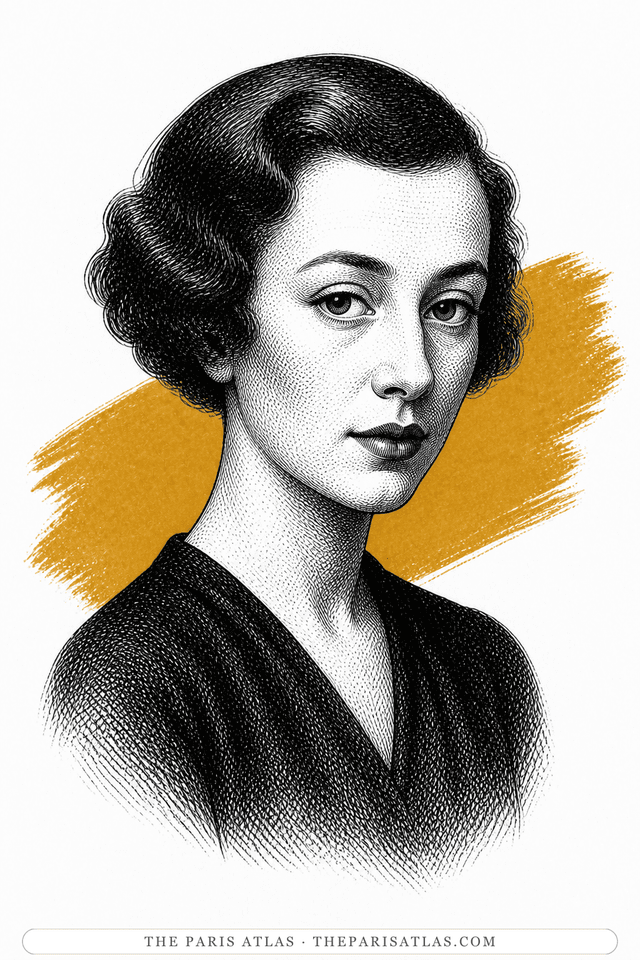
Meret Oppenheim
German-born Swiss artist who arrived in Paris in 1932 at eighteen and fell in with the Surrealists. In 1936 a lunch with Pablo Picasso and Dora Maar at the Café de Flore led directly to Object — a teacup, saucer and spoon covered in gazelle fur — which made her internationally famous at twenty-two and then followed her for the rest of her life, to her considerable irritation.
View artist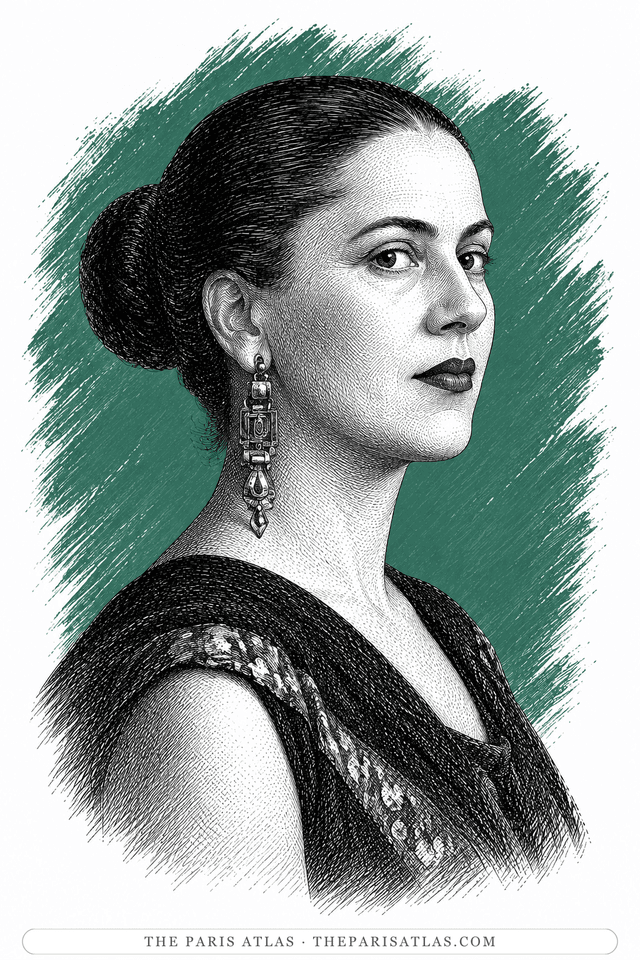
Tarsila do Amaral
Brazilian painter who spent the 1920s moving between São Paulo and Paris, studied Cubism under André Lhote, Albert Gleizes and Fernand Léger, and used what she learned to paint Brazilian towns, railways, plants and bodies. Her 1928 painting Abaporu prompted the manifesto that gave the Anthropophagic movement its name.
View artist
References
The sources below include collection records, catalogues, scholarly research, and primary materials that informed this page. They document The Blue Room, its making, and its place in cultural history.


1Suzanne Valadon, La Chambre bleue (1923) — collection notice
WebsiteCentre Pompidou, Musée national d'art moderneUsed forWeb source consulted for documented facts and historical context presented on the The Blue Room page.
2La Chambre bleue — Suzanne Valadon teaching dossier
WebsiteCentre PompidouUsed forWeb source consulted for documented facts and historical context presented on the The Blue Room page.
3Suzanne Valadon — exhibition press kit, Centre Pompidou (2025)
WebsiteCentre Pompidou, Paris, 2025Used forWeb source consulted for documented facts and historical context presented on the The Blue Room page.

4L'oeuvre complet de Suzanne Valadon
Exhibition catalogueCompagnie francaise des arts graphiques, Paris, 1971Used forCatalogue scholarship used to verify attribution, provenance, chronology, and interpretive context for The Blue Room.
5Suzanne Valadon — AWARE: Archives of Women Artists, Research and Exhibitions
WebsiteAWARE, from the Dictionnaire universel des creatrices, Editions des femmes - Antoinette Fouque, 2013Used forWeb source consulted for documented facts and historical context presented on the The Blue Room page.
These references provide the documented foundation for this work's history and interpretation. Claim-level citations remain attached to the specific claims they support.
 Explore more resources