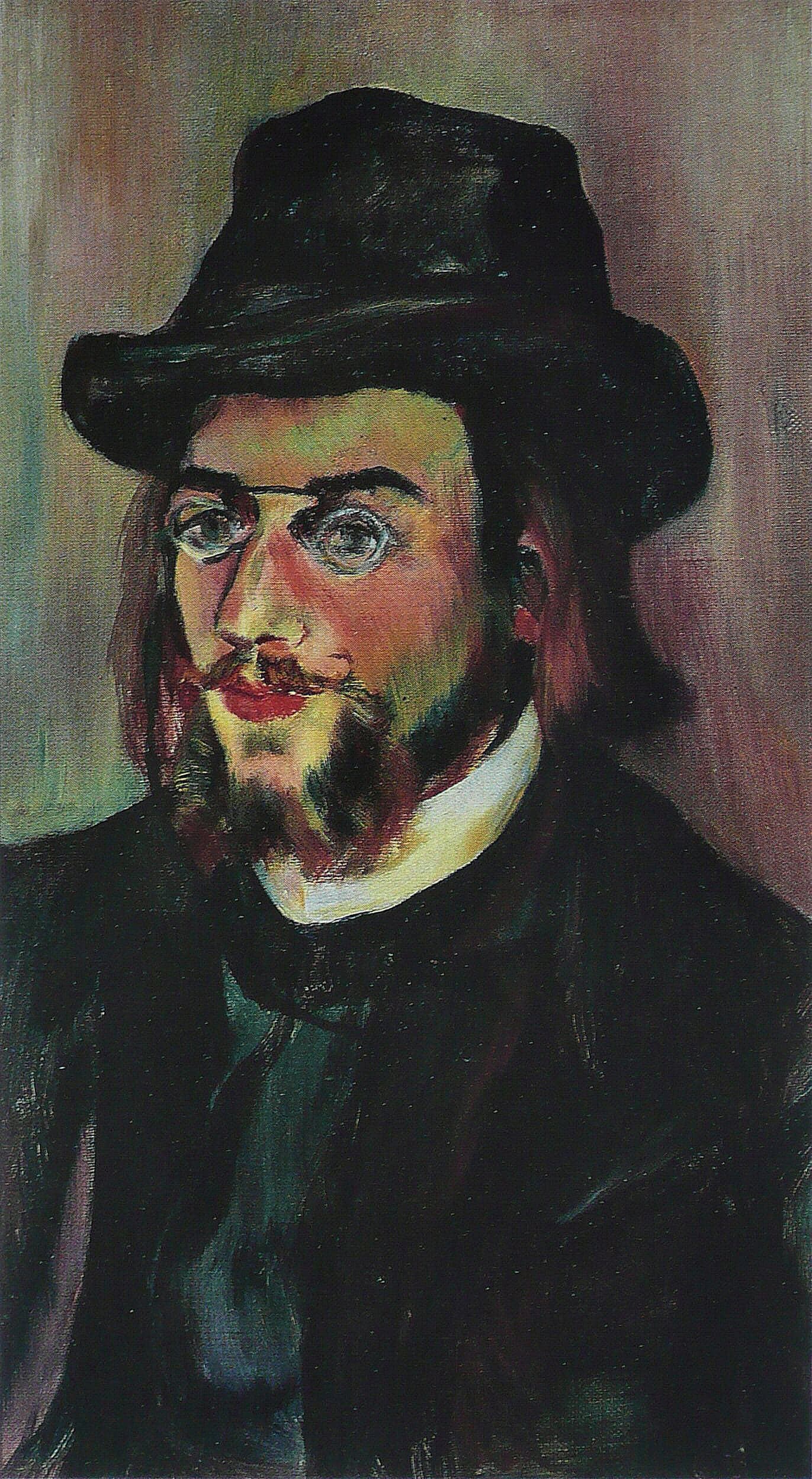
Suzanne Valadon painted the composer Erik Satie in a black hat and pince-nez on a narrow upright canvas, around 1892–93, while the two were together in Montmartre. It is one of her earliest paintings and was exhibited in Paris in the spring of 1893. The Centre Pompidou owns it.
A young man's head and shoulders fill a canvas 41 centimetres high and 22 wide, roughly twice as tall as it is broad. He wears a soft black hat with a turned brim, a white collar and a dark coat, and he looks slightly to his right, past the painter.
His hair hangs straight down both sides of his face, reaching the coat on his right side and stopping at the jaw on his left. The Centre Pompidou notes that the long hair and the beard are warmed with a red-brown. A short beard and a drooping moustache, its ends shaggy and turned down, frame a mouth painted in an emphatic red. Behind the pince-nez, two oval rims joined over the nose, the eyes are pale grey-green and fixed.
The museum's teaching notes single out those two features as the things Suzanne Valadon pushed hardest. She brought out the light eyes through the eyeglasses that later became the composer's attribute, and painted the mouth in what the notes call a kiss red.
The ground behind him is not a room. It is streaked green and grey on the left and dull mauve on the right, put down in vertical strokes that leave the hat as a near-black shape. The coat is darker still, and the only relief in it is a wedge of deep green at the neck.
Who Erik Satie was in 1893
Erik Satie was twenty-six and living on what the Montmartre cabarets paid him to play. He had already written the three Gymnopédies, published in 1888, which took decades to become the pieces everyone now knows.
Suzanne Valadon was twenty-seven, had modelled for Pierre-Auguste Renoir and Henri de Toulouse-Lautrec, and had been drawing for years. She had barely begun to paint. Paul Pétridès numbered this canvas second in her catalogue of paintings, which puts it among the first she made.
Six months in Montmartre
The Centre Pompidou says the two met at the Auberge du Clou in Montmartre, the district where both of them lived, and dates the start of the relationship to January 1893. It lasted about six months.
They drew each other. Erik Satie sketched Suzanne Valadon repeatedly on ruled music paper; the Centre Pompidou holds one of those sheets, an ink drawing titled Suzanne Valadon and inscribed ERIK SATIE PINXIT ANNO DOM. 1893. She painted this portrait. Both works came to the museum together in 1974.
After the break Erik Satie wrote to his brother: « Je viens de rompre définitivement avec Suzanne. J'aurai bien du mal à reprendre possession de moi-même ; aimant cette petite comme je l'aimais depuis ton départ ; elle avait su me prendre en entier. Le temps fera ce que je ne puis faire en ce moment. » He had broken with Suzanne for good, he wrote, and would find it hard to get hold of himself again; time would do what he could not do just then.
The Centre Pompidou links the end of the affair to Vexations, the short piece Erik Satie marked to be repeated 840 times. The museum's teaching notes say a performance can run to twenty-four hours depending on the tempo. It was found at his home after his death in 1925 and was never performed in his lifetime.
Pierre-Daniel Templier's 1932 biography, the first written about Erik Satie, records that women played no important part in his life and that no affairs were known of him as an adult. Suzanne Valadon is the exception the record holds.
Shown in 1893, then eighty years in private hands
The painting was seen almost immediately. It hung as number 136 in the fourth exhibition of Impressionist and Symbolist painters at Le Barc de Boutteville's gallery, 47 rue Le Peletier, in April and May 1893.
After that it disappeared into private ownership for most of a century. The catalogue of the 1948 Valadon tribute at the Musée national d'art moderne lists it as coming from a private collection, and so does the catalogue of the 1967 retrospective in the same museum.
It entered the national collections in 1974 with the bequest of Doctor Robert Le Masle, who left the museum both Suzanne Valadon's painting of Erik Satie and Erik Satie's drawing of Suzanne Valadon.
Where to see it
The Centre Pompidou owns the painting under inventory number AM 1974-117. Its collection record lists the canvas as being at the Monastère royal de Brou in Bourg-en-Bresse on a long-term loan running from 20 April 2026 to 30 December 2028.
Brou had borrowed it before, for Valadon et ses contemporaines. Peintres et sculptrices, 1880-1940, which ran there from 16 May to 13 September 2020 and then moved to the Musée des Beaux-Arts in Limoges.
Close reading
Reading the work, detail by detail
A canvas 22 centimetres across holds a hat, a pince-nez and a red mouth, and almost nothing else. Take them one at a time, then the two coloured grounds that stand in for a room.
1.The black hat
The hat is painted as one dark mass with a crease across the crown and a brim that changes height from side to side. It takes up the whole width of a canvas only 22 centimetres across.
2.The pince-nez
The eyeglasses are drawn with a bar and an oval rim rather than a full frame. The Centre Pompidou's teaching notes say Suzanne Valadon brought out Erik Satie's light eyes through the glasses that later became the composer's attribute.
3.The red mouth
The moustache droops: its ends spread sideways and fall, with no waxed points. The Centre Pompidou's teaching notes call the mouth a kiss red, painted to catch the eye.
4.The green-grey ground
There is no room behind him, only a band of streaked green and grey put down in vertical strokes. The hair hangs straight against it, and the Centre Pompidou notes that the long hair and the beard are warmed with a red-brown.
5.The white collar
The collar is the one clean light in the lower half of the canvas. It curves up under the beard and stops, with the coat closing round it on both sides.
6.Green inside the coat
The coat is close to black, but it is not flat: a column of dark green shows at the neck and runs down the chest. It is the only relief in the bottom third of the painting.
7.The mauve ground
The right-hand ground is a dull mauve, not the green-grey of the left, so the two sides of the head sit against different colours. The canvas weave shows through the thin paint.
Suzanne Valadon and Erik Satie meet at the Auberge du Clou in Montmartre; the Centre Pompidou dates the start of their relationship to January.
1893
Shown as number 136 in the fourth exhibition of Impressionist and Symbolist painters at Le Barc de Boutteville, 47 rue Le Peletier, in April and May.
1893
Erik Satie draws Suzanne Valadon in ink on music paper, signing it ERIK SATIE PINXIT ANNO DOM. 1893, and writes to his brother that he has broken with her for good.
1939
Number 1 in the Suzanne Valadon exhibition at the Galerie Bernier, Paris, where it is dated 1892.
1948
Number 4 in Hommage à Suzanne Valadon at the Musée national d'art moderne, lent from a private collection.
1974
Enters the Musée national d'art moderne with the bequest of Doctor Robert Le Masle, alongside Erik Satie's drawing of Suzanne Valadon.
2015–16
Number 1 in Suzanne Valadon, Maurice Utrillo & André Utter at the Musée de Montmartre, the building where the three of them lived.
2025
Shown in the Centre Pompidou's Valadon retrospective, 15 January to 26 May.
Where to see it
Centre Pompidou, Musée national d'art moderne
Paris, France
A public viewing address has not yet been confirmed for this holding.
Recorded by the Centre Pompidou as on long-term loan to the Monastère royal de Brou, Bourg-en-Bresse, from 20 April 2026 to 30 December 2028.
Frequently asked questions
Where is Suzanne Valadon's Portrait of Erik Satie?
The Centre Pompidou, Musée national d'art moderne, owns it under inventory number AM 1974-117. The museum's record lists it as on long-term loan to the Monastère royal de Brou in Bourg-en-Bresse from 20 April 2026 to 30 December 2028.
When did Suzanne Valadon paint Erik Satie?
The Centre Pompidou dates the canvas 1892–93, in square brackets, meaning the year is inferred rather than documented. A 1939 exhibition catalogue dated it 1892. The painting was on public view by April 1893.
Were Suzanne Valadon and Erik Satie a couple?
Yes, for about six months in 1893. The Centre Pompidou says they met at the Auberge du Clou in Montmartre, where both lived, and dates the start of the relationship to January 1893. After it ended Erik Satie wrote to his brother that he had broken with her for good.
Did Erik Satie write music about Suzanne Valadon?
The Centre Pompidou links Vexations to the end of the affair. Erik Satie wrote the short piece with an instruction to repeat its motif 840 times, which the museum says can take twenty-four hours depending on the tempo. It was found at his home after his death in 1925 and never performed while he lived.
How big is the Portrait of Erik Satie?
41 by 22 centimetres, oil on canvas. That is smaller than a sheet of A3 paper and almost twice as tall as it is wide, which is why the composition is a head and shoulders with nothing else in it.
Is this one of Suzanne Valadon's first paintings?
It is among the earliest. Paul Pétridès numbered it second in his 1971 catalogue of her paintings. Suzanne Valadon had been drawing since childhood and modelling since 1880, but she came to oil paint late, and the Centre Pompidou calls this canvas one of her very first.
In the atlas
What the graph records about this work — every claim carries its citation.
The Centre Pompidou titles the canvas Portrait d'Erik Satie and dates it 1892-93, to the months of the composer's affair with Suzanne Valadon. A black hat, a pince-nez, a drooping moustache and a vermilion mouth fill a canvas 22 centimetres across.
Explore painters from the same movements and circles.
Kiki de Montparnasse
Alice Prin — model for Soutine, Foujita and Modigliani, Man Ray's partner and the back with the violin f-holes, cabaret singer at Le Jockey, memoirist introduced by Hemingway, painter of a sold-out show, and, by acclamation in 1929, Queen of Montparnasse.
German-born Swiss artist who arrived in Paris in 1932 at eighteen and fell in with the Surrealists. In 1936 a lunch with Pablo Picasso and Dora Maar at the Café de Flore led directly to Object — a teacup, saucer and spoon covered in gazelle fur — which made her internationally famous at twenty-two and then followed her for the rest of her life, to her considerable irritation.
Brazilian painter who spent the 1920s moving between São Paulo and Paris, studied Cubism under André Lhote, Albert Gleizes and Fernand Léger, and used what she learned to paint Brazilian towns, railways, plants and bodies. Her 1928 painting Abaporu prompted the manifesto that gave the Anthropophagic movement its name.
The sources below include collection records, catalogues, scholarly research, and primary materials that informed this page. They document Portrait of Erik Satie, its making, and its place in cultural history.
These references provide the documented foundation for this work's history and interpretation. Claim-level citations remain attached to the specific claims they support.



 View source