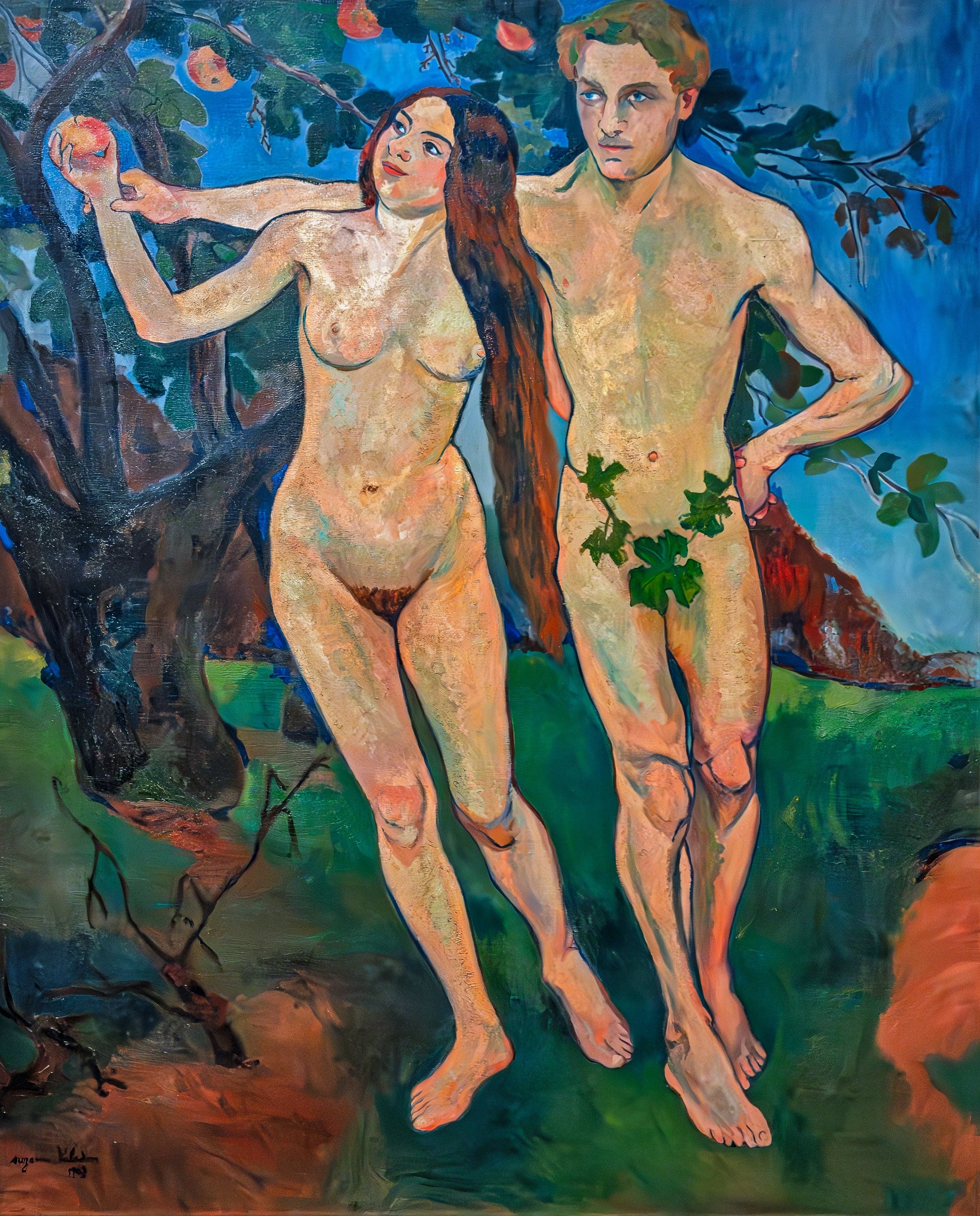
Suzanne Valadon painted herself and her new partner André Utter naked, as Adam and Eve beside an apple tree, in 1909. His hand closes on her wrist at the apple. The vine leaves that hide his genitals were painted in later. The canvas is at the Centre Pompidou in Paris, which bought it for the French state in 1937.
Two naked figures stand side by side in a garden. Eve is on the left. A thick fall of auburn hair comes over her left shoulder and reaches her thigh, and she tips her head back to look up and away. Her right arm is stretched out sideways, almost level, so that the reddening apple in her hand sits at the height of her own face rather than up among the branches.
A second hand closes on her wrist just below the apple. It belongs to Adam, whose right arm passes behind Eve's shoulders and reaches across in front of her to take hold. Adam himself stands on the right of the canvas, body frontal, fair hair worked through with green strokes, a small dark moustache, and his left hand set on his hip.
A spray of five-lobed green vine leaves runs down his lower abdomen, with one large leaf over his genitals. Nothing of him is exposed. The Centre Pompidou calls the addition a belt of vine leaves.
The setting is sparse: the dark forked trunk of the apple tree on the left, dark green grass underfoot, a wash of blue sky, and a red-brown slope at the right edge. Red-brown earth fills the lower corners, and the signature sits on it. The Centre Pompidou describes the figures as detaching themselves from an archaic backdrop, floating or dancing in paradise, while Eve gets ready to bite the apple.
The canvas is 162 by 131 centimetres, so the two figures stand close to life size. Suzanne Valadon signed and dated it at the lower left.
The two people in it
Both figures are portraits. The Centre Pompidou lists Suzanne Valadon and the painter André Utter as the sitters, and calls the picture a self-portrait hidden inside a biblical subject.
Suzanne Valadon was forty-four in 1909 and had just left her marriage to the banker Paul Mousis. André Utter was born in 1886 and was twenty-one years younger than her; her son Maurice Utrillo had introduced them. She married André Utter in 1914, and the three of them later shared the apartment-studio at 12 rue Cortot in Montmartre.
It was the year she stopped drawing as her main occupation and began painting full time.
Beatrice Loayza, reviewing the Centre Pompidou's 2025 retrospective for 4Columns, describes Eve as coy and nonchalant as she plucks the fruit. Of André Utter's hand she writes that a viewer cannot really tell whether he is stopping her or joining her.
The vine leaves came later
The vine leaves over André Utter are not part of the original picture. A photograph of the painting's first state survives, and the Centre Pompidou's catalogue reports that it shows no leaves: the belt of vine leaves, in the museum's phrase, is a repaint added afterwards.
The museum's teaching notes and its 2025 exhibition texts both say the leaves were added, most likely at the request of the organizers of the Salon des Indépendants in 1920, so that the canvas could be hung. Both accounts use a hedge — probably, most likely — rather than naming a document.
The same hedge is worth keeping. There is a photograph that establishes the repaint, and there is no published letter or committee minute that establishes why.
What is actually claimed for it
Adam and Eve is often described as the first painting of a male nude by a woman shown at a French Salon. No museum or scholar states it in that form, and the sourced versions are all narrower.
The Centre Pompidou's teaching notes say the work probably makes Suzanne Valadon the first woman artist to paint a frontal male nude with the genitals visible. Its 2025 press kit calls the painting one of the first works in the history of art by a woman artist showing a male nude. Its 2007 collection catalogue goes furthest in the other direction, saying only that the censoring of André Utter would confirm a pioneering role.
The art historian Catherine Gonnard, writing for AWARE, puts it as the first artist to dare the male nude painted full frontal. The claims agree that Suzanne Valadon did something almost no woman in France was doing in public, and they stop short of a count.
What is documented without hedging is narrower and more useful. Suzanne Valadon painted two life-size nudes, one of them a man and one of them herself, and the man's genitals were covered before the picture was shown in 1920.
First called Summer
The exhibition record has a wrinkle. The Centre Pompidou's bibliography for the painting cites the catalogue of the 7th Salon d'Automne, Grand Palais, 1 October to 8 November 1909, where it appears as number 1677 under the title Été, meaning Summer.
The same bibliography cites the catalogue of the 31st Salon des Indépendants, Grand Palais des Champs-Élysées, 28 January to 29 February 1920, where it appears as number 4433 under the title Adam et Ève.
The museum's own texts disagree about the 1920 venue. Its collection notice names the Salon d'Automne; its teaching notes and its 2025 press kit name the Salon des Indépendants. Only the Indépendants catalogue appears in the bibliography, and the AWARE entry follows the Salon d'Automne version.
The French state bought the painting in 1937 and assigned it to the national collections the same year. It has carried the inventory number AM 2325 P since.
Close reading
Reading the work, detail by detail
Two hands meet at the apple, and one of them is not Eve's. Start there, then follow the hair, the leaves that were added eleven years later, and the four bare feet on the grass.
1.The apple and the wrist
Eve's arm is stretched sideways, not raised: the apple sits at the height of her own face, with the loaded branches well above it. A second hand grips her wrist just below the fruit, and it belongs to Adam.
2.The two heads
Neither figure looks at the other or at the apple. Green strokes run through Adam's fair hair, close in colour to the tree behind him, and a thin dark moustache crosses his upper lip.
3.The hair between them
The hair comes over Eve's left shoulder and drops past her hip to her thigh, painted in red-brown over near-black. Blue sky shows through the gap it leaves, so the two figures stand side by side without touching at the torso.
4.The large vine leaf
One broad leaf covers his genitals and a sprig of smaller leaves runs up from it across his abdomen. The Centre Pompidou calls this a belt of vine leaves and reports that a photograph of the first state shows none of it.
5.The hand on his hip
His left arm is bent with the hand set against the hip, the fingers reading as four short pink marks. That accounts for one hand; the other is the one holding Eve's wrist at the far side of the canvas.
6.The forked trunk
The apple tree is reduced to a dark forked trunk filling the left of the canvas, with its fruiting branches only at the top. Eve's outstretched arm passes in front of it, which is why her hand reads as being beyond the tree rather than in it.
7.Four bare feet
All four feet are bare and flat to the grass, and none of them casts a shadow. The Centre Pompidou describes the figures as detaching themselves from the backdrop, floating or dancing in paradise, and the missing shadows are where that reading comes from.
8.The red-brown foreground
The green grass gives way to bare red-brown earth along the bottom edge and up the left side. Suzanne Valadon signed and dated the canvas there, in black, where the earth meets the corner.
Painted and signed. Suzanne Valadon, forty-four, leaves Paul Mousis for André Utter and turns from drawing to painting full time.
1909
Listed as number 1677 in the catalogue of the 7th Salon d'Automne, Grand Palais, 1 October to 8 November, under the title Été.
1920
Listed as number 4433 in the catalogue of the 31st Salon des Indépendants, 28 January to 29 February, as Adam et Ève. The vine leaves over André Utter were probably added for this showing.
1937
Bought by the French state and assigned to the national collections as AM 2325 P.
1948
Number 8 in Hommage à Suzanne Valadon at the Musée national d'art moderne, 28 May to 11 July.
1971
Catalogued by Paul Pétridès as painting number 23.
2021–22
Number 27 in Suzanne Valadon: Model, Painter, Rebel at the Barnes Foundation, Philadelphia, which closed on 9 January 2022.
2025
Hung in the Centre Pompidou's Valadon retrospective, 15 January to 26 May, in the section on the nude.
Where to see it
Centre Pompidou, Musée national d'art moderne
Paris, France
A public viewing address has not yet been confirmed for this holding.
Frequently asked questions
Where is Suzanne Valadon's Adam and Eve?
The Centre Pompidou, Musée national d'art moderne, in Paris, under inventory number AM 2325 P. The French state bought it in 1937 and assigned it to the national collections that year. It hung in the museum's Valadon retrospective in 2025.
Who are the models in Adam and Eve?
Suzanne Valadon herself and the painter André Utter, her partner from 1909 and her husband from 1914. The Centre Pompidou records both by name as sitters. André Utter was born in 1886 and was twenty-one years younger than Suzanne Valadon; her son Maurice Utrillo had introduced them.
Why does Adam have vine leaves over him?
They were painted in afterwards. A photograph of the painting's first state shows no leaves. The Centre Pompidou reports that the belt is a later repaint, most likely added at the request of the organizers of the Salon des Indépendants in 1920. No document naming the reason has been published.
What are Adam and Eve doing with their hands?
Eve holds a reddening apple in her outstretched right hand, level with her own face rather than up in the branches. Adam's right arm comes round behind her shoulders and his hand closes on her wrist just below the apple. His left hand rests on his own hip.
Was Adam and Eve the first male nude painted by a woman?
Not in that form, and nobody citable says so. The Centre Pompidou's teaching notes say the work probably makes Suzanne Valadon the first woman artist to paint a frontal male nude with the genitals visible. Its 2025 press kit calls it one of the first works by a woman artist showing a male nude. The art historian Catherine Gonnard calls her the first artist to dare the male nude painted full frontal.
Why was Adam and Eve once called Summer?
That is the title it carried at its first showing. The catalogue of the 7th Salon d'Automne in 1909 lists the painting as number 1677 under the title Été, French for summer. It appears as Adam et Ève in the 1920 Salon des Indépendants catalogue.
How big is Adam and Eve?
162 by 131 centimetres, oil on canvas, upright. At that size the two standing figures are close to life size, which is part of why the frontal male nude was difficult to hang.
In the atlas
What the graph records about this work — every claim carries its citation.
The Centre Pompidou calls the biblical subject a hidden self-portrait of the artist with her lover, and names Suzanne Valadon and André Utter as the two figures. She is the Eve on the left, holding the apple at arm's length while his hand closes on her wrist.
— Suzanne Valadon, Adam et Eve (1909) — collection notice, AM 2325 P; Adam et Eve — Suzanne Valadon teaching dossier
Explore painters from the same movements and circles.
Kiki de Montparnasse
Alice Prin — model for Soutine, Foujita and Modigliani, Man Ray's partner and the back with the violin f-holes, cabaret singer at Le Jockey, memoirist introduced by Hemingway, painter of a sold-out show, and, by acclamation in 1929, Queen of Montparnasse.
German-born Swiss artist who arrived in Paris in 1932 at eighteen and fell in with the Surrealists. In 1936 a lunch with Pablo Picasso and Dora Maar at the Café de Flore led directly to Object — a teacup, saucer and spoon covered in gazelle fur — which made her internationally famous at twenty-two and then followed her for the rest of her life, to her considerable irritation.
Brazilian painter who spent the 1920s moving between São Paulo and Paris, studied Cubism under André Lhote, Albert Gleizes and Fernand Léger, and used what she learned to paint Brazilian towns, railways, plants and bodies. Her 1928 painting Abaporu prompted the manifesto that gave the Anthropophagic movement its name.
The sources below include collection records, catalogues, scholarly research, and primary materials that informed this page. They document Adam and Eve, its making, and its place in cultural history.
1Suzanne Valadon, Adam et Eve (1909) — collection notice
Website
Centre Pompidou, Musée national d'art moderne
Used for
Web source consulted for documented facts and historical context presented on the Adam and Eve page.
These references provide the documented foundation for this work's history and interpretation. Claim-level citations remain attached to the specific claims they support.


 View source