The Paris AtlasCharting the artists, works, and places worth returning to.
  • Singer
  • Actor
· French · 1915–1963

Édith Piaf

The voice Paris gave the world — a street singer remade as an international star, carrying the city's loves, losses, and stubborn appetite for life into every song.

In images

Details

Lived
1915–1963
Born
19 December 1915
Birthplace
Hôpital Tenon, Paris
Died
10 October 1963 · aged 47
Place of death
Plascassier, near Grasse
Nationality
French
Married
Jacques Pills · 1952–1956Théo Sarapo · 1962–1963
Partner
Marcel Cerdan · 1948–1949
Children
Marcelle Dupont
Roles
SingerActor
Also known as
Édith Giovanna Gassion · La Môme Piaf · Édith Lamboukas

About Édith Piaf

Édith Piaf was born Édith Giovanna Gassion at the Hôpital Tenon in eastern Paris on 19 December 1915. The story told about her beginning — that she arrived on the pavement beneath a streetlamp at 72 rue de Belleville — is one of many legends the life gathered; the birth record says the hospital, but the mythology understood something true: she would always belong to the street. Her mother sang in cafés under the name Line Marsa, her father, Louis Gassion, was a circus and sidewalk acrobat, and neither could offer anything like a stable childhood.

The early years read like the repertoire she would later sing. Passed between her parents' itinerant acts, she spent part of her childhood in Normandy at her paternal grandmother's house in Bernay — a brothel, whose women by legend prayed to Saint Thérèse of Lisieux when the child's eyesight failed and credited the saint when it returned. The blindness story cannot be independently verified; Piaf herself kept it in circulation, and it belongs to her mythology rather than her medical record. What is certain is that she toured with her father from girlhood, discovered her voice stopped crowds better than any tumbling could, and by her mid-teens was singing on Paris streets on her own account with her companion Simone Berteaut — 'Mômone,' who would later claim, unreliably, to be her half-sister.

At seventeen she had a daughter, Marcelle, with Louis Dupont, a delivery boy from Belleville. The child died of meningitis in July 1935, at two. Piaf rarely spoke of her, and the temptation to read every later song of grief back to Marcelle should be resisted — but the loss sits at the front of a life in which nothing loved was ever safely kept.

The turn came that same autumn of 1935, at the corner of the rue Troyon and the rue Mac-Mahon, where Louis Leplée, proprietor of Le Gerny's off the Champs-Élysées, heard her singing and put her on his stage — dressed simply in black, renamed La Môme Piaf, Paris slang for the little sparrow. Her first records followed within months, and one of them, L'Étranger, brought her the composer Marguerite Monnot, the collaborator of her whole career. Then, in April 1936, Leplée was murdered in his apartment. Police questioned the protégée whose friends included Pigalle's underworld; the newspapers did the rest, and the scandal nearly returned her to the pavement. The lyricist Raymond Asso rebuilt her — drilling her diction, purging the repertoire, writing Mon légionnaire — until the ABC music hall in March 1937 confirmed a serious artist under the serious name Édith Piaf.

What Asso understood was that she had inherited a tradition. The chanson réaliste of Fréhel and Damia — compact dramas of soldiers, sailors, prostitutes, and abandoned lovers, for whom happiness never arrived without a bill — was already there; Piaf's achievement was to personalize it so completely that audiences heard every deserted woman as Piaf herself, even when the words were another writer's. She wrote some of her defining lyrics, La Vie en rose and Hymne à l'amour above all, but most of her repertoire she interpreted — which made the illusion of autobiography her deepest art.

In 1940 Jean Cocteau, fascinated by the concentration of feeling in her singing, wrote Le Bel Indifférent for her — one room, one wounded voice, a silent lover, played by her partner of the time, Paul Meurisse — placing the sparrow inside the theater of the avant-garde. The Occupation that followed is the biography's most contested ground. She kept performing — in Paris halls, and on trips to Germany to sing for French prisoners of war — and she emerged more famous than she had entered. Her secretary Andrée Bigard, a Resistance member, defended her conduct after the Liberation, and later accounts claimed photographs from the prisoner concerts were reworked into false papers for escapes; historians have questioned how much of that can be documented. The honest summary is ambiguity: she was neither the collaborator nor the resistance heroine of the competing legends.

The postwar remaking was swift. In 1944 she headlined the Moulin Rouge with a young Marseille singer named Yves Montand opening; she made him her lover and her project, refining his act until he outgrew the apprenticeship. In 1945 she wrote the words to La Vie en rose — Louiguy signed the credited music — setting the possibility of happiness against a city that had just survived; first heard in 1946, it became the international shorthand for Paris itself. She championed the vocal group Les Compagnons de la chanson, and their 1946 recording of Les Trois Cloches sold across two continents. When she first took the act to America in 1947, audiences expecting Folies-Bergère glamour met a small woman in a plain black dress singing French tragedies; the first campaign faltered, then critical champions and a residency at the Versailles club in New York turned respect into devotion. Carnegie Hall followed in 1956 and 1957, and eight appearances on The Ed Sullivan Show.

The defining relationship arrived in 1948, in New York, with Marcel Cerdan, the world middleweight champion — he married, she the most famous voice in France, the affair conducted across two continents in letters later published as Moi pour toi. It was during this affair that she wrote Hymne à l'amour, her vow of love against the end of the world, to Monnot's rising music; she had already sung it publicly when Cerdan's flight to New York went down in the Azores on 28 October 1949. She was told before that evening's performance at the Versailles and sang anyway, for him. The song she had written as a promise became permanently an elegy.

She was also an institution behind the curtain. Charles Aznavour joined her circle as secretary, driver, and songwriter and left it a star; Georges Moustaki, her lover and protégé in the late fifties, wrote the words to Milord; Charles Dumont and Michel Vaucaire arrived in 1960 carrying Non, je ne regrette rien. Monnot remained the constant. Around the workshop the body was failing: automobile crashes — one with Aznavour in 1951, another with Moustaki in 1958 — operations, morphine prescribed and then depended on, drink, arthritis, and a touring schedule she refused to surrender. The deterioration was not simple self-destruction but injury, treatment, dependency, and professional will tangled together, while the contrast only sharpened the effect: a tiny figure in black producing a sound larger than its source.

Non, je ne regrette rien gave her a final public identity — the past accepted, nothing repented, life begun again — and her Olympia performances of 1960 and 1961, booked when she could barely stand, became the most celebrated comeback in French music-hall history and a material rescue for the venue itself. In 1962 she married Théo Sarapo, a Greek-French singer twenty years her junior whom she had pushed onto the stage; they sang À quoi ça sert l'amour together, and he nursed her to the end.

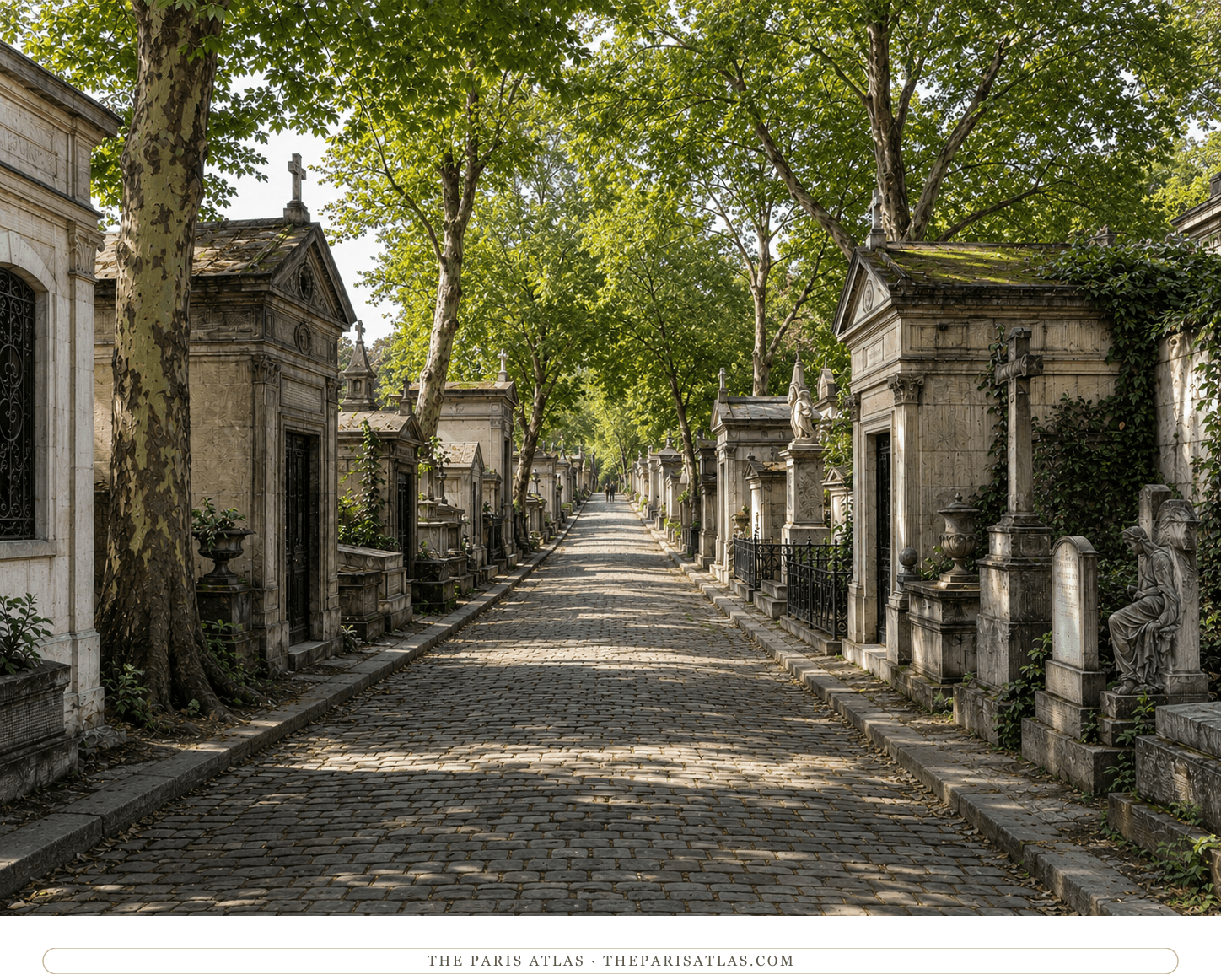
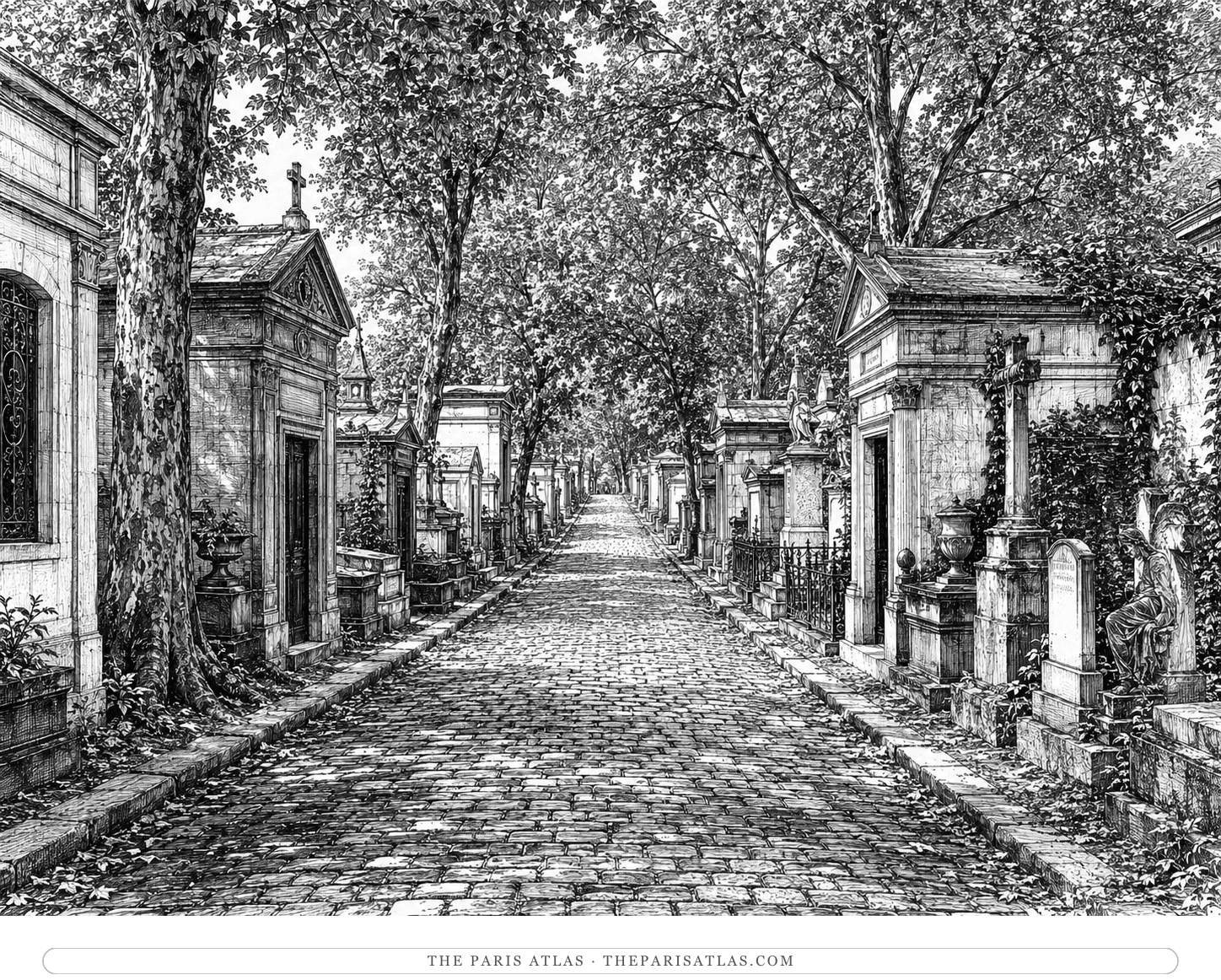
She died at Plascassier, near Grasse, on 10 October 1963, at forty-seven, after years of hepatic illness — the accounts differ on the final medical event. Her body was driven through the night to her apartment at 67 boulevard Lannes so that the death could be announced, on 11 October, as having happened in Paris: the woman whose legend said she was born in a Paris street was returned to the city so it could claim her final moment too. The Church, citing her life, refused a funeral Mass; an enormous crowd followed her to Père-Lachaise anyway, where she lies in division 97 with her daughter. Jean Cocteau died the day her death was announced — already ill, whatever the legend says about a broken heart.

Life events

  1. 1915

    Born Édith Giovanna Gassion on 19 December at the Hôpital Tenon in the 20e — not, as the legend insists, under a streetlamp at 72 rue de Belleville.

    Paris.fr — Une balade sur les pas d'Édith Piaf

  2. 1918–1929

    A childhood in pieces: her grandmother's brothel in Bernay, the legend of the cured blindness, then years on the road as part of her father's acrobatic act.

    Encyclopaedia Britannica — Édith Piaf

  3. 1933–1935

    Singing the streets of Paris on her own account. Her daughter Marcelle, born in February 1933 when Piaf was seventeen, dies of meningitis in July 1935.

    Encyclopaedia Britannica — Édith Piaf

  4. 1935

    Louis Leplée hears her at the corner of the rue Troyon and puts her on stage at Le Gerny's as La Môme Piaf — the little sparrow, in the plain black dress. First records by year's end.

    Paris.fr — Une balade sur les pas d'Édith Piaf

  5. 1936

    Leplée is murdered on 6 April. Questioned by police and savaged by the press, she is rebuilt by the lyricist Raymond Asso, who writes Mon légionnaire and retrains everything.

    Piaf singing Mon légionnaire at the Lune Rousse revue, drawn by Pierre Payen, 1938 — the chanson réaliste star two years out of the street. (Pierre Payen, Bibliothèque nationale de France)

    Encyclopaedia Britannica — Édith Piaf

  6. 1937

    The ABC music hall on the boulevard Poissonnière, March: the decisive Paris breakthrough. La Môme becomes Édith Piaf.

    Encyclopaedia Britannica — Édith Piaf

  7. 1940

    Jean Cocteau writes Le Bel Indifférent for her; she plays it opposite Paul Meurisse, and films Montmartre-sur-Seine with him the next year.

    BnF Chroniques no. 73 — Cocteau writes Le Bel Indifférent for Piaf

  8. 1944–1945

    Headlining the Moulin Rouge with Yves Montand opening — protégé and lover. In 1945 she writes the words to La Vie en rose and signs with Louis Barrier, her manager for the rest of her life.

    The 1945 contract with Louis Barrier, the manager of the rest of her life — signed in the year she wrote La Vie en rose. (Succession Louis Barrier (CC0))

    Encyclopaedia Britannica — Édith Piaf

  9. 1946

    La Vie en rose is first heard; Les Trois Cloches, with Les Compagnons de la chanson, becomes a phenomenon. Studio Harcourt makes the portraits.

    Édith Piaf by Studio Harcourt, 1946 — the year La Vie en rose was first heard, in the portrait style reserved for French stars. (Studio Harcourt)

    Encyclopaedia Britannica — Édith Piaf

  10. 1947–1948

    The first American campaign, touring with Les Compagnons de la chanson — puzzlement, then devotion, and a residency at the Versailles in New York. The affair with Marcel Cerdan, world middleweight champion, begins.

    With Les Compagnons de la chanson, Studio Harcourt, 1946 — the vocal group she championed and carried to America; together they made Les Trois Cloches a phenomenon. (Studio Harcourt)

    Encyclopaedia Britannica — Édith Piaf

  11. 1949

    She performs Hymne à l'amour, written during the affair to Marguerite Monnot's music. On 28 October Cerdan's flight to New York crashes in the Azores; told before curtain, she sings that night for him.

    BnF catalogue — Hymne à l'amour (work record); Encyclopaedia Britannica — Marcel Cerdan

  12. 1952

    Marries the singer Jacques Pills, with Marlene Dietrich standing witness; they divorce in 1956.

    With Marlene Dietrich, 1959 — the friend who had stood witness at her 1952 wedding, two of the century's voices in one frame. (Arquivo Nacional (Brazil))

    Encyclopaedia Britannica — Édith Piaf

  13. 1956–1957

    Carnegie Hall, twice — the plain black dress conquering the room that had once been puzzled by it — amid eight appearances on The Ed Sullivan Show across the fifties.

    Encyclopaedia Britannica — Édith Piaf

  14. 1959

    Milord — words by her protégé Georges Moustaki, music by Monnot — becomes a late international hit as the crashes, operations, and dependencies accumulate.

    BnF catalogue — Milord (score record)

  15. 1960–1961

    Charles Dumont and Michel Vaucaire bring her Non, je ne regrette rien. The Olympia comeback that follows, sung when she could barely stand, becomes music-hall legend.

    On stage in the Netherlands, December 1962 — the plain black dress, the hands, the voice larger than its source. (Eric Koch / Anefo, Nationaal Archief (CC0))

    INA — Édith Piaf, Non, je ne regrette rien (January 1961 broadcast)

  16. 1962

    Marries Théo Sarapo, the young singer she pushed onto the stage; they record À quoi ça sert l'amour together and tour to the end.

    With Théo Sarapo, the young singer she married in October 1962 — together on the Dutch tour that winter. (Eric Koch / Anefo, Nationaal Archief (CC0))

    Encyclopaedia Britannica — Édith Piaf

  17. 1963

    Dies at Plascassier on 10 October, at forty-seven; her body is returned overnight to 67 boulevard Lannes so Paris can announce the death as its own. Refused a funeral Mass, she is followed to Père-Lachaise by an enormous crowd.

    The Gassion-Piaf grave at Père-Lachaise, division 97 — rarely without flowers since October 1963. (Olivier Bruchez, Wikimedia Commons)

    Encyclopaedia Britannica — Édith Piaf

Selected works

Cataloged from the holding institutions' records. Reproductions appear only where the rights are verified.

Music

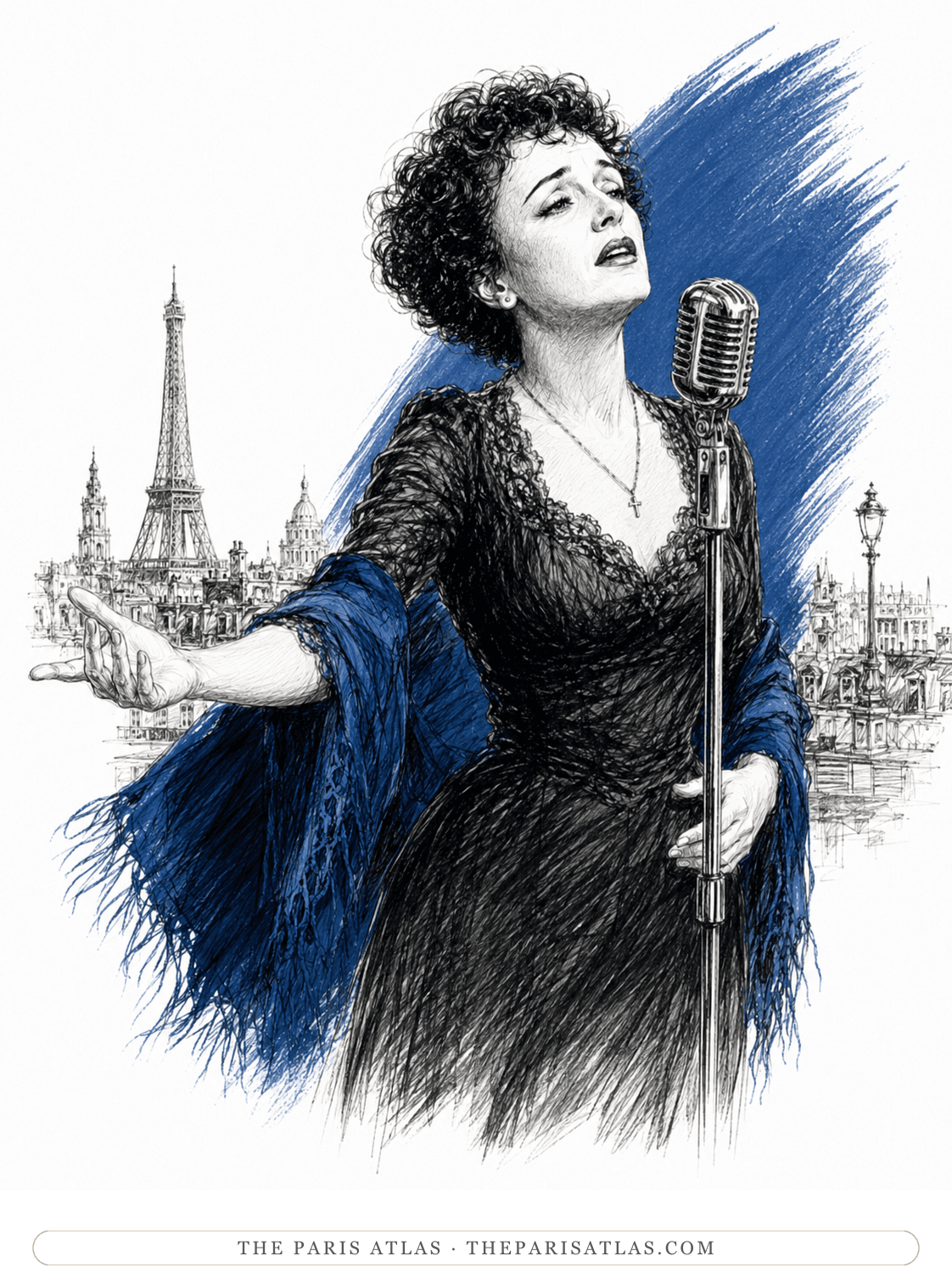
Édith Piaf singing with one arm outstretched at a vintage microphone against a blue wash, the Paris skyline behind her

Editorial illustration

Song

Hymne à l'amour

written 1949 · first released 1950 · Chanson

A promise of love made on the scale of apocalypse, written during her affair with the boxer Marcel Cerdan to Marguerite Monnot's steadily rising music. When Cerdan's flight went down in the Azores in October 1949, the song's extravagant vows became an elegy — and in 2024 Céline Dion returned it to the Paris skyline from the Eiffel Tower at the Olympic opening ceremony.

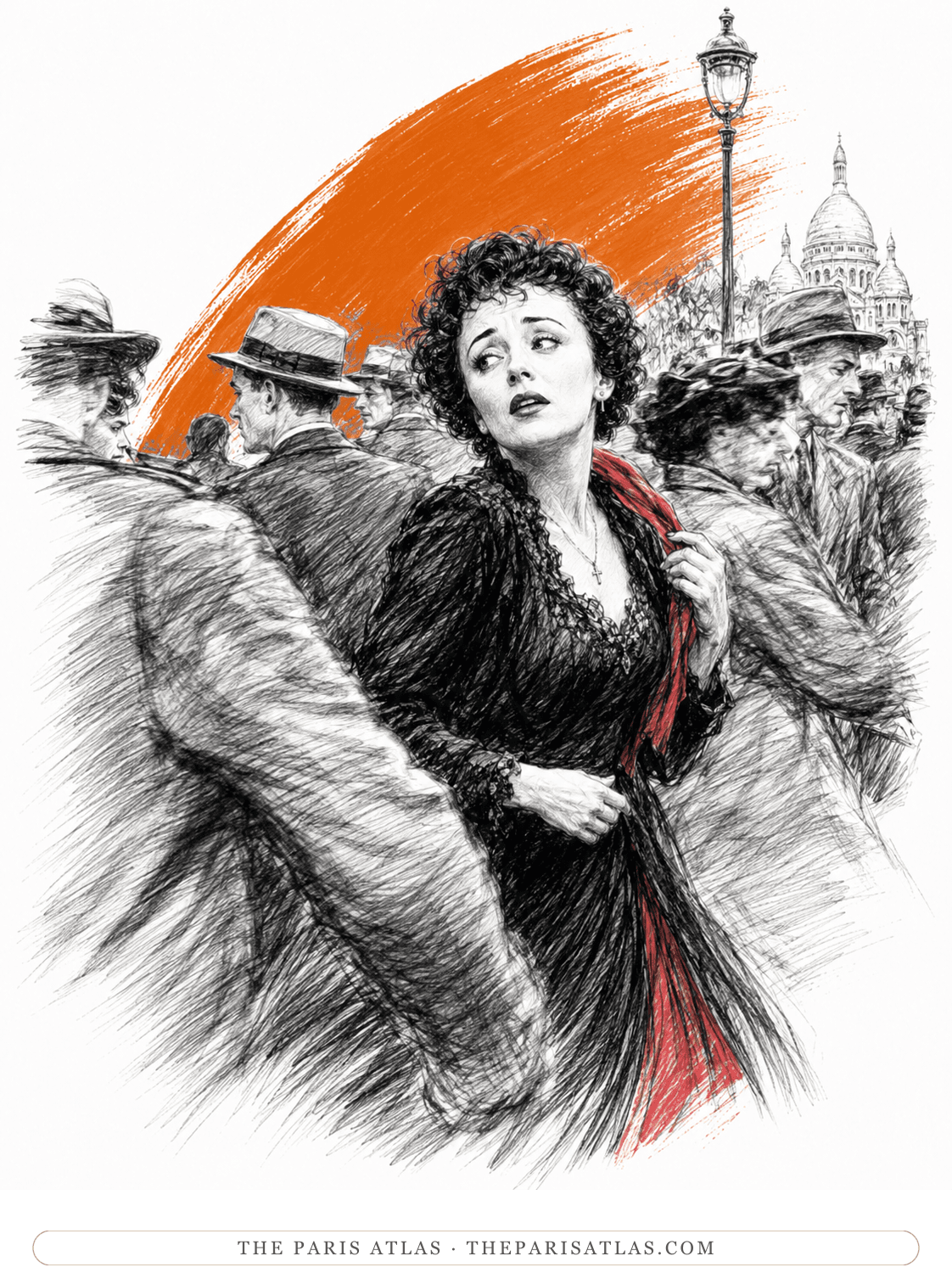
Édith Piaf pressed through a dense crowd of hatted figures, a red scarf at her throat, against an orange wash with the dome of Sacré-Cœur behind

Editorial illustration

Song

La Foule

1957 · Chanson

A crowd carries two strangers together and tears them apart again — a miniature film about chance and disappearance in a packed square. Piaf heard the South American waltz on tour; Michel Rivgauche's new words turned it French, and the whirling accompaniment became one of her most breathless recordings: Paris connected to Lima and Buenos Aires in three minutes.

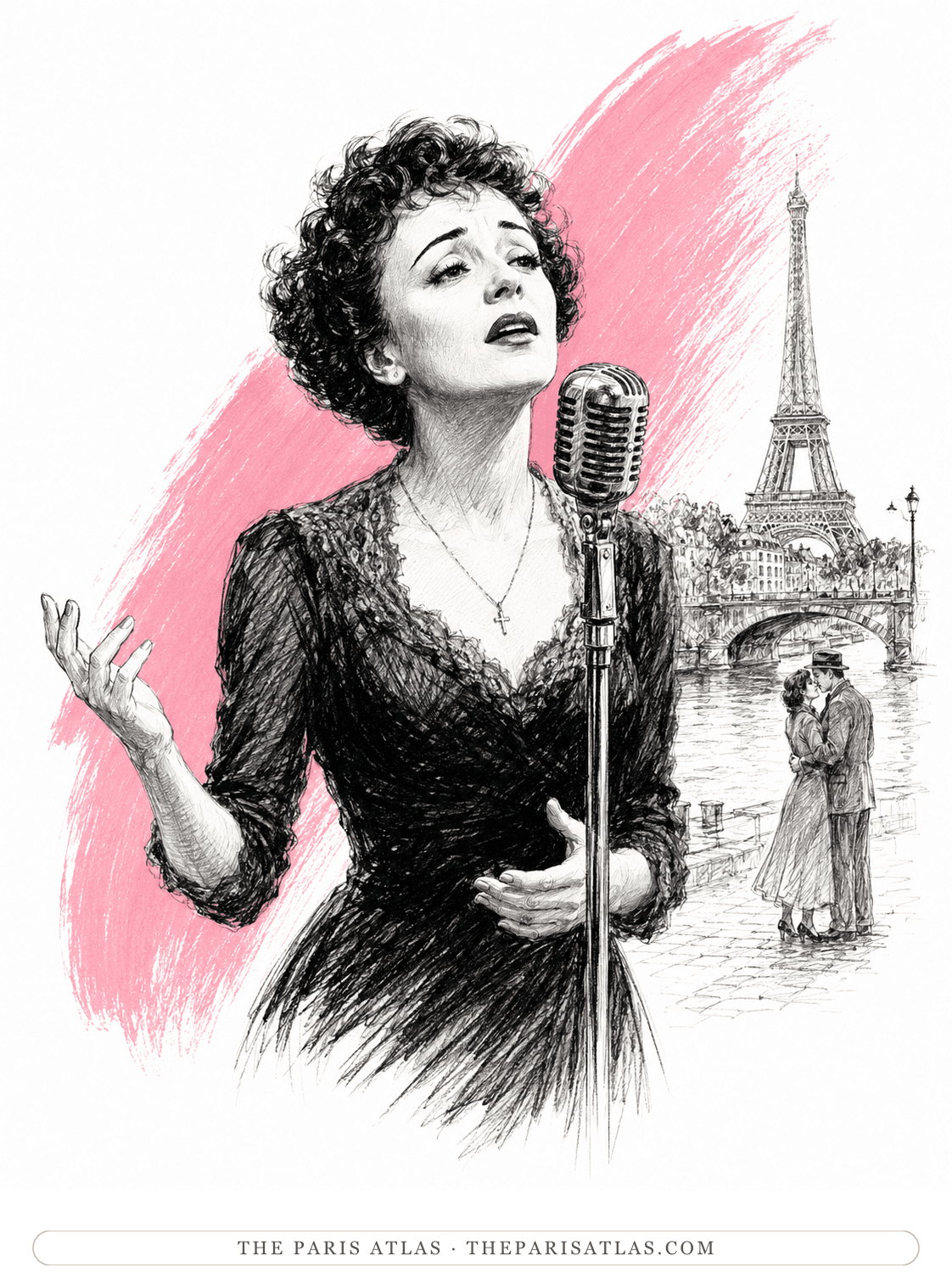
Édith Piaf singing at a vintage microphone in a black lace dress against a pink wash, the Eiffel Tower and a couple embracing on a bridge behind her

Editorial illustration

Song

La Vie en rose

written 1945, first recorded 1946 · Chanson

Piaf's own lyric, written in 1945: love as a change in perception — the beloved does not repair the world, only alters its color. Carried abroad on her postwar tours, it became the international shorthand for Paris and the possibility of happiness after catastrophe.

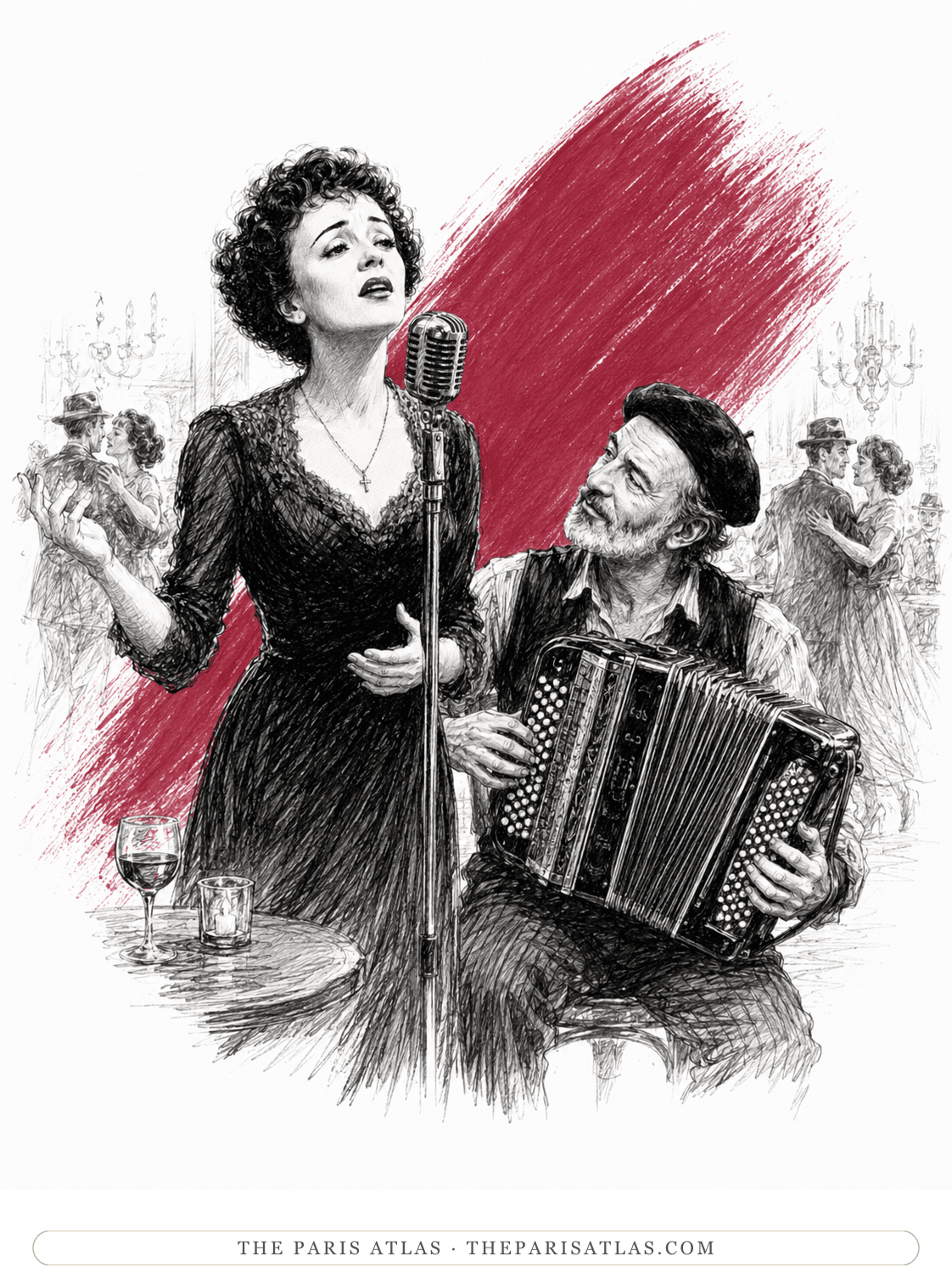
Édith Piaf singing beside a seated accordionist in a beret against a red wash, couples dancing in the hall behind them

Editorial illustration

Song

L'Accordéoniste

1940 · Chanson

A street girl loves an accordionist who goes away to the war; when he does not come back, the dance music that once meant happiness becomes unbearable. Michel Emer wrote both words and music, and Piaf compressed an entire ruined life into the sound of the instrument — the defining drama of wartime chanson, and the tradition she came from at full strength.

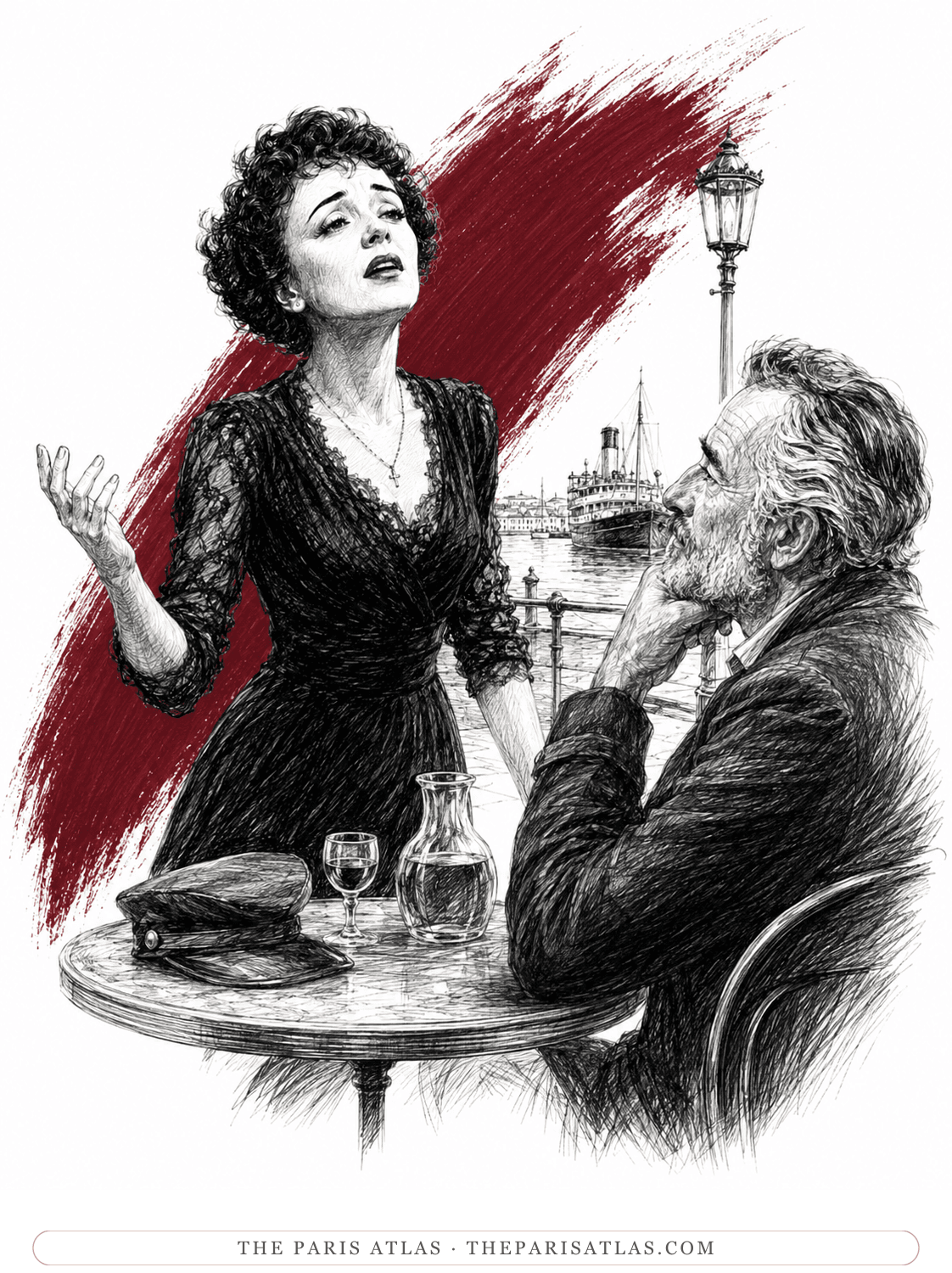
Édith Piaf singing to a weary bearded man seated at a harbor café table against a red wash, a steamship moored at the quay behind them

Editorial illustration

Song

Milord

1959 · Chanson

A harbor woman consoles an English gentleman whose respectable world has failed him — observer, then comforter, finally commanding the stranger back to his feet. Moustaki's words and Monnot's music returned Piaf to the streetwise tradition of her beginnings and gave her one of her biggest international hits.

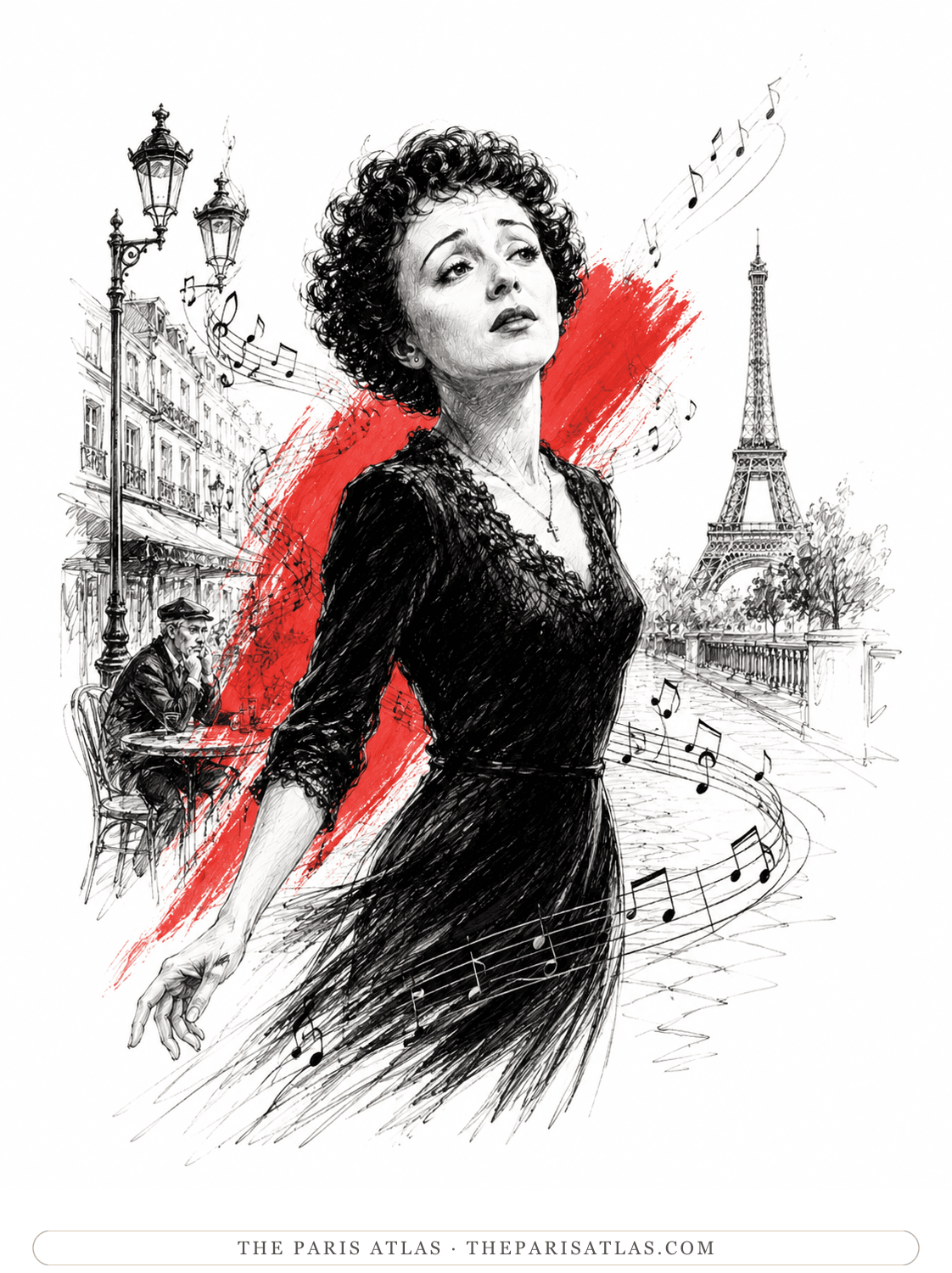
Édith Piaf striding forward in a black dress against a red wash, musical notes swirling around her with a Paris café and the Eiffel Tower behind

Editorial illustration

Song

Non, je ne regrette rien

composed 1956 · recorded 1960 · Chanson

The song that converted Piaf's past into a final act of defiance: no regrets, the good and the bad alike swept out, life beginning again. Dumont and Vaucaire brought it to her when career and health looked finished; it powered her last great Olympia seasons, and its later cinematic life — Inception included — keeps handing it to new audiences.

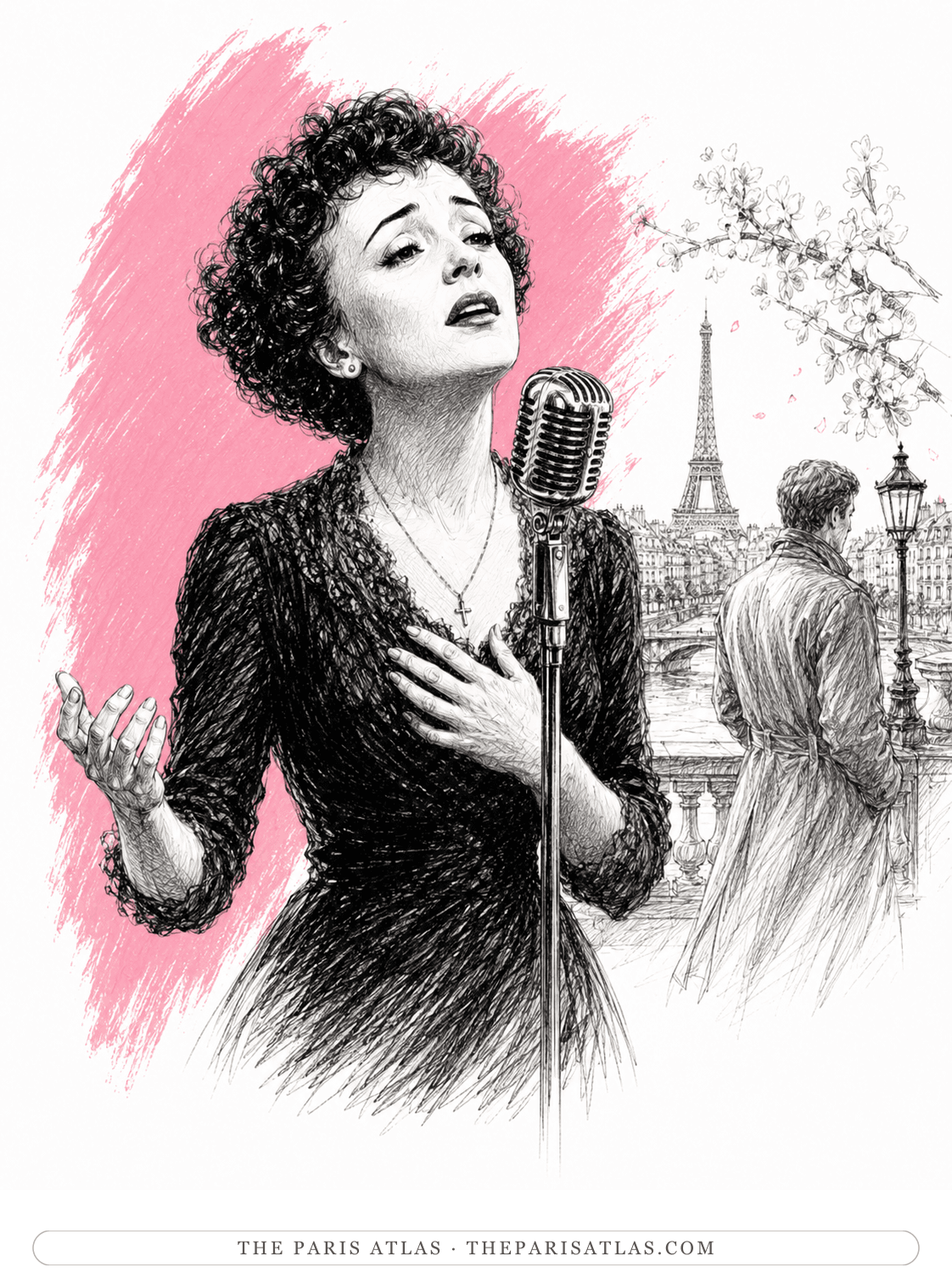
Édith Piaf singing at a microphone in a black dress against a pink wash, cherry blossoms and the Eiffel Tower to one side and a man walking away

Editorial illustration

Song

Padam, padam…

1951 · Chanson

Memory as a tune that will not stop following the singer through the streets — every corner of Paris replaying the same three beats of an old love. Glanzberg's waltz and Contet's words gave Piaf her great song about the city as an echo chamber of the heart.

In the credits

Works in our catalog that credit Édith.

People they knew

Documented connections — every one carries its source.

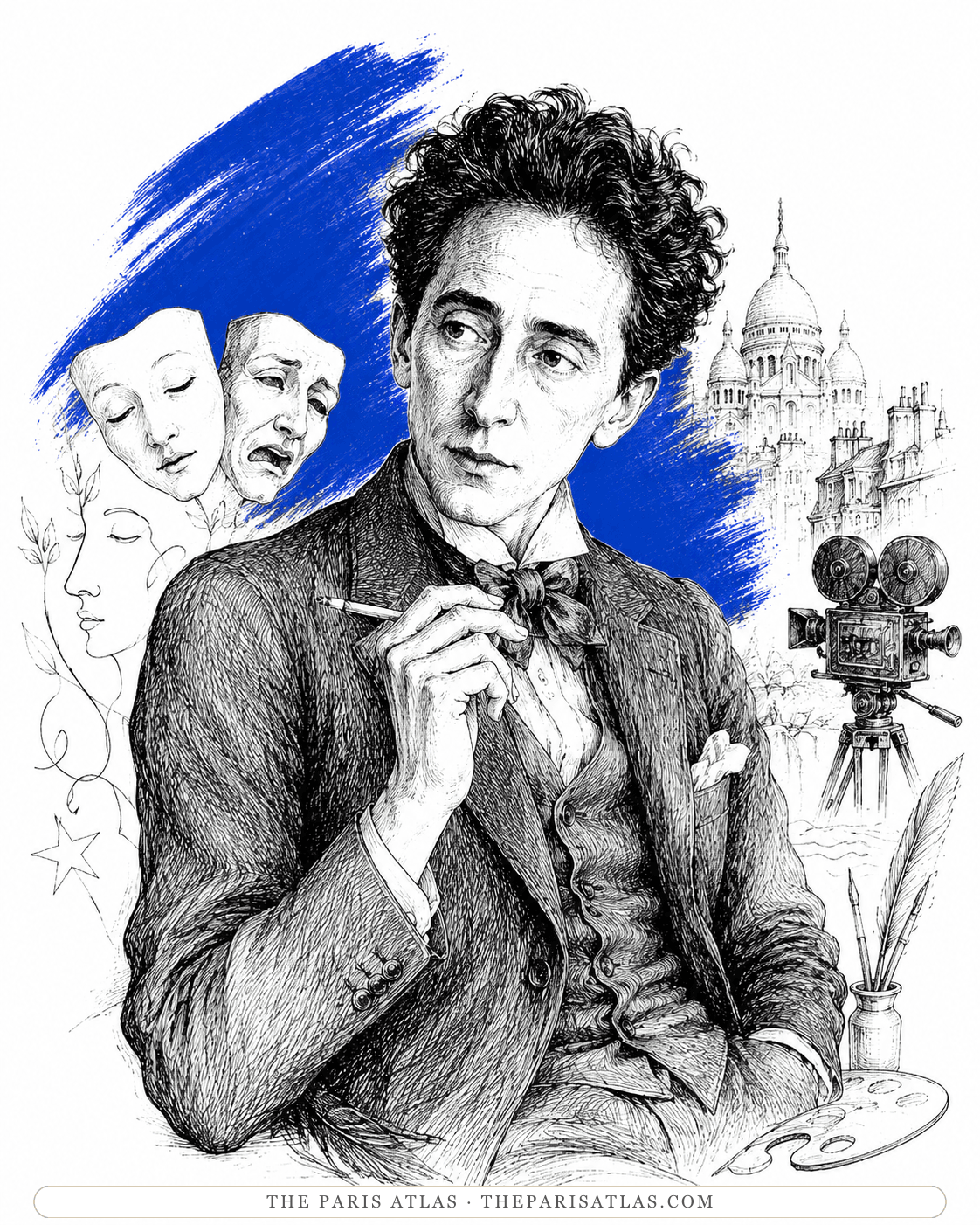
Illustrated portrait of Jean Cocteau

Jean Cocteau

  • Poet
  • Playwright
  • Illustrator
  • +1

Met · 1940

They met in February 1940, and within months Cocteau had written Le Bel Indifférent for her — the avant-garde's theater built around a street singer's voice. He died the day after she did, in October 1963.

BnF Chroniques no. 73 — Cocteau writes Le Bel Indifférent for Piaf

Illustrated portrait of Marlene Dietrich

Marlene Dietrich

  • Actor
  • Singer

Met · 1948

Close friends from Piaf's first American years — Dietrich stood witness at her 1952 wedding to Jacques Pills, and the two were photographed together across a decade of tours.

Encyclopaedia Britannica — Édith Piaf

Illustrated portrait of Marcel Cerdan

Marcel Cerdan

  • Boxer

Met · 1948–1949

The defining relationship of both lives — the singer and the world middleweight champion, an affair conducted across two continents from 1948 until his death aboard the Paris–New York flight in October 1949. She wrote Hymne à l'amour during it.

Encyclopaedia Britannica — Édith Piaf; Encyclopaedia Britannica — Marcel Cerdan

Édith Piaf’s Places

The cataloged places connected to Édith Piaf — through the books, and through the documented record.

Places you can enter today appear first, followed by addresses to see from outside and sites that have vanished.

Questions about Édith Piaf

Who was Édith Piaf?

A French singer (1915–1963), one of the most celebrated of the twentieth century — a Paris street singer remade into an international star, who carried the city's loves and losses into every song.

What is Édith Piaf best known for?

Her songs — La Vie en rose (1945), Hymne à l'amour, and Non, je ne regrette rien (1960) — and the voice that made them. La Vie en rose remains the song she is most identified with.

Who was Marcel Cerdan?

The world middleweight boxing champion and the love of Piaf's life. Their affair ran from 1948 until his death in a plane crash in October 1949; she wrote Hymne à l'amour during it.

How was Piaf connected to Jean Cocteau?

They met in February 1940, and within months Cocteau had written the one-woman play Le Bel Indifférent for her. He died the day after she did, in October 1963.

Where is Édith Piaf buried?

In the Gassion family grave at Père-Lachaise Cemetery, in division 97, in the east-end quarter of Paris that raised her. It remains one of the most visited graves in the cemetery.

Sourced claims

Every connection the graph holds for Édith, with the evidence behind it.

Met · 1940

Jean Cocteau

They met in February 1940, and within months Cocteau had written Le Bel Indifférent for her — the avant-garde's theater built around a street singer's voice. He died the day after she did, in October 1963.

BnF Chroniques no. 73 — Cocteau writes Le Bel Indifférent for Piaf

Met · 1948

Marlene Dietrich

Close friends from Piaf's first American years — Dietrich stood witness at her 1952 wedding to Jacques Pills, and the two were photographed together across a decade of tours.

Encyclopaedia Britannica — Édith Piaf

Met · 1948–1949

Marcel Cerdan

The defining relationship of both lives — the singer and the world middleweight champion, an affair conducted across two continents from 1948 until his death aboard the Paris–New York flight in October 1949. She wrote Hymne à l'amour during it.

Encyclopaedia Britannica — Édith Piaf; Encyclopaedia Britannica — Marcel Cerdan

Buried at · 1963

Père-Lachaise Cemetery

Buried in the Gassion family grave in division 97, in the east-end quarter of Paris that raised her — still one of the most visited graves in the cemetery.

Encyclopaedia Britannica — Père-Lachaise Cemetery; Paris Discovery Guide — 101 Famous Graves in Père Lachaise Cemetery

Performed at

Pigalle

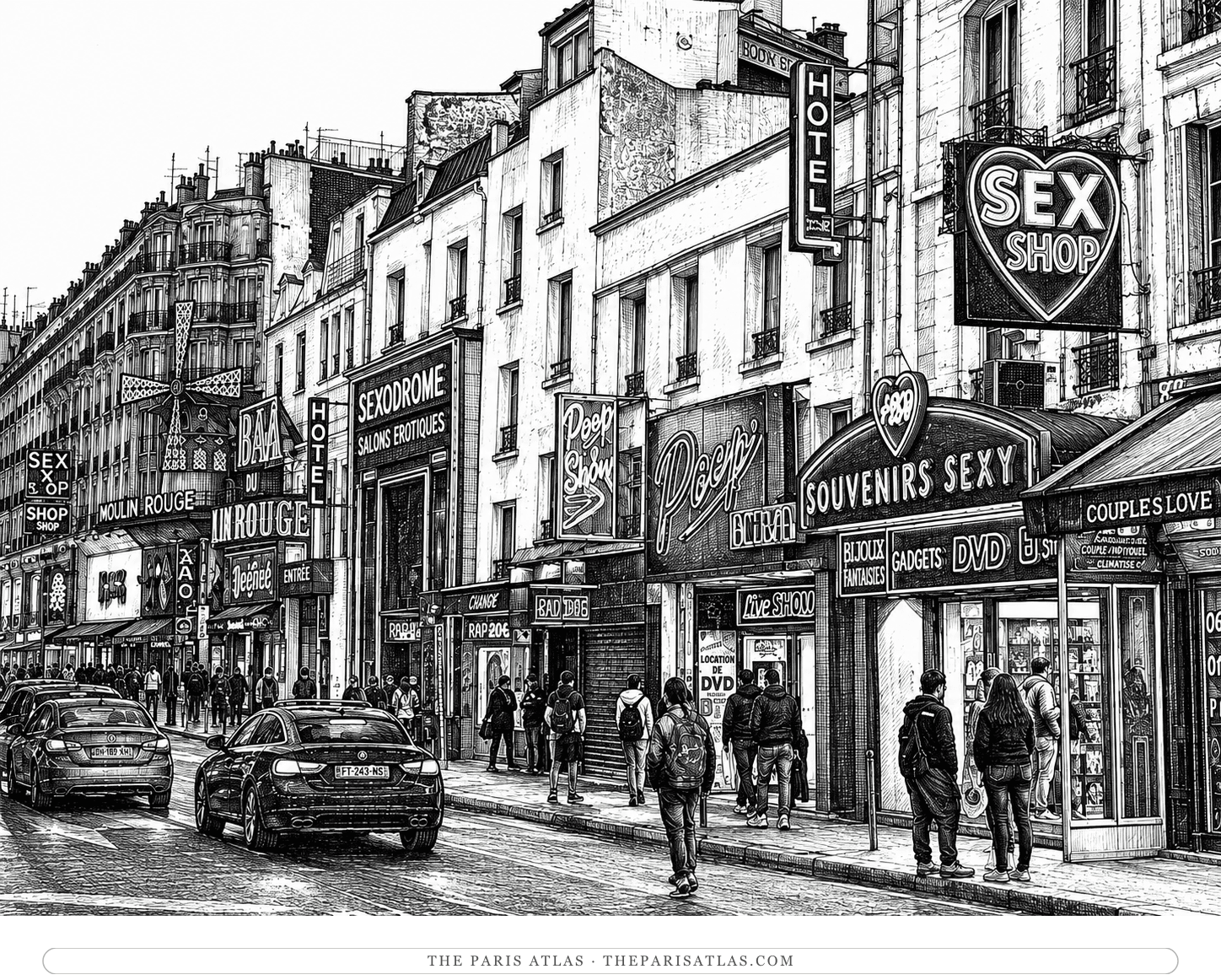
Piaf was singing for coins on these streets when the cabaret owner Louis Leplée heard her in 1935 and put her on a stage. He gave her the name she recorded under for the rest of her life: la Môme Piaf, the little sparrow.

Encyclopaedia Britannica — Édith Piaf