
L'Accordéoniste
by Édith Piaf
A street girl loves an accordionist who goes away to the war; when he does not come back, the dance music that once meant happiness becomes unbearable. Michel Emer wrote both words and music, and Piaf compressed an entire ruined life into the sound of the instrument — the defining drama of wartime chanson, and the tradition she came from at full strength.
- 1940
- Chanson
About Édith Piaf

What 'L'Accordéoniste' means
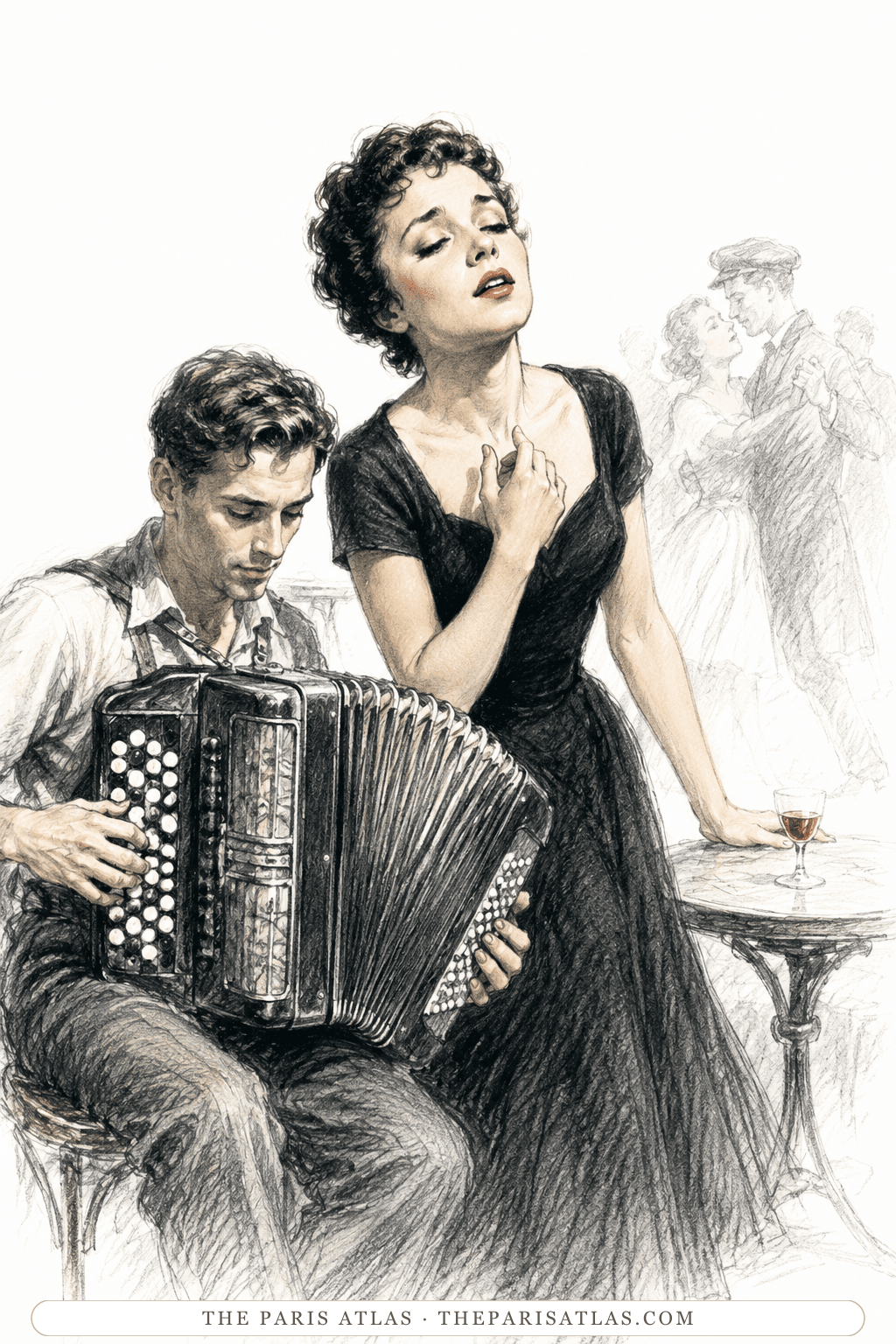
A street girl finds happiness at a neighborhood dance hall: her lover is the accordionist, and while he plays the java she imagines a modest future beyond her circumstances. The instrument stands for the man and the life at once. Then war interrupts — he leaves as a soldier and does not come back — and the music changes meaning. What once carried love now reproduces its absence: hearing another accordionist play the familiar dance collapses memory and reality into each other until she cannot bear the distinction.
The tragedy is intensified by the song's economy — a dance, a departure, an empty place; no long courtship, no battlefield. Piaf's performance moves from narration into possession: by the end she seems trapped inside the remembered rhythm herself.
Michel Emer and the beginning of wartime Piaf
Michel Emer wrote both words and music in 1940, at the start of the German invasion — the beginning of one of Piaf's most important writing partnerships, and a song whose simple story absorbed the fear and bereavement of its first audiences. The accordion was already the sound of popular Paris — the bal-musette, the working-class dance halls, the neighborhoods of her own beginnings — and the song used that instantly recognizable sound while stripping it of easy nostalgia: music preserves happiness, and the preservation becomes a torment.
It stayed in her repertoire for the rest of her life. In the late performances, the distance between the international star and the street singer she had been made it more affecting still — she had escaped the world of the song, and kept returning to it, holding the anonymous woman and her missing musician inside the public memory of Paris.
Timeline
1940
Michel Emer wrote both words and music and brought the song to Piaf, shortly before he was called up for the war.
1940
Piaf recorded it as the war began; it became a defining drama of wartime chanson.
Frequently asked questions
What is “L'Accordéoniste” about?
A street girl loves an accordionist who goes off to the war. When he does not come back, the dance music that once meant happiness becomes unbearable.
Who wrote it?
Michel Emer wrote both the words and the music.
When was it recorded?
In 1940, as the war began.
What is the story behind it?
Emer brought the song to Piaf shortly before he was mobilized. She took it up and made it a hit.
Why does it matter in Piaf's career?
It is the defining drama of wartime chanson, and the tradition she came from shown at full strength.
What does the accordion mean in the song?
It carries the whole story — the instrument that once meant happiness becomes the sound of loss.
More by Édith Piaf

If you like Édith Piaf
Explore musicians from the same movements and circles.
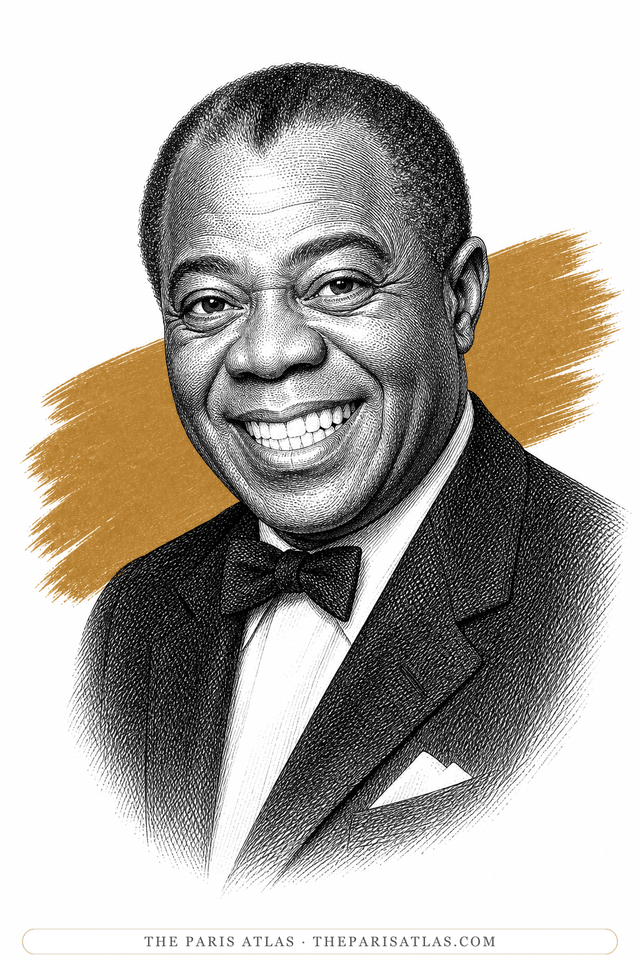
Louis Armstrong
The New Orleans trumpeter and singer who turned jazz from a band music into a soloist's art, and whose voice became one of the most recognisable sounds of the twentieth century. Paris took him early: he spent the autumn of 1934 living in the city, made his only French records that November, played the Salle Pleyel, the city's principal concert hall, and kept coming back for thirty years — including for the 1961 film Paris Blues, shot in the streets he had once idled in.
View artist
Josephine Baker
American-born French dancer and singer who conquered Paris at nineteen in La Revue Nègre, and who traded expatriate stories at James Baldwin's Saint-Paul-de-Vence table nearly fifty years later.
View artist
Harry Belafonte
American singer and actor; a civil-rights ally of James Baldwin who sat in the room when Baldwin's delegation confronted Robert Kennedy in May 1963.
View artist
References
The sources below include collection records, catalogues, scholarly research, and primary materials that informed this page. They document L'Accordéoniste, its making, and its place in cultural history.


1Encyclopaedia Britannica — Édith Piaf
WebsiteUsed forWeb source consulted for documented facts and historical context presented on the L'Accordéoniste page.

2Édith Piaf — L'Accordéoniste
ArchiveInstitut national de l'audiovisuelUsed forArchival evidence used to document the historical record connected to L'Accordéoniste.
3L'Accordéoniste — Enregistrement de 1940
Official recordBibliothèque nationale de France, 1940Used forOfficial record used to verify names, dates, institutional details, or other factual information on this page.
4Édith Piaf — L'Intégrale, 1936–1963
Official recordBibliothèque nationale de FranceUsed forOfficial record used to verify names, dates, institutional details, or other factual information on this page.
These references provide the documented foundation for this work's history and interpretation. Claim-level citations remain attached to the specific claims they support.
 Explore more resources