ArcelorMittal Orbit
by Anish Kapoor
A looping lattice of tubular steel 114.5 metres tall, standing on three legs in the Queen Elizabeth Olympic Park in east London. Anish Kapoor designed it with the engineer Cecil Balmond for the London 2012 Olympic and Paralympic Games, and it is the tallest sculpture in Britain. A staircase of 455 steps winds through it to two viewing platforms. The steel was given by the company whose name it carries.
- 2010–2012
- Tubular steel lattice, sixty per cent recycled, on a three-point base
- Queen Elizabeth Olympic Park, London Legacy Development CorporationLondon, United Kingdom
About Anish Kapoor
What the structure is
The Orbit is a tower that does not look like one. Its own official account describes it as a looping lattice of tubular steel 114.5 metres tall. Instead of tapering upwards from a wide base, the loops wind around and across each other and touch the ground at three points.
Inside it is a building. A spiral staircase 1,150 feet long with 455 steps runs up through the lattice, and there are two viewing platforms near the top, reached by lift as well as on foot.
The steel is partly scrap. The official account of its material states that sixty per cent of the structure is made from recycled steel and the rest from virgin steel, produced at ArcelorMittal's plant at Esch-Belval in Luxembourg.
The artist's own listing rounds the figures. It gives the title simply as Orbit, the year as 2012, the material as steel and the height as 115 metres, against the 114.5 metres the commissioning body states.
A conversation in a cloakroom
The commission began by accident. The official history records that in January 2009 the Mayor of London, Boris Johnson, met Lakshmi Mittal, chairman and chief executive of the steel company ArcelorMittal, by chance in a cloakroom at the World Economic Forum at Davos.
The Mayor described his wish for a landmark to mark the London 2012 Games. Lakshmi Mittal offered to donate the steel, and the account states that the plan was agreed in that 45-second conversation.
A competition followed in January 2010. The Mayor's office assembled an advisory panel from the London art world to draw up a list of artists, architects, designers and engineers, looking for an iconic, artistic object that the public could interact with. A joint entry from Anish Kapoor and Cecil Balmond won.
How Anish Kapoor and Cecil Balmond designed it
The brief was aggressive. When the Mayor's office invited Anish Kapoor and Cecil Balmond to enter, the official history records, it said it was looking for an icon to match the Eiffel Tower. The two men had collaborated before. The account names the Tower of Babel as a partial inspiration: a seemingly impossible structure reaching up beyond the clouds.
They set out to break the usual form. Towers are traditionally built as pyramids, and Cecil Balmond described wanting the opposite: we wanted to see if we could create a structure that seemed unstable, seemed to be propping itself up. He described slowly evolving a form that seems to be teetering, weaving itself, a loop.
The instability had to be a trick. Cecil Balmond recorded the moment the geometry resolved it. An orbit turning around itself and making contact with itself as it passed its own trace would give strength, he said, and three points touching the ground as a tripod, which is very stable. He added that he had the intuition it would work.
He also wanted the engineering to disappear. The account quotes his hope that visitors would forget about the engineering and simply experience the structure.
600 nodes, and four men on the site
The parts were made in Bolton. The official history records that 600 star-like nodes of steel were precision-built by a team of 100 staff at Watson Steel Structures in northern England, using computer and laser technology to accuracies of within one to two millimetres.
That precision was not optional. Because every line of the sculpture is curved and the whole thing is asymmetrical, the account states, it would not be possible to make adjustments once construction started on site.
The site team was tiny. Each piece was carried by lorry from Bolton to the Olympic Park and bolted into place by four men: the steel erectors Kirk Bibly and Andrew Canning, the crane operator Mark Stowers and the site foreman Matthew Collier. Every piece of the 114.5-metre structure was lifted and bolted without scaffolding, which the project's chief engineer Pierre Engel recorded as the first time a building of that height had been assembled that way.
Construction ran a year. A ground-breaking ceremony was held in November 2010 with Boris Johnson, Lakshmi Mittal, Anish Kapoor and Andrew Altman of the London Legacy Development Corporation. The final piece was bolted in during November 2011, and the fitting-out team handed the structure over in the spring of 2012.
The hostile reception
The design was disliked loudly and in public. British newspapers greeted the unveiling in March 2010 with mockery, one of them calling it a giant squiggle and another reporting the Mayor's ambitions under the label of a Piffle Tower.
The sponsor was attacked as well as the shape. The Guardian ran a piece arguing that the emissions of the steel company paying for it made a monumental joke of a tower in an Olympic park, and other commentary asked whether the work was public art or public posturing.
Money kept the argument alive. The Guardian reported in October 2015 that the Orbit was costing the taxpayer £10,000 a week, three years after the Games it was built for.
The official line never wavered. At the design launch at City Hall, Boris Johnson said the work would truly encapsulate the energy and spirit of London during the Games and become the perfect iconic cultural legacy.
What was added later
The tower did not draw the visitors it needed. Permission was given in 2015 to add a slide, and a tunnel slide by the artist Carsten Höller opened in 2016, wrapping around the outside of the lattice and billed as the world's longest and tallest of its kind.
The addition changed how the object looks. A photograph taken after 2016 shows a bright metal tube spiralling down through the red steel, which is not part of the work Anish Kapoor and Cecil Balmond completed in 2012.
The structure also appeared on a British passport. It was among the designs chosen for the document issued from 2015.
Close reading
Reading the work, detail by detail
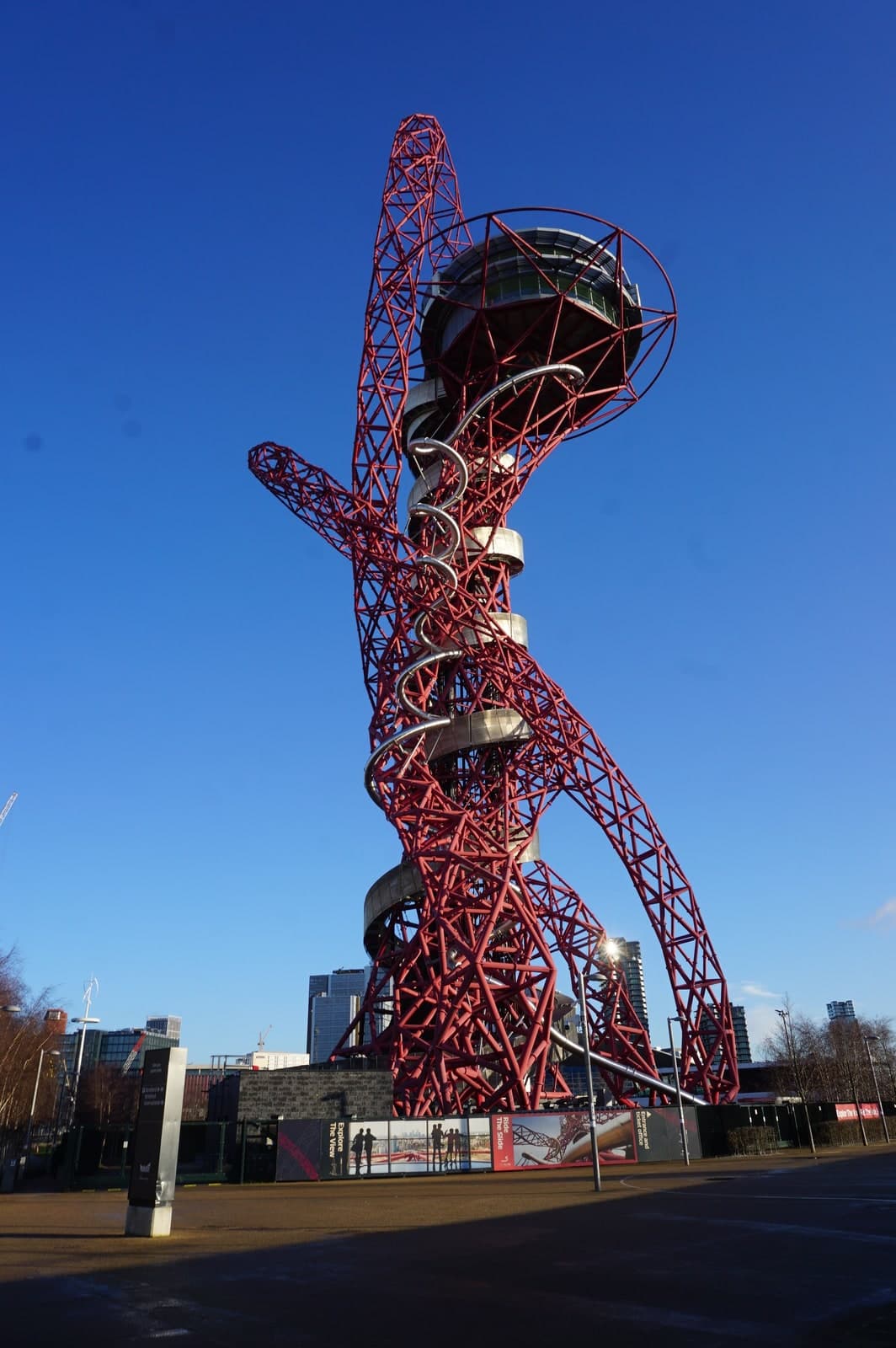
The photograph is taken from the paved forecourt at the foot of the tower, looking steeply up, in low winter sun under a cloudless sky. The whole structure is in frame. It was taken in January 2020, so it includes the tunnel slide added in 2016 by Carsten Höller, which is not part of the work Anish Kapoor and Cecil Balmond completed in 2012.
1.A loop rises above the summit
A tall narrow loop of red lattice stands above everything else, closing on itself against an empty sky. The structure does not taper to a point the way a tower normally does. This is the top of the form Cecil Balmond described as weaving itself, a loop, rather than a pyramid.
2.The viewing platform is a glazed drum
Near the summit a grey glazed drum sits within the steelwork, ringed by a red hoop that passes outside it. This is the viewing level reached by the 455-step staircase and by lift. The glazing is the only large flat surface in the whole structure; everything else is tube.
3.A silver tube that is a later addition
A bright silver tube coils down the outside of the tower, crossing in front of the red members and behind them in turn. It is the tunnel slide that opened in 2016, designed by Carsten Höller, added to draw visitors. A photograph of the Orbit taken before that year shows the red structure without it.
4.The lattice is tube meeting tube
Close to, the structure resolves into tubes running at many different angles and meeting at joints. The official account records 600 star-like nodes precision-built at Watson Steel Structures in Bolton to accuracies of one to two millimetres, because no adjustment was possible once assembly began. The photograph shows the density; it does not resolve individual nodes.
5.An arm swings clear of the tower
On the left a red arm curves out into open air, away from the mass of the structure, and returns lower down. Nothing supports it along its length. This is the part of the geometry that makes the tower look as though it should fall, which Cecil Balmond said was deliberate: a structure that seemed unstable, seemed to be propping itself up.
6.A leg comes down to the ground
On the right a heavy red member curves down and runs to the ground. Cecil Balmond's account describes three points touching the ground as a tripod, which is very stable, and the loop gaining its strength by making contact with itself as it passes its own trace. The plate shows this one leg clearly and the others only in part.
7.The base is a ticketed attraction
Hoardings run across the foot of the structure carrying photographs of visitors and the phrases Explore The View and Ride The Slide. The base is an entrance and a ticket point, not an open plinth. The Guardian reported in 2015 that the tower was costing the taxpayer £10,000 a week, which is the pressure the slide was added to answer.
8.Low sun, and an empty forecourt
The forecourt is empty and the sun is low enough to rake across it and throw long shadows. Bare trees, a lamp standard and a construction crane stand at the edges, with tower blocks behind. The date on the file is 28 January 2020, and the light and the leafless trees agree with it.
Timeline
2009
Boris Johnson meets Lakshmi Mittal by chance in a cloakroom at the World Economic Forum in Davos in January; Mittal offers to donate the steel in a 45-second conversation.
2010
The Mayor of London's office runs a competition in January; a joint entry from Anish Kapoor and Cecil Balmond wins.
2010
The design is shown publicly at a City Hall press conference in March and is widely mocked in the British press.
2010
A ground-breaking ceremony is held in November with Boris Johnson, Lakshmi Mittal, Anish Kapoor and Andrew Altman of the London Legacy Development Corporation.
2011
600 star-like steel nodes are built by 100 staff at Watson Steel Structures in Bolton to accuracies of one to two millimetres, and assembled on site by a team of four without scaffolding.
2011
The final piece is bolted into place in November, completing the United Kingdom's tallest sculpture at 114.5 metres.
2012
The structure is handed over to the London Legacy Development Corporation in the spring and opens to ticket holders during the Games.
2015
Permission is given for a slide; The Guardian reports in October that the tower is costing the taxpayer £10,000 a week.
2016
A tunnel slide designed by Carsten Höller opens, wrapping around the outside of the lattice.
Where to see it
Queen Elizabeth Olympic Park, London Legacy Development Corporation
London, United Kingdom
A public viewing address has not yet been confirmed for this holding.
On permanent public display in the Queen Elizabeth Olympic Park. A tunnel slide by Carsten Höller was added to the exterior in 2016 and appears in photographs taken since.
Frequently asked questions
How tall is the ArcelorMittal Orbit?
114.5 metres, which makes it the tallest sculpture in the United Kingdom. The commissioning body gives that figure consistently; Anish Kapoor's own work listing rounds it to 115 metres. A spiral staircase 1,150 feet long with 455 steps runs up through it to two viewing platforms.
Who designed the Orbit?
Anish Kapoor and the engineer Cecil Balmond, as a joint entry to a competition run by the Mayor of London's office in January 2010. They had collaborated before. Cecil Balmond worked out the geometry that lets a structure which looks unstable stand up: a loop that touches itself as it passes its own trace, resting on three points like a tripod.
Why is it called the ArcelorMittal Orbit?
Because the steel company ArcelorMittal paid for it. Its chairman Lakshmi Mittal offered to donate the steel when he met the Mayor of London, Boris Johnson, by chance in a cloakroom at Davos in January 2009. Anish Kapoor's own work listing calls the sculpture simply Orbit.
How was the Orbit built?
From 600 star-like steel nodes, precision-built by a team of 100 at Watson Steel Structures in Bolton to accuracies of one to two millimetres. The parts were driven to the Olympic Park and bolted together on site by four men, without scaffolding, over about a year from November 2010. Because every line is curved and the form is asymmetrical, no adjustment was possible once assembly began.
Is the Orbit made of recycled steel?
Partly. Its own official account states that sixty per cent of the structure is recycled steel and the rest is virgin steel, produced at ArcelorMittal's plant at Esch-Belval in Luxembourg. Another page on the same official site described it as made completely of recycled steel, which the sixty per cent figure corrects.
Why does the Orbit have a slide on it?
It was added later to draw visitors. Permission was given in 2015 and a tunnel slide designed by Carsten Höller opened in 2016, wrapping around the outside of the lattice. It is not part of the work Anish Kapoor and Cecil Balmond completed in 2012, so photographs taken before and after 2016 show different objects.
More by Anish Kapoor
If you like Anish Kapoor
Explore sculptors from the same movements and circles.
Arman
French-American artist, lifelong friend of Yves Klein, and a founder of New Realism.
View artist
Jean Arp
Strasbourg-born sculptor and poet — Hans in German, Jean in French, both all his life — who co-founded Dada at the Cabaret Voltaire in 1916, composed collages by dropping torn paper 'according to the laws of chance', and settled at Meudon outside Paris in a house his wife Sophie Taeuber-Arp designed.
View artist
Frédéric Auguste Bartholdi
Frédéric Auguste Bartholdi was a French sculptor best known for designing the Statue of Liberty, dedicated in New York Harbor in 1886. Born in Colmar and based in Paris, he created public monuments that gave visible form to ideas of freedom, resistance and national memory. His other major works include the Lion of Belfort and the fountain in Lyon's Place des Terreaux.
View artist
References
The sources below include collection records, catalogues, scholarly research, and primary materials that informed this page. They document ArcelorMittal Orbit, its making, and its place in cultural history.


1ArcelorMittal Orbit — Orbit's journey: The story
Official recordArcelorMittal OrbitUsed forThe commissioning history: the Davos cloakroom meeting of January 2009 and the 45-second agreement, the January 2010 competition, the Eiffel Tower brief and the Tower of Babel, Cecil Balmond's quoted account of the unstable form and the self-touching loop on a tripod, the 600 nodes and 100 staff at Watson Steel Structures, the four named site workers, Pierre Engel and the scaffold-free assembly, the 455-step staircase, and the November 2011 topping out.
2ArcelorMittal Orbit — Orbit's journey: Made of steel
Official recordArcelorMittal OrbitUsed forThe material: sixty per cent recycled steel and the remainder virgin steel, produced at the Esch-Belval plant in Luxembourg — the figure that corrects the same site's claim elsewhere that the structure is made completely of recycled steel.
3Anish Kapoor, Orbit — the artist's own work listing
Official recordAnish Kapoor StudioUsed forThe artist's own listing: the title Orbit, the year 2012, the material steel, the height given as 115 metres, and Queen Elizabeth Park, Stratford, as the location.

5Copyright, Designs and Patents Act 1988, section 62: representation of certain artistic works on public display
Official recordThe National Archives, legislation.gov.uk, 1988Used forThe United Kingdom freedom-of-panorama provision, read in full: it covers sculpture permanently situated in a public place, which the Orbit is, and is why freely licensed photographs of it exist. It is recorded rather than relied on, being United Kingdom law.
These references provide the documented foundation for this work's history and interpretation. Claim-level citations remain attached to the specific claims they support.
 Explore more resources