Leviathan
by Anish Kapoor
An inflated membrane of dark red PVC, almost a hundred metres long and thirty-three metres high, installed in the glass-roofed nave of the Grand Palais in Paris. Anish Kapoor made it for Monumenta 2011, the commission that hands the whole nave to one artist for one work. Visitors entered through an airlock and stood inside it, in red light, before walking out to see it whole from the floor of the nave.
- 2011
- PVC
- Monumenta 2011, Grand PalaisParis, France
About Anish Kapoor
What the work was
Leviathan was one object. The artist's own work listing gives the material as PVC and the size as 33.6 by 99.89 by 72.23 metres. It was a sealed membrane held in shape by the air inside it, not a frame with a skin stretched over it.
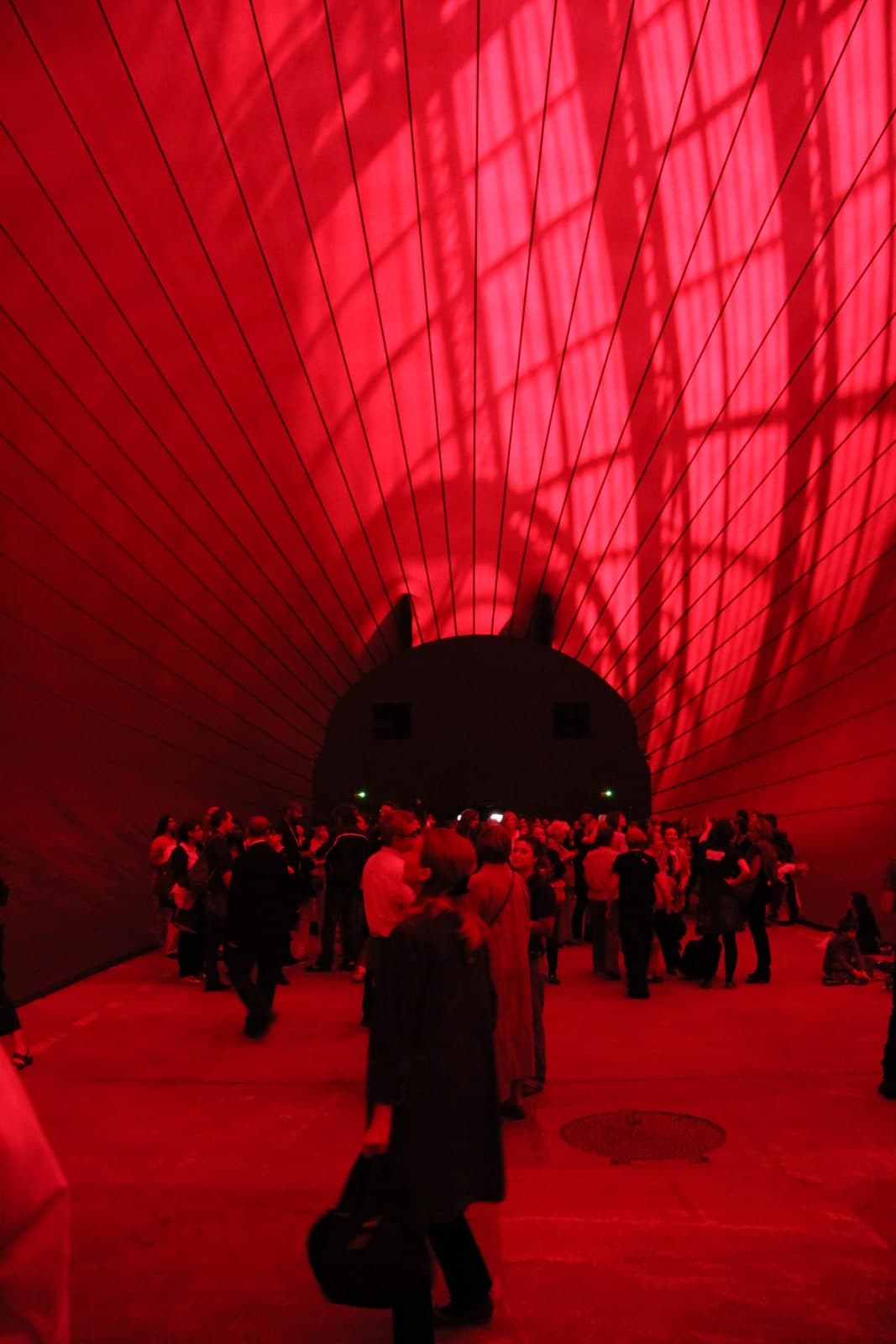
The form had three joined lobes. From outside, in the nave, they read as three vast dark spheres pressed together and touching the floor. From inside, the visitor stood in a single continuous chamber whose walls curved away in every direction.
Colour did the rest. The PVC was a deep red, and daylight through the Grand Palais glass roof passed through the membrane rather than falling on it. Everyone inside was lit red, and so was the concrete floor they stood on.
The commission and who paid for it
Monumenta was an annual French state commission. Its terms were simple and unusually demanding: each year one living artist was given the nave of the Grand Palais and asked to make one work for it. Anish Kapoor took the fourth edition, after three earlier years the organisers recorded as a growing success.
The producers were named on the exhibition's own site: the French Ministry of Culture and Communication, the Centre national des arts plastiques, and the Rmn – Grand Palais. Jean de Loisy was the curator.
The run was short. Monumenta 2011 opened on 11 May and closed on 23 June, six weeks for a work that could not be shown anywhere else at that size.
The building it was made for
The Grand Palais was built for the Exposition Universelle of 1900 and its nave is a single span. Monumenta's own description of the site gives the glass roof as rising to 45 metres beneath the central dome, the nave as extending 200 metres at ground level, and the covered area as some 13,500 square metres.
Those figures set the problem. A work that merely stood in the nave would be lost in it, and the organisers described the challenge as making something on a scale with the verticality and light of the hall.
Anish Kapoor's answer was to fill it and then put the audience inside. Monumenta summarised his ambition as an experience of colour on a scale with the nave, which he called "this interior greater than any exterior".
Two works in one visit
The route was deliberate. Visitors went in first, through an airlock that kept the pressure up, and met the inside before they had seen the outside. Only afterwards did they leave the membrane and walk around it in the nave.
Inside, there was nothing to look at except the membrane, the light coming through it and the other people. The seams between the panels ran overhead like the ribs of a vault, and the ironwork of the Grand Palais roof showed through the PVC as a shadow.
Outside, the same object was opaque and almost black, three lobes that hid the roof and made the nave feel smaller than it is. The work was red from within and dark from without, and a visitor could not see both at once.
Why it is called Leviathan
The name is biblical. Monumenta's own text for the work traced it to the Book of Job, the Book of Isaiah and several Psalms, where Leviathan is a sea-beast so terrifying that the sight of him casts a man down.
The organisers set out the later history too. They named the gaping mouth through which souls enter Hell in medieval imagery, the sea-serpent that raises storms, and the association with the Beast of the Apocalypse. They traced the serpent motif back to Sumerian iconography of the third millennium BC.
The reading the title invites is swallowing. A visitor walked into the mouth of the thing before seeing what it was, which is the sequence the name describes.
Kapoor's return to Paris
Monumenta framed the commission as a homecoming. Its exhibition text described Leviathan as Anish Kapoor's return to Paris thirty years after his very first exhibition, which his studio records as a 1980 solo show at Patrice Alexandre.
Two other Paris shows ran alongside it. Monumenta's own listing of events outside the Grand Palais names an exhibition at the Beaux-Arts de Paris and one at the Galerie Kamel Mennour, so the city carried three Anish Kapoor shows at once in the summer of 2011.
He built Dirty Corner in Milan the same year. That work came to France four years later, to the gardens of the Château de Versailles, where it was attacked three times and became a legal case. Leviathan caused no trouble at all.
What happened to it
Leviathan was inflated for six weeks and then taken down. A membrane held up by air is not a monument, and nothing of it remains at the Grand Palais.
Monumenta itself did not last much longer. The commission ran again in 2012 and 2016 and then stopped, and the Grand Palais closed for a long restoration.
Anish Kapoor received the Praemium Imperiale in the same year as Leviathan. The work is documented in photographs, in the exhibition's own website and in its catalogue, and not in an object that can be visited.
Close reading
Reading the work, detail by detail
The photograph is taken from inside the work, standing on the floor of the Grand Palais nave with the membrane closed overhead. The whole frame is interior. Nothing here shows the outside of Leviathan, which was opaque and near-black, and no part of the building is visible except as a shadow through the PVC.
1.The membrane closes into a vault
The wall rises on both sides and meets overhead, so the interior reads as a single vault rather than a room with a ceiling. Dark seam lines run the whole height and converge as they go up. They are the joins between the panels the membrane is welded from, and they are the only drawing on the surface.
2.The Grand Palais roof shows through as a shadow
A wide dark arc and a grid of soft bars lie across the red at the upper right. That is the ironwork and glazing of the Grand Palais roof, seen through the PVC rather than reflected on it, because the daylight is passing through the membrane from outside. The building is present in the photograph only in this form.
3.A dark mass rises at the far end
At the far end of the chamber a rounded dark mass rises from the floor and blocks the light behind it. Two small pointed projections stand up from its top edge. It reads as the junction where this lobe of the work meets the next, seen in silhouette; the photograph does not show what lies on the other side of it.
4.Two rectangles cut the silhouette
Two rectangular openings sit side by side in the face of the dark mass, level with each other and slightly paler than the form around them. Two small green points of light show below them at floor level. The plate does not resolve what is behind the rectangles, and the commentary does not guess.
5.Everyone inside is lit red
Several dozen visitors stand in a loose band across the middle of the frame. Skin, hair and pale clothing are all carrying the same red, because the only light reaching them has come through the membrane. The figures give the scale: the vault above them is many times their height.
6.The floor is the hall's, not the work's
The membrane has no floor of its own. It sits directly on the concrete of the nave, and a round metal drain cover is visible set into the surface at the right. The red on the concrete is light, not paint. This is the clearest sign in the photograph that the work was placed in a working building for six weeks.
7.The wall meets the ground without a join
On the left the membrane curves down and runs into the floor with no frame, base or fixing visible. The red darkens as the surface turns away from the light. Because the shape is held by air pressure rather than by structure, there is nothing at the foot of it to see.
8.A visitor in the foreground, walking out
A figure in a dark coat with a bag stands close to the camera, seen from behind and facing into the chamber. At this distance the red light is weak enough that the coat still reads as black. The photograph was made among visitors during the run, not in an empty hall.
Timeline
1980
Anish Kapoor's first solo exhibition takes place in Paris, at Patrice Alexandre.
2007
Monumenta begins at the Grand Palais, giving the nave to one artist a year.
2010
Anish Kapoor is photographed in the empty nave with Peter Lindbergh and the curator Jean de Loisy in September, while the work is being planned.
2011
Leviathan opens on 11 May as Monumenta 2011, co-produced by the French Ministry of Culture and Communication, the Centre national des arts plastiques and the Rmn – Grand Palais.
2011
Exhibitions at the Beaux-Arts de Paris and the Galerie Kamel Mennour run alongside it in the city.
2011
Monumenta 2011 closes on 23 June and the membrane is deflated and removed.
2011
Anish Kapoor receives the Praemium Imperiale; he builds Dirty Corner in Milan the same year.
2015
Dirty Corner is installed in the gardens of the Château de Versailles, defaced three times, and made the subject of a French court ruling.
Where to see it
Monumenta 2011, Grand Palais
Paris, France
A public viewing address has not yet been confirmed for this holding.
A temporary work, shown from 11 May to 23 June 2011 and removed. It is not in a collection and cannot be visited.
Frequently asked questions
What was Anish Kapoor's Leviathan?
A single inflated membrane of dark red PVC installed in the nave of the Grand Palais in Paris for Monumenta 2011. The artist's own listing gives its size as 33.6 by 99.89 by 72.23 metres. Visitors walked inside it through an airlock, stood in red light, and only then went out to see it whole.
When could you see Leviathan, and can you still?
No. It was shown from 11 May to 23 June 2011 and then deflated and removed. It was held in shape by the air inside it, so nothing was left standing afterwards. There is no Leviathan to visit in Paris or anywhere else.
What was Monumenta?
A French state commission that gave the whole nave of the Grand Palais to one living artist each year, to make one work for it. It was produced by the Ministry of Culture and Communication, the Centre national des arts plastiques and the Rmn – Grand Palais. Anish Kapoor took the fourth edition in 2011, with Jean de Loisy as curator.
How big is the nave of the Grand Palais?
Monumenta's own description gives the glass roof as rising to 45 metres beneath the central dome, the nave as extending 200 metres at ground level, and the covered area as some 13,500 square metres in a single span. The building was made for the Exposition Universelle of 1900.
Why is it called Leviathan?
After the biblical sea-monster. Monumenta's text for the work traced the name to the Book of Job, the Book of Isaiah and several Psalms. Leviathan is described there as a beast so terrifying that a man might be cast down at the sight of him. Visitors entered the work before they had seen it, which is the swallowing the name describes.
Is Leviathan the same work as Dirty Corner?
No. They are different works made in the same year. Leviathan was the inflated PVC membrane in the Grand Palais in Paris, shown in 2011. Dirty Corner was a rusted Cor-Ten steel horn built in 2011 for the Fabbrica del Vapore in Milan, which came to the gardens of the Château de Versailles in 2015 and was repeatedly defaced there.
More by Anish Kapoor
If you like Anish Kapoor
Explore sculptors from the same movements and circles.
Arman
French-American artist, lifelong friend of Yves Klein, and a founder of New Realism.
View artist
Jean Arp
Strasbourg-born sculptor and poet — Hans in German, Jean in French, both all his life — who co-founded Dada at the Cabaret Voltaire in 1916, composed collages by dropping torn paper 'according to the laws of chance', and settled at Meudon outside Paris in a house his wife Sophie Taeuber-Arp designed.
View artist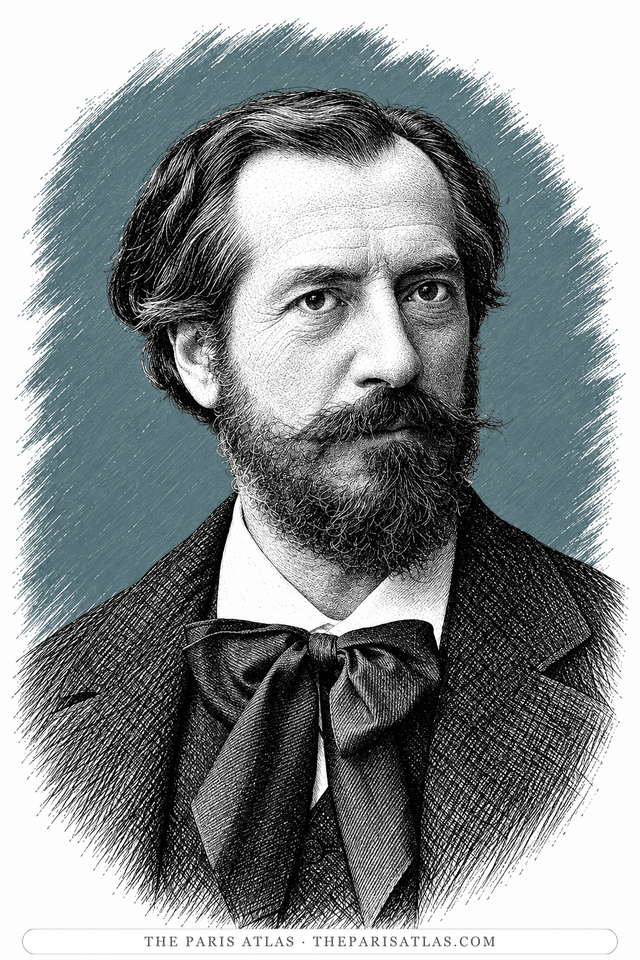
Frédéric Auguste Bartholdi
Frédéric Auguste Bartholdi was a French sculptor best known for designing the Statue of Liberty, dedicated in New York Harbor in 1886. Born in Colmar and based in Paris, he created public monuments that gave visible form to ideas of freedom, resistance and national memory. His other major works include the Lion of Belfort and the fountain in Lyon's Place des Terreaux.
View artist
References
The sources below include collection records, catalogues, scholarly research, and primary materials that informed this page. They document Leviathan, its making, and its place in cultural history.


1Anish Kapoor, Leviathan — the artist's own work listing
Official recordAnish Kapoor StudioUsed forThe artist's own work listing: the title, the year 2011, the material PVC, the dimensions 33.6 × 99.89 × 72.23 metres, and the Grand Palais as the venue.
2Monumenta 2011 au Grand Palais — Anish Kapoor, Leviathan
Official recordMinistère de la Culture et de la Communication, CNAP and Rmn – Grand Palais, 2011Used forThe commissioning bodies' own page for the work: the run from 11 May to 23 June 2011, and the account of the biblical Leviathan in Job, Isaiah and the Psalms quoted here.
3Monumenta 2011 — A challenge, and The site: the Nave of the Grand Palais
Official recordMinistère de la Culture et de la Communication, CNAP and Rmn – Grand Palais, 2011Used forMonumenta's framing of the commission, the curator Jean de Loisy, the co-producers, the return to Paris thirty years after the first exhibition, the phrase "this interior greater than any exterior", and the nave's 45-metre roof, 200-metre length and 13,500 square metres.

4Biography
WebsiteAnish Kapoor StudioUsed forThe 1980 first solo exhibition in Paris at Patrice Alexandre, and the dated exhibition record including Monumenta 2011.
5Anish Kapoor: Dirty Corner
WebsiteDesignboom, 2011Used forDirty Corner as first built in Milan in 2011, the separate work of the same year distinguished here.
6Code de la propriété intellectuelle, article L.122-5, 11° — architectural works and sculptures permanently placed on the public highway
Official recordLégifrance, République françaiseUsed forThe French freedom-of-panorama provision, article L.122-5 11°, read in full: it reaches only architectural works and sculptures placed permanently on the public highway, by natural persons and excluding commercial use, so it does not reach a six-week installation inside a building.
These references provide the documented foundation for this work's history and interpretation. Claim-level citations remain attached to the specific claims they support.
 Explore more resources