Cloud Gate
by Anish Kapoor
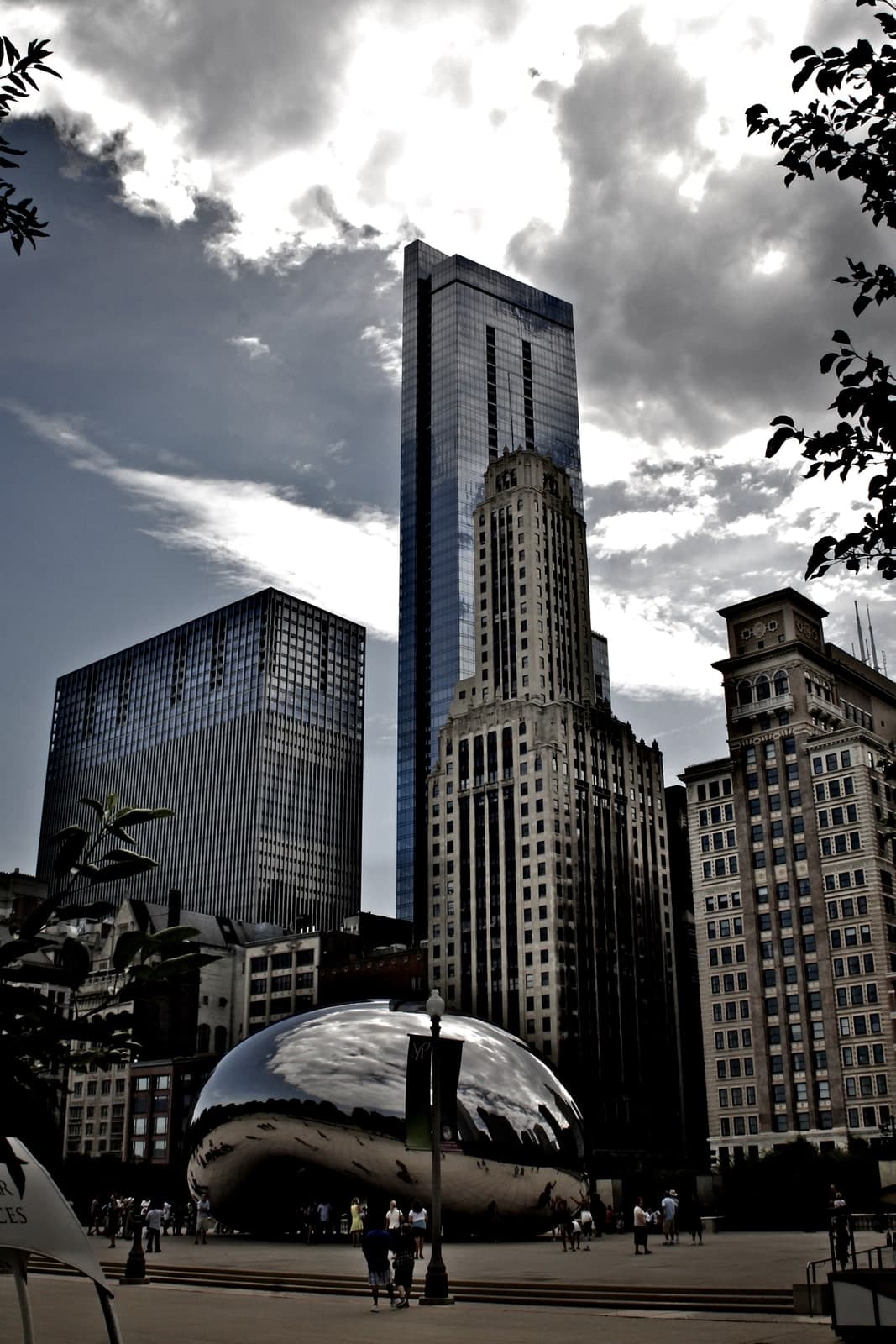
A polished stainless steel ellipsoid, 66 feet long and 33 feet high, standing on a paved plaza in Millennium Park in Chicago. Anish Kapoor designed it to reflect the city's skyline and the clouds, and had the 168 plates that make it welded together and the seams ground away until the surface reads as one unbroken mirror. A 12-foot arch leads into a concave chamber underneath. Chicago calls it the Bean, and so does the artist.
- 2004–2006
- Highly polished stainless steel plates, welded and ground seamless
- Millennium Park, City of ChicagoChicago, Illinois, United States
About Anish Kapoor
What the sculpture is
Millennium Park's own description gives the essentials. The sculpture weighs 110 tons, is forged of a seamless series of highly polished stainless steel plates, and measures 66 feet long by 33 feet high. Anish Kapoor said the form was inspired by liquid mercury.
It has two openings that matter. A 12-foot-high arch lets a visitor walk underneath, into a concave chamber the park calls the omphalos, which is 27 feet high at its crown. The word is Greek for navel.
There is no plinth and no base. The ellipsoid meets the granite paving directly at two points, so the object appears to rest on the plaza rather than to be mounted on it.
168 plates, and the work of hiding the joins
The plates were made in California. Performance Structures Inc., of Oakland, fabricated the 168 metal plates and shipped them to Chicago. MTH Industries, a Chicago glass and architectural metal contractor then 120 years old, installed the sculpture over what its engineer called a totally unique, two-year-long experience.
Underneath the mirror is a frame. Lou Cerny, vice president of engineering at MTH Industries and the project manager, described starting with two large fabricated 304 stainless steel O-shaped rings, one at the north end and one at the south, held together by criss-crossing pipe trusses. The ring-core subframe was built in sections and field-bolted with welded reinforcements.
The plates were then hung one at a time. The dome on the underside went up first, suspended from the truss on a temporary four-point system of hangers, cables and springs, and the springs were readjusted after each new plate to rebalance the load. Every plate had a four-point spring support of its own.
The tolerances were the hard part. Lou Cerny said the plates were put together to a 0/0 clearance and that the aim was not to overstress any joint, because a plate striking the one below it could cause problems. He added that the job had never been done before and that they had been told it could not be done.
Grinding the seams out
Welding came after hanging. Once every plate was installed and the exterior plate welding was complete, permanent weld-ups were done on the inside of the shell. The final phase was grinding and polishing.
Lou Cerny stated the goal plainly: to eliminate any visible trace of the seam, so as to maintain the reflective quality of the sculpture. His reasoning was about exposure rather than neatness. People can walk up to it from every possible angle, he said, and it is fully exposed under the brightest light available, the full sun at high noon. The work therefore had to remain invisible for the piece to work effectively.
The omphalos was finished last. Millennium Park recorded the final stage as grinding and polishing the seams inside the underbelly, with the archway entrances walled off in clear plastic and the chamber closed to the public while it went on.
The American Welding Society recognised the result. It gave its Extraordinary Welding Award to the project in 2007, honouring MTH Industries and Performance Structures Inc. among others.
The tent, and an opening before the work was finished
Assembly was meant to happen elsewhere. Lynn Becker's photo essay on the making records that the original plan was to assemble the sculpture offsite and ship it to Chicago finished, and that this soon proved impracticable. It was built in the park instead, in public.
A tent then hid it. The first structural piece went in during March 2004, a protective tent went up in April, and by June the work was shielded from view. The tent was partially opened in July for ventilation and the public could watch again.
Millennium Park opened on 16 July 2004 with the sculpture unfinished. The seams were still visible and still to be welded and ground. The work was untented completely only by 28 August 2005, and the omphalos polishing ran later still, which is why the sculpture carries a date range rather than a single year.
Who owns the copyright, and who may sell a photograph
The sculpture belongs to the city; the copyright does not. The Christian Science Monitor reported in 2005 that the artist retains copyright in the work. Chicago had bought a licence instead. The attorney Henry Kleeman, who negotiated with the park's artists, described it as a perpetual paid-up license to reproduce the artwork for commercial purposes.
That arrangement caused a public row. Security guards ejected a professional photographer, telling him he could not photograph the sculpture because its copyright belonged to the artist. The park's project director visited gallery owners and demanded they stop selling postcards of it. The city later said the ejection had been about permits rather than copyright, and suspended its photo-permit policy.
Casual photography was never the issue. The same report noted that a tourist taking a picture is protected by the fair-use exemption in the Copyright Act. The dispute was about who may sell the image, not who may make one.
Anish Kapoor has enforced the copyright since. In 2018 he began a copyright action against the National Rifle Association over a fleeting shot of Cloud Gate in its recruitment video The Violence of Lies, and settled out of court in December. He called the video abhorrent and said it sought to promote fear, hostility and division in American society, and he asked the organisation to donate a million dollars to charities supporting victims of gun violence.
The name nobody uses
Cloud Gate is the title and the Bean is the name. The nickname attached itself during construction, when the unfinished shape looked more like a bean than a gate, and it has not been dislodged.
Anish Kapoor gave up resisting it. He told the Chicago Sun-Times that he calls it the Bean too.
The title describes what he wanted. He said the point was to make something that would engage the Chicago skyline, so that one will see the clouds kind of floating in, with those very tall buildings reflected in the work. Because it is in the form of a gate, he added, the viewer can enter a deep chamber. That chamber does to a reflection what the outside of the piece does to the city.
Damage, cleaning and closure
A mirror in a city needs maintenance. The lower plates are wiped daily and the whole surface is washed twice a year, because the sculpture is at hand height and several million people a year touch it.
It has been scratched. Chicago newspapers reported an instance of deliberate damage to the surface, which the authorities described as rare.
The plaza beneath it was rebuilt. Cloud Gate was fenced off while Grainger Plaza, the paving it stands on, was reconstructed, and the city announced in June 2024 that the sculpture would fully reopen to visitors.
Close reading
Reading the work, detail by detail
The photograph is taken from across the plaza, end-on to the sculpture and some distance from it, under heavy cloud. The whole object is in frame, with the Chicago skyline behind it. What appears on the sculpture's surface is that skyline reflected and compressed; it is the city and the weather, not anything Anish Kapoor shaped. The underside chamber is visible only as a dark opening.
1.The whole form, end-on
From this end the object reads as a broad ellipsoid, much wider than it is high, pinched towards the ground at either side. Millennium Park gives it as 66 feet long by 33 feet high. Seen end-on the long axis runs away from the camera, so the sculpture looks more compact here than it does in profile.
2.The band of reflected city
A band of reflected buildings and cloud runs across the upper part of the surface, squeezed and bent by the curvature. Every element in it is the city standing behind and above the camera. The reflection changes with the weather and the hour, which is the part of the work the artist did not fix.
3.The arch into the chamber
Beneath the body of the sculpture an arch opens into a darker space, and small figures stand inside it. Millennium Park gives the arch as 12 feet high and the chamber above it, the omphalos, as 27 feet at its crown. At this distance the plate shows the opening but resolves nothing of the concave surface inside.
4.No joins are visible at this distance
The surface carries no visible lines. The object is built from 168 plates that were welded and then ground until the seams disappeared, and Lou Cerny of MTH Industries described the aim as eliminating any visible trace of the seam. The plate confirms the result at viewing distance; it cannot show whether a join is detectable close up.
5.The form darkens as it turns under
Along the bottom the mirror stops returning sky and goes almost black. The surface there is angled down and is reflecting the paving and the shadow beneath the work rather than the bright cloud above. The darkness is a reflection of the ground, not a change of material.
6.Visitors give the scale
Figures stand along the flank and under the arch, and each is a small fraction of the sculpture's height. They also stand close enough to touch it, which is how the lower plates come to need daily cleaning. The work is set on open paving with no barrier between it and the public.
7.The towers the work was made to catch
A blue glass tower and a pale stone skyscraper with a stepped crown rise directly behind the sculpture, with a dark slab to the left and brick towers to the right. Anish Kapoor said he wanted to make something that would engage the Chicago skyline, with those very tall buildings reflected in the work. The photograph holds both the buildings and their reflection.
8.The plaza it stands on
The sculpture sits on open paving with a street lamp in front of it and people crossing the square. There is no plinth: the ellipsoid meets the paving directly. The plaza in this photograph is the one that was later rebuilt, the work reopening fully in 2024.
Timeline
1999
Chicago holds a competition for a sculpture in the new Millennium Park; Anish Kapoor's proposal is selected.
2004
The first structural piece is installed in March; a protective tent goes up in April and closes the work to view by June.
2004
Millennium Park opens on 16 July with the sculpture in place but unfinished, its seams still visible.
2005
The Christian Science Monitor reports that Anish Kapoor retains the copyright and that the city holds a perpetual paid-up commercial reproduction licence; the photo-permit policy is suspended after a photographer is ejected.
2005
The sculpture is completely untented by 28 August.
2006
The final phase of grinding and polishing the seams inside the omphalos is carried out, the archways walled off while it goes on.
2007
The American Welding Society gives the project its Extraordinary Welding Award, honouring MTH Industries and Performance Structures Inc. among others.
2018
Anish Kapoor brings a copyright action against the National Rifle Association over a shot of the sculpture in a recruitment video, and settles out of court in December.
2024
The city announces in June that the sculpture will fully reopen after the reconstruction of Grainger Plaza.
Where to see it
Millennium Park, City of Chicago
Chicago, Illinois, United States
A public viewing address has not yet been confirmed for this holding.
On permanent public display outdoors. The plaza was rebuilt in the 2020s and the city announced a full reopening in June 2024.
Frequently asked questions
What is Cloud Gate made of and how big is it?
Highly polished stainless steel. Millennium Park gives the weight as 110 tons and the size as 66 feet long by 33 feet high, about 20 by 10 metres. It is built from 168 plates, welded together and ground until the seams are invisible. A 12-foot-high arch leads into a concave chamber underneath that is 27 feet high at its crown.
Who actually built Cloud Gate?
Performance Structures Inc. of Oakland, California, fabricated the 168 plates and shipped them to Chicago. MTH Industries, a Chicago architectural metal contractor, built the internal truss, hung the plates, welded them and ground the seams out over about two years. The American Welding Society gave the project its Extraordinary Welding Award in 2007.
Why is it called the Bean?
Because of its shape, and because the nickname stuck during construction. Cloud Gate is the title Anish Kapoor gave it, and he has said he calls it the Bean too. He named it a gate because a visitor can walk under the arch into the chamber beneath.
Can you take photographs of Cloud Gate?
Yes, as a visitor. Anish Kapoor retains the copyright in the sculpture and the City of Chicago bought a perpetual paid-up licence to reproduce it commercially, so selling photographs is the contested part. A row in 2005 over a photographer being ejected and galleries being told to stop selling postcards ended with the city suspending its photo-permit policy. Casual photography is protected by fair use.
Why is Cloud Gate dated 2004 to 2006?
Because it was opened unfinished. Millennium Park opened on 16 July 2004 with the sculpture standing but its seams still showing. It was completely untented in August 2005, and the last phase of work, grinding and polishing the seams inside the underside chamber, came later still.
Did Anish Kapoor sue the NRA over Cloud Gate?
Yes. He began a copyright action in 2018 after the National Rifle Association used a brief shot of the sculpture in its recruitment video The Violence of Lies. The case settled out of court in December that year, with the organisation agreeing to cut the shot. He called the video abhorrent and asked the NRA to give a million dollars to charities supporting victims of gun violence.
More by Anish Kapoor
If you like Anish Kapoor
Explore sculptors from the same movements and circles.
Arman
French-American artist, lifelong friend of Yves Klein, and a founder of New Realism.
View artist
Jean Arp
Strasbourg-born sculptor and poet — Hans in German, Jean in French, both all his life — who co-founded Dada at the Cabaret Voltaire in 1916, composed collages by dropping torn paper 'according to the laws of chance', and settled at Meudon outside Paris in a house his wife Sophie Taeuber-Arp designed.
View artist
Frédéric Auguste Bartholdi
Frédéric Auguste Bartholdi was a French sculptor best known for designing the Statue of Liberty, dedicated in New York Harbor in 1886. Born in Colmar and based in Paris, he created public monuments that gave visible form to ideas of freedom, resistance and national memory. His other major works include the Lion of Belfort and the fountain in Lyon's Place des Terreaux.
View artist
References
The sources below include collection records, catalogues, scholarly research, and primary materials that informed this page. They document Cloud Gate, its making, and its place in cultural history.


1Cloud Gate on the SBC Plaza — Millennium Park art and architecture
Official recordMillennium Park, City of ChicagoUsed forThe park's own description: 110 tons, the seamless polished stainless steel plates, 66 by 33 feet, the 12-foot arch, the 27-foot omphalos, the liquid-mercury inspiration, the final grinding phase, and Anish Kapoor's statement about engaging the Chicago skyline.
2Making Metal Gleam: the sculpture in Chicago's Millennium Park does just that
PeriodicalUSGlass, volume 42, issue 4, Key Communications, 2007Used forThe fabrication: the 168 plates made by Performance Structures Inc. in Oakland, MTH Industries as installer, Lou Cerny's account of the 304 stainless O-rings and pipe trusses, the four-point spring supports, the 0/0 clearance, and the aim of eliminating any visible trace of the seam.
3AWS Honors MTH and Others for Work on Cloud Gate Project
PeriodicalUSGlass News Network, Key Communications, 2007Used forThe American Welding Society's Extraordinary Welding Award, and the honouring of MTH Industries and Performance Structures Inc.

4A photo essay on the making of Anish Kapoor's Cloud Gate sculpture in Chicago's Millennium Park
WebsiteRepeatUsed forThe abandoned plan to assemble the work offsite, the March to July 2004 construction and tenting sequence, and the unwelded seams at the July 2004 opening.
5Who owns public art?
PeriodicalThe Christian Science Monitor, 2005Used forWho holds the copyright, the perpetual paid-up commercial licence bought by the city, the ejected photographer, the postcard demand, the suspension of the permit policy, and the fair-use position for visitors.
6Sculptor Anish Kapoor forces gun group NRA to cut his art from video
PeriodicalBBC News, 2018Used forThe copyright action against the National Rifle Association, the December 2018 settlement, and Anish Kapoor's statements quoted here.
7Anish Kapoor
WebsiteLisson GalleryUsed forCloud Gate in the artist's exhibition and commission record.
These references provide the documented foundation for this work's history and interpretation. Claim-level citations remain attached to the specific claims they support.
 Explore more resources