Descension
by Anish Kapoor
A circular pool of darkened water, spun by a hidden mechanism into a vortex that never stops and never drains. Anish Kapoor made it in 2014, and it has been installed at four sites, each time sunk into the ground so that a visitor looks down into it from the rim. It is a void made of moving water rather than of stone or pigment, and the hole at its centre has no bottom a viewer can see.
- 2014
- Water, steel and motor
- No permanent collection; shown by the Public Art Fund, New York, in 2017Brooklyn, New York, United States
About Anish Kapoor
What the work is
Descension is a machine as much as a sculpture. The artist's own listing dates it to 2014, and his gallery catalogues the related work Turning Water into Mirror, Blood into Sky of 2003 as steel, water and motor, which is the same set of parts at a smaller size.
The pool is circular and set into the ground. There is no plinth and nothing to walk around; the work is a hole in the surface the visitor is standing on, edged by a low rim.
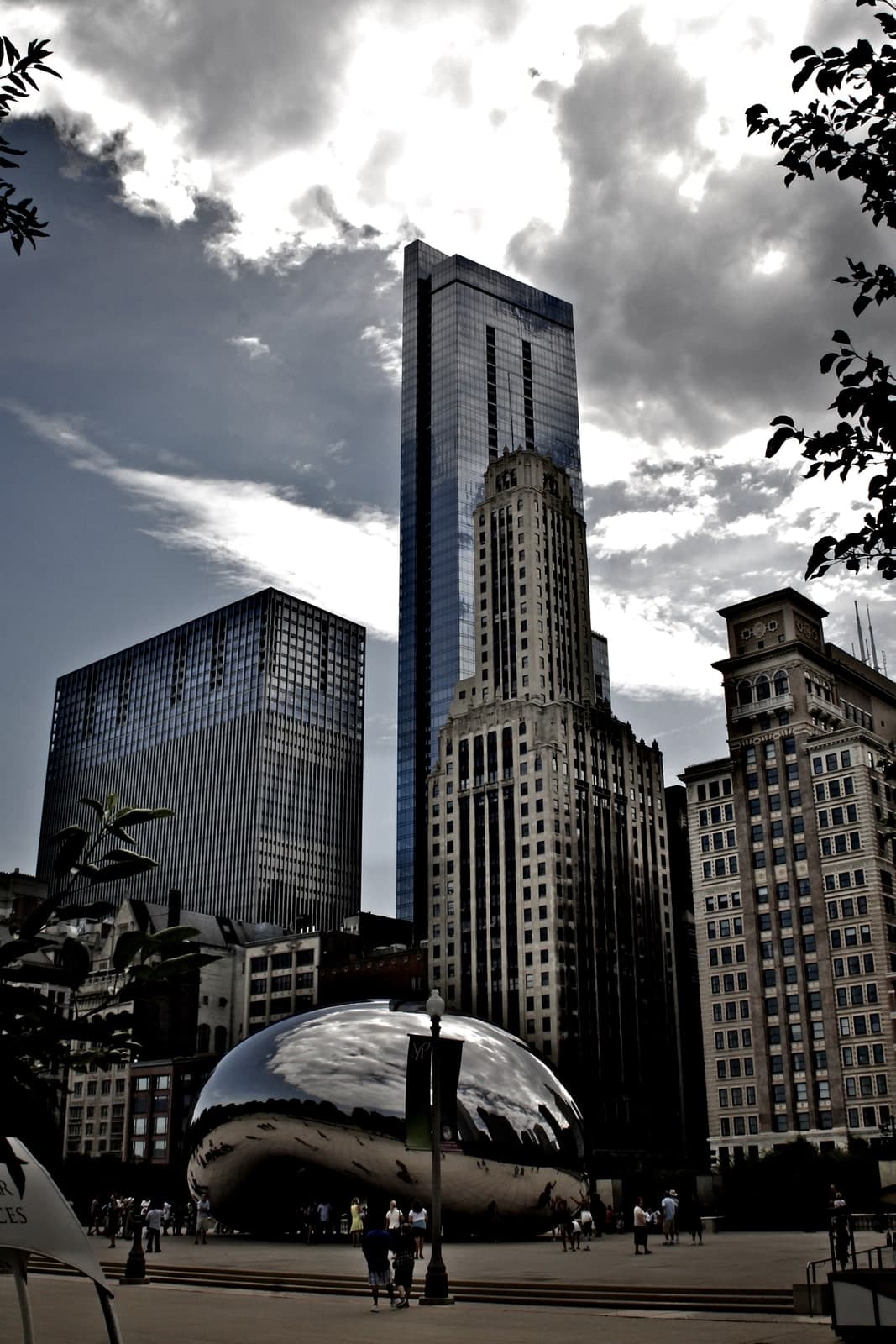
The water is darkened so that it does not reflect. That is the reversal of the mirrored works. Where Sky Mirror and Cloud Gate return the sky to the viewer, Descension absorbs the light that falls on it, and the spinning throat at the centre reads as black.
A void that moves
Anish Kapoor has worked on the void since the early 1980s. The earlier versions were static: stone and fibreglass hollowed out and coated so darkly that the eye cannot judge the depth of the opening, and a flat dark disc that turns out to be a hole.
Descension makes the same object out of motion. The vortex is continuously generated, so the depth is not merely unreadable but genuinely unfixed, and the surface is never still long enough to be measured.
Sound does work the pigment pieces cannot. A visitor standing at the rim hears the water being pulled down, which is a register the silent voids do not have.
In the gardens of Versailles
Descension came to France in 2015. It was one of six works Anish Kapoor showed in the gardens of the Château de Versailles from 9 June to 1 November, an exhibition marking the tricentenary of the death of Louis XIV. Five of the six stood outdoors and one, Shooting into the Corner, was inside the salle du Jeu de paume.
The exhibition is not remembered for this work. The argument that engulfed it concerned Dirty Corner, the sixty-metre steel horn on the garden's central axis, which was thrown with paint in June, sprayed with antisemitic slogans in September and defaced a third time within days.
A French court then ordered the inscriptions removed, and Anish Kapoor, who had said he would leave them as a record, answered by covering the defaced areas in gold leaf. Descension stood through all of it without incident.
Paris, Kochi and Brooklyn
The work has moved repeatedly. The artist's own listing gives four venues: the Kochi-Muziris Biennale of 2014 to 2015 in India, the Château de Versailles in 2015, Nuit Blanche in 2016, and Brooklyn Bridge Park in 2017.
Nuit Blanche is the Paris all-night arts festival, which brings the work into the city itself rather than the royal estate twenty kilometres west of it. The Versailles showing is the better documented of the two French installations.
The New York showing was the longest. The Public Art Fund presented it at Pier 1 in Brooklyn Bridge Park from 3 May to 1 October 2017, on a lawn above the East River, with the photographer James Ewing credited on the organisation's own images.
Why the site keeps changing the work
The pool is the same and the frame is not. At Versailles it sat in a formal garden laid out for Louis XIV; in Brooklyn it sat on grass beside a public path with apartment blocks behind it and a fence round the rim.
The fence is part of what a visitor sees. In the Brooklyn installation a white railing rings the pool at chest height, so the work is approached as something to be kept out of. Gravel and lawn run up to a low stone kerb at the water's edge.
That makes the reproduction of it unusually site-specific. A photograph of Descension records one installation rather than one object, and the water, the light and the barrier differ from site to site.
What it is not
It is not a drain and nothing is being emptied. The water is recirculated, so the level stays constant while the vortex continues.
It is not black in every light. Photographs taken in daylight show the water reading as grey or brown, with white foam picking out the spiral arms, and the true black confined to the throat at the centre.
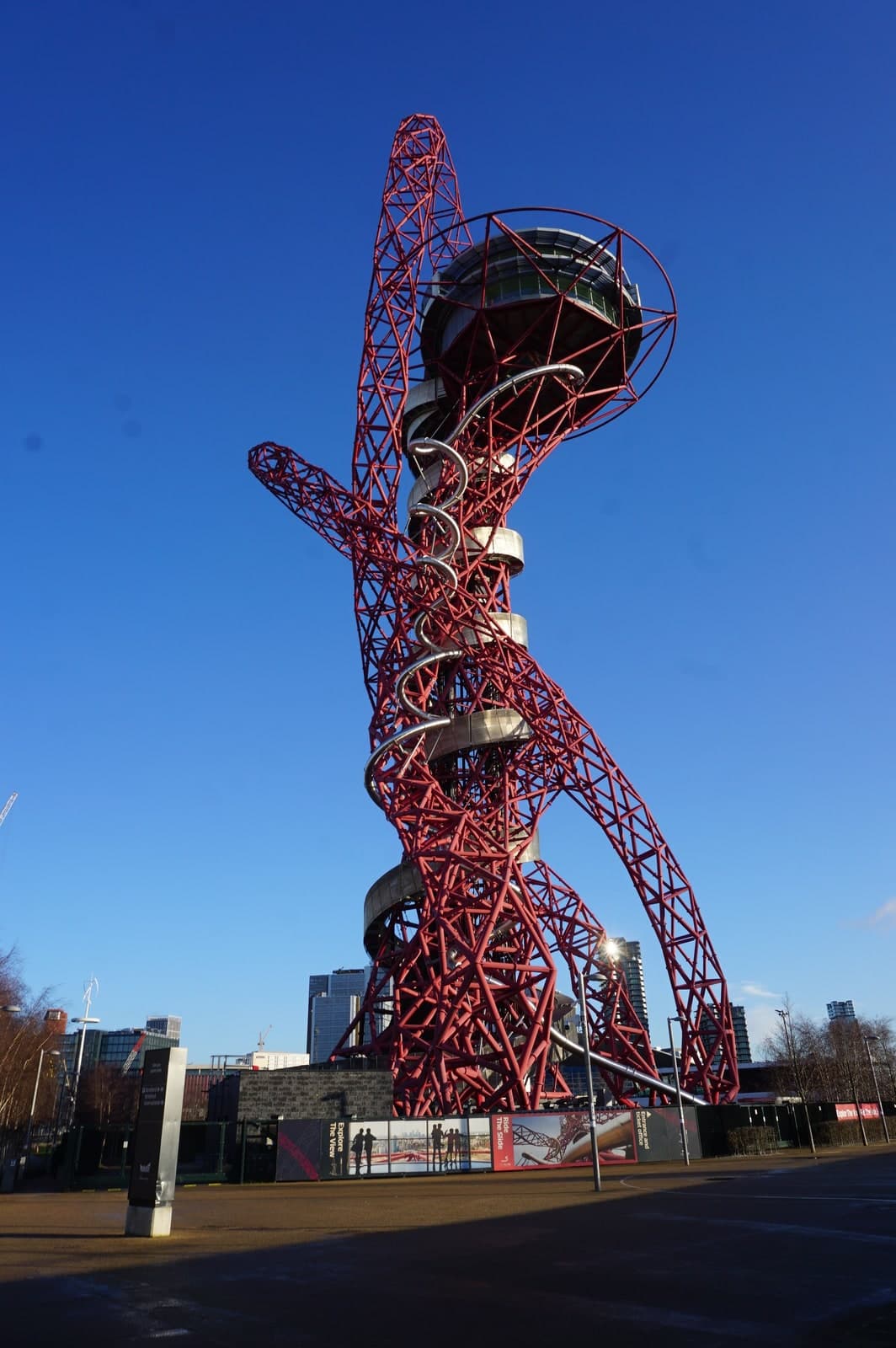
It is also not a permanent work anywhere. All four installations were temporary, so Descension cannot be visited at a fixed address the way Cloud Gate or the ArcelorMittal Orbit can.
Close reading
Reading the work, detail by detail
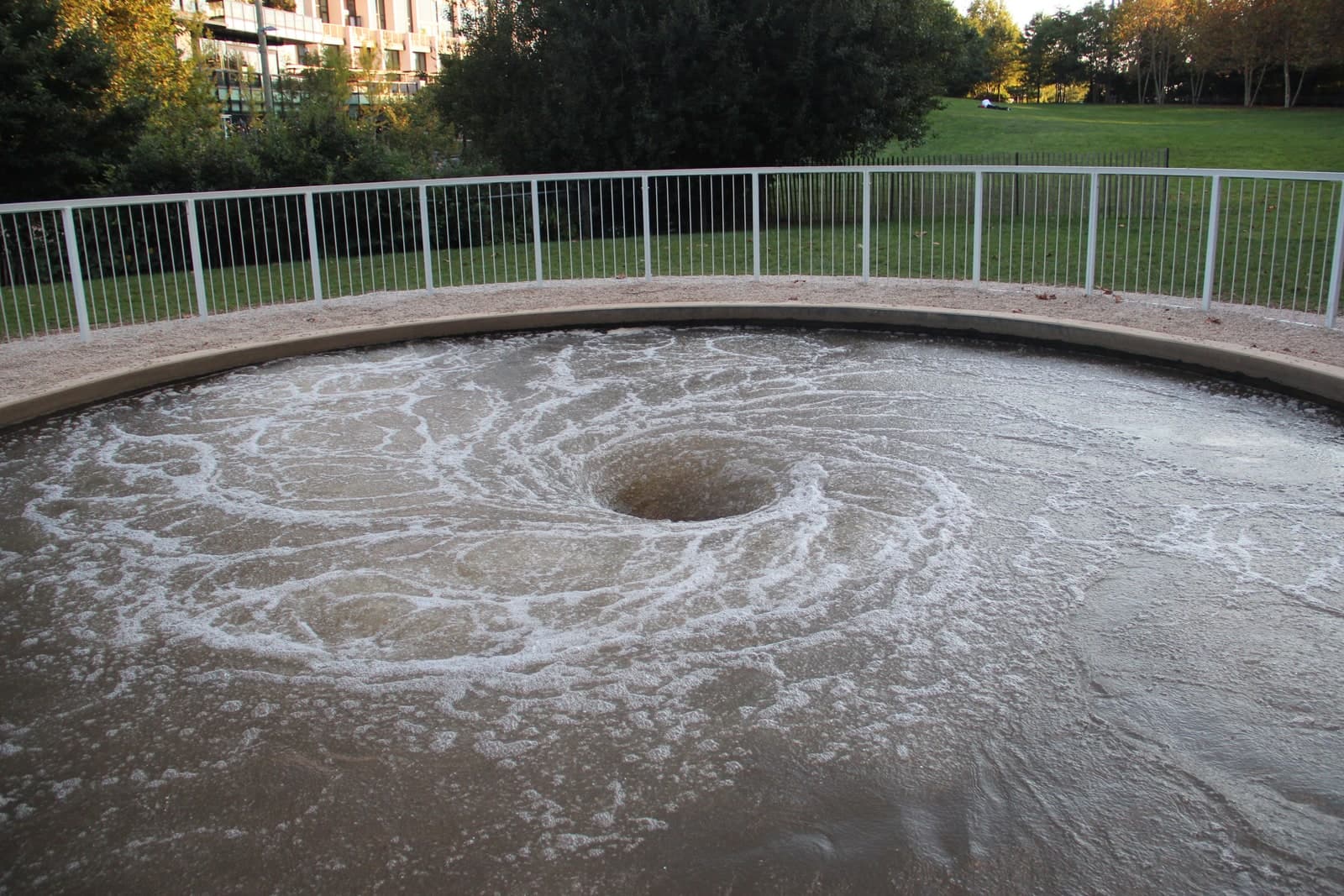
The photograph is taken from the rim of the pool, looking down and across it, in flat daylight. It records the Brooklyn Bridge Park installation of 2017 and not a permanent object: the railing, the gravel, the lawn and the building behind belong to that site alone. The mechanism that drives the water is below the surface and is not visible.
1.The throat of the vortex
At the centre the water opens into a steep dark funnel with a smooth wall. It is the only part of the work that reads as genuinely black in this light. The photograph shows no bottom to it, which is the effect the work is built for, and a single frame cannot show how deep it actually goes.
2.Foam draws the spiral
Broad arms of white foam curl outward from the centre across the whole surface, thinning as they go. The foam is what makes the rotation legible: the water itself is too dark and too uniform to show which way it is turning. The pattern is momentary and different in every photograph of the work.
3.The outer water is brown, not black
Away from the centre the water reads as grey-brown rather than black, with a broken sheen on it. The work is described as a pool of darkened water, and in this daylight the darkening shows as an absence of reflection rather than as a colour. Where the surface tilts, it returns no image of the sky.
4.A low kerb, and no plinth
A low pale kerb runs round the pool and the water comes up to meet it. There is no plinth and nothing raised: the work is a circular hole cut into the ground the visitor is standing on. The level stays constant because the water is recirculated rather than drained.
5.A railing holds the public back
A white railing set on a black fence encloses the far side at about chest height. The barrier is part of what a visitor meets: the work is approached as something to be kept out of. At Versailles in 2015 the same work stood in a formal garden, so its framing changes completely from site to site.
6.Gravel between the water and the fence
A band of pinkish gravel runs between the kerb and the fence, with a few fallen leaves on it. The leaves and the state of the grass agree with the file's date of 29 September 2017, near the end of the Brooklyn run, which the Public Art Fund gives as closing on 1 October.
7.A public park, not a gallery
Beyond the fence are mown grass, dense trees and a modern apartment block with balconies. The work sat on open parkland at Pier 1 in Brooklyn Bridge Park, where people walked past it rather than visiting it. Nothing in the frame is part of the sculpture; the setting is the photographer's, and the next installation had none of it.
Timeline
2003
Anish Kapoor makes Turning Water into Mirror, Blood into Sky, catalogued by Lisson Gallery as steel, water and motor at 150 by 300 by 300 centimetres.
2014
Descension is made, and shown at the Kochi-Muziris Biennale in India over the winter of 2014 to 2015.
2015
It is installed in the gardens of the Château de Versailles from 9 June to 1 November, one of six works marking the tricentenary of the death of Louis XIV.
2015
Dirty Corner, another work in the same exhibition, is defaced three times and becomes the subject of a French court ruling.
2016
The work is shown at Nuit Blanche, the Paris all-night arts festival.
2017
The Public Art Fund presents it at Pier 1 in Brooklyn Bridge Park, New York, from 3 May to 1 October.
Where to see it
No permanent collection; shown by the Public Art Fund, New York, in 2017
Brooklyn, New York, United States
A public viewing address has not yet been confirmed for this holding.
A temporary work with no fixed site. Its four recorded installations — Kochi, Versailles, Nuit Blanche in Paris and Brooklyn Bridge Park — have all closed.
Frequently asked questions
What is Anish Kapoor's Descension?
A circular pool of darkened water spun into a continuous whirlpool by a hidden mechanism. It is sunk into the ground so that a visitor looks down into it from a rim. The artist dates it to 2014, and the related work of 2003 is catalogued as steel, water and motor, the same parts at a smaller size.
Where can you see Descension?
Nowhere permanently. It has been installed four times, and all four were temporary. The venues were the Kochi-Muziris Biennale in 2014 to 2015, the gardens of the Château de Versailles in 2015, and Nuit Blanche in Paris in 2016. The last was Pier 1 in Brooklyn Bridge Park in New York, from 3 May to 1 October 2017.
Is the water really black?
It is darkened so that it absorbs rather than reflects light, which is the opposite of what his mirrored works do. In daylight photographs the body of the water reads as grey or brown with white foam marking the spiral, and the black is concentrated in the throat of the vortex at the centre.
Was Descension the work vandalised at Versailles?
No. Descension was one of six Anish Kapoor works in the gardens of the Château de Versailles from 9 June to 1 November 2015 and was not attacked. The work that was defaced three times, and that a French court then ordered cleaned, was Dirty Corner, a sixty-metre Cor-Ten steel horn on the garden's central axis.
How does the whirlpool keep going?
It is driven and recirculated. The pool is not draining, so the water level stays constant while the vortex continues, and the mechanism that spins it sits out of sight beneath the surface. The work is as much a machine as a sculpture.
How does Descension relate to Kapoor's other voids?
It is the same idea in motion. From the early 1980s he made hollows in stone and fibreglass coated so darkly that the eye cannot judge their depth, so that an opening reads as a flat disc. Descension makes the depth genuinely unfixed rather than merely unreadable, and adds the sound of the water being pulled down.
More by Anish Kapoor
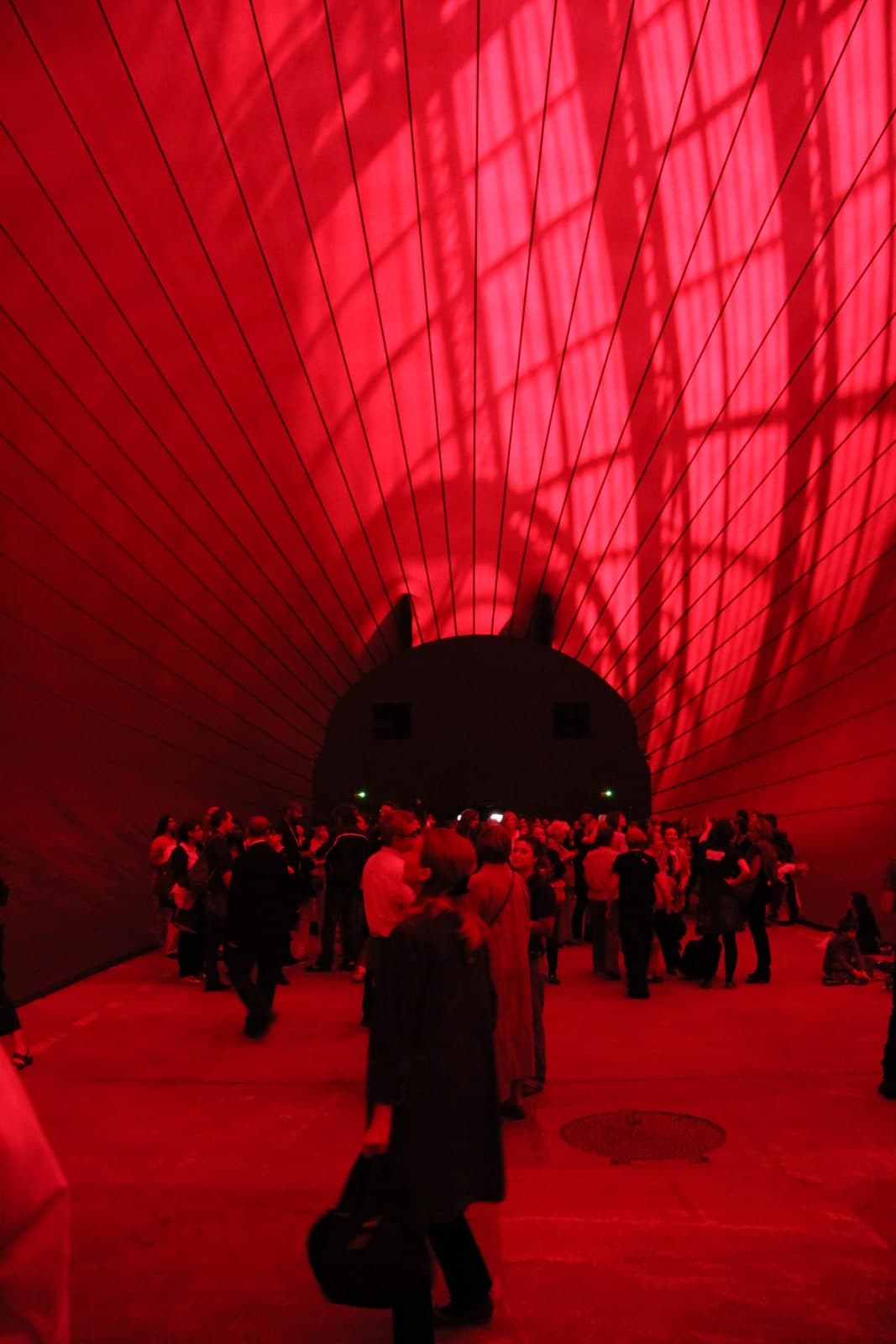
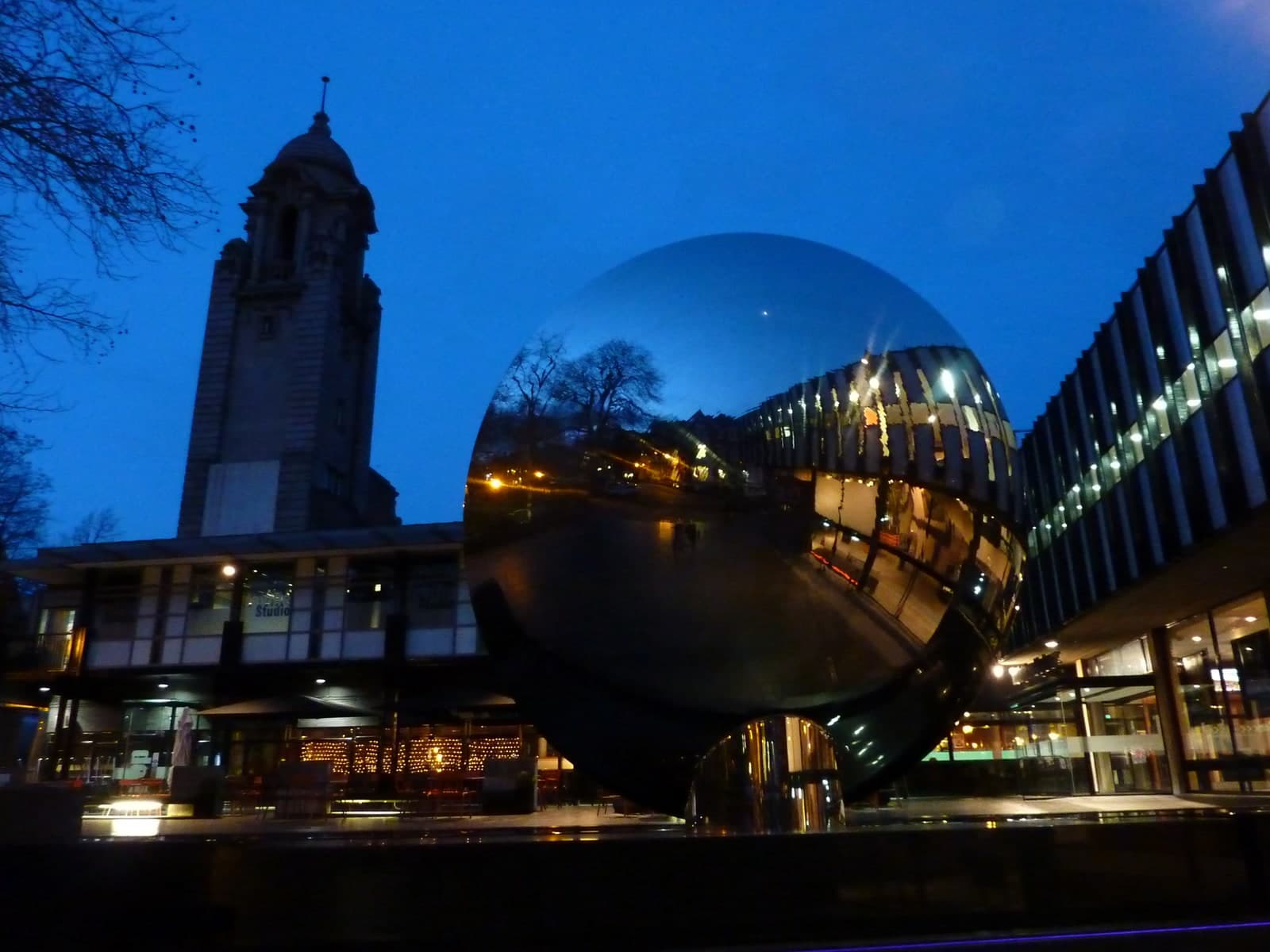
If you like Anish Kapoor
Explore sculptors from the same movements and circles.
Arman
French-American artist, lifelong friend of Yves Klein, and a founder of New Realism.
View artist
Jean Arp
Strasbourg-born sculptor and poet — Hans in German, Jean in French, both all his life — who co-founded Dada at the Cabaret Voltaire in 1916, composed collages by dropping torn paper 'according to the laws of chance', and settled at Meudon outside Paris in a house his wife Sophie Taeuber-Arp designed.
View artist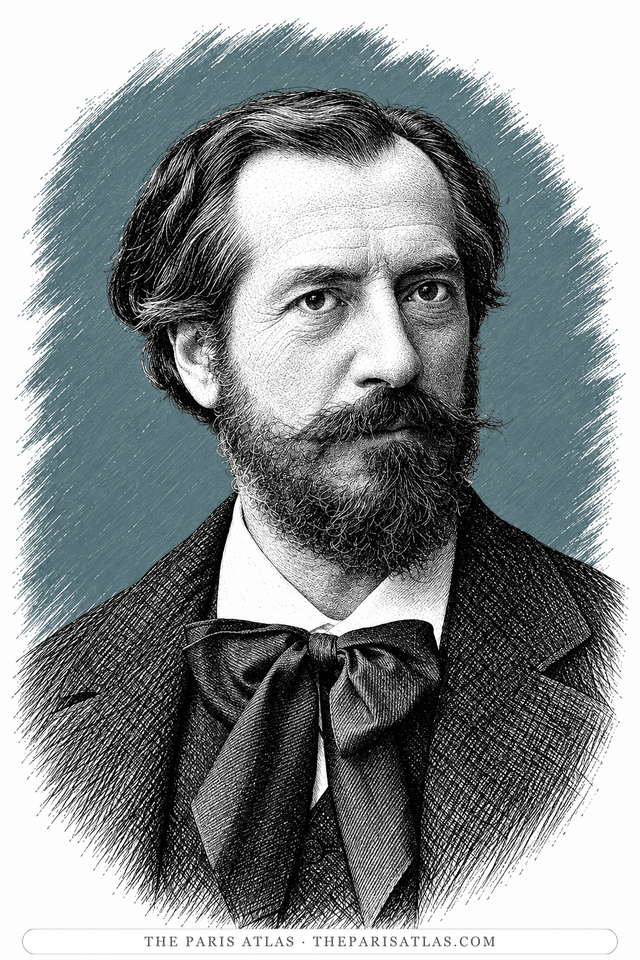
Frédéric Auguste Bartholdi
Frédéric Auguste Bartholdi was a French sculptor best known for designing the Statue of Liberty, dedicated in New York Harbor in 1886. Born in Colmar and based in Paris, he created public monuments that gave visible form to ideas of freedom, resistance and national memory. His other major works include the Lion of Belfort and the fountain in Lyon's Place des Terreaux.
View artist
References
The sources below include collection records, catalogues, scholarly research, and primary materials that informed this page. They document Descension, its making, and its place in cultural history.


1Anish Kapoor, Descension — the artist's own work listing
Official recordAnish Kapoor StudioUsed forThe artist's own listing: the year 2014 and the four venues — the Kochi-Muziris Biennale 2014–2015, the Château de Versailles 2015, Nuit Blanche 2016 and Brooklyn Bridge Park 2017.
2Anish Kapoor: Descension, Brooklyn Bridge Park, Pier 1
Official recordPublic Art Fund, New York, 2017Used forThe New York installation at Brooklyn Bridge Park, Pier 1, from 3 May to 1 October 2017, and the photographer credit to James Ewing on the organisation's own images.

3Anish Kapoor
WebsiteLisson GalleryUsed forTurning Water into Mirror, Blood into Sky (2003) catalogued as steel, water and motor at 150 × 300 × 300 cm, the smaller precursor cited here.
4Anish Kapoor à Versailles : qu'y voit-on vraiment ?
PeriodicalLes Inrockuptibles, 2015Used forThe Versailles exhibition of 9 June to 1 November 2015, its six works including Descension, the five sited outdoors and Shooting into the Corner in the salle du Jeu de paume.
5Anish Kapoor's Dirty Corner sculpture vandalised again
PeriodicalBBC News, 2015Used forThe attacks on Dirty Corner during the same exhibition, distinguished here from Descension, which was not damaged.
6Kapoor's moral right to keep hateful graffiti in place: a legal perspective
PeriodicalApollo — The International Art Magazine, 2015Used forThe court ruling that followed the defacement of Dirty Corner and Anish Kapoor's response to it.
7Code de la propriété intellectuelle, article L.122-5, 11° — architectural works and sculptures permanently placed on the public highway
Official recordLégifrance, République françaiseUsed forThe French freedom-of-panorama provision, read in full: its requirement of permanent siting on the public highway is not met by the temporary Versailles installation, and its non-commercial and natural-person limits would bar reliance in any event.
These references provide the documented foundation for this work's history and interpretation. Claim-level citations remain attached to the specific claims they support.
 Explore more resources