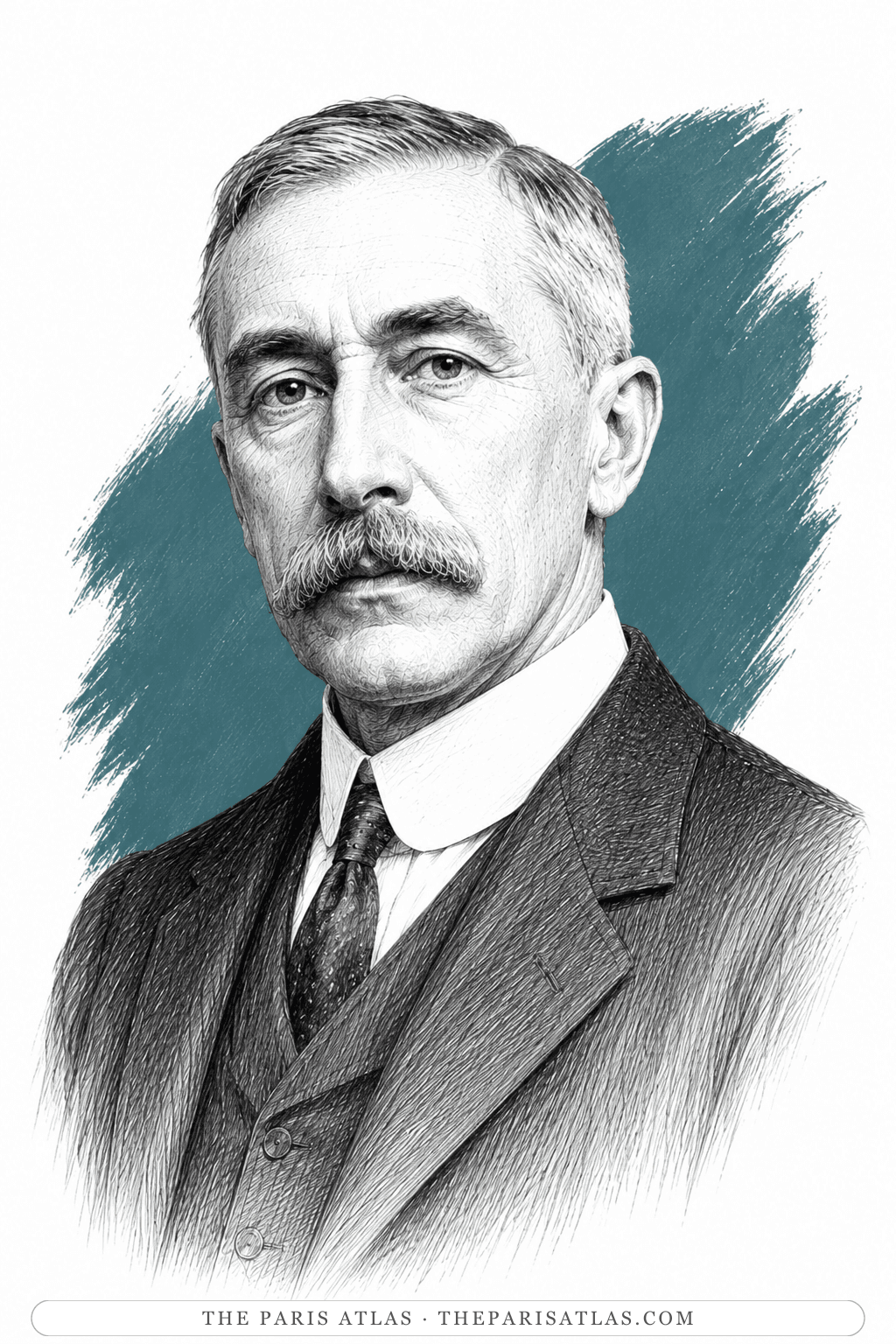
A. E. Housman
The poet who held the deepest grip on the young when George Orwell was seventeen, and the starting point of the literary history in "Inside the Whale". Orwell uses him to ask why a writer's hold on a generation collapses.
The book

At a glance
- Part II of "Inside the Whale"
- A Shropshire Lad
- Readers who were adolescent between 1910 and 1925
- About seventeen, and knew the whole sequence by heart
Who they are in the book
Spoiler-freeA. E. Housman is where the second part of "Inside the Whale" begins. Among people who were adolescent between 1910 and 1925 his influence was enormous, and George Orwell says that in 1920, when he was about seventeen, he probably knew the whole of A Shropshire Lad by heart. Twenty years later he re-reads the same lines and hears something that just tinkles, and the essay's real question follows from that: why the bubble always bursts, and what external conditions make a writer popular at a particular moment.
His answer is that Housman supplied several things a particular generation needed at once. He was a country poet at a time when the professional middle class was losing its last contact with the soil. His themes were adolescent ones. And he was satisfyingly anti-Christian in a decade when official belief was dissolving and boys were writhing under their schoolmasters. Orwell is careful not to leave it as a verdict against the poems.
How A. E. Housman Is Portrayed
- Known by heartOrwell and his contemporaries recited the poems over and over in a kind of ecstasy, as earlier generations had recited Meredith and Swinburne. He quotes four lines about golden friends and roselipt maidens and adds two words: it just tinkles.
- The country motifBuried villages and the nostalgia of place-names: Clunton and Clunbury, Knighton, Ludlow, the blue remembered hills. Orwell reads it as background rather than subject, and contrasts it with the week-ending gush of Rupert Brooke's "Grantchester".
- Adolescent subjectsMurder, suicide, unhappy love, early death — the simple intelligible disasters that feel like the bedrock facts of life. Orwell notes the exquisite self-pity that runs with them, and answers one stanza with "Hard cheese, old chap!"
- The sexual pessimismThe girl always dies or marries somebody else, which looked like wisdom to boys herded together in public schools. The woman's point of view is never considered; she is the treacherous half-human creature who leads you a little way and gives you the slip.
- The blasphemous strainA bitter defiant paganism, the conviction that life is short and the gods are against you, carried in fragile verse made almost entirely of words of one syllable. Patriotic, but in the old-fashioned red-coat way rather than the hang-the-Kaiser way.
- Not written offOrwell says there is no need to under-rate him now because he was over-rated a few years ago, and names "Into my heart an air that kills" and "Is my team ploughing?" as poems unlikely to stay long out of favour.
If you like Inside the Whale and Other Essays


If you like George Orwell
Explore authors with a similar voice, perspective, and influence.

Henry Miller
The Brooklyn dropout who arrived in Paris broke at thirty-eight and wrote the exuberant, banned books that ended American censorship.
View author
Louis-Ferdinand Céline
The doctor of the Paris slums who wrote the century's blackest, funniest novel — and changed the sound of French prose.
View author
Simone de Beauvoir
French writer and philosopher whose novels, memoirs, and social analysis examined freedom, gender, responsibility, aging, and the material conditions that shape a life.
View author