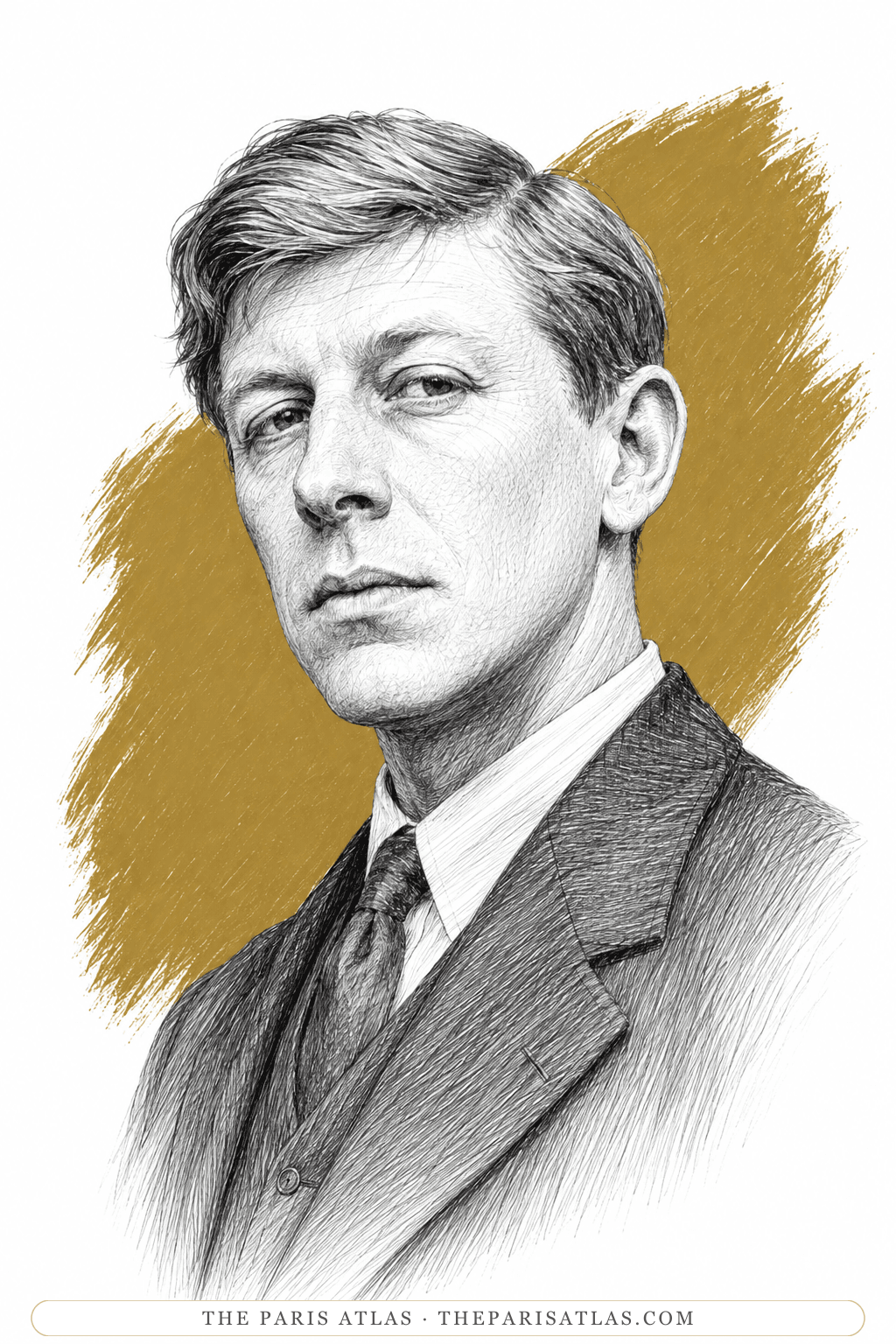
W. H. Auden
The leading poet of the thirties group, and the target of the sharpest paragraph in "Inside the Whale". George Orwell quotes the phrase "the necessary murder" from Auden's poem "Spain" and says it could only be written by someone to whom murder is at most a word, while also calling the poem one of the few decent things written about the Spanish war, and admitting that his own earlier jibe about Auden was a spiteful remark.
The book

At a glance
- Part II of "Inside the Whale", the title essay
- "Spain", two stanzas
- "the necessary murder"
- Auden, Stephen Spender, Cecil Day Lewis and Louis MacNeice
- "a sort of gutless Kipling", which he calls a spiteful remark
Who they are in the book
Spoiler-freeW. H. Auden was an English poet. "Inside the Whale" is an essay rather than a story, published in 1940, and its middle section works through the writers who dominated English literature in each recent decade. George Orwell's account of the nineteen-thirties puts Auden at the head of the group that mattered, alongside Stephen Spender, Cecil Day Lewis and Louis MacNeice, with a long list of others behind them.
Orwell dates the change to the years between 1930 and 1935. The typical literary man, he writes, stopped being a cultured expatriate with a leaning towards the Church and became an eager-minded schoolboy with a leaning towards Communism. Where the writers of the twenties had a tragic sense of life, the new ones had serious purpose. Orwell adds that almost all of them had come through the same route of public school, university and literary London, that several had gone back to public schools as masters, and that they were too young to have any clear memory of the First World War.
The sharpest paragraph in the essay is about a poem. Orwell quotes two stanzas of Auden's "Spain", written about the Spanish Civil War, and stops on the phrase "the necessary murder". He says the phrase could only be written by a person to whom murder is at most a word, and sets against it what he says he has seen himself: the terror, the hatred, the howling relatives, the post-mortems, the blood, the smells. In a bracket in the same paragraph he calls "Spain" one of the few decent things written about that war.
How W. H. Auden Is Portrayed
- Head of the thirties groupOrwell says that for the middle and late nineteen-thirties Auden, Stephen Spender and the writers around them were "the movement", in the way James Joyce and T. S. Eliot had been for the twenties. He says outright that he is sorting people by tendency, and notes how much easier this group is to sort than the older one: close in technique, almost indistinguishable in politics, and mild about each other's books.
- An earlier insult, and what Orwell makes of itOrwell recalls that some years before he had described Auden as "a sort of gutless Kipling". He calls that quite unworthy as criticism and merely spiteful, and then says the likeness to Rudyard Kipling is a fact all the same, at least in the earlier poems.
- The scoutmaster noteOrwell writes that an atmosphere of uplift is never far away in Auden's work, especially the earlier work, of the kind found in Rudyard Kipling's "If" or Henry Newbolt's "Play up, Play up, and Play the Game!". He picks out the poem beginning "You're leaving now, and it's up to you boys" and calls it pure scoutmaster, adding that some of the parody is intended and some of the resemblance is not.
- The poem about SpainThe two stanzas Orwell quotes set tomorrow against today: tomorrow the bicycle races through the suburbs on summer evenings, today the deliberate increase in the chances of death and the expending of powers on the flat ephemeral pamphlet and the boring meeting. Orwell reads the second stanza as a sketch of a day in the life of a good party man.
- "The necessary murder"The phrase Orwell objects to comes in Auden's line about the conscious acceptance of guilt in the necessary murder. Orwell says he has seen the bodies of a number of murdered men, so he knows what the word covers, and that Hitler and Stalin do find murder necessary but call it liquidation or elimination rather than advertising their callousness. His verdict on the phrase is that this kind of amoralism is only possible if you are the sort of person who is always somewhere else when the trigger is pulled.
- Where Orwell says the group came fromNearly all the younger writers, in his account, fit a pattern of public school, university and London, and several had been boys and then masters at public schools. They belonged to the comfortable middle class and were too young to remember the war of 1914. England still guarantees a prisoner a trial, he writes, and most English people never meet violence or illegality at all, so purges, secret police and executions without trial stay too remote to frighten them.
- Not popular writersEven allowing for the time-lag, Orwell writes, Auden and Stephen Spender are farther from being popular writers than James Joyce and T. S. Eliot, let alone D. H. Lawrence. Marxism had handed poetry new material, in his view, without bringing literature any nearer to a mass readership.
- What they wrote once Spain went wrongBefore the Spanish war ended, and even before the Munich agreement of 1938, Orwell says some of the better left-wing writers were beginning to squirm. Neither Auden nor, on the whole, Stephen Spender wrote about the war in quite the vein that was expected of them.
If you like Inside the Whale and Other Essays


If you like George Orwell
Explore authors with a similar voice, perspective, and influence.

Henry Miller
The Brooklyn dropout who arrived in Paris broke at thirty-eight and wrote the exuberant, banned books that ended American censorship.
View author
Louis-Ferdinand Céline
The doctor of the Paris slums who wrote the century's blackest, funniest novel — and changed the sound of French prose.
View author
Simone de Beauvoir
French writer and philosopher whose novels, memoirs, and social analysis examined freedom, gender, responsibility, aging, and the material conditions that shape a life.
View author