Auguste Rodin spent seven years on a monument to Honoré de Balzac. He delivered a figure with no arms, no pen and no chair: a head thrown back above a column of dressing gown. The literary society that commissioned the monument refused it in 1898. Auguste Rodin never saw it cast in bronze.
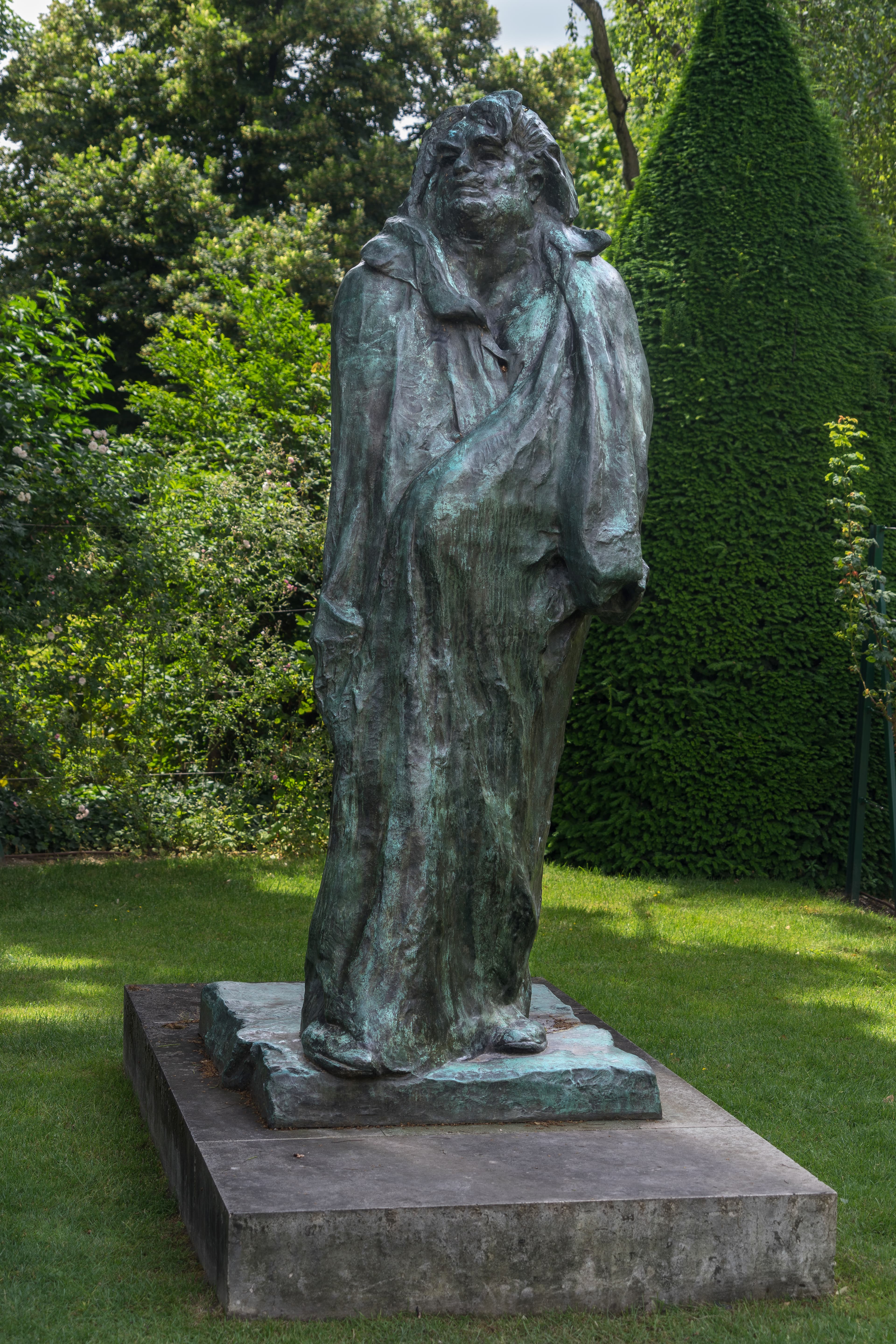
The sculpture is a single standing figure, wrapped from the neck to the ground in a long loose robe. No arms emerge. The figure has no hands, no pen, no book and no chair. The whole body below the collar is one continuous mass of cloth, tapering slightly and then flaring where it meets the ground.
The head is thrown back and tilted, the face turned up and to one side. Deep-set eyes sit in shadow under a heavy brow. The nose is broad, the mouth wide, the jaw heavy. A thick mane of hair sweeps back from the forehead into two wing-like masses that frame the face and merge with a high collar rising behind the head.
The Musée Rodin lists the attributes Auguste Rodin left out: the writer's usual armchair, pen and book. The figure that remains, the museum says, is not so much a portrait as an evocation of the inspired creator, draped in the monk's habit he wore when writing.
The commission and the seven years
Honoré de Balzac died in 1850. The Art Institute of Chicago records that a literary society commissioned Auguste Rodin in 1891 to produce a posthumous monument to the writer. Over seven years, the museum says, the sculptor created numerous studies.
The Cleveland Museum of Art gives the same start date. It describes the figure evolving through multiple stages over a seven-year period, as Auguste Rodin explored different methods of conveying the author's genius and personality. An early full-length version stood upright with the legs apart and the arms crossed over the belly.
The Musée Rodin says Auguste Rodin worked on the body and the head at the same time. He ended with an assemblage in which head and body carried their own separate values. The head moved from a likeness of the writer towards a concentration of expressive features. The body moved the other way, towards a dilution of form in the fluid surface of the dressing gown.
The refusal of 1898
Auguste Rodin exhibited the finished monument in 1898. The Musée Rodin states that it caused such an outrage that the commission was cancelled. The Art Institute of Chicago puts it in the same terms. The version in which the writer appears enveloped in a robe provoked harsh criticism from the public, and the literary society rejected it when it was first exhibited.
The Cleveland Museum of Art explains what the public objected to. Auguste Rodin's unglamorous portrayal of a national hero shocked an audience accustomed to idealised figures in public monuments. The final design drew even sharper criticism because he had reduced the body to a powerful abstract mass.
The society refused the statue, not the sculptor. Auguste Rodin kept the work, and the monument went to Meudon rather than to a Paris square. The Musée Rodin records the consequence plainly: Rodin never saw his monument cast in bronze.
Which cast this is
The bronze pictured above stands in the sculpture garden of the Musée Rodin at the Hôtel Biron, inventory S.01296. The museum gives a date of conception of 1898. It states that Alexis Rudier cast the bronze in 1935 for the museum collections. The bronze measures 270 by 120.5 by 128 centimetres.
That makes the Paris bronze posthumous by eighteen years. Auguste Rodin died in 1917, and the plaster he had finished in 1897 waited nearly four decades for metal. The Musée Rodin dates its own cast to 1935. The Wikimedia Commons record for the photograph used here gives 1931, and the museum's figure is the one taken.
The bronze carries Rodin's signature at the back of the terrace and the mark of the Alexis Rudier foundry in Paris on the back. Those are the marks of an authorised edition rather than of Auguste Rodin's own hand at the furnace.
Reading the Musée Rodin garden bronze
The photograph is taken outdoors from a low position, in front of the figure and slightly to its right. The photograph does not show the back of the sculpture, and the description below covers only the front and that one side.
The robe reads as one mass rather than as folds of cloth over a body. A single broad diagonal sweeps from the upper right down across the front of the robe to the lower left. Beneath that diagonal opens a deep pocket of shadow, where a sleeve mass ends in a blunt rounded stump. The sculpture shows no wrist and no hand.
Down the lower centre the bronze carries close vertical grooves, as if the clay had been dragged downward with the fingers or a tool and not smoothed afterwards. Elsewhere the surface is broad and smeared, with wide flat planes meeting at soft ridges.
At the hem, two foot-shapes push forward from under the cloth. They are the only parts of the body below the neck that the sculpture admits.
The patina of an outdoor bronze
The garden bronze does not look like the studio bronzes of the same sculptor. Its patina is a pale blue-green, mint and celadon, laid in patches and streaks over a darker grey-brown and purplish-grey ground. That colour is weathering rather than a finish applied at the foundry.
The green patina is thickest where rainwater collects and lingers: along the brow, across the shoulders, in the hollows of the collar and on the flat top of the base. Vertical rain tracks run down the robe as darker lines through the green patina. Rust-orange deposits sit where the base meets its plinth.
Photographs of Auguste Rodin's bronzes are often described as green by default. The Metropolitan Museum of Art's indoor casts of other subjects read dark brown to black. This bronze is green because it has stood outside.
The sculpture, the base and the garden
Three layers stack under the figure and only the first belongs to the work. A thick irregular bronze slab with a broken, rocky edge was cast with the sculpture, and it steps down to a second slab at the left. That slab is Auguste Rodin's base.
Under the base sits a plain rectangular grey stone plinth, low and flat, resting on mown grass. That plinth is the museum's, and it sets the height at which a visitor meets the figure.
Behind is the sculpture garden itself: a clipped conical conifer to the right, a rose bush in pink flower to the left, trees and a patch of bright sky above. Sunlight falls across the lawn in patches. None of that is part of the sculpture, and all of it changes how the bronze reads.
The head Rodin arrived at
The head carries the whole likeness, and even there the features are pushed past portraiture. The brow is a heavy shelf. The eye sockets are cut deep enough to hold shadow in almost any light, and the hair is built up in ridged locks rather than described strand by strand.
The Musée Rodin's account of the process explains the result: the head evolved from a portrait resembling the writer into a concentration of expressive features. Auguste Rodin kept enough of Honoré de Balzac to be recognisable and discarded the rest.
Separate studies for the head survive in other collections. The Cleveland Museum of Art holds a Study for the Head of the Monument to Honoré de Balzac, dated 1893–1897. The Art Institute of Chicago holds a Head of Balzac modelled about 1892–93.
The nude studies behind the robe
Auguste Rodin built the figure from the body outward before covering it. The Art Institute of Chicago holds a deliberately ungainly nude portrait of Honoré de Balzac, modelled in 1893. The museum describes it as a departure from the idealised classical bodies typical of public statuary.
The Cleveland Museum of Art's bust of 1891–1892 is a study for the first version. In that version the full figure stood upright, with the legs apart and the arms crossed over the belly. That version was already unflattering enough to shock.
The robe came last and took the body away again. Of those studies, the finished monument keeps only a sense of bulk under the cloth, and nothing a viewer can point to as an arm or a chest.
The studio during the Balzac years
The commission ran from 1891 through the parting that ended Auguste Rodin's working decade with Camille Claudel. The Musée Rodin dates that decade from 1882 to 1892 and lists her roles as student, assistant, mistress and muse.
Camille Claudel worked in the studio on Auguste Rodin's commissions in the first year or two of the Balzac. The museum's wording does not assign her any particular passage of the monument, and no reader should infer one.
She left, and the Balzac went on for six more years. At the end of that labour, in 1897, Auguste Rodin produced what the Musée Rodin calls a revolutionary monument.
Close reading
Reading the work, detail by detail
An outdoor photograph of the Musée Rodin garden bronze, S.01296, taken from a low position in front of the figure and slightly to its right. The back of the sculpture is not in frame. The green of the bronze is weathering rather than a foundry finish, and the stone plinth and the garden behind it are not part of the work.
1.The face is thrown back, the eyes cut deep
The head tips back and the face turns up. The brow is a heavy shelf and the eye sockets are cut deep enough to hold shadow in almost any light. The nose is broad, the mouth wide and closed. Turquoise-green patina lies in patches across the brow and cheek.
2.The hair is a ridged mass, not strands
The hair sweeps back from the forehead in broad ridged locks and gathers into a wing-shaped mass beside the face. No individual strands are described. The Musée Rodin says the head moved from a portrait likeness towards a concentration of expressive features, and the hair is where that shift is easiest to see.
3.A high collar rises behind the head
Behind the head the collar of the gown stands up and runs into the hair, so that neck and shoulder never separate. A blunt fold projects from the collar's edge. The figure has no visible neck at this angle.
4.One long diagonal crosses the whole front
A single broad ridge sweeps from the upper right down across the front of the robe to the lower left. That ridge is the only strong line in the lower two-thirds of the sculpture. Above and beside the ridge the surface is worked into soft smeared planes that meet at rounded edges.
5.The sleeve ends in a blunt stump
At the side of the robe a sleeve mass comes forward and stops in a blunt rounded end above a deep pocket of shadow. The sculpture shows no wrist and no hand. The Musée Rodin lists what Auguste Rodin took away: armchair, pen and book.
6.The clay was dragged downward and left that way
Down the lower centre the bronze carries close vertical furrows, as if the soft clay had been pulled downward and never smoothed. The marks survived the mould and the pour. Rain has since run along the same lines, darkening the green patina between them.
7.A blunt foot-form pushes out from under the hem
Where the robe meets the ground, a rounded blunt mass pushes forward onto the base. The mass reads as a foot, but no toes are modelled and no ankle appears. It is the only part of the body below the collar that the sculpture admits.
8.Rodin's base is a broken slab
The bronze stands on a thick irregular slab whose edge is broken and rocky rather than cut square, stepping down to a second slab at one side. That slab was cast with the figure. Its upper surface holds the brightest mint green anywhere in the photograph, because rain sits on it.
9.The grey stone block underneath is the museum's
Below the bronze sits a plain rectangular grey stone plinth, weathered and stained, with leaf litter caught along the joint and mown grass at its foot. The plinth is museum furniture rather than sculpture, and it decides how far above a visitor the figure stands.
10.The setting is a garden, and it is doing work
Behind the bronze are a clipped conical conifer, leafy trees and a patch of bright sky, all out of focus. None of it belongs to the sculpture. The pale green silhouette is read against the dark hedge, and a different background would change the figure's edge.
Timeline
1850
Honoré de Balzac dies in Paris, forty-one years before the monument to him is commissioned.
1891
A literary society commissions Auguste Rodin to make a posthumous monument to the writer.
1891–1892
Rodin models a bust for a first full-length version that stands upright, legs apart, arms crossed over the belly.
1893
He models a deliberately ungainly nude study of Balzac, away from the idealised bodies of public statuary.
1893–1897
Studies for the head continue as Rodin works the body and the head separately towards their final forms.
1897
After six years of labour, in the Musée Rodin's account, Rodin arrives at the finished monument.
1898
The monument is exhibited, causes an outrage, and is rejected by the literary society; the commission is cancelled.
1917
Auguste Rodin dies without having seen the Balzac cast in bronze.
1935
The Alexis Rudier foundry casts the bronze now in the Musée Rodin sculpture garden, inventory S.01296.
Where to see it
Musée Rodin
Paris, France
A public viewing address has not yet been confirmed for this holding.
Shown in the sculpture garden at the Hôtel Biron. The museum states that works may go out on loan and does not guarantee that any one of them is on view.
Frequently asked questions
Why was Rodin's Balzac rejected?
The literary society that commissioned it refused the finished statue when it was first exhibited in 1898. The Musée Rodin says the monument caused such an outrage that the commission was cancelled, and the Cleveland Museum of Art attributes the anger to Rodin reducing the body to an abstract mass instead of an idealised figure.
Where are Balzac's arms?
Inside the robe, and not shown. The sculpture has no visible arms or hands. The Musée Rodin lists the attributes Auguste Rodin stripped away: armchair, pen and book. The gown closes over everything below the collar.
Did Rodin ever see the Balzac in bronze?
No. The Musée Rodin states that he never saw his monument cast in bronze. He died in 1917, and the museum's garden cast was made by the Alexis Rudier foundry in 1935.
How long did the Monument to Balzac take?
Seven years from the 1891 commission, in the wording of the Art Institute of Chicago and the Cleveland Museum of Art. The Musée Rodin says Auguste Rodin produced the finished monument in 1897 after six years of labour.
What is Balzac wearing?
A long loose robe. The Musée Rodin identifies it as the monk's habit the writer wore when he worked, and treats the garment as the whole body of the sculpture rather than as clothing over one.
How tall is the Monument to Balzac?
The Musée Rodin's bronze is 270 centimetres high, 120.5 wide and 128 deep, before its stone plinth. The bronze stands well above head height for a visitor on the lawn.
Where can you see the Monument to Balzac in Paris?
In the sculpture garden of the Musée Rodin at the Hôtel Biron, where the 1935 bronze stands on a low stone plinth on the lawn. The museum warns that works may be lent, so check before visiting to see one object.
Why is the statue green when other Rodin bronzes are dark?
Because it stands outdoors. The Paris cast has weathered to a pale blue-green over a grey-brown ground, with the green patina heaviest where rain collects. Indoor casts of other Rodin subjects keep a dark brown to black patina.
In the atlas
What the graph records about this work — every claim carries its citation.
The Art Institute of Chicago records that in 1891 Auguste Rodin was commissioned by a literary society to produce a posthumous monument to the French writer Honore de Balzac, who had died in 1850. The Musee Rodin catalogues the garden bronze S.01296 as Monument to Balzac and describes the figure as an evocation of the writer in the monk's habit he wore when working. The date is the museum's date of conception for the finished monument.
— Monument to Balzac — collection record, S.01296; Portrait of Balzac, 1957.529 — the 1891 commission from a literary society and the 1898 rejection, 1957.529
Strasbourg-born sculptor and poet — Hans in German, Jean in French, both all his life — who co-founded Dada at the Cabaret Voltaire in 1916, composed collages by dropping torn paper 'according to the laws of chance', and settled at Meudon outside Paris in a house his wife Sophie Taeuber-Arp designed.
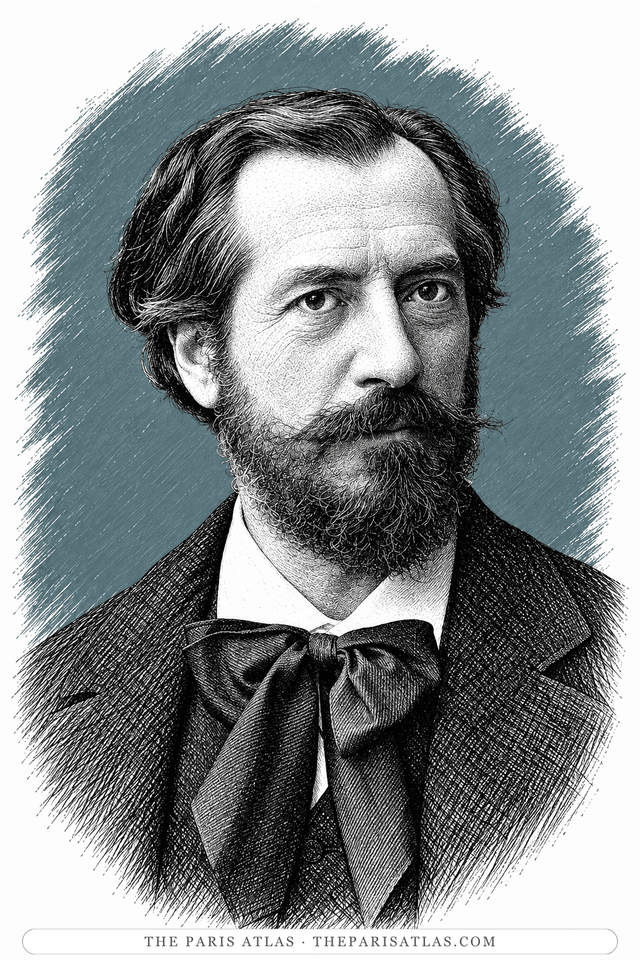
Frédéric Auguste Bartholdi was a French sculptor best known for designing the Statue of Liberty, dedicated in New York Harbor in 1886. Born in Colmar and based in Paris, he created public monuments that gave visible form to ideas of freedom, resistance and national memory. His other major works include the Lion of Belfort and the fountain in Lyon's Place des Terreaux.
The sources below include collection records, catalogues, scholarly research, and primary materials that informed this page. They document Monument to Balzac, its making, and its place in cultural history.
1Monument to Balzac — collection record
Website
Musée Rodin
Used for
The 1935 Alexis Rudier cast, the stripped attributes, the 1898 outrage and the cancelled commission.
These references provide the documented foundation for this work's history and interpretation. Claim-level citations remain attached to the specific claims they support.


 View source