The Age of Bronze
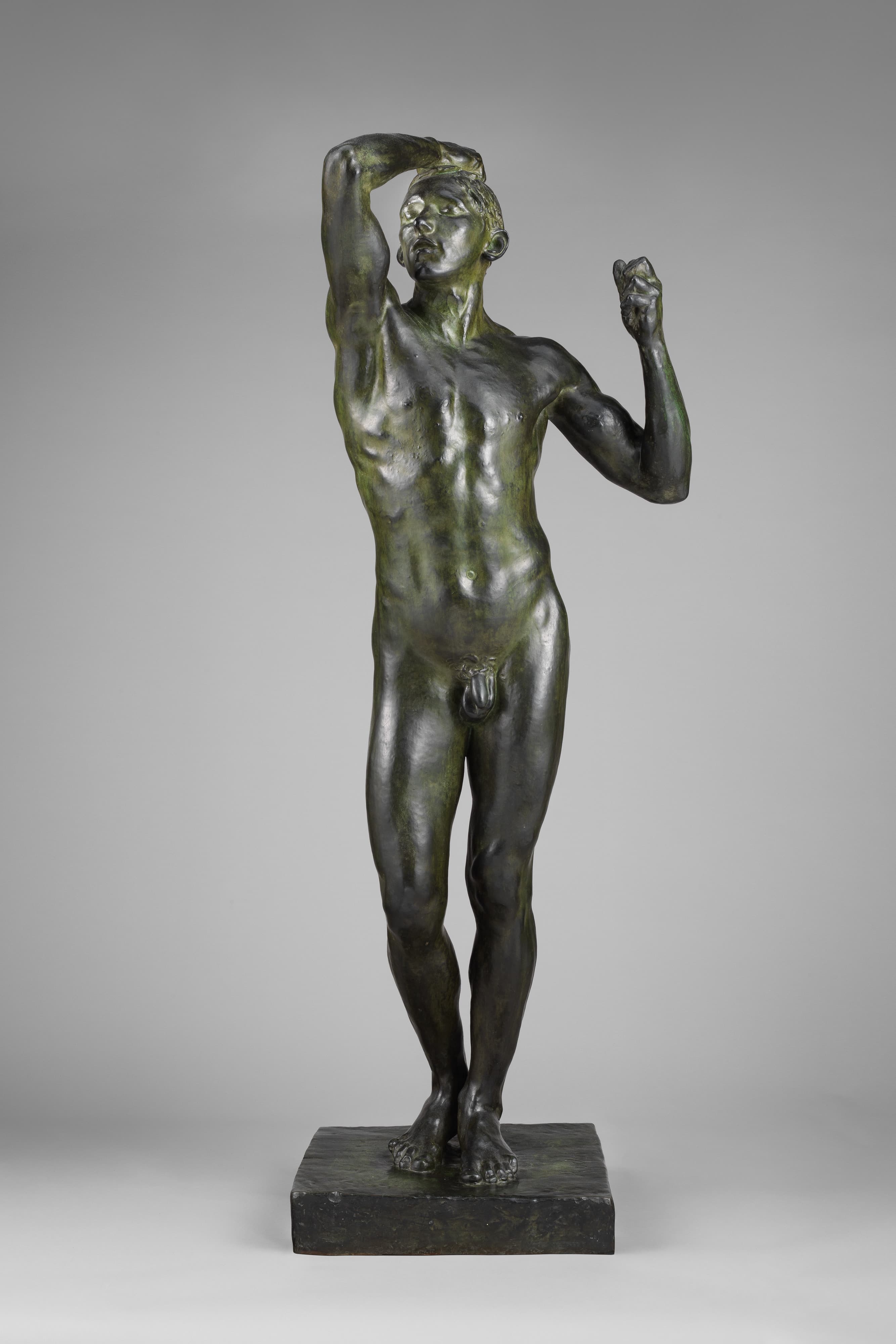
Auguste Rodin's first life-size figure, modelled in Brussels from a young Belgian soldier named Auguste Ney. A spear once stood in the raised left hand. When Rodin removed it and exhibited the nude alone, critics accused him of casting the sculpture directly from a living body.
- Modelled 1876; Metropolitan Museum of Art cast about 1906
- Bronze
- The Metropolitan Museum of ArtNew York, United States
About Auguste Rodin
What the sculpture shows
A naked young man stands with his weight through both legs and his head tipped back. His right arm is bent above him, and the hand rests on the crown of his head. His left arm is raised and folded at the elbow, the fingers curled around nothing.
The body is neither striding nor at rest. The chest is lifted, the ribs show through the skin, and the abdominal wall is drawn tight. The face is turned upward with the eyes almost closed and the lips parted. The figure states no subject, no period and no story.
Auguste Rodin left that emptiness deliberately. The Musée Rodin records the statue as devoid of any element that would shed light on the subject's identity.
Which cast this is
The Metropolitan Museum of Art holds the bronze pictured above, accession 07.127. The museum dates the model to 1876 and the cast to about 1906. The Alexis Rudier foundry made that cast. Mrs. John W. Simpson gave the bronze to the museum in 1907. The cast stands 182.9 centimetres high and weighs 124.7 kilograms.
That cast was poured while Auguste Rodin was alive, so it is a lifetime cast rather than one of the posthumous bronzes elsewhere. The Musée Rodin's own version, inventory S.986, was cast by the Alexis Rudier foundry before 1941 and measures 180.5 by 68.5 by 54.5 centimetres. Auguste Rodin died in 1917, so the Paris bronze is a later edition.
The Cleveland Museum of Art's bronze, 1918.328, has a documented origin of its own. The museum states that its trustee Ralph King commissioned the cast from Auguste Rodin in 1916, and that Rodin personally supervised the casting. Rodin finished it with his favourite patina, a deep reddish tone he called crushed grape.
Three museums, three dates for the model
The holding institutions do not agree on when the figure was modelled. The Cleveland Museum of Art dates it 1875–76. The Metropolitan Museum of Art says 1876. The Musée Rodin gives a date of conception of 1877, the year the figure was first exhibited.
The spread is small but it is real, and it reflects a work made over a stretch of months in Brussels rather than finished on a single day. Where the difference matters, the safe form is to name the museum along with the date.
The spear that was taken away
The raised left hand once held a spear. The Musée Rodin records that the weapon appears in a photograph of the sculpture by Gaudenzio Marconi. Auguste Rodin then decided to suppress the spear, so as to free the arm of any attribute.
Removing the spear removed the subject. With a weapon, the figure is a soldier or a warrior and the raised arm has a job. Without the weapon, the Cleveland Museum of Art writes, Auguste Rodin stripped the sculpture of narrative symbols and focused on the male nude itself.
The hand kept the shape the spear had given it. The fingers still close around a shaft that is no longer there, and the gap they leave is visible in the bronze.
The accusation of casting from a living model
Auguste Rodin exhibited the figure without a title at the Cercle Artistique in Brussels in 1877, then sent it to the Salon in Paris. The Musée Rodin says the figure caused a scandal there. Critics claimed the modelling was too exact to have been made by hand, and that Rodin had taken a mould from his living model.
The charge was serious. Casting from life counted as mechanical reproduction rather than sculpture, and the charge would have disqualified the work as art. Rodin had to prove, in the Musée Rodin's words, that the quality of his sculpture's modelling came from a thorough study of profiles and not from a life cast.
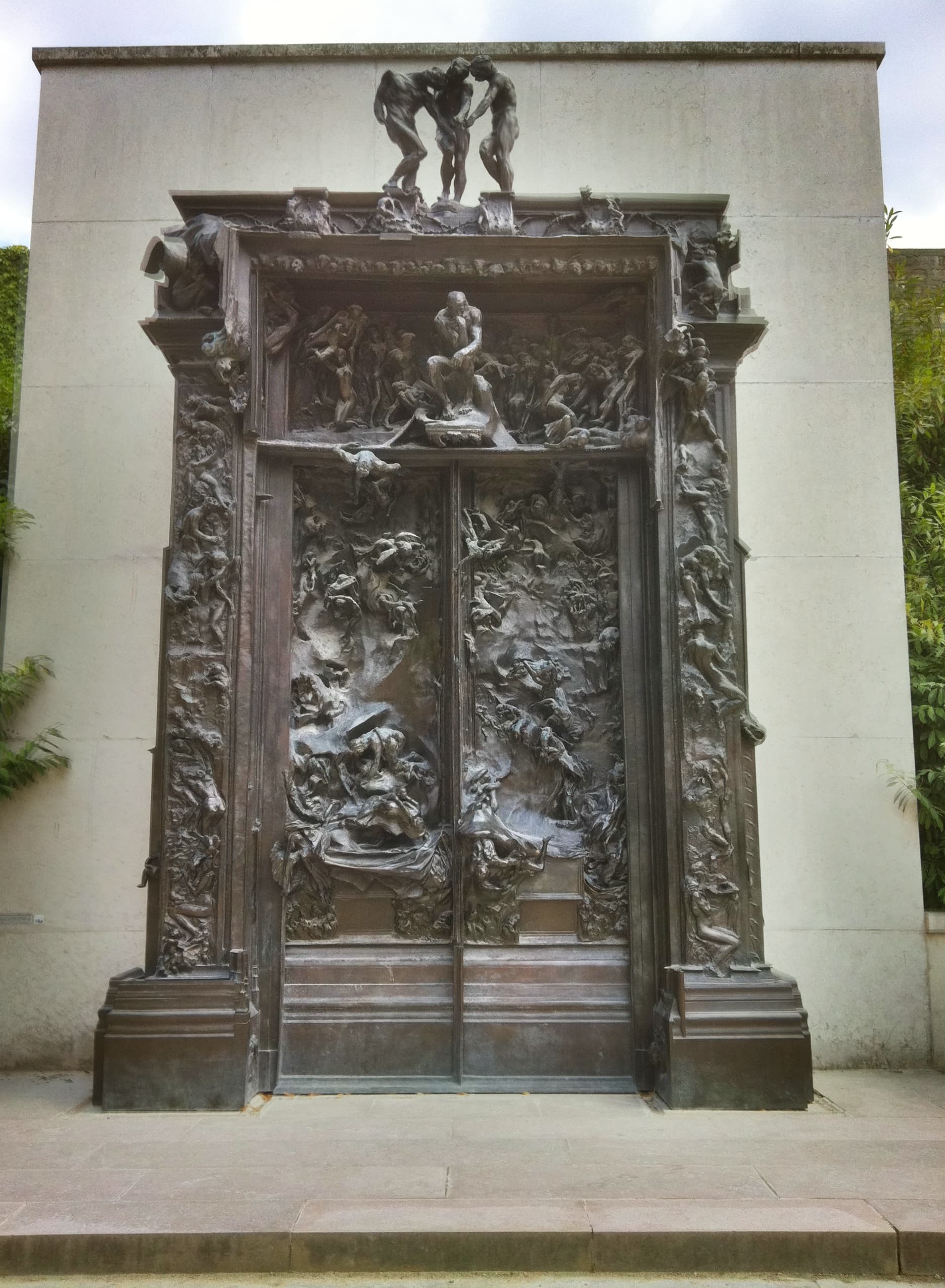
He was cleared. The Musée Rodin records that his critics eventually recognised that the sculptor was innocent of any trickery, and the Cleveland Museum of Art calls the accusation false. The Musée Rodin also notes one result of the affair: the scandal drew attention to Auguste Rodin and earned him the commission for The Gates of Hell in 1880.
Auguste Ney, the model
The Musée Rodin names the model as Auguste Ney, a young Belgian soldier. Rodin was living and working in Brussels at the time, and the figure is the first life-size sculpture of his that survives, according to the Cleveland Museum of Art.
The soldier's identity does not enter the sculpture. The figure has no uniform, no weapon in the finished bronze and no attribute of rank. The accusation of 1877 objected to precisely that closeness between the bronze and the man who stood for it.
The surface, and why it carries the argument
Auguste Rodin's defence rested on modelling, so the surface of the bronze carries his case. The skin over the ribs, the hollow of the flank and the tendons at the neck are described separately rather than smoothed into one another. Light breaks differently on each passage.
The Metropolitan Museum of Art's cast carries a dark brown patina with heavy olive-green mottling across the chest, the raised arm and the thighs. Where the form projects, the patina is rubbed back to a paler grey. The hollows hold the green patina.
Small round pits and raised blisters are scattered over the chest and ribs. They belong to the metal rather than to the body, and they are one way a viewer can tell a bronze surface from the clay it was taken from.
The titles it has carried
The sculpture went unnamed at Brussels in 1877. The Musée Rodin records two other titles the sculpture has carried, The Awakening Man and The Vanquished One. The museum says the title now in use recalls one of the early ages of mankind.
Each title pulls the figure a different way. An awakening man is coming to consciousness, and a vanquished one has been beaten. The bronze supports both readings because Auguste Rodin took away the object that would have settled the question.
How many Age of Bronze casts exist
No single answer covers every version. Bronzes were cast in Rodin's lifetime and after it, and casts exist in reduced sizes as well as at full height. The Metropolitan Museum of Art alone holds more than one version of the subject.
For casts made after his death, the Musée Rodin publishes the rule it works to. As Auguste Rodin's beneficiary the museum holds his intellectual property rights and oversees casting from the original models and molds in his bequest. It limits the number of bronzes cast from an original work to twelve, and two committees of sculpture experts must validate each project.
Where it sits in Rodin's working life
The Age of Bronze precedes the studio Auguste Rodin is best known for. Camille Claudel, who worked beside him as student and assistant, entered his studio in 1882, several years after the Brussels figure was finished and exhibited.
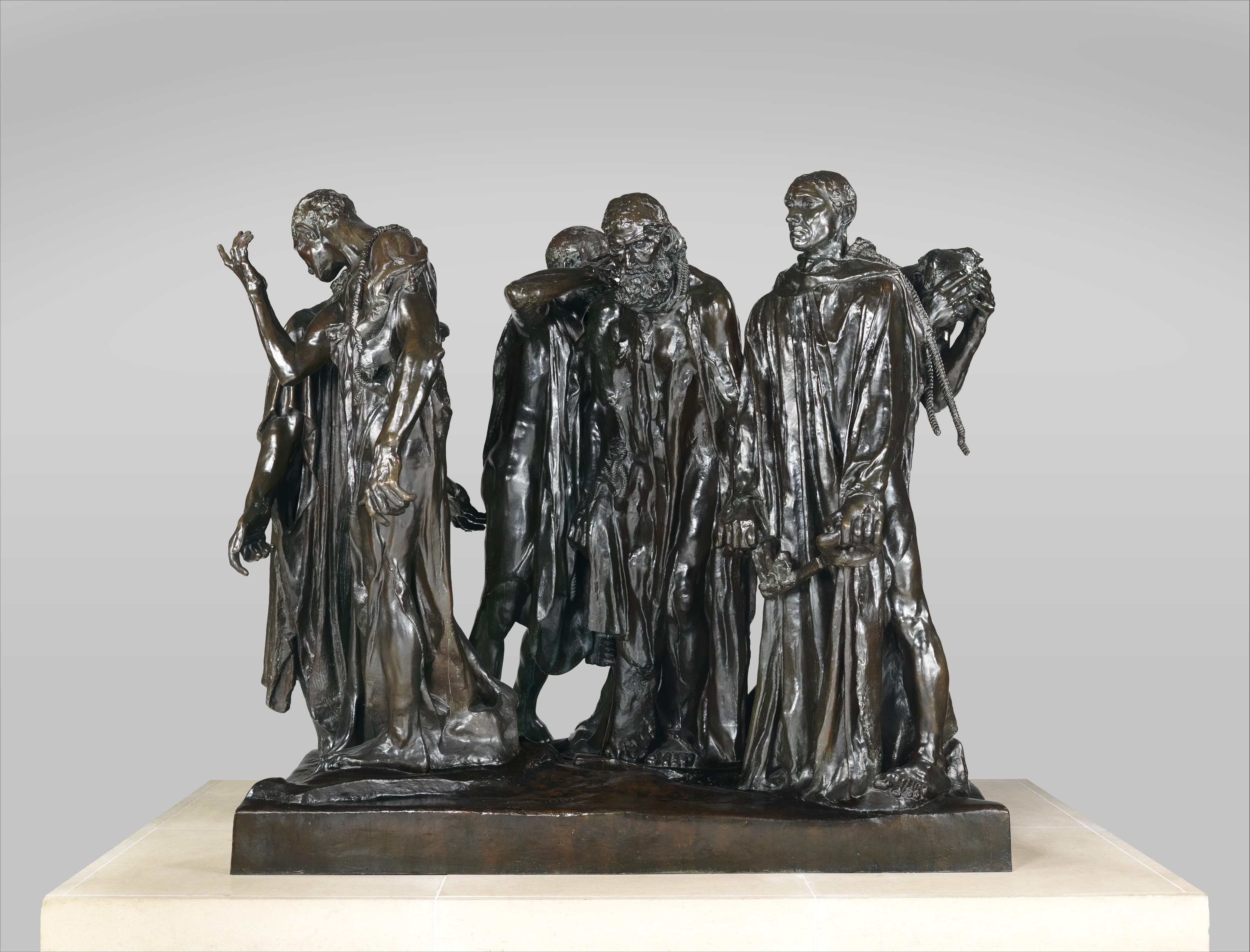
The Gates of Hell followed in 1880, and The Burghers of Calais in 1884. Both were large commissions with assistants and subcontracted labour behind them. The Age of Bronze was made before any of that, by a sculptor in his mid-thirties with no public reputation to protect.
Close reading
Reading the work, detail by detail
A Metropolitan Museum of Art studio plate of the museum's cast 07.127, taken from directly in front against a plain grey backdrop. The whole figure is in frame from the crown of the head to the bronze slab under the feet. The back of the sculpture is not visible at all, and Auguste Rodin worked it as hard as the front.
1.The right hand rests on top of the head
The right arm bends above the skull and the hand settles on the crown. The fingers are barely separated, and the hand sinks into the rough locks of hair rather than gripping them. The arm carries no weight in this pose.
2.The face is tipped back with the eyes almost shut
The head tilts back and slightly to one side. Both eyes are nearly closed under heavy lids and the lips are just parted. The face is polished to a pale grey-green where it projects, while the hair beside it stays rough and dark.
3.The left hand still closes around a missing spear
The fingers curl over and the thumb comes across, leaving a clear open channel through the middle of the fist. A spear stood there once, recorded in a photograph by Gaudenzio Marconi. The Musée Rodin says Auguste Rodin suppressed the weapon to free the arm of any attribute, and the hand kept its shape.
4.Small round pits sit across the chest
The ribs are described one by one under a tight skin, and the collarbones stand out at the top. Small round pits and raised blisters are scattered across the pectorals and ribs. They belong to the casting and not to the body.
5.The green patina collects where the form goes in
The patina is not one colour. Olive green lies thick along the flank and under the arm, where the surface turns away from the light. On the ridges the patina is rubbed back to a paler warm grey. The green patina marks the hollows.
6.The abdominal wall is drawn tight
Below the ribs the abdominal wall is pulled taut and divided into separate planes rather than smoothed into one surface. The navel is a deep round pit. The critics of 1877 said modelling like this was too exact to be handmade.
7.Both feet stand flat, set slightly apart
Both feet are flat on the bronze base and set a little apart, one slightly ahead of the other. Every toe is modelled separately and the nails are indicated. The stance suggests neither walking nor turning.
8.The base is cast rough, not polished
The base is a thick rectangular bronze slab. Its top is hammered and uneven, and the vertical edge is pitted, with a run of metal visible at one corner. The base is part of the sculpture rather than museum furniture, and Auguste Rodin left it deliberately coarse.
Timeline
1871–1877
Auguste Rodin lives and works in Brussels, where he models the life-size figure from a young Belgian soldier, Auguste Ney.
1875–1877
The model is made. The Cleveland Museum of Art dates it 1875–76, the Metropolitan Museum of Art 1876, and the Musée Rodin 1877.
1877
The untitled figure is shown at the Cercle Artistique in Brussels, then at the Salon in Paris, where it causes a scandal.
1877
Auguste Rodin is accused of taking a cast from his living model and has to defend the work as modelling built from a study of profiles.
1880
The French state commissions The Gates of Hell. The Musée Rodin links the commission to the attention the scandal brought him.
About 1906
The Alexis Rudier foundry casts the bronze now in the Metropolitan Museum of Art, accession 07.127.
1907
Mrs. John W. Simpson gives that cast to the Metropolitan Museum of Art.
1916
Ralph King commissions a cast from Auguste Rodin for the Cleveland Museum of Art. Rodin supervises the casting and its crushed-grape patina.
1917
Auguste Rodin dies at Meudon, near Paris. Every later bronze of the subject is a posthumous cast.
Where to see it
The Metropolitan Museum of Art
1000 Fifth Avenue, New York, NY 10028, United States
The Musée Rodin in Paris and the Cleveland Museum of Art also hold casts of the subject. Museums lend works, so check the object page before travelling to see one.
Plan your visit on the museum’s official website (opens in a new tab)Frequently asked questions
Why was Rodin accused of cheating with The Age of Bronze?
Critics at the 1877 Salon thought the modelling was too exact to be handmade and claimed he had moulded the figure directly from his living model. Casting from life counted as reproduction rather than sculpture, so the charge attacked the work's status as art.
Was the accusation true?
No. The Musée Rodin records that his critics eventually recognised that the sculptor was innocent of any trickery, and the Cleveland Museum of Art describes the accusation as false. Rodin defended the work as modelling built from a thorough study of profiles.
Who modelled for The Age of Bronze?
The Musée Rodin names him as Auguste Ney, a young Belgian soldier. Rodin was working in Brussels at the time.
Did the figure once hold something?
Yes. A spear stood in the raised left hand, recorded in a photograph by Gaudenzio Marconi. Rodin removed it to free the arm of any attribute, and the hand still closes around the space where the shaft was.
What does the title mean?
The Musée Rodin says the statue recalls one of the early ages of mankind. The sculpture has also been exhibited as The Awakening Man and The Vanquished One, and it was shown without any title at all in Brussels in 1877.
How tall is The Age of Bronze?
About 1.8 metres, or life size. The Metropolitan Museum of Art's cast is 182.9 centimetres high, the Cleveland Museum of Art's is 182.2 centimetres with its base, and the Musée Rodin's is 180.5 centimetres.
Where is the original Age of Bronze?
The question has no single answer, because bronze sculpture exists in authorised editions. The Metropolitan Museum of Art holds a cast made about 1906, during Rodin's life. The Musée Rodin, the Cleveland Museum of Art and other institutions hold their own casts with their own dates.
Is it Rodin's first sculpture?
The Age of Bronze is his first surviving life-size sculpture, in the Cleveland Museum of Art's wording. He had worked for two decades as an ornamental modeller before it.
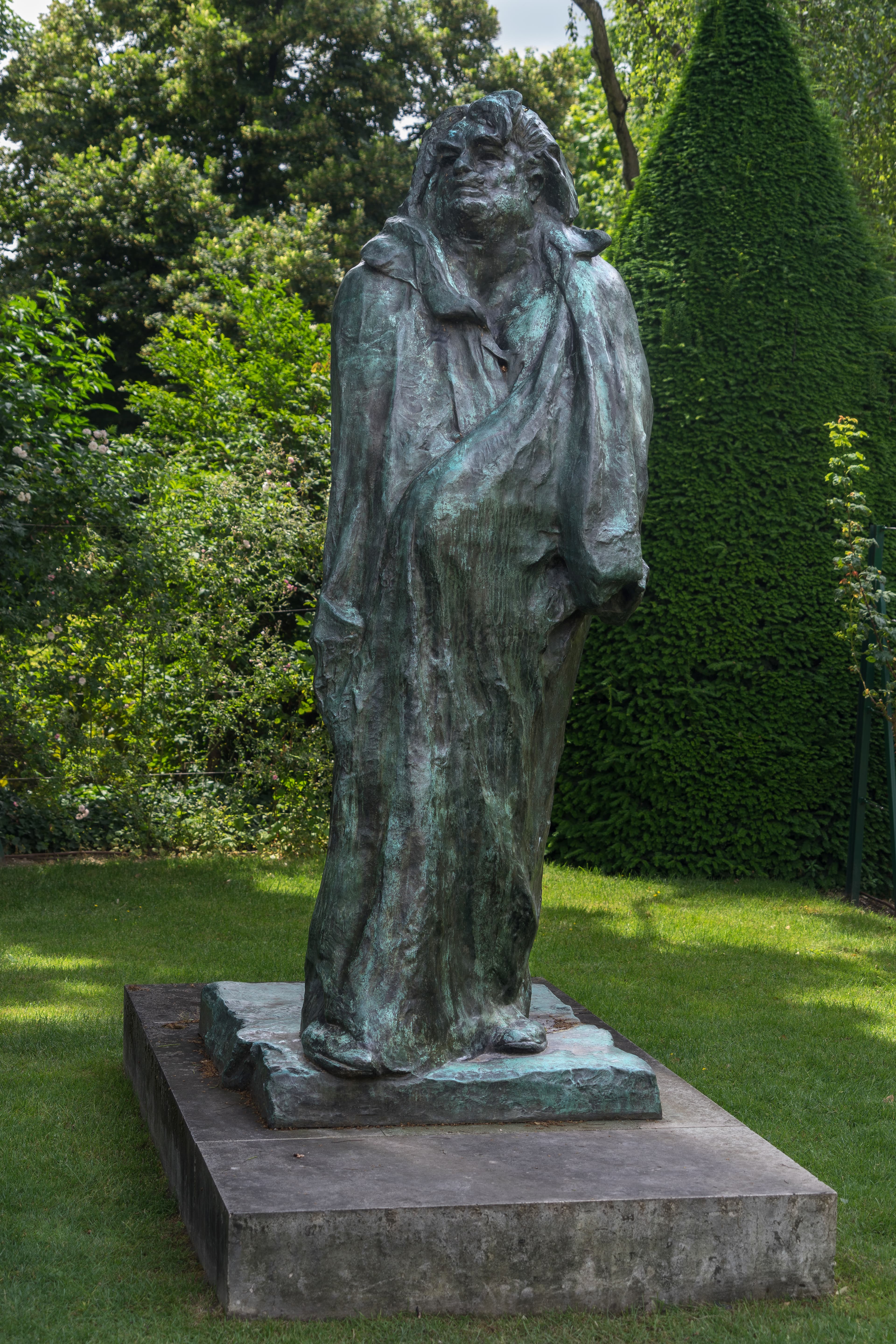
More by Auguste Rodin
If you like Auguste Rodin
Explore sculptors from the same movements and circles.
Arman
French-American artist, lifelong friend of Yves Klein, and a founder of New Realism.
View artist
Jean Arp
Strasbourg-born sculptor and poet — Hans in German, Jean in French, both all his life — who co-founded Dada at the Cabaret Voltaire in 1916, composed collages by dropping torn paper 'according to the laws of chance', and settled at Meudon outside Paris in a house his wife Sophie Taeuber-Arp designed.
View artist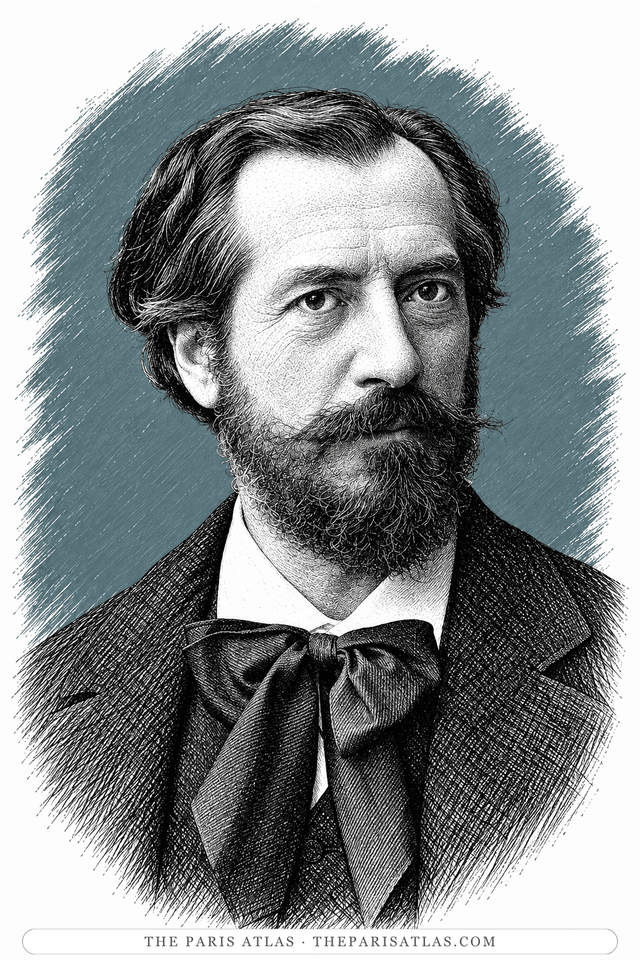
Frédéric Auguste Bartholdi
Frédéric Auguste Bartholdi was a French sculptor best known for designing the Statue of Liberty, dedicated in New York Harbor in 1886. Born in Colmar and based in Paris, he created public monuments that gave visible form to ideas of freedom, resistance and national memory. His other major works include the Lion of Belfort and the fountain in Lyon's Place des Terreaux.
View artist
References
The sources below include collection records, catalogues, scholarly research, and primary materials that informed this page. They document The Age of Bronze, its making, and its place in cultural history.


1The Age of Bronze (L'Age d'airain), 07.127 — modelled 1876, cast about 1906 by the Alexis Rudier foundry
WebsiteThe Metropolitan Museum of ArtUsed forWeb source consulted for documented facts and historical context presented on the The Age of Bronze page.
2The Age of Bronze — Paris bronze S.986
WebsiteMusee RodinUsed forAuguste Ney as the model, the suppressed spear, the life-cast accusation and its resolution.
3The Age of Bronze, 1918.328 — cast commissioned from Rodin in 1916 by Ralph King
WebsiteCleveland Museum of ArtUsed forRodin's earliest surviving life-size sculpture; the 1916 King commission and the crushed-grape patina.
4Original bronze casts
WebsiteMusée Rodin, 2026Used forWeb source consulted for documented facts and historical context presented on the The Age of Bronze page.
5The Gates of Hell — S.01304
WebsiteMusée Rodin, 2026Used forWeb source consulted for documented facts and historical context presented on the The Age of Bronze page.
6Camille Claudel comes out of the reserve collections
WebsiteMusée Rodin, 2026Used forWeb source consulted for documented facts and historical context presented on the The Age of Bronze page.
These references provide the documented foundation for this work's history and interpretation. Claim-level citations remain attached to the specific claims they support.
 Explore more resources