The Burghers of Calais
Six men walk out of a besieged city to be executed. Auguste Rodin was commissioned in 1884 to commemorate the citizens who surrendered themselves to end the siege of Calais in 1347, and he refused to make them heroes. He gave each one a separate way of being afraid.
- Modelled 1884–1895; Metropolitan Museum of Art cast 1985
- Bronze
- The Metropolitan Museum of ArtNew York, United States
About Auguste Rodin
What the sculpture shows
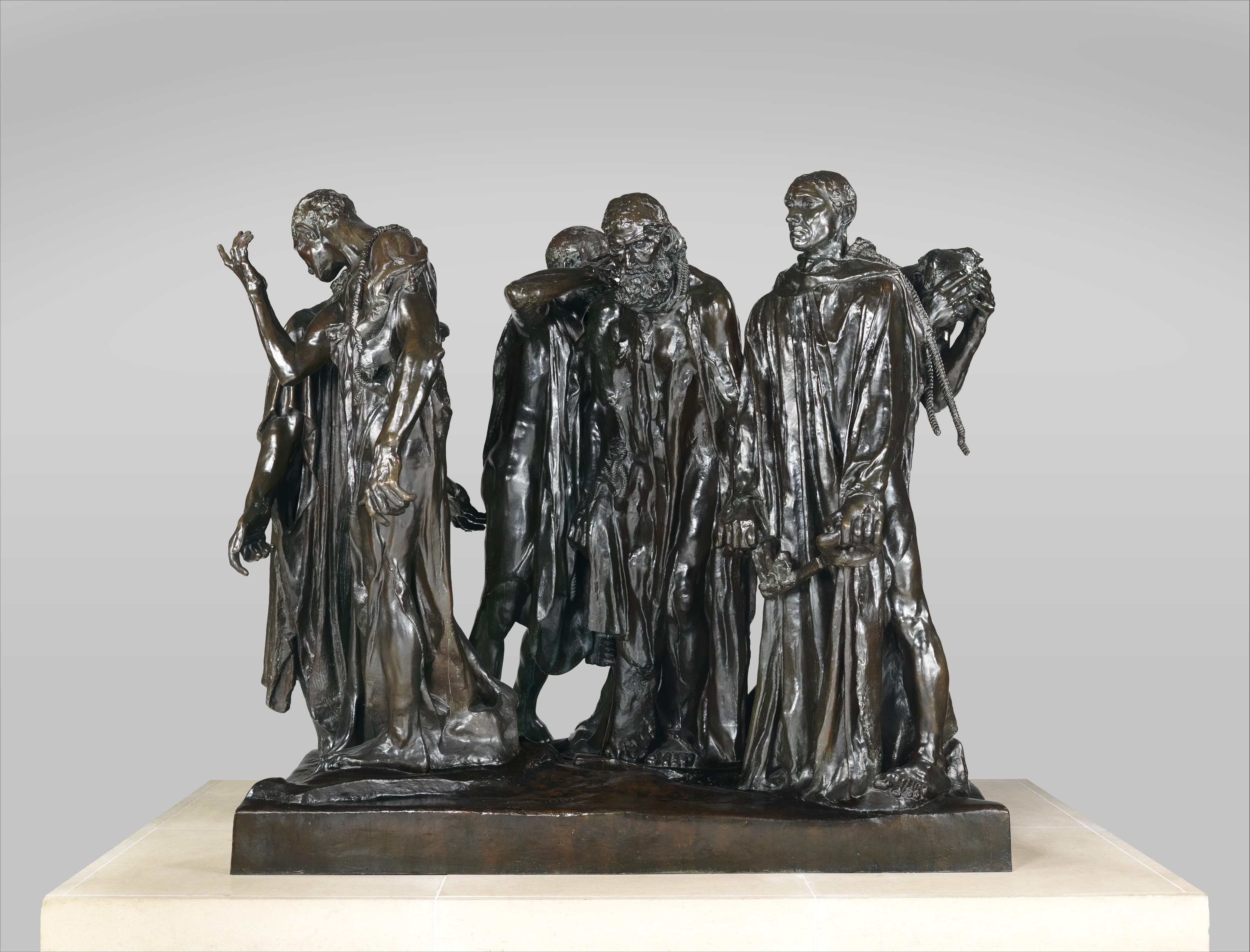
Six men in coarse full-length robes stand close together, roped at the neck. They are not arranged in a line or a pyramid. They crowd against one another at different depths, facing different ways, so that no single viewpoint takes all six faces at once.
Nobody leads. One man bows his head almost to his chest. Another raises an open hand. A third stands upright with his jaw set and his eyes forward. A fourth clamps both hands over his own head. Each figure is working through the same fact alone.
The Musée Rodin describes the choice directly: Rodin grouped the six as an indivisible whole going to their sacrifice together, while working the identity and psychology of each one facing the drama.
What happened at Calais in 1347
The event belongs to the Hundred Years' War between France and England. The Musée Rodin sets it out plainly: six citizens sacrificed themselves when they gave the keys of their city to the King of England in 1347, ending a siege that had lasted a year.
The Cleveland Museum of Art calls the siege brutal and gives its length as eleven months, and describes the six as men who volunteered to be taken prisoner in exchange for the release of the town. The Art Institute of Chicago names the king as Edward III and says the siege had been starving the inhabitants for nearly a year.
The Musée Rodin names the six: Eustache de Saint-Pierre, Jean d'Aire, Pierre and Jacques de Wissant, Andrieu d'Andres and Jean de Fiennes.
The commission, and a date worth checking
Omer Dewavrin, the mayor of Calais, approached Rodin through the sculptor Alphonse Prosper Isaac, and an official commission followed the next year. The Musée Rodin tells that sequence on its own page for the Meudon plaster, but prints the approach as 1894 — a year that cannot stand beside the completion date of 1889 on the same page.
The Cleveland Museum of Art gives the year that fits: in 1884 Rodin received a commission to create a large public monument honouring the six. The same museum dates the monument 1884–89. The approach therefore belongs to 1884 and the formal commission to 1885.
Rodin completed the final version in 1889, according to the Musée Rodin. After casting, it was unveiled in Calais on 3 June 1895, six years later.
Which cast is described here
The bronze pictured above belongs to the Metropolitan Museum of Art, accession 1989.407. The museum dates the modelling 1884–95 and the cast to 1985, made by the Coubertin foundry at Saint-Rémy-lès-Chevreuse. Iris and B. Gerald Cantor gave it to the museum in 1989. It measures 209.6 by 238.8 by 241.3 centimetres.
That cast is posthumous by sixty-eight years. Auguste Rodin died in 1917, so no hand of his touched the metal. What he left behind were the models and molds, and the right to cast from them.
The Musée Rodin holds the plaster the bronzes descend from, inventory S.153, in the plaster gallery at its Meudon site. The museum records it as 225 by 240 by 200 centimetres and dates its completion to 1889.
Lifetime casts and posthumous casts
The date of the model is not the date of the cast, and for Rodin the two can be a century apart. A label reading 'modelled 1884–95, cast 1985' describes one object accurately rather than contradicting itself.
The Musée Rodin publishes the rule that governs the later bronzes. As Rodin's beneficiary it holds his intellectual property rights, and it oversees casting from the original models and molds in his bequest. The number of bronzes that may be cast from an original work is limited to twelve, and the museum traditionally acquires one of them for the French national collections.
Each project, the museum states, requires detailed historical and archival research and must be validated by two committees of sculpture experts, French and foreign. An ethical charter sets the criteria. That machinery is why an authorised 1985 bronze is a different category of object from an unauthorised aftercast.
Reading the Metropolitan Museum of Art plate
The photograph is a studio plate taken from slightly above eye level, a little to the left of centre. It shows the group from one side only. Five of the six heads are legible in the frame; the sixth is hidden behind the others, and nothing below the far side of the group can be seen.
At the left of the plate a man bows his head until the face is nearly horizontal, and raises his right hand open with the fingers spread. A thick braided rope loops around his neck and falls across the shoulder. His other arm hangs, and a second bare arm and hand belonging to a figure behind him drop into the same passage.
In the middle a bearded man faces forward. Beside him a bald head is bowed so low that only the crown and a sliver of cheek show, and a forearm sweeps horizontally in front of it. At the right a man stands upright in profile with his jaw set, a heavy rope around his neck running down his back in two strands.
Behind that upright figure, two hands press against a bowed head, the fingers of one lying across the other. His face is completely hidden behind them at this angle. The plate shows the gesture and withholds the expression.
Low in the frame, two large hands hang clear of the robes. One is closed into a fist with the knuckles forward. The other curls loosely around a shaft, and beside it a ring-shaped bow and a flat bit read as a large key — the keys of the city the six were carrying out.
The modelling and the patina
The drapery is the main surface event. The robes fall in long unbroken ridges that catch the light as hard white lines, with deep near-black troughs between them. Rodin used the cloth to carry the weight of the figures downward while the heads and hands do the acting.
The patina on the Metropolitan Museum of Art's cast reads dark brown to black, not green. The high points of the drapery are polished to a silvery sheen. Warm reddish-brown shows along the top of the base where the light falls flat, and the deepest recesses at the lower centre of the group go a greenish black.
Hands and faces are modelled at a different pitch from the cloth. Knuckles, tendons, the cords of a neck and the texture of a beard are worked in small separate touches, so those passages break the light into many pieces while the robes break it into few.
The sculpture, the base and the pedestal
Three things stack in the photograph and only one of them is the sculpture. The figures stand on a bronze plinth cast with them, whose top surface ripples slightly and over whose edge the hems of the robes spill. That plinth is part of the work.
Under it sits a plain pale museum pedestal with a visible joint line. That is museum furniture, chosen by the Metropolitan Museum of Art, and it is not Rodin's. Behind everything is a graduated grey studio backdrop, which is lighting equipment rather than a wall in a gallery.
The distinction matters for this sculpture more than for most. How high the burghers stand above a viewer changes what the group does, and the height in the photograph is the museum's decision about display, not a fact about the monument.
The figures that left the group
Rodin made the six as separate studies before assembling them, and the separate versions kept circulating afterwards. The Musée Rodin holds numerous models and studies of nude figures, hands and drapery at Meudon.
The Cleveland Museum of Art records that Rodin exhibited a life-size Pierre de Wissant as an independent work before he completed the monument, and that he later made multiple versions in various sizes and media. Of Jean d'Aire the same museum writes that the figure was immensely popular on its own and that Rodin made numerous versions at various scales.
One of those travelled early. The Art Institute of Chicago holds a plaster Jean d'Aire, painted to look like bronze, that was shown at the World's Columbian Exposition in Chicago in 1893 and entered the collection that year. The monument itself would not be unveiled in Calais for another two years.
What Rodin refused to make
Public monuments of the period tended to elevate a single figure and idealise him. The Cleveland Museum of Art states what Rodin did instead: rather than idealised heroes, he portrayed the prominent citizens as ordinary men experiencing personal confrontations with death.
The same museum reads the individual figures that way. Jean d'Aire faces his fate with stoic resolve, and the thick folds of his tunic weigh on his body. Pierre de Wissant's expression suggests extreme mental suffering as he contemplates his expected execution.
Fear and resolve sit side by side in the same group, at the same scale, with no one raised above the others. A monument built to honour six men shows some of them close to breaking.
The studio behind the commission
The years of the monument overlap the decade Camille Claudel spent in Rodin's studio. The Musée Rodin dates that period from 1882, when they met, to their parting in 1892, and lists her roles in one line: student, assistant, mistress and muse.
Claudel worked in the studio on Rodin's commissions during exactly the years the Burghers were modelled and cast. The museum's phrasing describes the arrangement without assigning her particular passages of particular works, and no attribution of specific hands or heads within the group follows from it.
She was one of several. A commission on this scale ran on assistants, enlargers, mould-makers and a foundry, and the finished bronze is the product of a workshop with Rodin's name on it.
Close reading
Reading the work, detail by detail
A Metropolitan Museum of Art studio plate of the museum's 1985 cast, 1989.407, taken from slightly above eye level and a little left of centre. Five of the six heads are legible in the frame. The sixth is hidden behind the others, and the whole far side of the group is out of view.
1.An open hand rises at the left of the group
At the left edge of the group a hand lifts with all five fingers spread and slightly curled. It holds nothing and reaches for nothing in the frame. The gesture is the largest movement anywhere in the sculpture.
2.Beside it, a head bows almost to the horizontal
The head next to the raised hand drops until the face is close to horizontal. The hair is a thick textured cap over it. A braided rope loops around the neck and falls across the shoulder, and the rope is modelled strand by strand.
3.The bearded man faces forward
In the middle of the group a bearded man holds his head up and faces forward. The beard is built from deep separate touches that catch the light in many small pieces. His eyes sit far back under the brow and are in shadow at this angle.
4.A bare head drops so low the face disappears
To the bearded man's left a bare head bows so far that only the crown and a sliver of cheek remain visible. A forearm sweeps horizontally across in front of it. Whatever this man's face is doing, the photograph does not show it.
5.One man stands upright with his jaw set
At the right of the group a man holds his head up and looks out in profile. The jaw is set and the mouth closed. He is the only figure in the frame whose head is above the level of his own shoulders.
6.Behind him, two hands close over a bowed head
Behind the upright figure, two hands come up and press against a bowed head, the fingers of one lying across the other. The knuckles stand up sharply. It is the most extreme gesture in the group, and it is almost hidden from this viewpoint.
7.The rope falls in two braided strands
A heavy rope runs over a shoulder and drops in two strands, each twist of the braid modelled separately. The ropes mark the six as men handed over for execution. They hang loose rather than pulling tight.
8.One hand is closed hard into a fist
Low among the robes a hand hangs clear and closed hard, the knuckles turned forward and the fingers curled in. Rodin modelled the hands larger in proportion than the heads. Nothing is being held in this one.
9.A large key hangs from a loosened hand
Beside the fist, a second hand curls loosely around a shaft. The shaft runs down to a looped bow and a flat bit, and the object reads as a large key. The Musée Rodin records that the six carried the keys of their city out to the King of England.
10.A bare foot stands on the bronze plinth
Where the robes part at ground level, a bare foot shows with the toes modelled one by one. The men walked out unshod. The top of the bronze plinth around it is not flat but rippled, like ground that has been walked over.
11.The bronze base is the sculpture; the pale block is not
Two different things stack here. The dark bronze plinth was cast with the figures and the hems of the robes spill over its edge, so it belongs to the work. The pale block under it is a museum pedestal chosen by the Metropolitan Museum of Art, and the height it sets is a display decision.
Timeline
1347
Six citizens of Calais surrender themselves and the keys of the city to Edward III of England, ending a siege of about a year.
1884
Omer Dewavrin, mayor of Calais, approaches Rodin through the sculptor Alphonse Prosper Isaac about a commemorative monument.
1885
The official commission follows, a year after the approach, in the Musée Rodin's account of the sequence.
1886
Rodin exhibits a life-size Pierre de Wissant as an independent work before the monument is finished.
1889
Rodin completes the final version of the monument, after numerous studies of nude figures, hands and drapery.
1893
A plaster Jean d'Aire, painted to simulate bronze, is shown at the World's Columbian Exposition in Chicago.
3 June 1895
The monument is unveiled in Calais, six years after Rodin finished it.
1917
Auguste Rodin dies. Every cast made afterwards is a posthumous one, produced under the Musée Rodin's authority.
1985
The Coubertin foundry at Saint-Rémy-lès-Chevreuse casts the bronze now in the Metropolitan Museum of Art.
1989
Iris and B. Gerald Cantor give that cast to the Metropolitan Museum of Art, where it is accession 1989.407.
Where to see it
The Metropolitan Museum of Art
1000 Fifth Avenue, New York, NY 10028, United States
The monument itself stands in Calais, and the Musée Rodin holds the 1889 plaster at Meudon. Museums lend works, so check the object page before travelling to see one.
Plan your visit on the museum’s official website (opens in a new tab)Frequently asked questions
Who are the six burghers?
The Musée Rodin names them as Eustache de Saint-Pierre, Jean d'Aire, Pierre and Jacques de Wissant, Andrieu d'Andres and Jean de Fiennes. They were citizens of Calais who gave themselves up to the King of England in 1347.
What are they carrying?
The keys of the city, which they surrendered to the King of England, and the ropes around their necks that marked them for execution. A large key is visible low in the group, held in a hanging hand.
Were the burghers executed?
The sculpture shows the moment of the offer, not its outcome. The Cleveland Museum of Art describes Pierre de Wissant contemplating his expected execution, which is what the figures are shown facing.
When was The Burghers of Calais commissioned?
In 1884, in the Cleveland Museum of Art's wording, after the mayor of Calais approached Rodin through the sculptor Alphonse Prosper Isaac. The official commission followed the next year. The Musée Rodin's English and French pages both print 1894, which cannot fit their own completion date of 1889.
How many casts of The Burghers of Calais are there?
Several, in museums and public sites in different countries. For bronzes cast after Rodin's death, the Musée Rodin limits an original work to twelve casts and validates each project through two committees of sculpture experts.
Is the Metropolitan Museum of Art's cast an original?
It is an authorised cast made in 1985, sixty-eight years after Rodin died, from the models and molds he left. It is not a lifetime bronze, and the museum's own label gives both dates: modelled 1884–95, cast 1985.
Where can you see The Burghers of Calais?
The monument stands in Calais, where it was unveiled in 1895. The Musée Rodin shows the 1889 plaster in the plaster gallery at its Meudon site, and the Metropolitan Museum of Art holds the 1985 bronze. Other casts are elsewhere.
Why does the group have no obvious front?
Rodin modelled the six facing different directions at different depths, so no single viewpoint gathers all six faces. In the studio photograph five heads are legible and the sixth is hidden behind the others.
How big is the sculpture?
The Metropolitan Museum of Art's bronze is 209.6 centimetres high, 238.8 wide and 241.3 deep. The Musée Rodin's Meudon plaster is 225 by 240 by 200 centimetres. The figures are close to life size.
More by Auguste Rodin
If you like Auguste Rodin
Explore sculptors from the same movements and circles.
Arman
French-American artist, lifelong friend of Yves Klein, and a founder of New Realism.
View artist
Jean Arp
Strasbourg-born sculptor and poet — Hans in German, Jean in French, both all his life — who co-founded Dada at the Cabaret Voltaire in 1916, composed collages by dropping torn paper 'according to the laws of chance', and settled at Meudon outside Paris in a house his wife Sophie Taeuber-Arp designed.
View artist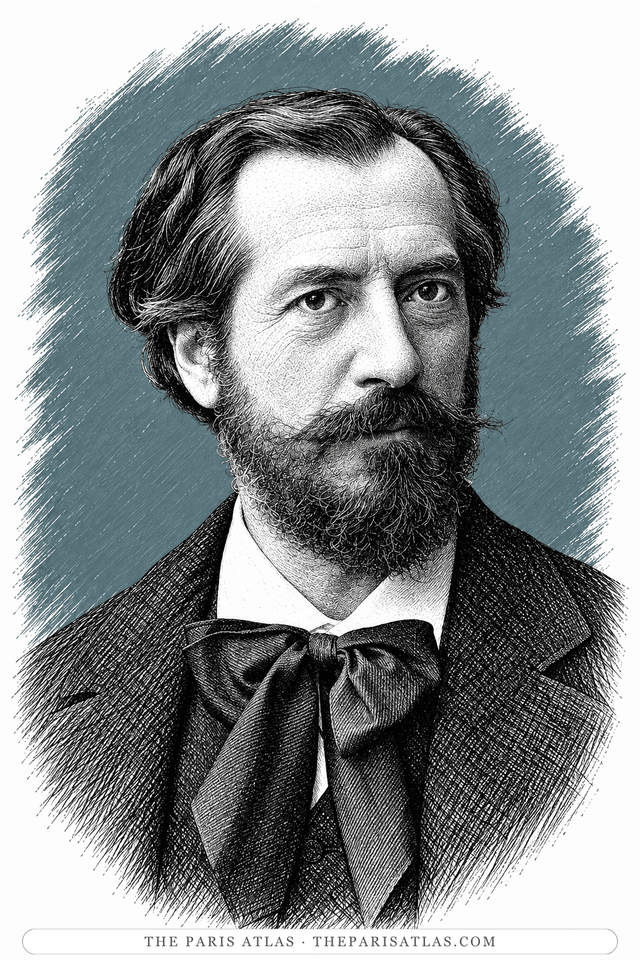
Frédéric Auguste Bartholdi
Frédéric Auguste Bartholdi was a French sculptor best known for designing the Statue of Liberty, dedicated in New York Harbor in 1886. Born in Colmar and based in Paris, he created public monuments that gave visible form to ideas of freedom, resistance and national memory. His other major works include the Lion of Belfort and the fountain in Lyon's Place des Terreaux.
View artist
References
The sources below include collection records, catalogues, scholarly research, and primary materials that informed this page. They document The Burghers of Calais, its making, and its place in cultural history.

1The Burghers of Calais, 1989.407 — modelled 1884-95, cast 1985 by the Coubertin foundry
WebsiteThe Metropolitan Museum of ArtUsed forWeb source consulted for documented facts and historical context presented on the The Burghers of Calais page.
2Monument to the Burghers of Calais — Meudon plaster S.153
WebsiteMusee RodinUsed forThe six names, the indivisible group, the 1889 completion and the unveiling at Calais on 3 June 1895.
3Jean d'Aire, 1917.723 — the 1884 Calais commission
WebsiteCleveland Museum of ArtUsed forThe 1884 commission, the eleven-month siege, and Rodin's refusal to idealise the six.
4Heroic Head of Pierre de Wissant, One of the Burghers of Calais, 1920.120
WebsiteCleveland Museum of ArtUsed forThe monument dated 1884-89, and the life-size figure exhibited alone before completion.
5A Burgher of Calais (Jean d'Aire), 1893.187 — plaster shown at the 1893 World's Columbian Exposition
WebsiteArt Institute of ChicagoUsed forEdward III named, and the plaster shown at the 1893 World's Columbian Exposition.
6Original bronze casts
WebsiteMusée Rodin, 2026Used forWeb source consulted for documented facts and historical context presented on the The Burghers of Calais page.
7Camille Claudel comes out of the reserve collections
WebsiteMusée Rodin, 2026Used forWeb source consulted for documented facts and historical context presented on the The Burghers of Calais page.
These references provide the documented foundation for this work's history and interpretation. Claim-level citations remain attached to the specific claims they support.
 Explore more resources