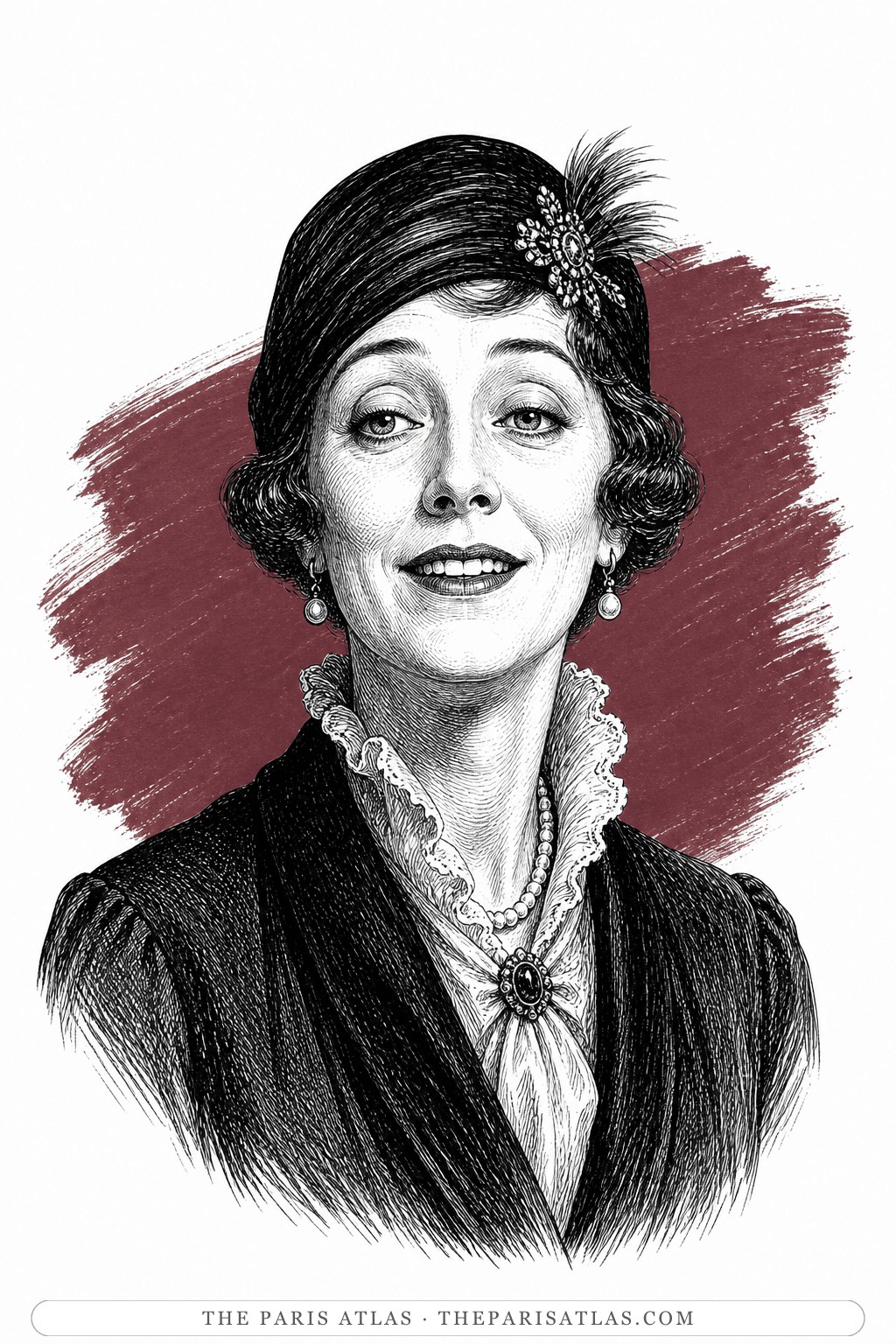
Jenny Petherbridge
A widow four times over who furnishes her life out of other people's, and takes Robin Vote away from Nora Flood.
A great love of her own, and witnesses to it. Barnes's judgement is that she could not participate in a great love and could only report it, so she appropriated the most passionate one she knew, which was Nora's for Robin.
The book

At a glance
- The subject of "The Squatter", and the reason Nora and Robin separate
- Four times; all four husbands dead
- The collective income four dead husbands could afford
- A Paris apartment with mustard-coloured paper in the salon, and later a New York hotel
- A year before the night at the opera she pretends was the first time
- Tiny ivory and jade elephants, theatre programmes, and other people's stories
Who they are in the book
Spoiler-freeJenny Petherbridge is the woman who takes Robin Vote away from Nora Flood in Nightwood, the 1936 novel by the American writer Djuna Barnes. She is middle-aged and has been married four times; each husband wasted away and died. Barnes's explanation is that she wore them out trying to make them historical.
She has money from four estates and a Paris apartment stuffed with second-hand dealings with life. Somebody else's wedding ring is on her finger. The books in her library are other people's choices. The photograph of Robin that was taken for Nora sits on her table. She keeps carriages circling her address in case she wants them, sends actresses baskets of camellias and men books by the dozen, and tells anecdote after anecdote in a light, rapid, lisping voice.
Barnes gives her the novel's coldest paragraphs: she is called one of the most unimportantly wicked women of her time, a squatter by instinct, a woman who could not take part in a great love and could only report one. She also gives her the book's most physically violent scene, in a hired carriage going round the Bois at midnight, and the loneliest: Jenny in a New York hotel room, walking up and down and crying, unable to understand anything Robin does.
How Jenny Petherbridge Is Portrayed
- The four husbandsAll dead. She had been, Barnes writes, like a squirrel racing a wheel day and night in an endeavour to make them historical, and they could not survive it. She has the collective income the four of them left.
- The houseWalls, cupboards and bureaux teeming with other people's things. She lives among her own possessions like a visitor to a room kept exactly as it was, tiptoes even when she goes to run a bath, and stops in front of every object before naming it — a virgin from Palma, the left-hand glove of the actress Eleonora Duse — with an uncertainty that makes the thing almost impossible for a visitor to see at all.
- The elephantsShe has a fancy for tiny ivory or jade elephants and says they are lucky, and leaves a trail of them wherever she goes, going hurriedly and gasping.
- How she tells a storyWell, and in a voice that never drops into an everyday register. She widens her eyes, tosses her hands, and everyone in the room comes away feeling that one person present has missed the point of the moment — the teller herself.
- The word for herBarnes writes that she was a "squatter" by instinct, and uses the word straight after describing how Jenny appropriated the dignity of speech from usage and then appropriated Nora's love for Robin the same way, having no means of generating either.
- The night in the carriagesShe orders three open hacks at midnight to break up a conversation she is not part of, appears in the doorway in a hoop, a bonnet and a shawl, and gets Robin and an English girl into her fiacre with a child sitting opposite. Somewhere past the Bois she starts crying to be noticed, and then strikes Robin, scratching and clutching until the blood runs down Robin's face.
- The eighty-two VirginsIn America afterwards she buys eighty-two plaster Virgins because Robin owned one good one. The doctor's account of it is that when people laugh at the row of them she runs back to a picture of her mother on the wall and stands between two tortures: a past she cannot share and a present she cannot copy.
- The child called SylviaA little girl she calls her niece, and who is no relation. When Jenny suspects Robin of having no heart, she brings the child back from the holidays to test it, then tells Felix Volkbein that nobody can accuse her of using a child for her own ends.
If you like Nightwood


If you like Djuna Barnes
Explore authors with a similar voice, perspective, and influence.

Henry Miller
The Brooklyn dropout who arrived in Paris broke at thirty-eight and wrote the exuberant, banned books that ended American censorship.
View author
Louis-Ferdinand Céline
The doctor of the Paris slums who wrote the century's blackest, funniest novel — and changed the sound of French prose.
View author
Martha Gellhorn
War correspondent who covered the Spanish Civil War, D-Day, and conflicts across five more decades; Hemingway's third wife, 1940–1945.
View author