

Fable for Another Time
The first volume — read it before Normance, which continues directly from its psychological world.
Read our take
Louis-Ferdinand Céline's 1954 novel — the second volume of the Féerie sequence, a single night of Allied bombing over Montmartre.
The direct sequel to Féerie pour une autre fois I concentrates the action into a terrifying night of Allied bombing over Montmartre. Ferdinand, Lili and Bébert try to survive while the building and the narrator's mind seem to collapse together. Whether the threat is entirely real or enlarged by Ferdinand's paranoia becomes increasingly difficult to separate.
Ferdinand returns home sick from a visit to Jules, the painter he believes has betrayed him. Together with Lili and Bébert, he endures a night of violent bombing while the world around him seems to disintegrate.
He eventually takes refuge in the concierge's lodge, where the other residents — particularly Normance — turn on him. Whether the danger is real or enlarged by paranoia is impossible to fully separate.
Ferdinand leaves Jules feeling sick, returns to his building on rue Girardon and falls into the elevator shaft. He is brought upstairs to Lili and Bébert.
Then the bombing begins.
Through the night, Montmartre seems to shake apart. Ferdinand imagines Jules stationed above the neighborhood like an orchestra conductor directing the destruction. He eventually takes refuge in the concierge's lodge, where the other residents — particularly Normance — turn on him. Whether the threat is entirely real or enlarged by Ferdinand's paranoia becomes increasingly difficult to separate.
At dawn, Ottavio helps Ferdinand back upstairs. He reunites with Lili and Bébert and encounters the actor Norbert in a state almost as delirious as his own. Ferdinand and Lili finally decide they must leave the apartment.
The two-volume sequence does not deliver a conventional resolution.
At the end of Normance, Ferdinand and Lili leave their building and struggle through the devastated streets of Montmartre, trying to reach the northern side of the hill and the Lamarck–Caulaincourt Métro station.
Around them, hundreds of pages of Céline's own manuscript appear to be falling through the air, and the concierge Toiselle tries to gather them from the street.
It is a wonderfully appropriate final image for the two books: the city, the narrator, history and the book itself have all been blown apart, and the fragments are literally scattering through the sky.
The chamomile episode sets ordinary care against a room that no longer behaves like a room. Furniture appears to dance while Lili tries to keep a full cup steady. Ferdinand's account makes her balance a practical achievement amid the confusion of bombing and injury. His attention then shifts from the drink to his fear that she might leave him. What matters is not the remedy itself but her presence: the scene measures catastrophe through the difficulty of sustaining a small, intimate act of care.
Ottavio's intervention changes the possibilities of movement in a narrative dominated by confinement. In Colin W. Nettelbeck's reading, the rescue from the concierge's lodge, the recovery of Lili and the discovery of an intact neighboring house prepare a partial release from the night's enclosed world. Daylight alone cannot restore a dependable sense of order. Nettelbeck also emphasizes the ending's persistent reminders of death and Ferdinand's expectation that the planes will return. Escape opens another perspective without establishing that fear, or the narrator's suspicion of others, has ended.
The whole novel is one night of bombing over Montmartre — a compressed, hallucinatory piece with a single sustained event holding it together.
The final image — hundreds of pages of Céline's own manuscript falling through the destroyed streets — is one of the great endings in twentieth-century French fiction.
Normance continues directly from the psychological world of Féerie I. Read them in order: the bombing night arrives already loaded with the imagined grievances of the first volume.

The narrator. Sick and paranoid, he returns home from Jules, falls into the elevator shaft, and endures a night of bombing while his mind and building collapse together.

The narrator's wife, Céline's real companion Lucette Destouches. She receives him upstairs after the elevator-shaft fall and stays with him through the bombing.

The cat. Present in the apartment through the bombing night as he was through the German trilogy.

The painter and former friend the narrator believes has betrayed him. Ferdinand imagines him orchestrating the bombing from above the neighborhood like a conductor.

A resident of the building who turns on Ferdinand in the concierge's lodge during the bombing. The novel takes its title from him.

Another resident. At dawn he helps Ferdinand back upstairs from the concierge's lodge.

The concierge. In the final scene, he tries to gather hundreds of pages of Céline's own manuscript falling through the destroyed street.
1952
Féerie pour une autre fois opens the paired work of which Normance becomes the second volume.
1954
Gallimard publishes Normance, also known as Féerie pour une autre fois II.
1993
The two Féerie novels are collected together in the Bibliothèque de la Pléiade, accompanied by manuscript variants.
The first volume — read it before Normance, which continues directly from its psychological world.
Read our take
The German trilogy's first volume; the discipline that Céline brings to Sigmaringen memory grows out of the experiments of Normance.
Read our take

Céline's 1932 debut — same narrator's voice, twenty years earlier.
Read our take
The second novel — the childhood autofiction that stands as the counterpart to the postwar delirium of Normance.
Read our takeOne long night of Allied bombing over Montmartre. Ferdinand, sick and paranoid, endures the night in his rue Girardon apartment with Lili and Bébert. Whether the danger is real or enlarged by paranoia is impossible to fully separate.
Gallimard published Normance in 1954, two years after Féerie pour une autre fois. It is the second volume of the Féerie sequence, subtitled Féerie pour une autre fois II.
Yes — a direct one. Normance continues from the psychological world of Féerie I and concentrates it into one sustained night of bombing. The two volumes are one continuous work.
Not as described. Céline compresses fragmentary raids on wartime Paris into one apocalyptic night. Normance is a work of memory under pressure, not a documentary account.
Hundreds of pages of Céline's own manuscript appear to fall through the destroyed streets. The concierge Toiselle tries to gather them. It is one of the great endings in twentieth-century French fiction — and became historically prescient when Céline's own lost manuscripts began surfacing in 2021.
Normance is the resident of Ferdinand's building who turns on him in the concierge's lodge during the bombing. The name is one of Céline's blank, resonant coinages — a neighbor without prior identity who nevertheless becomes central to the night's paranoia.
Explore authors with a similar voice, perspective, and influence.

Miller read Journey in manuscript while writing Tropic of Cancer and never recovered — the two books are the era's twin gutter-testaments.
View author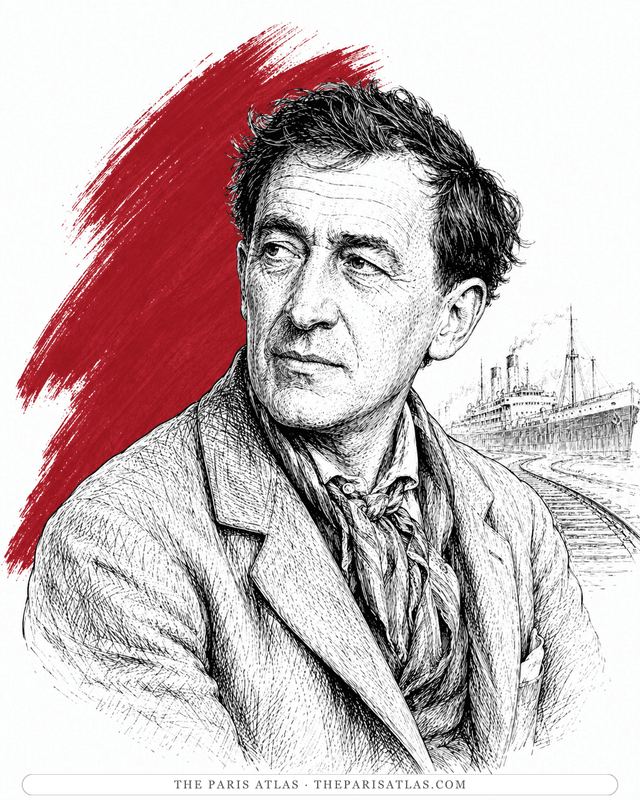
The other French modernist Céline could not look away from: a war-wounded amputee whose spoken prose ran ahead of grammar and whose Moravagine anticipates Bardamu's tour of the century's slaughterhouses.
View author
The same war, the same refusal of the big words — delivered in whispers where Céline delivers it in screams. Both writers died in the same week of July 1961.
View authorThe sources below include the primary text, editions, scholarship, archival materials, and other records that informed this page. They document Normance, its publication, and its place in literary history.


Published opening excerpt only; not the complete novel or an independently collated French edition.
Attributed interpretation from the author-authorized online reprint excerpt, not a complete-article or whole-novel collation.

Published analysis and historical context used in preparing the Normance page.
Biographical evidence used to verify chronology, relationships, and historical context connected to Normance.
Christine Sautermeister's scholarship provides historical context for Céline's wartime and postwar fiction.
The scholarly study situates Normance within Céline's wartime sequence and its historical method.
Web source consulted for documented facts and historical context presented on the Normance page.
The primary text is the baseline reference for every book page. Additional references document publication history, interpretation, and historical context where that evidence is available.
 Explore more resources